
Homework Answers
MATLAB Script:
close all
clear
clc
f = @(t,y) exp(2/y); % Given ODE
t0 = 0; tf = 2; % Intervals of t
y0 = 2; % Initial condition
n = 4;
h = (tf - t0)/n; % Step Size
t = t0:h:tf;
[t_e, y_e] = ode45(f, [t0, tf], y0); % Exact solution
plot(t_e, y_e), hold on % Plot the exact solution
y = my_euler(t0, y0, tf, h, f);
plot(t, y, 'o-') % Plot Euler's method solution
y = my_imp_euler(t0, y0, tf, h, f);
plot(t, y, '*-') % Plot Improved Euler's method solution
y = my_rk4(t0, y0, tf, h, f);
plot(t, y, '^-'), hold off % Plot RK4 method solution
fprintf('RK4 Method
Solution\n-----------------------------------------------------------\n')
fprintf('%-10s%-20s\n', 't(i)', 'y(i)')
for i = 1:length(t)
fprintf('%-10.4f%-20.4f\n', t(i), y(i))
end
xlabel('t'), ylabel('y(t)')
legend('Exact Solution', 'Euler''s Method', 'Improved Euler''s
Method', 'RK4 Method', 'Location', 'northwest')
title('Solution of ODE')
function y = my_euler(t0, y0, tf, h, f)
y(1) = y0;
t = t0:h:tf;
for i = 1:length(t)-1
y(i+1) = y(i) + h*f(t(i), y(i)); % Euler Update
end
end
function y = my_imp_euler(t0, y0, tf, h, f)
y(1) = y0;
t = t0:h:tf;
for i = 1:length(t)-1
f1 = f(t(i), y(i));
f2 = f(t(i) + h, y(i) + h*f1);
y(i+1) = y(i) + (h/2)*(f1 + f2); % Improved Euler's Update
end
end
function y = my_rk4(t0, y0, tf, h, f)
y(1) = y0;
t = t0:h:tf;
for i = 1:length(t)-1
k1 = f(t(i), y(i));
k2 = f(t(i) + 0.5*h, y(i) + 0.5*h*k1);
k3 = f(t(i) + 0.5*h, y(i) + 0.5*h*k2);
k4 = f(t(i) + h, y(i) + k3*h);
y(i + 1) = y(i) + (1/6)*(k1 + 2*k2 + 2*k3 + k4)*h; % RK4
Update
end
end
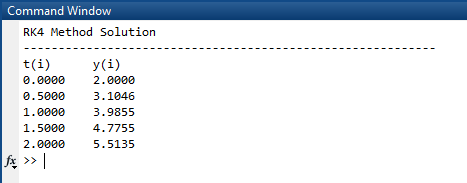
Output:
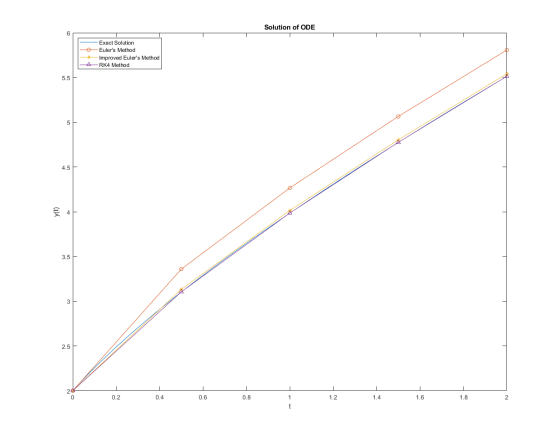
Plot:
Add Answer to:
In Exercise, use the Runge-Kutta method with the given number n of steps to approximate the...
Use Improved Euler for first question, Runge- Katta for 2nd one. Thank you In each of...
 Use Improved Euler for first question, Runge- Katta for 2nd one.
Thank you
In each of Problems 7 through 12, find approximate values of the solution of the given initial value problem at t-0.5,1.0, 1.5, and 2.0 (a) Use the improved Euler method with h 0.025 (b) Use the improved Euler method with h-0.0125 In each of Problems 7 through 12, find approximate values of the solution of the given initial value problem at0.5,1.0, 1.5, and 2.0. Compare the results...
Use Improved Euler for first question, Runge- Katta for 2nd one.
Thank you
In each of Problems 7 through 12, find approximate values of the solution of the given initial value problem at t-0.5,1.0, 1.5, and 2.0 (a) Use the improved Euler method with h 0.025 (b) Use the improved Euler method with h-0.0125 In each of Problems 7 through 12, find approximate values of the solution of the given initial value problem at0.5,1.0, 1.5, and 2.0. Compare the results...
Both parts please! 1 Runge-Kutta Method The discretization of the spatial derivatives of a PDE often...
 Both parts please!
1 Runge-Kutta Method The discretization of the spatial derivatives of a PDE often results in a system of ODEs of the fornm du Runge-Kutta methods are the most commonly used schemes for numerically integrating in time the ODE system. We will numerically implement the "standard" third-order Runge-Kutta method. To advance the solution u from time t to t + Δ1, three sub-steps, are taken. If the solution at time t is un the following three steps are...
Both parts please!
1 Runge-Kutta Method The discretization of the spatial derivatives of a PDE often results in a system of ODEs of the fornm du Runge-Kutta methods are the most commonly used schemes for numerically integrating in time the ODE system. We will numerically implement the "standard" third-order Runge-Kutta method. To advance the solution u from time t to t + Δ1, three sub-steps, are taken. If the solution at time t is un the following three steps are...
Numerical Methods Consider the following IVP dy=0.01(70-y)(50-y), with y(0)-0 (a) [10 marks Use the Runge-Kutta method of order four to obtain an approximate solution to the ODE at the points t-0.5 an...
 Numerical Methods
Consider the following IVP dy=0.01(70-y)(50-y), with y(0)-0 (a) [10 marks Use the Runge-Kutta method of order four to obtain an approximate solution to the ODE at the points t-0.5 and t1 with a step sizeh 0.5. b) [8 marks Find the exact solution analytically. (c) 7 marks] Use MATLAB to plot the graph of the true and approximate solutions in one figure over the interval [.201. Display graphically the true errors after each steps of calculations.
Consider the...
Numerical Methods
Consider the following IVP dy=0.01(70-y)(50-y), with y(0)-0 (a) [10 marks Use the Runge-Kutta method of order four to obtain an approximate solution to the ODE at the points t-0.5 and t1 with a step sizeh 0.5. b) [8 marks Find the exact solution analytically. (c) 7 marks] Use MATLAB to plot the graph of the true and approximate solutions in one figure over the interval [.201. Display graphically the true errors after each steps of calculations.
Consider the...
Using the fourth order Runge-Kutta method (KK4 to solve a first order initial value problem NOTE:...
 Need help with this MATLAB problem:
Using the fourth order Runge-Kutta method (KK4 to solve a first order initial value problem NOTE: This assignment is to be completed using MATLAB, and your final results including the corresponding M- iles shonma ac Given the first order initial value problem with h-time step size (i.e. ti = to + ih), then the following formula computes an approximate solution to (): i vit), where y(ti) - true value (ezact solution), (t)-f(t, v), vto)...
Need help with this MATLAB problem:
Using the fourth order Runge-Kutta method (KK4 to solve a first order initial value problem NOTE: This assignment is to be completed using MATLAB, and your final results including the corresponding M- iles shonma ac Given the first order initial value problem with h-time step size (i.e. ti = to + ih), then the following formula computes an approximate solution to (): i vit), where y(ti) - true value (ezact solution), (t)-f(t, v), vto)...
Runge-Kutta method R-K method is given by the following algorithm. o y(xo)- given k2-f(xi5.yi tk,...
 Runge-Kutta method R-K method is given by the following algorithm. Yo = y(xo) = given. k1-f(xy) k4-f(xi +h,yi + k3) 6 For i = 0, 1, 2, , n, where h = (b-a)/n. Consider the same IVP given in problem 2 and answer the following a) Write a MATLAB script file to find y(2) using h = 0.1 and call the file odeRK 19.m b) Generate the following table now using both ode Euler and odeRK19 only for h -0.01....
use matlab Assignment: 1) Write a function program that implements the 4th Order Runge Kutta Method....
 use
matlab
Assignment: 1) Write a function program that implements the 4th Order Runge Kutta Method. The program must plot each of the k values for each iteration (one plot per k value), and the approximated solution (approximated solution curve). Use the subplot command. There should be a total of five plots. If a function program found on the internet was used, then please cite the source. Show the original program and then show the program after any modifications. Submission...
use
matlab
Assignment: 1) Write a function program that implements the 4th Order Runge Kutta Method. The program must plot each of the k values for each iteration (one plot per k value), and the approximated solution (approximated solution curve). Use the subplot command. There should be a total of five plots. If a function program found on the internet was used, then please cite the source. Show the original program and then show the program after any modifications. Submission...
Find an approximate solution to the pendulum problem such that d2 theta /dt2 +g/l theta =...
Find an approximate solution to the pendulum problem such that d2 theta /dt2 +g/l theta = 0. Use an approximate solver in matlab to find the solution to the exact equation d2 theta/dt2 +g/l * sin( theta) = 0. Compare the two solutions when the initial angle is 10, 30, and 90. Find a way to quantify the difference. One approximate method for solving differential equations is Runge-Kutta, which in Matlab goes by the name ode45. I have made a...
Numerical Methods for Differential Equations - Please post full correct solution!!! - need to use MATLAB...
 Numerical Methods for Differential Equations - Please
post full correct solution!!! - need to use MATLAB
3. (a) Write Matlab functions to integrate the initial value problem y = f(x,y), y(a) = yo, on an interval [a, b] using: • Euler's method • Modified Euler • Improved Euler • Runge Kutta 4 It is suggested that you implement, for example, Improved Euler as [x, y) = eulerimp('f', a, yo, b, stepsize), where (2,y) = (In, Yn) is the computed solution....
Numerical Methods for Differential Equations - Please
post full correct solution!!! - need to use MATLAB
3. (a) Write Matlab functions to integrate the initial value problem y = f(x,y), y(a) = yo, on an interval [a, b] using: • Euler's method • Modified Euler • Improved Euler • Runge Kutta 4 It is suggested that you implement, for example, Improved Euler as [x, y) = eulerimp('f', a, yo, b, stepsize), where (2,y) = (In, Yn) is the computed solution....
Solve Example 6.2 on page 111 of textbook, using (1) the 4th order Runge Kutta method...
 Solve Example 6.2 on page 111 of textbook, using (1) the 4th order Runge Kutta method and (2) Simulink method, respectively. Please submit your MATLAB code m file and slx file You can use the results from the code attached below (from the textbook by ODE45 solver) as a reference Example 6.2 ode45 ex.m % This program solves a system of 3 differential equations % by using ode45 function % y1 (0)=0, y2 (0)=1.0, y3 (0)=1.0 clear; clc initial [0.0...
 Use Improved Euler for first question, Runge- Katta for 2nd one.
Thank you
In each of Problems 7 through 12, find approximate values of the solution of the given initial value problem at t-0.5,1.0, 1.5, and 2.0 (a) Use the improved Euler method with h 0.025 (b) Use the improved Euler method with h-0.0125 In each of Problems 7 through 12, find approximate values of the solution of the given initial value problem at0.5,1.0, 1.5, and 2.0. Compare the results...
Use Improved Euler for first question, Runge- Katta for 2nd one.
Thank you
In each of Problems 7 through 12, find approximate values of the solution of the given initial value problem at t-0.5,1.0, 1.5, and 2.0 (a) Use the improved Euler method with h 0.025 (b) Use the improved Euler method with h-0.0125 In each of Problems 7 through 12, find approximate values of the solution of the given initial value problem at0.5,1.0, 1.5, and 2.0. Compare the results...
 Both parts please!
1 Runge-Kutta Method The discretization of the spatial derivatives of a PDE often results in a system of ODEs of the fornm du Runge-Kutta methods are the most commonly used schemes for numerically integrating in time the ODE system. We will numerically implement the "standard" third-order Runge-Kutta method. To advance the solution u from time t to t + Δ1, three sub-steps, are taken. If the solution at time t is un the following three steps are...
Both parts please!
1 Runge-Kutta Method The discretization of the spatial derivatives of a PDE often results in a system of ODEs of the fornm du Runge-Kutta methods are the most commonly used schemes for numerically integrating in time the ODE system. We will numerically implement the "standard" third-order Runge-Kutta method. To advance the solution u from time t to t + Δ1, three sub-steps, are taken. If the solution at time t is un the following three steps are...
 Numerical Methods
Consider the following IVP dy=0.01(70-y)(50-y), with y(0)-0 (a) [10 marks Use the Runge-Kutta method of order four to obtain an approximate solution to the ODE at the points t-0.5 and t1 with a step sizeh 0.5. b) [8 marks Find the exact solution analytically. (c) 7 marks] Use MATLAB to plot the graph of the true and approximate solutions in one figure over the interval [.201. Display graphically the true errors after each steps of calculations.
Consider the...
Numerical Methods
Consider the following IVP dy=0.01(70-y)(50-y), with y(0)-0 (a) [10 marks Use the Runge-Kutta method of order four to obtain an approximate solution to the ODE at the points t-0.5 and t1 with a step sizeh 0.5. b) [8 marks Find the exact solution analytically. (c) 7 marks] Use MATLAB to plot the graph of the true and approximate solutions in one figure over the interval [.201. Display graphically the true errors after each steps of calculations.
Consider the...
 Need help with this MATLAB problem:
Using the fourth order Runge-Kutta method (KK4 to solve a first order initial value problem NOTE: This assignment is to be completed using MATLAB, and your final results including the corresponding M- iles shonma ac Given the first order initial value problem with h-time step size (i.e. ti = to + ih), then the following formula computes an approximate solution to (): i vit), where y(ti) - true value (ezact solution), (t)-f(t, v), vto)...
Need help with this MATLAB problem:
Using the fourth order Runge-Kutta method (KK4 to solve a first order initial value problem NOTE: This assignment is to be completed using MATLAB, and your final results including the corresponding M- iles shonma ac Given the first order initial value problem with h-time step size (i.e. ti = to + ih), then the following formula computes an approximate solution to (): i vit), where y(ti) - true value (ezact solution), (t)-f(t, v), vto)...
 Runge-Kutta method R-K method is given by the following algorithm. Yo = y(xo) = given. k1-f(xy) k4-f(xi +h,yi + k3) 6 For i = 0, 1, 2, , n, where h = (b-a)/n. Consider the same IVP given in problem 2 and answer the following a) Write a MATLAB script file to find y(2) using h = 0.1 and call the file odeRK 19.m b) Generate the following table now using both ode Euler and odeRK19 only for h -0.01....
 use
matlab
Assignment: 1) Write a function program that implements the 4th Order Runge Kutta Method. The program must plot each of the k values for each iteration (one plot per k value), and the approximated solution (approximated solution curve). Use the subplot command. There should be a total of five plots. If a function program found on the internet was used, then please cite the source. Show the original program and then show the program after any modifications. Submission...
use
matlab
Assignment: 1) Write a function program that implements the 4th Order Runge Kutta Method. The program must plot each of the k values for each iteration (one plot per k value), and the approximated solution (approximated solution curve). Use the subplot command. There should be a total of five plots. If a function program found on the internet was used, then please cite the source. Show the original program and then show the program after any modifications. Submission...
 Numerical Methods for Differential Equations - Please
post full correct solution!!! - need to use MATLAB
3. (a) Write Matlab functions to integrate the initial value problem y = f(x,y), y(a) = yo, on an interval [a, b] using: • Euler's method • Modified Euler • Improved Euler • Runge Kutta 4 It is suggested that you implement, for example, Improved Euler as [x, y) = eulerimp('f', a, yo, b, stepsize), where (2,y) = (In, Yn) is the computed solution....
Numerical Methods for Differential Equations - Please
post full correct solution!!! - need to use MATLAB
3. (a) Write Matlab functions to integrate the initial value problem y = f(x,y), y(a) = yo, on an interval [a, b] using: • Euler's method • Modified Euler • Improved Euler • Runge Kutta 4 It is suggested that you implement, for example, Improved Euler as [x, y) = eulerimp('f', a, yo, b, stepsize), where (2,y) = (In, Yn) is the computed solution....
 Solve Example 6.2 on page 111 of textbook, using (1) the 4th order Runge Kutta method and (2) Simulink method, respectively. Please submit your MATLAB code m file and slx file You can use the results from the code attached below (from the textbook by ODE45 solver) as a reference Example 6.2 ode45 ex.m % This program solves a system of 3 differential equations % by using ode45 function % y1 (0)=0, y2 (0)=1.0, y3 (0)=1.0 clear; clc initial [0.0...
Most questions answered within 3 hours.
-
Where is the error in this code sequence?
String s1 = "Hello";
String s2 = "ello";...
asked 11 months ago -
Financial data for Joel de Paris, Inc., for last year
follow:
Joel de Paris, Inc.
Balance...
asked 11 months ago -
Consider this reaction:
Al2(SO4)3 (aq)+ BaCl3
(aq) Al2Cl6 (aq)- +
3BaSO4(s) . What is the...
asked 11 months ago -
Suppose that Savneet is considering increasing her
recent random sample from 20 car rentals to 40...
asked 11 months ago -
Trucks arrive at an unloading terminal at an average rate of 120
per hour.
Trucks arrive...
asked 11 months ago -
Why are methanol and ethanol completely soluble in water while
octanol is not very little soluble....
asked 11 months ago -
A facilities manager at a university reads in a research report
that the mean amount of...
asked 11 months ago -
When the CuSO4 is rehydrated by adding water to the anhydrous
compound, is this an endothermic...
asked 11 months ago -
A ray of sunlight is passing from diamond into crown glass; the
angle of incidence is...
asked 11 months ago -
A block of mass 0.249 kg is placed on top of a light, vertical
spring of...
asked 11 months ago -
how do the kidneys compensate in the presences of acidosis
a) trigger hyperventilate
b) reserve acid...
asked 11 months ago -
Question 501 pts
The rental rate of capital to the firm increases. Which of the
following...
asked 11 months ago