You are preparing some apparatus for a visit to a newly discovered planet Caasi having oceans...
You are preparing some apparatus for a visit to a newly
discovered planet Caasi having oceans of glycerine and a surface
acceleration due to gravity of 4.80 m/s2. If your
apparatus floats in the oceans on earth with 47.0% of its volume
submerged, what percentage will be submerged in the glycerine
oceans of Caasi?
____ %
Homework Answers

Add Answer to:
You are preparing some apparatus for a visit to a newly
discovered planet Caasi having oceans...
on a newly discovered planet, the period of a pendulum with a length of 2 m...
on a newly discovered planet, the period of a pendulum with a length of 2 m is found to be 5 seconds. what is the acceleration due to gravity on this new planet?
Having landed on a newly discovered planet, an astronaut sets up a simple pendulum of length...
Having landed on a newly discovered planet, an astronaut sets up a simple pendulum of length 1.1 m and finds that it makes 500 complete oscillations in 1,121 s. What is the gravitational acceleration g on the surface of this planet?
A newly discovered planet has twice the mass and three times the radius of the earth....
A newly discovered planet has twice the mass and three times the radius of the earth. What is the free-fall acceleration at its surface, in terms of the free-fall acceleration g at the surface of the earth? a. 1/9 g b. 2/3 g c. 3/4 g d. 4/3 g E. None of these
points A newly discovered planet is in a circular orbit around a distant star with an...
 points A newly discovered planet is in a circular orbit around a distant star with an orbital period of 400 Earth days. The planet also rotates on its axis, making one full rotation every 4.00 Earth days. The radius of the planet is rp = 7.00 × 10⁶ m and the radius of the planet's orbit about the star is r 7.00×10¹¹ m. My Notes Ask Your Tea Determine the ratio of the radial acceleration, due to the rotation of...
A new Earth size planet has been discovered in a distant star system. The planet has...
A new Earth size planet has been discovered in a distant star system. The planet has six times the mass of Earth and has a radius of twice the radius of the Earth. Do NOT mix or change system of units! There is an equation in the posted handout for solving this problem. If you do not use it you will only receive 1 point for this problem no matter your answer. What is the acceleration due to gravity on...
You are the science officer on a visit to a distant solar system. Prior to landing...
You are the science officer on a visit to a distant solar system. Prior to landing on a planet you measure its diameter to be 1.60×10⁷ m and its rotation period to be 22.3 hours. You have previously determined that the planet orbits 2.10×10¹¹ m from its star with a period of 402 earth days. Once on the surface you find that the free-fall acceleration is 12.2 m/s2 . Part A: What is the mass of the planet? Part B:...
A new planet is discovered and we think it may be able to support life. We...
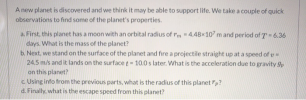 A new planet is discovered and we think it may be able to support life. We take a couple of quick observations to find some of the planet's properties. a. First, this planet has a moon with an orbital radius of m = 4.48x10⁷ m and period of T 6.36 days. What is the mass of the planet? b.Next,we stand on the surface of the planet and fire a projectile straight up at a speed of v 24.5m/s and it...
On planet Tehar, the free-fall acceleration is the same as that on Earth, but there is...
On planet Tehar, the free-fall acceleration is the same as that on Earth, but there is also a strong downward electric field that is uniform close to the planet's surface. A 2.36-kg ball having a charge of 5.02 μC is thrown upward at a speed of 20.1 m/s. It hits the ground after an interval of 4.10 s. What is the potential difference between the starting point and the top point of the trajectory? (Use 9.8 m/s2 for the acceleration...
On planet Tehar, the free-fall acceleration is the same as that on Earth, but there is...
On planet Tehar, the free-fall acceleration is the same as that on Earth, but there is also a strong downward electric field that is uniform close to the planet's surface. A 2.20-kg ball having a charge of 4.92 μC is thrown upward at a speed of 20.1 m/s. It hits the ground after an interval of 4.10 s. What is the potential difference between the starting point and the top point of the trajectory? (Use 9.8 m/s2 for the acceleration...
On planet Tehar, the free-fall acceleration is the same as that of Earth, but there is...
On planet Tehar, the free-fall acceleration is the same as that of Earth, but there is also a strong downward electric field that is uniform close to the planet’s surface. A 2.82 kg ball having a charge of 4.37 µC is thrown upward at a speed of 10 m/s, and it hits the ground after an interval of 3.32 s. What is the potential difference between the starting point and the top point of the trajectory? The acceleration due to...
 points A newly discovered planet is in a circular orbit around a distant star with an orbital period of 400 Earth days. The planet also rotates on its axis, making one full rotation every 4.00 Earth days. The radius of the planet is rp = 7.00 × 10⁶ m and the radius of the planet's orbit about the star is r 7.00×10¹¹ m. My Notes Ask Your Tea Determine the ratio of the radial acceleration, due to the rotation of...
 A new planet is discovered and we think it may be able to support life. We take a couple of quick observations to find some of the planet's properties. a. First, this planet has a moon with an orbital radius of m = 4.48x10⁷ m and period of T 6.36 days. What is the mass of the planet? b.Next,we stand on the surface of the planet and fire a projectile straight up at a speed of v 24.5m/s and it...
Most questions answered within 3 hours.
-
Where is the error in this code sequence?
String s1 = "Hello";
String s2 = "ello";...
asked 10 months ago -
Financial data for Joel de Paris, Inc., for last year
follow:
Joel de Paris, Inc.
Balance...
asked 10 months ago -
Consider this reaction:
Al2(SO4)3 (aq)+ BaCl3
(aq) Al2Cl6 (aq)- +
3BaSO4(s) . What is the...
asked 10 months ago -
Suppose that Savneet is considering increasing her
recent random sample from 20 car rentals to 40...
asked 10 months ago -
Trucks arrive at an unloading terminal at an average rate of 120
per hour.
Trucks arrive...
asked 10 months ago -
Why are methanol and ethanol completely soluble in water while
octanol is not very little soluble....
asked 10 months ago -
A facilities manager at a university reads in a research report
that the mean amount of...
asked 10 months ago -
When the CuSO4 is rehydrated by adding water to the anhydrous
compound, is this an endothermic...
asked 10 months ago -
A ray of sunlight is passing from diamond into crown glass; the
angle of incidence is...
asked 10 months ago -
A block of mass 0.249 kg is placed on top of a light, vertical
spring of...
asked 10 months ago -
how do the kidneys compensate in the presences of acidosis
a) trigger hyperventilate
b) reserve acid...
asked 10 months ago -
Question 501 pts
The rental rate of capital to the firm increases. Which of the
following...
asked 10 months ago