
Homework Answers
Given
Demand
P = 8000 - Y / 4
Supply
P = 500 - Y / 8
1) Market equilibrium price and quantity
Equilibrium is where both demand and supply are equal so equating both demand and supply equation
8000 - Y / 4 = 500 - Y / 8
64000 - 2Y = 4000 + Y
60000 = 3Y
20000 = Y
Equilibrium quantity is 20000
Also, the equilibrium price can find out by putting the value of the quantity in any of the equations
P = 8000 - Y / 4
P = 8000 - 20000 / 4
P = 3000
Equilibrium price is 3000
2) Given cost function is C = 100000 + 200Y + 2Y2
First thing we need to do is to recognize that in perfect competition, profit maximization requires that the firm produce the amount of output consistent where the price equals the marginal cost.
P = MC
We have price which is 3000 so we have to find MC function
Now from the above TC function, MC function can find out through the differential.
There are some properties of differential
1) C = xn

example -
C = x3
C = 3x2
2) if an equation has constant then after differential it will be 0
Now to the question
C(Y) = 100000 + 200Y + 2Y2
TC = 100000 + 200Y + 2Y2
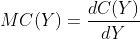
MC (Y) = 0 + (1)200Y1-1 + (2)2Y2-1
MC = 200 + 4Y
Now we have MC function and we know P = MC
3000 = 200 + 4Y
Y = 700
Profit maximizing output is 700
3) For calculating profit
Profit = TR -TC
TR = Price x Quantity
TR = 3000 x 700
TR = 2100000
For calculating the total cost, we have the cost function
C = 100000 + 200Y + 2Y2 .
and we have the value of Y as 700 so putting 700 in the cost function
C = 100000 + 200(700) + 2(700)2 .
C = 1220000
Profit = TR - TC
Profit = 2100000 - 1220000
Profit = 880000
Add Answer to:
Q3. Market demand: P-8000-4y I. Perfect competition with market supply P 500 A. Find the market...
The characteristics of perfect competition are: ___________________, _____________________, ________________________ ___________________, ___________________ 2. The demand curve in...
The characteristics of perfect competition are: ___________________, _____________________, ________________________ ___________________, ___________________ 2. The demand curve in perfect competition is: ______________ (Shape or slope) 3. The firm operates at the quantity where _________ equals ___________. 4. Total profit is equal to ___________ minus ________________. 5. The marginal revenue curve in perfect competition is: ______________ (Shape or slope) 6. The entrance of one or two new firms (in perfect competition) does what to market price? _______________________________________, 7. For a firm to operate,...
Labour Demand with Monopsony in the Labour Market and Perfect Competition in the Output Market in...
 Labour Demand with Monopsony in the Labour Market and Perfect Competition in the Output Market in Short Run. Suppose a monopsony has a production function Q = 2L. The firm sells its output in a perfectly competitive market at a price of $200 and its market supply of labor is w=20L. a. Determine the profit-maximizing level of employment and wage offered by the firm. b. Make a diagram. Explain why Marginal Cost of Labour increases at a faster rate than...
1. Consider the market for good x. The market demand is given by, D(p) = 100...
1. Consider the market for good x. The market demand is given by, D(p) = 100 ? 2P (Demand) and the supply function is given by, S(p) = 25 + 5P. (Supply) (a) (5 points) Solve for the equilibrium price and quantity in this market . (b) (10 points) If the government imposes a $2 value tax on x, calculate the the after tax equilibrium (buyer’s price, seller’s price and quantity). (c) (5 points) Which side of the market shares...
This is an Industrial Organization Economics Question: Suppose that demand for rollerblades is given by D(p)...
This is an Industrial Organization Economics Question: Suppose that demand for rollerblades is given by D(p) = A − p. The cost function for all firms is C(y) = wy2 + f , where f is a fixed set-up cost. The marginal cost of production is MC(y) = 2wy. Assume that the industry is perfectly competitive. (a) Find a competitive firm’s supply function. If there are n firms in the industry, what is industry supply? (b) If there are n...
Suppose the market of carpets is competitive. The demand for and the supply of tables have...
Suppose the market of carpets is competitive. The demand for and the supply of tables have been estimated as follows: Q = 370 – 10P Q = 80P +10 A typical firm producing tables has a total cost function of C = 64 +?2/4 a. Find the equilibrium market price and quantity. (2 marks) b. Derive MC and AC functions of a typical firm. Then find the efficient scale of output of the firm. Show your steps clearly. (5 marks)...
can I get help please A firm under perfect competition has the following inverse demand function...
 can I get help please
A firm under perfect competition has the following inverse demand function given by Q=210-3P and it costs $50 to provide an extra unit. (a) Write the equation representing the demand function (1 mark) (b) What is the firm's marginal revenue? (4 marks) (c) What is the profit maximizing quantity? (5 marks) Suppose the industry had only one firm faced with the demand curve faced in part (a) of question 3. How would output price and...
can I get help please
A firm under perfect competition has the following inverse demand function given by Q=210-3P and it costs $50 to provide an extra unit. (a) Write the equation representing the demand function (1 mark) (b) What is the firm's marginal revenue? (4 marks) (c) What is the profit maximizing quantity? (5 marks) Suppose the industry had only one firm faced with the demand curve faced in part (a) of question 3. How would output price and...
Question Two [Total 50 marks] Suppose the market of carpets is competitive. The demand for and...
 Question Two [Total 50 marks] Suppose the market of carpets is competitive. The demand for and the supply of carpets in the market have been estimated as follows: Demand: Qd = 6500 - 100P Supply: Qs = 1200P A typical firm producing carpets has a total cost function of C = 100+ 4.C and q stand for total cost and the output level of the firm respectively. a. Find the equilibrium market price and quantity of carpets. (5 marks] b....
Labour Demand with Perfect Competition in the Labour Market and Perfect Competition in the Output Market...
Labour Demand with Perfect Competition in the Labour Market and Perfect Competition in the Output Market in the Long Run. You are the manager of a business that operates in perfectly competitive markets {both the Labour Market and Output Market}. The production function of the business is given by:Q =2L1/4K1/4 .The price of the product is “10”. The wage rate is “1”. The price of capital is “2”. 1. Find the use of labour and capital in the long run....
Consider a market with two firms in Cournot (quantity) competition. Market demand is given by q(p)...
Consider a market with two firms in Cournot (quantity) competition. Market demand is given by q(p) = a − p. Each firm faces a constant marginal cost of c. a. (15 points) Suppose that the government imposes a unit tax of δ, so that if a firm sells q units of the good, that firm owes q · δ to the government. Find the equilibrium quantity, price paid by consumers, consumer surplus, and tax revenue. Your answers should be functions...
14. (Perfect Competition) Apples are produced in a perfectly competitive industry. As- sume that there are...
 14. (Perfect Competition) Apples are produced in a perfectly competitive industry. As- sume that there are 100 identical firms in this industry. Below are graphs for the market supply and demand as well as the cost curves of these firms 6 MC ATC AVC 2 0 0 0 100 200 300 400 500 600 0 1 23 4 5 6 Q(kg) q(kg) (a) Draw the market supply curve for apples (b) What are the market price and quantity for apples?...
 Labour Demand with Monopsony in the Labour Market and Perfect Competition in the Output Market in Short Run. Suppose a monopsony has a production function Q = 2L. The firm sells its output in a perfectly competitive market at a price of $200 and its market supply of labor is w=20L. a. Determine the profit-maximizing level of employment and wage offered by the firm. b. Make a diagram. Explain why Marginal Cost of Labour increases at a faster rate than...
 can I get help please
A firm under perfect competition has the following inverse demand function given by Q=210-3P and it costs $50 to provide an extra unit. (a) Write the equation representing the demand function (1 mark) (b) What is the firm's marginal revenue? (4 marks) (c) What is the profit maximizing quantity? (5 marks) Suppose the industry had only one firm faced with the demand curve faced in part (a) of question 3. How would output price and...
can I get help please
A firm under perfect competition has the following inverse demand function given by Q=210-3P and it costs $50 to provide an extra unit. (a) Write the equation representing the demand function (1 mark) (b) What is the firm's marginal revenue? (4 marks) (c) What is the profit maximizing quantity? (5 marks) Suppose the industry had only one firm faced with the demand curve faced in part (a) of question 3. How would output price and...
 Question Two [Total 50 marks] Suppose the market of carpets is competitive. The demand for and the supply of carpets in the market have been estimated as follows: Demand: Qd = 6500 - 100P Supply: Qs = 1200P A typical firm producing carpets has a total cost function of C = 100+ 4.C and q stand for total cost and the output level of the firm respectively. a. Find the equilibrium market price and quantity of carpets. (5 marks] b....
 14. (Perfect Competition) Apples are produced in a perfectly competitive industry. As- sume that there are 100 identical firms in this industry. Below are graphs for the market supply and demand as well as the cost curves of these firms 6 MC ATC AVC 2 0 0 0 100 200 300 400 500 600 0 1 23 4 5 6 Q(kg) q(kg) (a) Draw the market supply curve for apples (b) What are the market price and quantity for apples?...
Most questions answered within 3 hours.
-
Where is the error in this code sequence?
String s1 = "Hello";
String s2 = "ello";...
asked 11 months ago -
Financial data for Joel de Paris, Inc., for last year
follow:
Joel de Paris, Inc.
Balance...
asked 11 months ago -
Consider this reaction:
Al2(SO4)3 (aq)+ BaCl3
(aq) Al2Cl6 (aq)- +
3BaSO4(s) . What is the...
asked 11 months ago -
Suppose that Savneet is considering increasing her
recent random sample from 20 car rentals to 40...
asked 11 months ago -
Trucks arrive at an unloading terminal at an average rate of 120
per hour.
Trucks arrive...
asked 11 months ago -
Why are methanol and ethanol completely soluble in water while
octanol is not very little soluble....
asked 11 months ago -
A facilities manager at a university reads in a research report
that the mean amount of...
asked 11 months ago -
When the CuSO4 is rehydrated by adding water to the anhydrous
compound, is this an endothermic...
asked 11 months ago -
A ray of sunlight is passing from diamond into crown glass; the
angle of incidence is...
asked 11 months ago -
A block of mass 0.249 kg is placed on top of a light, vertical
spring of...
asked 11 months ago -
how do the kidneys compensate in the presences of acidosis
a) trigger hyperventilate
b) reserve acid...
asked 11 months ago -
Question 501 pts
The rental rate of capital to the firm increases. Which of the
following...
asked 11 months ago