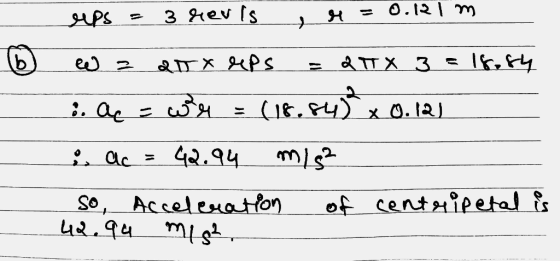
Olympic ice skaters are able to spin at about 3 rev/s. b. What is the centripetal...
Olympic ice skaters are able to spin at about 3 rev/s.
b. What is the centripetal acceleration (in m/s2) of the skater's nose if it is 0.121 m from the axis of rotation?
(I got 41.41 and it was incorrect)
Homework Answers
Add Answer to:
Olympic ice skaters are able to spin at about 3 rev/s.
b. What is the centripetal...
Calculate the angular momentum, in kg · m2/s, of an ice skater spinning at 6.00 rev/s...
 Calculate the angular momentum, in kg · m2/s, of an ice skater
spinning at 6.00 rev/s given his moment of inertia is 0.330 kg ·
m2.
(a) Calculate the angular momentum, in kg . m/s, of an ice skater spinning at 6.00 rev/s given his moment of inertia is 0.330 kg . m2. kg. m/s (b) He reduces his rate of spin (his angular velocity) by extending his arms and increasing his moment of inertia. Find the value of his...
Calculate the angular momentum, in kg · m2/s, of an ice skater
spinning at 6.00 rev/s given his moment of inertia is 0.330 kg ·
m2.
(a) Calculate the angular momentum, in kg . m/s, of an ice skater spinning at 6.00 rev/s given his moment of inertia is 0.330 kg . m2. kg. m/s (b) He reduces his rate of spin (his angular velocity) by extending his arms and increasing his moment of inertia. Find the value of his...
(a) Calculate the angular momentum of an ice skater spinning at 6.00 rev/s given his moment...
(a) Calculate the angular momentum of an ice skater spinning at 6.00 rev/s given his moment of inertia is 0.300 kg · m2. _____kg · m2/s (b) He reduces his rate of spin (his angular velocity) by extending his arms and increasing his moment of inertia. Find the value of his moment of inertia if his angular velocity drops to 1.75 rev/s. ______kg · m2 (c) Suppose instead he keeps his arms in and allows friction with the ice to...
Review Constants i Periodic Table Ice skaters often end their performances with spin turns, where they...
 Review Constants i Periodic Table Ice skaters often end their performances with spin turns, where they spin very fast about their center of mass with their arms folded in and legs together. Upon ending, their arms extend outward, proclaiming their finish. Not quite as noticeably, one leg goes out as well Part A Suppose that the moment of inertia of a skater with arms out and one leg extended is 3.0 kg mº and for arms and legs in is...
Your car tire is rotating at 3.4 rev/s when suddenly you press down hard on the...
 Your car tire is rotating at 3.4 rev/s when suddenly you press
down hard on the accelerator. After traveling 240 m, the tire's
rotation has increased to 6.6 rev/s. The radius of the tire is 32
cm.
What was the tire's angular acceleration? Give your answer in
rad/s^2.
Express the answer using two significant digits.
The answer I got is, approximately, 0.013405, but, apparently,
it's wrong.
Problem 4.67 Your car tire is rotating at 3.4 rev/s when suddenly you press...
Your car tire is rotating at 3.4 rev/s when suddenly you press
down hard on the accelerator. After traveling 240 m, the tire's
rotation has increased to 6.6 rev/s. The radius of the tire is 32
cm.
What was the tire's angular acceleration? Give your answer in
rad/s^2.
Express the answer using two significant digits.
The answer I got is, approximately, 0.013405, but, apparently,
it's wrong.
Problem 4.67 Your car tire is rotating at 3.4 rev/s when suddenly you press...
Problems 18-20 Information: Two ice skaters, male (blue) and female (red) hold hands (purple) as they...
 Problems 18-20 Information: Two ice skaters, male (blue) and female (red) hold hands (purple) as they swing in a U-shape (yellow). The length of their extended arms is 0.5 m and the radius of the U is 0.3 m. At the instant shown, the man skates with a velocity of 4 m/s to the right (+x), slowing at an acceleration of -0.3 m/s2 (so am points to the left, (-x)). Approximate the skaters as a rigid body system of two...
Two ice-skaters, whose masses are 45 kg and 75 kg, hold hands and rotate about a...
Two ice-skaters, whose masses are 45 kg and 75 kg, hold hands and rotate about a vertical axis that passes between them, making one revolution in 3 s. Their centers of mass are separated by 1.7 m, and their center of mass is stationary. Model each skater as a point particle. (a) Find the angular momentum of the system about it's center of mass. ___________________ J·s_________J.s (b) Find the total kinetic energy of the system. _______J
An electric ceiling fan is rotating about a fixed axis with an initial angular velocity magnitude of 0.250 rev/s.
An electric ceiling fan is rotating about a fixed axis with an initial angular velocity magnitude of 0.250 rev/s. The magnitude of the angular acceleration s 0.912 rev/s2. Both the angular velocity and angular acceleration are directed clockwise. The electric ceiling fan blades form a circle of diameter 0.750 m. Part A Compute the fan's angular velocity magnitude after time 0.208 s has passed. Part B Through how many revolutions has the blade turned in the time interval 0.208 s from Part A? Part C What...
An ice skater is spinning at 5.2 rev/s and has a moment of inertia of 0.56...
 An ice skater is spinning at
5.2 rev/s and has a moment of inertia of 0.56 kg ⋅
m2.
(9%) Problem 9: An ice skater is spinning at 5.2 rev/s and has a moment of inertia of 0.56 kg. m². > A 33% Part (a) Calculate the angular momentum, in kilogram meters squared per second, of the ice skater spinning at 5.2 rev/s. Grade Summary Deductions 0% Potential 100% L = 1 E sin() cos() tan() cotano asino acos atan...
An ice skater is spinning at
5.2 rev/s and has a moment of inertia of 0.56 kg ⋅
m2.
(9%) Problem 9: An ice skater is spinning at 5.2 rev/s and has a moment of inertia of 0.56 kg. m². > A 33% Part (a) Calculate the angular momentum, in kilogram meters squared per second, of the ice skater spinning at 5.2 rev/s. Grade Summary Deductions 0% Potential 100% L = 1 E sin() cos() tan() cotano asino acos atan...
1.A flywheel rotating at 12 rev/s is brought to rest in 5 s. The magnitude of...
1.A flywheel rotating at 12 rev/s is brought to rest in 5 s. The magnitude of the average angular acceleration in rad/s2 of the wheel during this process is: 2.The coefficient of static friction between a certain cylinder and a horizontal floor is 0.50. If the rotational inertia of the cylinder about its symmetry axis is given by I = (1/2)MR2, then the magnitude of the maximum acceleration in m/s2 the cylinder can have without sliding is: 3.A playground merry-go-round...
The Olympic snowboarding 'halfpipe' has a circular radius of 10.0 m. How fast, in m/s and...
 The Olympic snowboarding 'halfpipe' has a circular radius of 10.0 m. How fast, in m/s and mph, is the person going across the bottom if they feel a force (their Apparent Weight) equal to three times their actual weight? 3. You hang a mass from the ceiling on a 2.00 m string and get it moving in a horizontal circle. a conical pendulum. You measure the string's angle to be 47.5° with respect to the vertical. Use g = 9.80...
 Calculate the angular momentum, in kg · m2/s, of an ice skater
spinning at 6.00 rev/s given his moment of inertia is 0.330 kg ·
m2.
(a) Calculate the angular momentum, in kg . m/s, of an ice skater spinning at 6.00 rev/s given his moment of inertia is 0.330 kg . m2. kg. m/s (b) He reduces his rate of spin (his angular velocity) by extending his arms and increasing his moment of inertia. Find the value of his...
Calculate the angular momentum, in kg · m2/s, of an ice skater
spinning at 6.00 rev/s given his moment of inertia is 0.330 kg ·
m2.
(a) Calculate the angular momentum, in kg . m/s, of an ice skater spinning at 6.00 rev/s given his moment of inertia is 0.330 kg . m2. kg. m/s (b) He reduces his rate of spin (his angular velocity) by extending his arms and increasing his moment of inertia. Find the value of his...
 Review Constants i Periodic Table Ice skaters often end their performances with spin turns, where they spin very fast about their center of mass with their arms folded in and legs together. Upon ending, their arms extend outward, proclaiming their finish. Not quite as noticeably, one leg goes out as well Part A Suppose that the moment of inertia of a skater with arms out and one leg extended is 3.0 kg mº and for arms and legs in is...
 Your car tire is rotating at 3.4 rev/s when suddenly you press
down hard on the accelerator. After traveling 240 m, the tire's
rotation has increased to 6.6 rev/s. The radius of the tire is 32
cm.
What was the tire's angular acceleration? Give your answer in
rad/s^2.
Express the answer using two significant digits.
The answer I got is, approximately, 0.013405, but, apparently,
it's wrong.
Problem 4.67 Your car tire is rotating at 3.4 rev/s when suddenly you press...
Your car tire is rotating at 3.4 rev/s when suddenly you press
down hard on the accelerator. After traveling 240 m, the tire's
rotation has increased to 6.6 rev/s. The radius of the tire is 32
cm.
What was the tire's angular acceleration? Give your answer in
rad/s^2.
Express the answer using two significant digits.
The answer I got is, approximately, 0.013405, but, apparently,
it's wrong.
Problem 4.67 Your car tire is rotating at 3.4 rev/s when suddenly you press...
 Problems 18-20 Information: Two ice skaters, male (blue) and female (red) hold hands (purple) as they swing in a U-shape (yellow). The length of their extended arms is 0.5 m and the radius of the U is 0.3 m. At the instant shown, the man skates with a velocity of 4 m/s to the right (+x), slowing at an acceleration of -0.3 m/s2 (so am points to the left, (-x)). Approximate the skaters as a rigid body system of two...
 An ice skater is spinning at
5.2 rev/s and has a moment of inertia of 0.56 kg ⋅
m2.
(9%) Problem 9: An ice skater is spinning at 5.2 rev/s and has a moment of inertia of 0.56 kg. m². > A 33% Part (a) Calculate the angular momentum, in kilogram meters squared per second, of the ice skater spinning at 5.2 rev/s. Grade Summary Deductions 0% Potential 100% L = 1 E sin() cos() tan() cotano asino acos atan...
An ice skater is spinning at
5.2 rev/s and has a moment of inertia of 0.56 kg ⋅
m2.
(9%) Problem 9: An ice skater is spinning at 5.2 rev/s and has a moment of inertia of 0.56 kg. m². > A 33% Part (a) Calculate the angular momentum, in kilogram meters squared per second, of the ice skater spinning at 5.2 rev/s. Grade Summary Deductions 0% Potential 100% L = 1 E sin() cos() tan() cotano asino acos atan...
 The Olympic snowboarding 'halfpipe' has a circular radius of 10.0 m. How fast, in m/s and mph, is the person going across the bottom if they feel a force (their Apparent Weight) equal to three times their actual weight? 3. You hang a mass from the ceiling on a 2.00 m string and get it moving in a horizontal circle. a conical pendulum. You measure the string's angle to be 47.5° with respect to the vertical. Use g = 9.80...
Most questions answered within 3 hours.
-
Where is the error in this code sequence?
String s1 = "Hello";
String s2 = "ello";...
asked 10 months ago -
Financial data for Joel de Paris, Inc., for last year
follow:
Joel de Paris, Inc.
Balance...
asked 10 months ago -
Consider this reaction:
Al2(SO4)3 (aq)+ BaCl3
(aq) Al2Cl6 (aq)- +
3BaSO4(s) . What is the...
asked 10 months ago -
Suppose that Savneet is considering increasing her
recent random sample from 20 car rentals to 40...
asked 10 months ago -
Trucks arrive at an unloading terminal at an average rate of 120
per hour.
Trucks arrive...
asked 10 months ago -
Why are methanol and ethanol completely soluble in water while
octanol is not very little soluble....
asked 10 months ago -
A facilities manager at a university reads in a research report
that the mean amount of...
asked 10 months ago -
When the CuSO4 is rehydrated by adding water to the anhydrous
compound, is this an endothermic...
asked 10 months ago -
A ray of sunlight is passing from diamond into crown glass; the
angle of incidence is...
asked 10 months ago -
A block of mass 0.249 kg is placed on top of a light, vertical
spring of...
asked 10 months ago -
how do the kidneys compensate in the presences of acidosis
a) trigger hyperventilate
b) reserve acid...
asked 10 months ago -
Question 501 pts
The rental rate of capital to the firm increases. Which of the
following...
asked 10 months ago