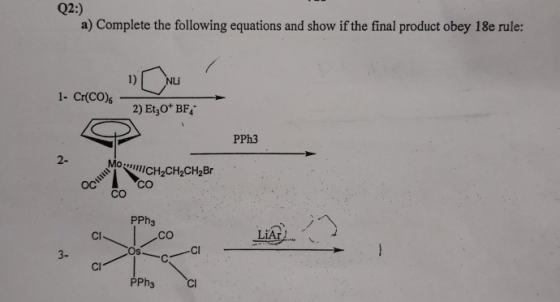
Please, can I got more explain for carbyne
Homework Answers
Kindly find the answer of the 1st part here:
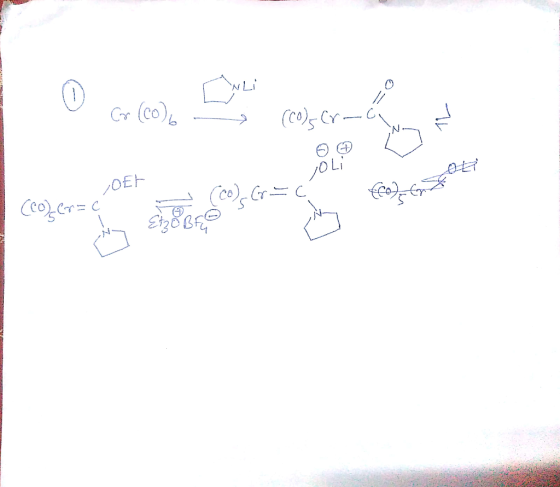
The final product is an 18 electron species.
Add Answer to:
Please, can I got more explain for carbyne
Q2:) a) Complete the following equations and show...
Can you please show and explain how you got your answer please 5. Write a balanced...
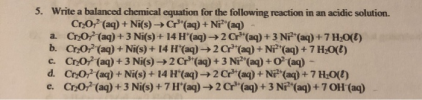 Can you please show and explain how you got your answer
please
5. Write a balanced chemical equation for the following reaction in an acidic solution. Cr207 (aq) + Ni(s) → Cr(aq) + N1"(aq) - a. Cr 07 (aq) + 3 Ni(s) + 14 H(aq) → Cr(aq) + 3 NP(aq) + 7 H2O(1) b. Cr2O72 (aq) + Ni(s) + 14 H(aq) + 2Cr (aq) + Ni?'(aq) + 7 H2O(l) c. Cr2072 (aq) + 3 Ni(s) 2 Cr(aq) + 3 Ni?'...
Can you please show and explain how you got your answer
please
5. Write a balanced chemical equation for the following reaction in an acidic solution. Cr207 (aq) + Ni(s) → Cr(aq) + N1"(aq) - a. Cr 07 (aq) + 3 Ni(s) + 14 H(aq) → Cr(aq) + 3 NP(aq) + 7 H2O(1) b. Cr2O72 (aq) + Ni(s) + 14 H(aq) + 2Cr (aq) + Ni?'(aq) + 7 H2O(l) c. Cr2072 (aq) + 3 Ni(s) 2 Cr(aq) + 3 Ni?'...
7. Write balance chemical equations that illustrate the following types of reactions. For reactants choose only from the...
 7. Write balance chemical
equations that illustrate the following types of reactions. For
reactants choose only from the following lists of reactants. Please
limit yourselves to only reactants in the following lists. Use each
reactant in only one of the reactions you write. You must identify
the appropriate products. List of reactants: Ir(CO)Cl(PPh3)2, C2H6,
CN-, [NiBr4]2-, CH3I, [Cr(H2O)6]2+, CH3CH2Re(CO)5, [Fe(CN)6]3-,
PPh3, [PtBr6]2-, [(C2H4)PtCl3]-,[Co(NH3)5N3]2+, a) Migratory
Insertion.b) Ligand Substitution. c) Oxidative Addition. d)
Inner-Sphere Electron Transfer.
7. Write balance chemical equations...
7. Write balance chemical
equations that illustrate the following types of reactions. For
reactants choose only from the following lists of reactants. Please
limit yourselves to only reactants in the following lists. Use each
reactant in only one of the reactions you write. You must identify
the appropriate products. List of reactants: Ir(CO)Cl(PPh3)2, C2H6,
CN-, [NiBr4]2-, CH3I, [Cr(H2O)6]2+, CH3CH2Re(CO)5, [Fe(CN)6]3-,
PPh3, [PtBr6]2-, [(C2H4)PtCl3]-,[Co(NH3)5N3]2+, a) Migratory
Insertion.b) Ligand Substitution. c) Oxidative Addition. d)
Inner-Sphere Electron Transfer.
7. Write balance chemical equations...
Please show your work and explain for me so I can understand better please. 1. Complete...
 Please show your work and explain for me so I can understand
better please.
1. Complete the following Balance Sheet Equations: Assets Liability Stockholders' Equity a. 245000 130000 ? b. 318000 Liability is twice the Stockholders' Equity c. ? Liability is half the Stockholders' Equity 168000
Please show your work and explain for me so I can understand
better please.
1. Complete the following Balance Sheet Equations: Assets Liability Stockholders' Equity a. 245000 130000 ? b. 318000 Liability is twice the Stockholders' Equity c. ? Liability is half the Stockholders' Equity 168000
hi i need some guidance with this question please, can you explain it? 1) Propose a...
 hi
i need some guidance with this question please, can you explain it?
1) Propose a mechanism for the following vinylogous Wittig reaction. Do you expect high stereoselection for the illustrated product? NCCO Et O PBuz Ph. PhH CHCl3, rt CN CO Et
hi
i need some guidance with this question please, can you explain it?
1) Propose a mechanism for the following vinylogous Wittig reaction. Do you expect high stereoselection for the illustrated product? NCCO Et O PBuz Ph. PhH CHCl3, rt CN CO Et
Can someone explain this please? I got completely the opposite answer Stereolengo The following reactions were...
 Can someone explain this please? I got completely the opposite
answer
Stereolengo The following reactions were taken from thesywhesis of TTN. нсон, CH₃ : Ph O ОН о Pho OH 0 Compound H Me Me Me Me Compound G 2) BF3 Et,0 no Stereocenter Me Me Compound I = Compound J A asymmet!! Which compounds in this reaction are chiral? (Circle all that apply.) 2pt Compound G Compound H Compound Compound J How are Compounds I and J related to...
Can someone explain this please? I got completely the opposite
answer
Stereolengo The following reactions were taken from thesywhesis of TTN. нсон, CH₃ : Ph O ОН о Pho OH 0 Compound H Me Me Me Me Compound G 2) BF3 Et,0 no Stereocenter Me Me Compound I = Compound J A asymmet!! Which compounds in this reaction are chiral? (Circle all that apply.) 2pt Compound G Compound H Compound Compound J How are Compounds I and J related to...
2. For each of the following compounds, 1) write the formal oxidation state of the transition...
2. For each of the following compounds, 1) write the formal oxidation state of the transition metal and 2) the corresponding number of d electrons. 3) State whether or not each one is likely to be stable enough to be characterized. (a) [Re(CO)5] (b) [Cr(η6 -C6H6)2] (c) [Mo(CO)3(PPh3)3] (d) [Fe(η2 -C2H4)(CO)4] (e) [Zr(η5 -C5H5)Cl(OH)] (f) [Co(η5 -C5H5)2] 3. Identify the first-row transition metal (M) that follows the 18-electron rule for each of the following compounds (show how you arrived at...
2. For each of the following compounds, 1) write the formal oxidation state of the transition met...
2. For each of the following compounds, 1) write the formal oxidation state of the transition metal and 2) the corresponding number of d electrons. 3) State whether or not each one is likely to be stable enough to be characterized. (a) [Re(CO)5] (b) [Cr(η6 -C6H6)2] (c) [Mo(CO)3(PPh3)3] (d) [Fe(η2 -C2H4)(CO)4] (e) [Zr(η5 -C5H5)Cl(OH)] (f) [Co(η5 -C5H5)2] 3. Identify the first-row transition metal (M) that follows the 18-electron rule for each of the following compounds (show how you arrived at...
explain how you got it 9. Complete and balance the following equations. (a) Mg(s) + O2(g)...
 explain how you got it
9. Complete and balance the following equations. (a) Mg(s) + O2(g) → _ (b) Sr(s) + H2O(l) → _ (aq) +_ () (c) Li(s) + N2(g) – – (d) Rb(s) + O2(g) → _ (e) Na(s) + 18-crown-6(1) ► Ni catalyst (f) CH4(g) + H2O(g) → 800 °C _(g) +
explain how you got it
9. Complete and balance the following equations. (a) Mg(s) + O2(g) → _ (b) Sr(s) + H2O(l) → _ (aq) +_ () (c) Li(s) + N2(g) – – (d) Rb(s) + O2(g) → _ (e) Na(s) + 18-crown-6(1) ► Ni catalyst (f) CH4(g) + H2O(g) → 800 °C _(g) +
please explain Complete the following reaction equations. Explain product formation and conditions. H2O Br 50 °C,...
 please explain
Complete the following reaction equations. Explain product formation and conditions. H2O Br 50 °C, 4 h NaOH, H20 50 °C, 4 h NaOET, ETOH "W Br
please explain
Complete the following reaction equations. Explain product formation and conditions. H2O Br 50 °C, 4 h NaOH, H20 50 °C, 4 h NaOET, ETOH "W Br
If someone can help please help me with this, and please show each reaction so I can learn!
 If someone can help please help me with this, and
please show each reaction so I can learn!
6: 3: Reaction of 2-propanol with the reagents listed here afforded which product? 1) PBr3 2) Mg, Et20; 3) CHsCHO; 4) H20; 5) PCC, CH2Cl2; 6) [H3O], Br2; 7) Pyridine 8) Et2CULI 9) C3 10) NaOH, Br2; 11) H3O 12) SOCI2;13) LİAİ(OR)3H 14) H20; 7: Reaction of oxirane with the reagents listed here afforded which product? 1) MeMgBr; 2) H20; 3) PCC,...
If someone can help please help me with this, and
please show each reaction so I can learn!
6: 3: Reaction of 2-propanol with the reagents listed here afforded which product? 1) PBr3 2) Mg, Et20; 3) CHsCHO; 4) H20; 5) PCC, CH2Cl2; 6) [H3O], Br2; 7) Pyridine 8) Et2CULI 9) C3 10) NaOH, Br2; 11) H3O 12) SOCI2;13) LİAİ(OR)3H 14) H20; 7: Reaction of oxirane with the reagents listed here afforded which product? 1) MeMgBr; 2) H20; 3) PCC,...
 Can you please show and explain how you got your answer
please
5. Write a balanced chemical equation for the following reaction in an acidic solution. Cr207 (aq) + Ni(s) → Cr(aq) + N1"(aq) - a. Cr 07 (aq) + 3 Ni(s) + 14 H(aq) → Cr(aq) + 3 NP(aq) + 7 H2O(1) b. Cr2O72 (aq) + Ni(s) + 14 H(aq) + 2Cr (aq) + Ni?'(aq) + 7 H2O(l) c. Cr2072 (aq) + 3 Ni(s) 2 Cr(aq) + 3 Ni?'...
Can you please show and explain how you got your answer
please
5. Write a balanced chemical equation for the following reaction in an acidic solution. Cr207 (aq) + Ni(s) → Cr(aq) + N1"(aq) - a. Cr 07 (aq) + 3 Ni(s) + 14 H(aq) → Cr(aq) + 3 NP(aq) + 7 H2O(1) b. Cr2O72 (aq) + Ni(s) + 14 H(aq) + 2Cr (aq) + Ni?'(aq) + 7 H2O(l) c. Cr2072 (aq) + 3 Ni(s) 2 Cr(aq) + 3 Ni?'...
 7. Write balance chemical
equations that illustrate the following types of reactions. For
reactants choose only from the following lists of reactants. Please
limit yourselves to only reactants in the following lists. Use each
reactant in only one of the reactions you write. You must identify
the appropriate products. List of reactants: Ir(CO)Cl(PPh3)2, C2H6,
CN-, [NiBr4]2-, CH3I, [Cr(H2O)6]2+, CH3CH2Re(CO)5, [Fe(CN)6]3-,
PPh3, [PtBr6]2-, [(C2H4)PtCl3]-,[Co(NH3)5N3]2+, a) Migratory
Insertion.b) Ligand Substitution. c) Oxidative Addition. d)
Inner-Sphere Electron Transfer.
7. Write balance chemical equations...
7. Write balance chemical
equations that illustrate the following types of reactions. For
reactants choose only from the following lists of reactants. Please
limit yourselves to only reactants in the following lists. Use each
reactant in only one of the reactions you write. You must identify
the appropriate products. List of reactants: Ir(CO)Cl(PPh3)2, C2H6,
CN-, [NiBr4]2-, CH3I, [Cr(H2O)6]2+, CH3CH2Re(CO)5, [Fe(CN)6]3-,
PPh3, [PtBr6]2-, [(C2H4)PtCl3]-,[Co(NH3)5N3]2+, a) Migratory
Insertion.b) Ligand Substitution. c) Oxidative Addition. d)
Inner-Sphere Electron Transfer.
7. Write balance chemical equations...
 Please show your work and explain for me so I can understand
better please.
1. Complete the following Balance Sheet Equations: Assets Liability Stockholders' Equity a. 245000 130000 ? b. 318000 Liability is twice the Stockholders' Equity c. ? Liability is half the Stockholders' Equity 168000
Please show your work and explain for me so I can understand
better please.
1. Complete the following Balance Sheet Equations: Assets Liability Stockholders' Equity a. 245000 130000 ? b. 318000 Liability is twice the Stockholders' Equity c. ? Liability is half the Stockholders' Equity 168000
 hi
i need some guidance with this question please, can you explain it?
1) Propose a mechanism for the following vinylogous Wittig reaction. Do you expect high stereoselection for the illustrated product? NCCO Et O PBuz Ph. PhH CHCl3, rt CN CO Et
hi
i need some guidance with this question please, can you explain it?
1) Propose a mechanism for the following vinylogous Wittig reaction. Do you expect high stereoselection for the illustrated product? NCCO Et O PBuz Ph. PhH CHCl3, rt CN CO Et
 Can someone explain this please? I got completely the opposite
answer
Stereolengo The following reactions were taken from thesywhesis of TTN. нсон, CH₃ : Ph O ОН о Pho OH 0 Compound H Me Me Me Me Compound G 2) BF3 Et,0 no Stereocenter Me Me Compound I = Compound J A asymmet!! Which compounds in this reaction are chiral? (Circle all that apply.) 2pt Compound G Compound H Compound Compound J How are Compounds I and J related to...
Can someone explain this please? I got completely the opposite
answer
Stereolengo The following reactions were taken from thesywhesis of TTN. нсон, CH₃ : Ph O ОН о Pho OH 0 Compound H Me Me Me Me Compound G 2) BF3 Et,0 no Stereocenter Me Me Compound I = Compound J A asymmet!! Which compounds in this reaction are chiral? (Circle all that apply.) 2pt Compound G Compound H Compound Compound J How are Compounds I and J related to...
 explain how you got it
9. Complete and balance the following equations. (a) Mg(s) + O2(g) → _ (b) Sr(s) + H2O(l) → _ (aq) +_ () (c) Li(s) + N2(g) – – (d) Rb(s) + O2(g) → _ (e) Na(s) + 18-crown-6(1) ► Ni catalyst (f) CH4(g) + H2O(g) → 800 °C _(g) +
explain how you got it
9. Complete and balance the following equations. (a) Mg(s) + O2(g) → _ (b) Sr(s) + H2O(l) → _ (aq) +_ () (c) Li(s) + N2(g) – – (d) Rb(s) + O2(g) → _ (e) Na(s) + 18-crown-6(1) ► Ni catalyst (f) CH4(g) + H2O(g) → 800 °C _(g) +
 please explain
Complete the following reaction equations. Explain product formation and conditions. H2O Br 50 °C, 4 h NaOH, H20 50 °C, 4 h NaOET, ETOH "W Br
please explain
Complete the following reaction equations. Explain product formation and conditions. H2O Br 50 °C, 4 h NaOH, H20 50 °C, 4 h NaOET, ETOH "W Br
 If someone can help please help me with this, and
please show each reaction so I can learn!
6: 3: Reaction of 2-propanol with the reagents listed here afforded which product? 1) PBr3 2) Mg, Et20; 3) CHsCHO; 4) H20; 5) PCC, CH2Cl2; 6) [H3O], Br2; 7) Pyridine 8) Et2CULI 9) C3 10) NaOH, Br2; 11) H3O 12) SOCI2;13) LİAİ(OR)3H 14) H20; 7: Reaction of oxirane with the reagents listed here afforded which product? 1) MeMgBr; 2) H20; 3) PCC,...
If someone can help please help me with this, and
please show each reaction so I can learn!
6: 3: Reaction of 2-propanol with the reagents listed here afforded which product? 1) PBr3 2) Mg, Et20; 3) CHsCHO; 4) H20; 5) PCC, CH2Cl2; 6) [H3O], Br2; 7) Pyridine 8) Et2CULI 9) C3 10) NaOH, Br2; 11) H3O 12) SOCI2;13) LİAİ(OR)3H 14) H20; 7: Reaction of oxirane with the reagents listed here afforded which product? 1) MeMgBr; 2) H20; 3) PCC,...
Most questions answered within 3 hours.
-
Where is the error in this code sequence?
String s1 = "Hello";
String s2 = "ello";...
asked 10 months ago -
Financial data for Joel de Paris, Inc., for last year
follow:
Joel de Paris, Inc.
Balance...
asked 10 months ago -
Consider this reaction:
Al2(SO4)3 (aq)+ BaCl3
(aq) Al2Cl6 (aq)- +
3BaSO4(s) . What is the...
asked 10 months ago -
Suppose that Savneet is considering increasing her
recent random sample from 20 car rentals to 40...
asked 10 months ago -
Trucks arrive at an unloading terminal at an average rate of 120
per hour.
Trucks arrive...
asked 10 months ago -
Why are methanol and ethanol completely soluble in water while
octanol is not very little soluble....
asked 10 months ago -
A facilities manager at a university reads in a research report
that the mean amount of...
asked 10 months ago -
When the CuSO4 is rehydrated by adding water to the anhydrous
compound, is this an endothermic...
asked 10 months ago -
A ray of sunlight is passing from diamond into crown glass; the
angle of incidence is...
asked 10 months ago -
A block of mass 0.249 kg is placed on top of a light, vertical
spring of...
asked 10 months ago -
how do the kidneys compensate in the presences of acidosis
a) trigger hyperventilate
b) reserve acid...
asked 10 months ago -
Question 501 pts
The rental rate of capital to the firm increases. Which of the
following...
asked 10 months ago