For the example problem 2.2.4 (page 20, textbook or page 3,
ClassNote Wk#3), the system is oscillating without any external
excitation. Parameters are given as follows. (Picture
Posted)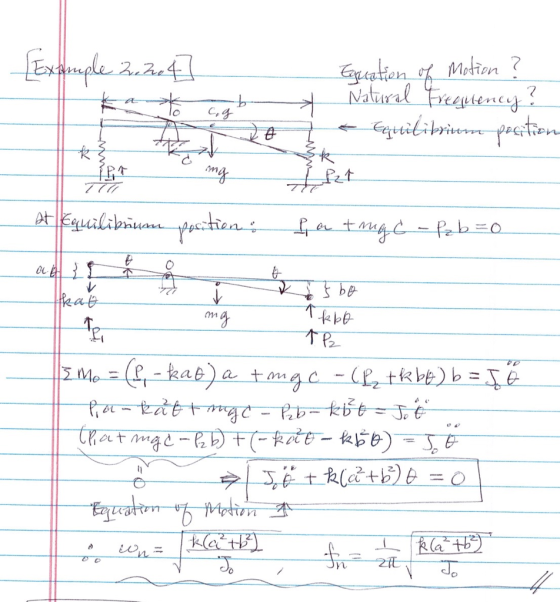
initial conditions:  = 0.5 rad/sec,
  (0) = 2
degrees
(0) = 2
degrees
Mass of the bar: 5kgm
Moment of inertia of the bar about O: Jo= 0.1 kg-m2
Spring constant: k = 150 N/m
Dimentions: a= 0.5 m; b= 1.5 m; c= 0.5 m
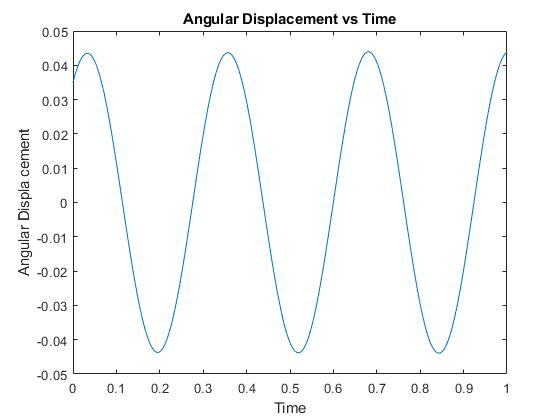
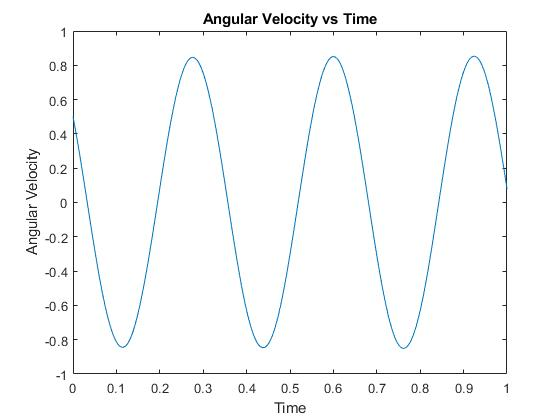
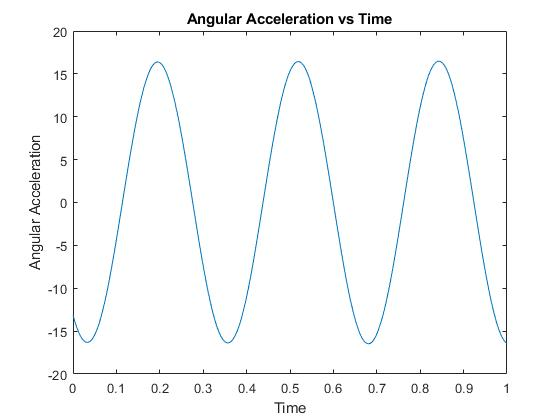
Using the MATLAB, plot the angular displacement, angular velocity and angular acceleration of the system.
Note: Use an appropriate time vector to show at least 3 cycles.
Homework Answers
Governing Equation:

Given:  kg-m2 ,
  N/m ,
N/m ,  m,
m,  m,
m,  ,
,  kg,
kg,
 rad/s and
Converting the second order differential equation to first order for MATLAB calculation, Let

Then,
 or
or 
Also, 
Time Period for one cycle 
MATLAB CODE
clear
clc
k=150
a=0.5
b=1.5
J0=1
tspan = 0:0.001:1;
y0 = [0.035, 0.5];
opts = odeset('RelTol',1e-2,'AbsTol',1e-4);
sol = ode45(@(t,y) odefun(t,y,k,a,b,J0), tspan, y0, opts);
t = linspace(0,1,1000);
y = deval(sol,t);
% plot(t,y(1,:)) %Plot angular displacement vs t
% plot(t,y(2,:)) %Plot angular velocity vs t
acc=-k*(a^2+b^2)/J0*y(1,:);
plot(t,acc) % Angular acceleration vs Time
function dydt = odefun(t,y,k,a,b,J0)
dydt = zeros(2,1);
dydt(1) = y(2);
dydt(2) = -k*(a^2+b^2)/J0*y(1);
end
Add Answer to:
For the example problem 2.2.4 (page 20, textbook or page 3,
ClassNote Wk#3), the system is...
Most questions answered within 3 hours.
-
Where is the error in this code sequence?
String s1 = "Hello";
String s2 = "ello";...
asked 10 months ago -
Financial data for Joel de Paris, Inc., for last year
follow:
Joel de Paris, Inc.
Balance...
asked 10 months ago -
Consider this reaction:
Al2(SO4)3 (aq)+ BaCl3
(aq) Al2Cl6 (aq)- +
3BaSO4(s) . What is the...
asked 10 months ago -
Suppose that Savneet is considering increasing her
recent random sample from 20 car rentals to 40...
asked 10 months ago -
Trucks arrive at an unloading terminal at an average rate of 120
per hour.
Trucks arrive...
asked 10 months ago -
Why are methanol and ethanol completely soluble in water while
octanol is not very little soluble....
asked 10 months ago -
A facilities manager at a university reads in a research report
that the mean amount of...
asked 10 months ago -
When the CuSO4 is rehydrated by adding water to the anhydrous
compound, is this an endothermic...
asked 10 months ago -
A ray of sunlight is passing from diamond into crown glass; the
angle of incidence is...
asked 10 months ago -
A block of mass 0.249 kg is placed on top of a light, vertical
spring of...
asked 10 months ago -
how do the kidneys compensate in the presences of acidosis
a) trigger hyperventilate
b) reserve acid...
asked 10 months ago -
Question 501 pts
The rental rate of capital to the firm increases. Which of the
following...
asked 10 months ago