
Homework Answers
Add Answer to:
13. Suggest three ways in which the concentration of CO, could be increased if an equilibrium...
What are four ways that the concentration of SO2(g) could be increased in an equilibrium described...
What are four ways that the concentration of SO2(g) could be increased in an equilibrium described by the following reaction: 2 SO2(g) + O2(g) ⇌ 2 SO3(g) ΔH = -296 kJ/mole
8. a. Balance and write the equilibrium constant for CO(g)+ 02(g) = Co:(g) b. If the...
 8. a. Balance and write the equilibrium constant for CO(g)+ 02(g) = Co:(g) b. If the concentration of CO is increased, will the equilibrium shift toward products or reactants? Circle the correct answer. c. If the pressure in the reaction vessel is increased, will the equilibrium shift toward products or reactants? Circle the correct answer d.Assume the BDE for CO is 257 kcal/mol (and the other BDES are those given above). If heat is added to the vessel, will the...
e) Suggest two ways of increasing the concentration of an aqueous solution. Concentrate please! A student...
 e) Suggest two ways of increasing the concentration of an aqueous solution. Concentrate please! A student had a solution of sodium chloride with a concentration of 93.6g/dm'. Calculate the mass of sodium chloride dissolved in 25.0cm' of the solution Extension questions: g) Concentration can be expressed in units of mol/dm'. A student has a solution of 73g/dm HCl. What is the concentration of the hydrochloric acid in mol/dm? (A H = 1, CI = 35.5) h) A student has a...
Question 19 (2 points) Identify each of the following as a homogeneous or heterogeneous eq uilibrium...
 Question 19 (2 points) Identify each of the following as a homogeneous or heterogeneous eq uilibrium 4HCI@+020 2H20 7+2Cl29 CH«+H20 3H2g+CO 1. homogeneous equilibrium 2. heterogeneous equilibrium 2NaHCO3) = Na2C030+C020+H20 2030 3029 Question 20(1.5 points) Co+ H2+ 31 kcal - H269 + Coa Indicate how each of the following will affect the equilibrium concentration of CO in the following reaction: 1. This will cause an increase in the equilibrium concentration of CO decrease the temperature of the reaction add a...
4. For which of the two reactions below will the equilibrium constant increase with increasing tempat 250z(8) + 0.8...
 4. For which of the two reactions below will the equilibrium constant increase with increasing tempat 250z(8) + 0.8 - 25O3(8) AH = - 47 kcal/mol 2H (9) H:() + 1:(8) AH = + 3.21 kcal/mol 5. Before travelling from Orlando to Miami, a student accidentally inflates his car tires with a known concentration of HX gas instead of air. Some of the HX immediately dissociates to form H, and X2 as shown in the reaction below. Based on what...
1:Consider the following equilibrium process at 686°C: CO2(g) + H2(g) ⇌ CO(g) + H2O(g) The equilibrium...
1:Consider the following equilibrium process at 686°C: CO2(g) + H2(g) ⇌ CO(g) + H2O(g) The equilibrium concentrations of the reacting species are [CO] = 0.0570 M, [H2] = 0.0420 M, [CO2] = 0.0860 M, and [H2O] = 0.0430 M. (a) Calculate Kc for the reaction at 686°C. (b)If we add CO2 to increase its concentration to 0.440 mol / L, what will the concentrations of all the gases be when equilibrium is reestablished? (c) CO2: H2: CO: H2O: 2:The following...
Question 13 For the reaction with AH = 30 kJ/mol at equilibrium 2NOBrig = 2ND which...
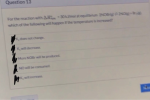 Question 13 For the reaction with AH = 30 kJ/mol at equilibrium 2NOBrig = 2ND which of the following will happen if the temperature is increased K does not change. K will decrease More NOBr will be produced NO will be consumed MK will increase
part b Part Suppose that the molar concentrations for CO and H, at equilibrium are (CO)...
 part b
Part Suppose that the molar concentrations for CO and H, at equilibrium are (CO) = 0.03 M and H2) = 0.06 M. Use the formula you found in Part B to calculate the concentration of CH, OH. Express your answer to one decimal place and include the appropriate units. View Available Hint(s) : HÅR O a ? (CH3OH) = Value Units Submit art D Complete previous part(s) Review Constants I Periodic Table The equilibrium-constant expression is a mathematical...
part b
Part Suppose that the molar concentrations for CO and H, at equilibrium are (CO) = 0.03 M and H2) = 0.06 M. Use the formula you found in Part B to calculate the concentration of CH, OH. Express your answer to one decimal place and include the appropriate units. View Available Hint(s) : HÅR O a ? (CH3OH) = Value Units Submit art D Complete previous part(s) Review Constants I Periodic Table The equilibrium-constant expression is a mathematical...
1) What is the correct mathematical expression for the reaction quotient, Qc, for the following reaction:...
 1) What is the correct mathematical expression for the reaction quotient, Qc, for the following reaction: CH(E) + 2O2(g) = CO2(g) + 2H20 (1) [CH][02] [CO2][H2012 [CH][02] [CO2] L = LIQUID (CO2) [CH][0212 (d) 1C02) P2012 [CH][02] e) None of the above. 2) A change of pressure has no effect on which of the following reactions at equilibrium? 1) 2502(g) + O2(g) = 2503(8) 2) 4NH3(g) +502(g) = 4NO(g) + 6H2O(g) 3) CH2(g) + Cl2(g) = CH2Cl(g) + HCl(g) 4)...
16. For the system CO + CO2(g) → CaCO(s) the equilibrium constant expression is a. [CO]...
 16. For the system CO + CO2(g) → CaCO(s) the equilibrium constant expression is a. [CO] b. 1/[CO] c. COCO/CaCO, d. Cacos/CaoCO 17. The value of K, for the reaction 2NOH). N204) is 1.52 at 319 K. What is the value of ko at this temperature for the reaction N04() → 2NOR ? b. 1.23 c. 5.74 x 10 d. 0.658 18. The value of Ke for the reaction C() + COX() -----2CO(g) is 1.6. What is the equilibrium concentration...
 8. a. Balance and write the equilibrium constant for CO(g)+ 02(g) = Co:(g) b. If the concentration of CO is increased, will the equilibrium shift toward products or reactants? Circle the correct answer. c. If the pressure in the reaction vessel is increased, will the equilibrium shift toward products or reactants? Circle the correct answer d.Assume the BDE for CO is 257 kcal/mol (and the other BDES are those given above). If heat is added to the vessel, will the...
 e) Suggest two ways of increasing the concentration of an aqueous solution. Concentrate please! A student had a solution of sodium chloride with a concentration of 93.6g/dm'. Calculate the mass of sodium chloride dissolved in 25.0cm' of the solution Extension questions: g) Concentration can be expressed in units of mol/dm'. A student has a solution of 73g/dm HCl. What is the concentration of the hydrochloric acid in mol/dm? (A H = 1, CI = 35.5) h) A student has a...
 Question 19 (2 points) Identify each of the following as a homogeneous or heterogeneous eq uilibrium 4HCI@+020 2H20 7+2Cl29 CH«+H20 3H2g+CO 1. homogeneous equilibrium 2. heterogeneous equilibrium 2NaHCO3) = Na2C030+C020+H20 2030 3029 Question 20(1.5 points) Co+ H2+ 31 kcal - H269 + Coa Indicate how each of the following will affect the equilibrium concentration of CO in the following reaction: 1. This will cause an increase in the equilibrium concentration of CO decrease the temperature of the reaction add a...
 4. For which of the two reactions below will the equilibrium constant increase with increasing tempat 250z(8) + 0.8 - 25O3(8) AH = - 47 kcal/mol 2H (9) H:() + 1:(8) AH = + 3.21 kcal/mol 5. Before travelling from Orlando to Miami, a student accidentally inflates his car tires with a known concentration of HX gas instead of air. Some of the HX immediately dissociates to form H, and X2 as shown in the reaction below. Based on what...
 Question 13 For the reaction with AH = 30 kJ/mol at equilibrium 2NOBrig = 2ND which of the following will happen if the temperature is increased K does not change. K will decrease More NOBr will be produced NO will be consumed MK will increase
 part b
Part Suppose that the molar concentrations for CO and H, at equilibrium are (CO) = 0.03 M and H2) = 0.06 M. Use the formula you found in Part B to calculate the concentration of CH, OH. Express your answer to one decimal place and include the appropriate units. View Available Hint(s) : HÅR O a ? (CH3OH) = Value Units Submit art D Complete previous part(s) Review Constants I Periodic Table The equilibrium-constant expression is a mathematical...
part b
Part Suppose that the molar concentrations for CO and H, at equilibrium are (CO) = 0.03 M and H2) = 0.06 M. Use the formula you found in Part B to calculate the concentration of CH, OH. Express your answer to one decimal place and include the appropriate units. View Available Hint(s) : HÅR O a ? (CH3OH) = Value Units Submit art D Complete previous part(s) Review Constants I Periodic Table The equilibrium-constant expression is a mathematical...
 1) What is the correct mathematical expression for the reaction quotient, Qc, for the following reaction: CH(E) + 2O2(g) = CO2(g) + 2H20 (1) [CH][02] [CO2][H2012 [CH][02] [CO2] L = LIQUID (CO2) [CH][0212 (d) 1C02) P2012 [CH][02] e) None of the above. 2) A change of pressure has no effect on which of the following reactions at equilibrium? 1) 2502(g) + O2(g) = 2503(8) 2) 4NH3(g) +502(g) = 4NO(g) + 6H2O(g) 3) CH2(g) + Cl2(g) = CH2Cl(g) + HCl(g) 4)...
 16. For the system CO + CO2(g) → CaCO(s) the equilibrium constant expression is a. [CO] b. 1/[CO] c. COCO/CaCO, d. Cacos/CaoCO 17. The value of K, for the reaction 2NOH). N204) is 1.52 at 319 K. What is the value of ko at this temperature for the reaction N04() → 2NOR ? b. 1.23 c. 5.74 x 10 d. 0.658 18. The value of Ke for the reaction C() + COX() -----2CO(g) is 1.6. What is the equilibrium concentration...
Most questions answered within 3 hours.
-
Where is the error in this code sequence?
String s1 = "Hello";
String s2 = "ello";...
asked 10 months ago -
Financial data for Joel de Paris, Inc., for last year
follow:
Joel de Paris, Inc.
Balance...
asked 10 months ago -
Consider this reaction:
Al2(SO4)3 (aq)+ BaCl3
(aq) Al2Cl6 (aq)- +
3BaSO4(s) . What is the...
asked 10 months ago -
Suppose that Savneet is considering increasing her
recent random sample from 20 car rentals to 40...
asked 10 months ago -
Trucks arrive at an unloading terminal at an average rate of 120
per hour.
Trucks arrive...
asked 10 months ago -
Why are methanol and ethanol completely soluble in water while
octanol is not very little soluble....
asked 10 months ago -
A facilities manager at a university reads in a research report
that the mean amount of...
asked 10 months ago -
When the CuSO4 is rehydrated by adding water to the anhydrous
compound, is this an endothermic...
asked 10 months ago -
A ray of sunlight is passing from diamond into crown glass; the
angle of incidence is...
asked 10 months ago -
A block of mass 0.249 kg is placed on top of a light, vertical
spring of...
asked 10 months ago -
how do the kidneys compensate in the presences of acidosis
a) trigger hyperventilate
b) reserve acid...
asked 10 months ago -
Question 501 pts
The rental rate of capital to the firm increases. Which of the
following...
asked 10 months ago