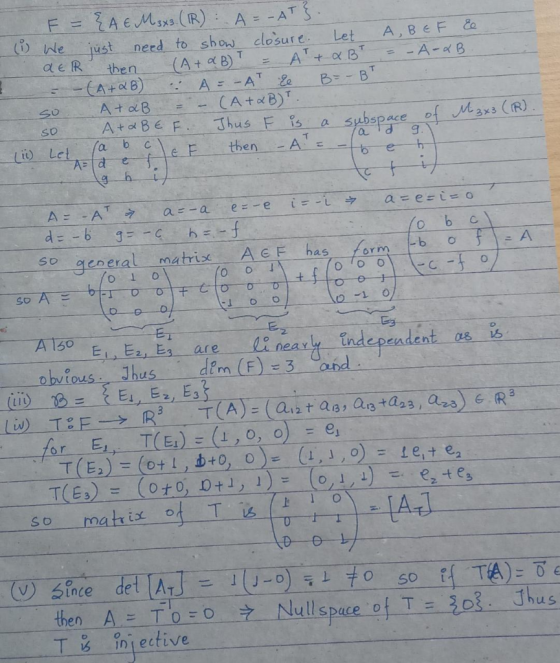
Being F the subset of  of the hemi-symmetric matrices (
such as
of the hemi-symmetric matrices (
such as  ).
).
i) Show that F is a
subspace of .
ii) Determine the dimension of F.
iii) Determine the base  of
F.
of
F.
iv) Being  the application that corresponds
to each matrix
the application that corresponds
to each matrix  of F the vector
  of
of  .
.
Determine the matrix that represents T
regarding the base of the previous question (iii) and the canonical
base of .
v) Determine if T is injective.
vi) Determine if T is surjective.
vii) Verify that T
satisfies the Dimension theorem , such as 
Homework Answers
 please
rate
please
rate
Add Answer to:
Being F the subset of of the hemi-symmetric matrices (
such as ).
i) Show that...
We say that an nxn matrix is skew-symmetric if A^T=-A. Let W be the set of...
 We say that an nxn matrix is skew-symmetric if A^T=-A. Let W be
the set of all 2x2 skew-symmetric matrices: W = {A in m2x2(R) l
A^T=-A}.
(a) Show that W is a subspace of M2x2(R)
(b) Find a basis for W and determine dim(W).
(c) Suppose T: M2x2(R) is a linear transformation given by
T(A)=A^T +A. Is T injective? Is T surjective? Why or why not? You
do not need to verify that T is linear.
3. (17 points)...
We say that an nxn matrix is skew-symmetric if A^T=-A. Let W be
the set of all 2x2 skew-symmetric matrices: W = {A in m2x2(R) l
A^T=-A}.
(a) Show that W is a subspace of M2x2(R)
(b) Find a basis for W and determine dim(W).
(c) Suppose T: M2x2(R) is a linear transformation given by
T(A)=A^T +A. Is T injective? Is T surjective? Why or why not? You
do not need to verify that T is linear.
3. (17 points)...
Consider the map defined A) Compute B) Verify that F is a linear transformation. C) Is...
 Consider the map
defined
A) Compute
B) Verify that F is a linear transformation.
C) Is F one-to-one (injective)? Justify your answer.
D) Is F onto (surjective)? Justify your answer.
E) Describe the kernel (null space) of F.
F) Describe the image (what the book calls the range) of F.
G) Find one solution
to the equation
H) Find all solutions
to the equation
G:P2 → P3 G(p(t) = P(dx F(t + + 5) We were unable to transcribe this...
Consider the map
defined
A) Compute
B) Verify that F is a linear transformation.
C) Is F one-to-one (injective)? Justify your answer.
D) Is F onto (surjective)? Justify your answer.
E) Describe the kernel (null space) of F.
F) Describe the image (what the book calls the range) of F.
G) Find one solution
to the equation
H) Find all solutions
to the equation
G:P2 → P3 G(p(t) = P(dx F(t + + 5) We were unable to transcribe this...
If C is a subspace of , prove that . (C is a binary linear code...
If C is a subspace of , prove that . (C is a binary linear code with length n and dimension k, is the dual code of C) F dim(C) dim(C)= n We were unable to transcribe this image
Let be an arbitrary function and A X. i) Show that A ii) Give an example...
 Let
be an arbitrary function and A
X.
i) Show that A
ii) Give an example to show that in general A =
.
iii) Show that, if
is injective, then A =
iv) Show that, if X and Y are modules;
is a homomorphism of modules and A is a submodule of X such that
ker,
then we also have A =
We were unable to transcribe this imageWe were unable to transcribe this imageWe were unable to transcribe...
Let
be an arbitrary function and A
X.
i) Show that A
ii) Give an example to show that in general A =
.
iii) Show that, if
is injective, then A =
iv) Show that, if X and Y are modules;
is a homomorphism of modules and A is a submodule of X such that
ker,
then we also have A =
We were unable to transcribe this imageWe were unable to transcribe this imageWe were unable to transcribe...
Please argument all your answers and explain why of your arguments so i can understand better and...
Please argument all your answers and explain why of your arguments so i can understand better and do not use advanced things im just taking linear algebra course. Let V be a vector space of finite dimension over a field K. T a linear operator over V and a eigenvector of T associated to the eigenvalue . If , show that . Being A any matrix associated to T in some basis of V. We were unable to transcribe this...
a) By direct substitution determine which of the following functions satisfy the wave equation. 1. g(x,...
a) By direct substitution determine which of the following functions satisfy the wave equation. 1. g(x, t) = Acos(kx − t) where A, k, are positive constants. 2. h(x, t) = Ae where A, k, are positive constants. 3. p(x, t) = Asinh(kx − t) where A, k, are positive constants. 4. q(x, t) = Ae where A, a, are positive constants. 5. An arbitrary function: f(x, t) = f(kx−t) where k and are positive constants. (Hint: Be careful with...
satisfies the integral equation: Find the solution of the integral equation using Fourier transforms. Your answer should be expressed as a function of t using the correct syntax. f(t) =...
satisfies the integral equation: Find the solution of the integral equation using Fourier transforms. Your answer should be expressed as a function of t using the correct syntax. f(t) = We were unable to transcribe this image(t-ue (t-ue
Find the line integral of F = (3x^2-7x) i +7z j + k from (0,0,0) to...
 Find the line integral of F = (3x^2-7x)
i +7z j + k from
(0,0,0) to (1,1,1) over each of the following paths in the
accompanying figure.
a. C1: r(t) = t i + t
j + t k,
b: C2: r(t) = t i +t^2 j + t^4 k,
c: C3C4:
the path consisting of the line segment from (0,0,0) to (1,1,0)
followed by the segment from (1,1,0) to (1,1,1)
We were unable to transcribe this imageWe were unable...
Find the line integral of F = (3x^2-7x)
i +7z j + k from
(0,0,0) to (1,1,1) over each of the following paths in the
accompanying figure.
a. C1: r(t) = t i + t
j + t k,
b: C2: r(t) = t i +t^2 j + t^4 k,
c: C3C4:
the path consisting of the line segment from (0,0,0) to (1,1,0)
followed by the segment from (1,1,0) to (1,1,1)
We were unable to transcribe this imageWe were unable...
satisfies the integral equation: Find the solution of the integral equation using Fourier transforms. Your answer should be expressed as a function of t using the correct syntax. f(t) =...
satisfies the integral equation: Find the solution of the integral equation using Fourier transforms. Your answer should be expressed as a function of t using the correct syntax. f(t) = We were unable to transcribe this image1510 1510
Part 1: For each of the following structures, indicate the integration expected for the signal associated...
 Part 1: For each of the following structures, indicate the
integration expected for the signal associated with the indicated
hydrogen(s).
a)
i)
ii)
iii)
iv)
b)
i)
ii)
iii)
c)
i)
ii)
iii)
d)
i)
ii)
iii)
iv)
v)
vi)
e)
i)
ii)
iii)
iv)
f)
i)
ii)
iii)
iv)
v)
vi)
Part 2: For each of the following structures, indicate the
coupling (a.k.a, splitting) pattern expected for the signal
associated with the indicated hydrogen(s) by placing the
appropriate letter(s)...
Part 1: For each of the following structures, indicate the
integration expected for the signal associated with the indicated
hydrogen(s).
a)
i)
ii)
iii)
iv)
b)
i)
ii)
iii)
c)
i)
ii)
iii)
d)
i)
ii)
iii)
iv)
v)
vi)
e)
i)
ii)
iii)
iv)
f)
i)
ii)
iii)
iv)
v)
vi)
Part 2: For each of the following structures, indicate the
coupling (a.k.a, splitting) pattern expected for the signal
associated with the indicated hydrogen(s) by placing the
appropriate letter(s)...
 We say that an nxn matrix is skew-symmetric if A^T=-A. Let W be
the set of all 2x2 skew-symmetric matrices: W = {A in m2x2(R) l
A^T=-A}.
(a) Show that W is a subspace of M2x2(R)
(b) Find a basis for W and determine dim(W).
(c) Suppose T: M2x2(R) is a linear transformation given by
T(A)=A^T +A. Is T injective? Is T surjective? Why or why not? You
do not need to verify that T is linear.
3. (17 points)...
We say that an nxn matrix is skew-symmetric if A^T=-A. Let W be
the set of all 2x2 skew-symmetric matrices: W = {A in m2x2(R) l
A^T=-A}.
(a) Show that W is a subspace of M2x2(R)
(b) Find a basis for W and determine dim(W).
(c) Suppose T: M2x2(R) is a linear transformation given by
T(A)=A^T +A. Is T injective? Is T surjective? Why or why not? You
do not need to verify that T is linear.
3. (17 points)...
 Consider the map
defined
A) Compute
B) Verify that F is a linear transformation.
C) Is F one-to-one (injective)? Justify your answer.
D) Is F onto (surjective)? Justify your answer.
E) Describe the kernel (null space) of F.
F) Describe the image (what the book calls the range) of F.
G) Find one solution
to the equation
H) Find all solutions
to the equation
G:P2 → P3 G(p(t) = P(dx F(t + + 5) We were unable to transcribe this...
Consider the map
defined
A) Compute
B) Verify that F is a linear transformation.
C) Is F one-to-one (injective)? Justify your answer.
D) Is F onto (surjective)? Justify your answer.
E) Describe the kernel (null space) of F.
F) Describe the image (what the book calls the range) of F.
G) Find one solution
to the equation
H) Find all solutions
to the equation
G:P2 → P3 G(p(t) = P(dx F(t + + 5) We were unable to transcribe this...
 Let
be an arbitrary function and A
X.
i) Show that A
ii) Give an example to show that in general A =
.
iii) Show that, if
is injective, then A =
iv) Show that, if X and Y are modules;
is a homomorphism of modules and A is a submodule of X such that
ker,
then we also have A =
We were unable to transcribe this imageWe were unable to transcribe this imageWe were unable to transcribe...
Let
be an arbitrary function and A
X.
i) Show that A
ii) Give an example to show that in general A =
.
iii) Show that, if
is injective, then A =
iv) Show that, if X and Y are modules;
is a homomorphism of modules and A is a submodule of X such that
ker,
then we also have A =
We were unable to transcribe this imageWe were unable to transcribe this imageWe were unable to transcribe...
 Find the line integral of F = (3x^2-7x)
i +7z j + k from
(0,0,0) to (1,1,1) over each of the following paths in the
accompanying figure.
a. C1: r(t) = t i + t
j + t k,
b: C2: r(t) = t i +t^2 j + t^4 k,
c: C3C4:
the path consisting of the line segment from (0,0,0) to (1,1,0)
followed by the segment from (1,1,0) to (1,1,1)
We were unable to transcribe this imageWe were unable...
Find the line integral of F = (3x^2-7x)
i +7z j + k from
(0,0,0) to (1,1,1) over each of the following paths in the
accompanying figure.
a. C1: r(t) = t i + t
j + t k,
b: C2: r(t) = t i +t^2 j + t^4 k,
c: C3C4:
the path consisting of the line segment from (0,0,0) to (1,1,0)
followed by the segment from (1,1,0) to (1,1,1)
We were unable to transcribe this imageWe were unable...
 Part 1: For each of the following structures, indicate the
integration expected for the signal associated with the indicated
hydrogen(s).
a)
i)
ii)
iii)
iv)
b)
i)
ii)
iii)
c)
i)
ii)
iii)
d)
i)
ii)
iii)
iv)
v)
vi)
e)
i)
ii)
iii)
iv)
f)
i)
ii)
iii)
iv)
v)
vi)
Part 2: For each of the following structures, indicate the
coupling (a.k.a, splitting) pattern expected for the signal
associated with the indicated hydrogen(s) by placing the
appropriate letter(s)...
Part 1: For each of the following structures, indicate the
integration expected for the signal associated with the indicated
hydrogen(s).
a)
i)
ii)
iii)
iv)
b)
i)
ii)
iii)
c)
i)
ii)
iii)
d)
i)
ii)
iii)
iv)
v)
vi)
e)
i)
ii)
iii)
iv)
f)
i)
ii)
iii)
iv)
v)
vi)
Part 2: For each of the following structures, indicate the
coupling (a.k.a, splitting) pattern expected for the signal
associated with the indicated hydrogen(s) by placing the
appropriate letter(s)...
Most questions answered within 3 hours.
-
Where is the error in this code sequence?
String s1 = "Hello";
String s2 = "ello";...
asked 11 months ago -
Financial data for Joel de Paris, Inc., for last year
follow:
Joel de Paris, Inc.
Balance...
asked 11 months ago -
Consider this reaction:
Al2(SO4)3 (aq)+ BaCl3
(aq) Al2Cl6 (aq)- +
3BaSO4(s) . What is the...
asked 11 months ago -
Suppose that Savneet is considering increasing her
recent random sample from 20 car rentals to 40...
asked 11 months ago -
Trucks arrive at an unloading terminal at an average rate of 120
per hour.
Trucks arrive...
asked 11 months ago -
Why are methanol and ethanol completely soluble in water while
octanol is not very little soluble....
asked 11 months ago -
A facilities manager at a university reads in a research report
that the mean amount of...
asked 11 months ago -
When the CuSO4 is rehydrated by adding water to the anhydrous
compound, is this an endothermic...
asked 11 months ago -
A ray of sunlight is passing from diamond into crown glass; the
angle of incidence is...
asked 11 months ago -
A block of mass 0.249 kg is placed on top of a light, vertical
spring of...
asked 11 months ago -
how do the kidneys compensate in the presences of acidosis
a) trigger hyperventilate
b) reserve acid...
asked 11 months ago -
Question 501 pts
The rental rate of capital to the firm increases. Which of the
following...
asked 11 months ago