
Homework Answers
Add Answer to:
Boyle's law states that when a sample of gas is compressed at a
constant temperature, the...
Processing Data for Part I: Boyle's Law Volume Pressure Constant, k (mL) (kPa) 105.2 119.4 15...
 Processing Data for Part I: Boyle's Law Volume Pressure Constant, k (mL) (kPa) 105.2 119.4 15 139.5 17.5 166.1 T 205.8 232.6 232.4 1. What happens to the Pressure as the piston is pushed to lower the volume of the air inside the syringe? 2. What is the value of the constant k, in PV=k 3. How should the pressure be expressed so that the graph shows a straight line?
1.) Charles Law states: volume and temperature are directly proportional when pressure remains constant 2.) Boyle's...
 1.) Charles Law states: volume and temperature are directly proportional when pressure remains constant 2.) Boyle's Law states:_pressure and volume are inversely related when temperature remains constant 3.) What is the relative humidity of inspired gas in a person's airway if the water vapor content breathed in is 30 mg/L at normal body temperature? 30/44x100=68% 4.) Calculate the FEV1%. FVC is 6L and FEV1 is 4L 4/6=0.67 or 67% 5.) True or False: Vital Capacity is Total Lung Capacity -...
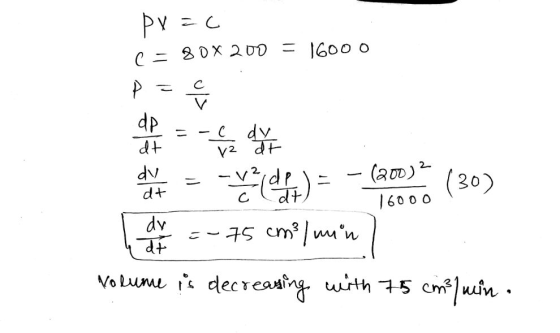
When air expands adiabatically (without gaining or losing heat), its pressure P and volume V are...
 When air expands adiabatically (without gaining or losing heat), its pressure P and volume V are related by the equation PV 1.4 = C, where is a constant. Suppose that at a certain instant the volume is 500 cm and the pressure is 80 kPa and is decreasing at a rate of 10 kPa/min. At what rate is the volume increasing at this instant? (Round your answer to the nearest whole number.) cm/min When air expands adiabatically (without gaining or...
A sample of gas at 760 torr and 2.8 L is compressed at constant temperature to...
A sample of gas at 760 torr and 2.8 L is compressed at constant temperature to the pressure at 3.5 atm. What is the final volume of the gas? My biggest problem with answering this question is the fact that I don't know what the "constant temperature" is..I know I'm using the combined gas law with formula: V2= p1v1/t1p2 * T2 and that p1=760 torr or 1 atm, v1=2.8L and p2=3.5 atm... Any help on this is very much appreciated.
Problem 1: Ideal Gas Law Problem 1. The ideal gas law states PV nRT where P,...
 Problem 1: Ideal Gas Law
Problem 1. The ideal gas law states PV nRT where P, V, and T are the pressure, volume and absolute temperature; n is the number of moles of gas; and R is the the ideal gas constant. Consider a 1-gallon canister of gas at a pressure of 1 atm. Answer the following questions: 1. How much energy would be needed to increase the pressure of the closed canister to 50 psi without changing its volume?...
Problem 1: Ideal Gas Law
Problem 1. The ideal gas law states PV nRT where P, V, and T are the pressure, volume and absolute temperature; n is the number of moles of gas; and R is the the ideal gas constant. Consider a 1-gallon canister of gas at a pressure of 1 atm. Answer the following questions: 1. How much energy would be needed to increase the pressure of the closed canister to 50 psi without changing its volume?...
Problem 7. (1 point) When air expands adiabatically (without gaining or losing heat), its pressure P...
 Problem 7. (1 point) When air expands adiabatically (without gaining or losing heat), its pressure P and volume V are related by the equation PV 14 = C where C is a constant. Suppose that at a certain instant the volume is 340 cm, and the pressure is 97 kPa (kPa = kiloPascals) and is decreasing at a rate of 15 kPa/minute. At what rate is the volume increasing at this instant? The volume is increasing at cm/min Problem 5....
*SHOW YOUR WORK* (Boyle's Law): 1. What is the final volume (in mL) or argon gas...
*SHOW YOUR WORK* (Boyle's Law): 1. What is the final volume (in mL) or argon gas is 50.0 mL at 705 torr is compressed to a pressure of 2.75 atm, at constant temperature? (Lewis Dot Structures): 2. Draw Lewis structures for the following molecules. Include partial charges, AXE designation, (example: AX2 E2), Electron-pair geometry and geometric-molecular shapes. Is it Polar or Non-Polar? CH2Cl2 SO2 3. Which of the following explains why the pressure of a gas increases when the temperature...
Please answer all parts of the question: a,b,c,d Ideal Gas Law The ideal gas law states...
 Please answer all parts of the question: a,b,c,d
Ideal Gas Law The ideal gas law states that PV = Nk T where P is the absolute pressure of a gas, V is the volume it occupies, N is the number of atoms and molecules in the gas, and T is its absolute temperature. The constant kg is called the Boltzmann constant and has the value kg = 1.38x10⁻²⁹ J/K. A very common expression of the ideal gas law uses the...
Please answer all parts of the question: a,b,c,d
Ideal Gas Law The ideal gas law states that PV = Nk T where P is the absolute pressure of a gas, V is the volume it occupies, N is the number of atoms and molecules in the gas, and T is its absolute temperature. The constant kg is called the Boltzmann constant and has the value kg = 1.38x10⁻²⁹ J/K. A very common expression of the ideal gas law uses the...
1. Which law does the equation PV=constant represent? a.Avogadro's Law b. Boyle's Law c. Charle's Law...
1. Which law does the equation PV=constant represent? a.Avogadro's Law b. Boyle's Law c. Charle's Law d. Graham's Law 2. Which postulate from the kinetic molecular theory is most relevant to explain rms speeds? a. the average kinetic energy is proportional to the temperature b. collisions of gas particles are elastic c. the volume of the particles is negligible comapred to the volume of the gas d. gas particles move in random straight line motion 3. Which of the follow...
MODEL 2: THE IDEAL GAS LAW Gases demonstrate all of the following properties V x 17p...
 MODEL 2: THE IDEAL GAS LAW Gases demonstrate all of the following properties V x 17p VT Boyle's Law Charles's law Avogadro's Law CRITICAL THINKING QUESTIONS GUM OV which of the following incorporates all the gas behavior observed VONTP V." V Decall that yox is the same thing as y e x in which is a proportionality constant Rewrite the correct expression from CTQ5 with an equals sign, using the symbol Ras the proportionality constant. 7. Starting with your expression...
 Processing Data for Part I: Boyle's Law Volume Pressure Constant, k (mL) (kPa) 105.2 119.4 15 139.5 17.5 166.1 T 205.8 232.6 232.4 1. What happens to the Pressure as the piston is pushed to lower the volume of the air inside the syringe? 2. What is the value of the constant k, in PV=k 3. How should the pressure be expressed so that the graph shows a straight line?
 1.) Charles Law states: volume and temperature are directly proportional when pressure remains constant 2.) Boyle's Law states:_pressure and volume are inversely related when temperature remains constant 3.) What is the relative humidity of inspired gas in a person's airway if the water vapor content breathed in is 30 mg/L at normal body temperature? 30/44x100=68% 4.) Calculate the FEV1%. FVC is 6L and FEV1 is 4L 4/6=0.67 or 67% 5.) True or False: Vital Capacity is Total Lung Capacity -...
 When air expands adiabatically (without gaining or losing heat), its pressure P and volume V are related by the equation PV 1.4 = C, where is a constant. Suppose that at a certain instant the volume is 500 cm and the pressure is 80 kPa and is decreasing at a rate of 10 kPa/min. At what rate is the volume increasing at this instant? (Round your answer to the nearest whole number.) cm/min When air expands adiabatically (without gaining or...
 Problem 1: Ideal Gas Law
Problem 1. The ideal gas law states PV nRT where P, V, and T are the pressure, volume and absolute temperature; n is the number of moles of gas; and R is the the ideal gas constant. Consider a 1-gallon canister of gas at a pressure of 1 atm. Answer the following questions: 1. How much energy would be needed to increase the pressure of the closed canister to 50 psi without changing its volume?...
Problem 1: Ideal Gas Law
Problem 1. The ideal gas law states PV nRT where P, V, and T are the pressure, volume and absolute temperature; n is the number of moles of gas; and R is the the ideal gas constant. Consider a 1-gallon canister of gas at a pressure of 1 atm. Answer the following questions: 1. How much energy would be needed to increase the pressure of the closed canister to 50 psi without changing its volume?...
 Problem 7. (1 point) When air expands adiabatically (without gaining or losing heat), its pressure P and volume V are related by the equation PV 14 = C where C is a constant. Suppose that at a certain instant the volume is 340 cm, and the pressure is 97 kPa (kPa = kiloPascals) and is decreasing at a rate of 15 kPa/minute. At what rate is the volume increasing at this instant? The volume is increasing at cm/min Problem 5....
 Please answer all parts of the question: a,b,c,d
Ideal Gas Law The ideal gas law states that PV = Nk T where P is the absolute pressure of a gas, V is the volume it occupies, N is the number of atoms and molecules in the gas, and T is its absolute temperature. The constant kg is called the Boltzmann constant and has the value kg = 1.38x10⁻²⁹ J/K. A very common expression of the ideal gas law uses the...
Please answer all parts of the question: a,b,c,d
Ideal Gas Law The ideal gas law states that PV = Nk T where P is the absolute pressure of a gas, V is the volume it occupies, N is the number of atoms and molecules in the gas, and T is its absolute temperature. The constant kg is called the Boltzmann constant and has the value kg = 1.38x10⁻²⁹ J/K. A very common expression of the ideal gas law uses the...
 MODEL 2: THE IDEAL GAS LAW Gases demonstrate all of the following properties V x 17p VT Boyle's Law Charles's law Avogadro's Law CRITICAL THINKING QUESTIONS GUM OV which of the following incorporates all the gas behavior observed VONTP V." V Decall that yox is the same thing as y e x in which is a proportionality constant Rewrite the correct expression from CTQ5 with an equals sign, using the symbol Ras the proportionality constant. 7. Starting with your expression...
Most questions answered within 3 hours.
-
Where is the error in this code sequence?
String s1 = "Hello";
String s2 = "ello";...
asked 11 months ago -
Financial data for Joel de Paris, Inc., for last year
follow:
Joel de Paris, Inc.
Balance...
asked 11 months ago -
Consider this reaction:
Al2(SO4)3 (aq)+ BaCl3
(aq) Al2Cl6 (aq)- +
3BaSO4(s) . What is the...
asked 11 months ago -
Suppose that Savneet is considering increasing her
recent random sample from 20 car rentals to 40...
asked 11 months ago -
Trucks arrive at an unloading terminal at an average rate of 120
per hour.
Trucks arrive...
asked 11 months ago -
Why are methanol and ethanol completely soluble in water while
octanol is not very little soluble....
asked 11 months ago -
A facilities manager at a university reads in a research report
that the mean amount of...
asked 11 months ago -
When the CuSO4 is rehydrated by adding water to the anhydrous
compound, is this an endothermic...
asked 11 months ago -
A ray of sunlight is passing from diamond into crown glass; the
angle of incidence is...
asked 11 months ago -
A block of mass 0.249 kg is placed on top of a light, vertical
spring of...
asked 11 months ago -
how do the kidneys compensate in the presences of acidosis
a) trigger hyperventilate
b) reserve acid...
asked 11 months ago -
Question 501 pts
The rental rate of capital to the firm increases. Which of the
following...
asked 11 months ago