
Homework Answers
Add Answer to:
12.3 (a) In which of these scenarios do you hear a higher pitched sound? Explain speed...
As you stand near a railroad track, a train passes by at a speed of 30.1...
 As you stand near a railroad track, a train passes by at a speed of 30.1 m/s while sounding its horn at a frequency of 218 Hz. What frequency do you hear as the train approaches you and what frequency while it recedes? Take the speed of sound in air to be 343 m/s. approaching: Hz receding:
As you stand near a railroad track, a train passes by at a speed of 34.1...
As you stand near a railroad track, a train passes by at a speed of 34.1 m/s while sounding its horn at a frequency of 216 Hz. What frequency do you hear as the train approaches you and what frequency while it recedes? Take the speed of sound in air to be 344 m/s. approaching_____Hz receding______Hz
You are driving a massive truck and become stuck at a railway crossing. Your truck completely...
 You are driving a massive truck and become stuck at a railway crossing. Your truck completely blocks the railway tracks, which extend in a straight line in both directions. You hear a train approaching when it toots its horn. (a) Let /1 be the intensity of the sound you hear from the horn initially, and 12-70 dB the sound when the train is at half the original distance. ) Calculate the intensity of the horn, 11, in dB. i) Calculate...
A car is moving towards you at a speed of 34m/s34m/s. You hear its horn at...
A car is moving towards you at a speed of 34m/s34m/s. You hear its horn at a frequency of 1200Hz1200Hz. What is the actual frequency of the horn, if the speed of sound on that day is 320m/s320m/s? True or False: The Doppler effect also occurs with waves other than sound waves. How will your perceived frequency change if you move away from a stationary source of sound? 1, frequency will be lower 2. Frequency doubled 3. Frequency tripled 4....
As you stand by the side of the road, a car approaches you at a constant...
As you stand by the side of the road, a car approaches you at a constant speed, sounding its horn, and you hear a frequency of 80.0 Hz. After the car goes by, you hear a frequency of 60.0 Hz. What is the speed of the car? Assume that he speed of sound in air is 343 m/s.
You are jogging along a straight road one day at constant velocity vo when you hear...
You are jogging along a straight road one day at constant velocity vo when you hear the siren of an ambulance approaching from behind. The frequency you hear is f1 = 756 Hz. You stop to take a break and the frequency you hear changes to f2 = 765 Hz. The ambulance then overtakes you and speeds away, and the frequency you hear is f3 = 680 Hz. The speed of sound in air is vsound = 340 m/s and...
1. A source moving with a speed 37 m/s, emits a sound wave with a frequency...
1. A source moving with a speed 37 m/s, emits a sound wave with a frequency f = 377 Hz. Determine the frequency detected by a stationary observer if the speed of sound is v = 343 m/s and the source is moving towards the observer. 2.A stationary source, emits a sound wave with a frequency f = 428 Hz. Determine the frequency detected by an observer moving towards the source with a speed v = 43 m/s, if the...
step by step pls In an attempt to get the last parking spot at West Edmonton...
 step by step pls
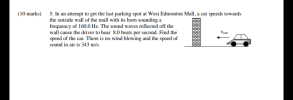
In an attempt to get the last parking spot at West Edmonton Mall, a car speeds towards the outside wall of the mall with its horn sounding a frequency of 160.0 Hz. The sound waves reflected off the wall cause the driver to hear 8.0 beats per second. Find the speed of the car. There is no wind blowing and the speed of sound in air is 343 m/s.
step by step pls
In an attempt to get the last parking spot at West Edmonton Mall, a car speeds towards the outside wall of the mall with its horn sounding a frequency of 160.0 Hz. The sound waves reflected off the wall cause the driver to hear 8.0 beats per second. Find the speed of the car. There is no wind blowing and the speed of sound in air is 343 m/s.
A commuter train blows its 200 Hz horn as it approaches a crossing. The speed of...
A commuter train blows its 200 Hz horn as it approaches a crossing. The speed of sound is 330 m/s. (a) An observer waiting at the crossing receives a frequency of 210 Hz. What is the speed of the train (in m/s)? (b) What frequency (in Hz) does the observer receive as the train moves away?
a train moving at a speed of 60 km/h sounds its whistle pitch to a frequency...
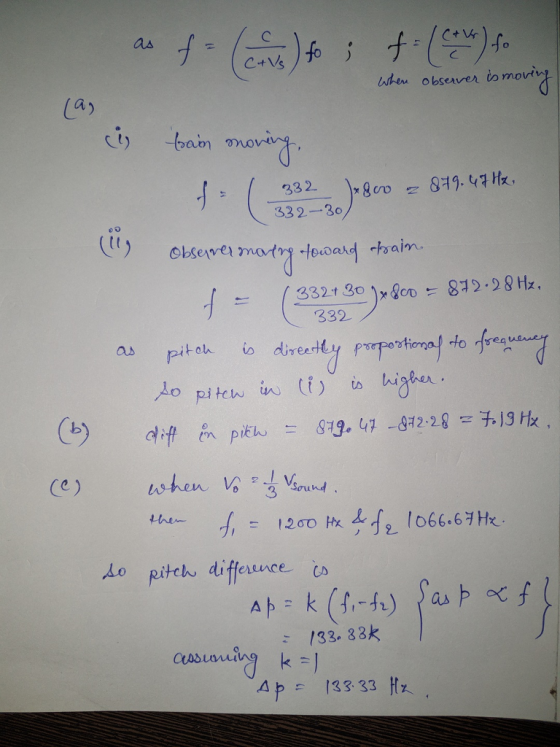
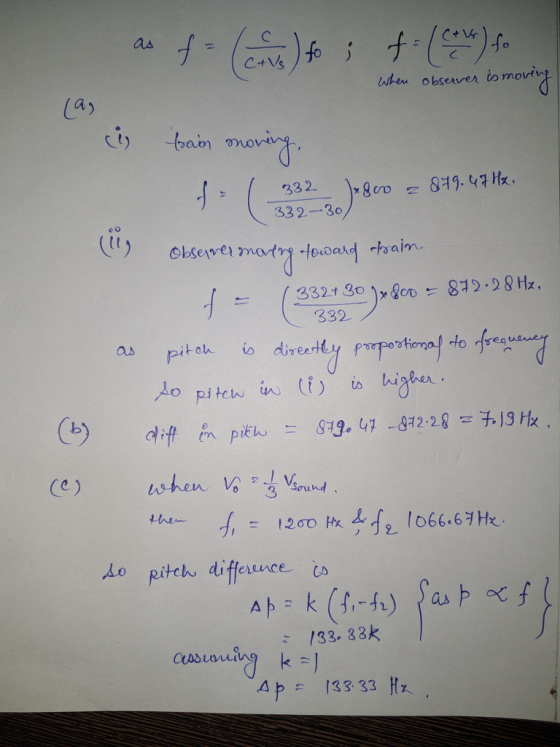
a train moving at a speed of 60 km/h sounds its whistle pitch to a frequency of 500 Hz. What frequency would be heard by an observer on the ground (i) ahead of the train (ii) behind the train. take the speed of sound as 332 m/s
 As you stand near a railroad track, a train passes by at a speed of 30.1 m/s while sounding its horn at a frequency of 218 Hz. What frequency do you hear as the train approaches you and what frequency while it recedes? Take the speed of sound in air to be 343 m/s. approaching: Hz receding:
 You are driving a massive truck and become stuck at a railway crossing. Your truck completely blocks the railway tracks, which extend in a straight line in both directions. You hear a train approaching when it toots its horn. (a) Let /1 be the intensity of the sound you hear from the horn initially, and 12-70 dB the sound when the train is at half the original distance. ) Calculate the intensity of the horn, 11, in dB. i) Calculate...
 step by step pls
In an attempt to get the last parking spot at West Edmonton Mall, a car speeds towards the outside wall of the mall with its horn sounding a frequency of 160.0 Hz. The sound waves reflected off the wall cause the driver to hear 8.0 beats per second. Find the speed of the car. There is no wind blowing and the speed of sound in air is 343 m/s.
step by step pls
In an attempt to get the last parking spot at West Edmonton Mall, a car speeds towards the outside wall of the mall with its horn sounding a frequency of 160.0 Hz. The sound waves reflected off the wall cause the driver to hear 8.0 beats per second. Find the speed of the car. There is no wind blowing and the speed of sound in air is 343 m/s.
Most questions answered within 3 hours.
-
Where is the error in this code sequence?
String s1 = "Hello";
String s2 = "ello";...
asked 11 months ago -
Financial data for Joel de Paris, Inc., for last year
follow:
Joel de Paris, Inc.
Balance...
asked 11 months ago -
Consider this reaction:
Al2(SO4)3 (aq)+ BaCl3
(aq) Al2Cl6 (aq)- +
3BaSO4(s) . What is the...
asked 11 months ago -
Suppose that Savneet is considering increasing her
recent random sample from 20 car rentals to 40...
asked 11 months ago -
Trucks arrive at an unloading terminal at an average rate of 120
per hour.
Trucks arrive...
asked 11 months ago -
Why are methanol and ethanol completely soluble in water while
octanol is not very little soluble....
asked 11 months ago -
A facilities manager at a university reads in a research report
that the mean amount of...
asked 11 months ago -
When the CuSO4 is rehydrated by adding water to the anhydrous
compound, is this an endothermic...
asked 11 months ago -
A ray of sunlight is passing from diamond into crown glass; the
angle of incidence is...
asked 11 months ago -
A block of mass 0.249 kg is placed on top of a light, vertical
spring of...
asked 11 months ago -
how do the kidneys compensate in the presences of acidosis
a) trigger hyperventilate
b) reserve acid...
asked 11 months ago -
Question 501 pts
The rental rate of capital to the firm increases. Which of the
following...
asked 11 months ago