
Homework Answers
Add Answer to:
math help!
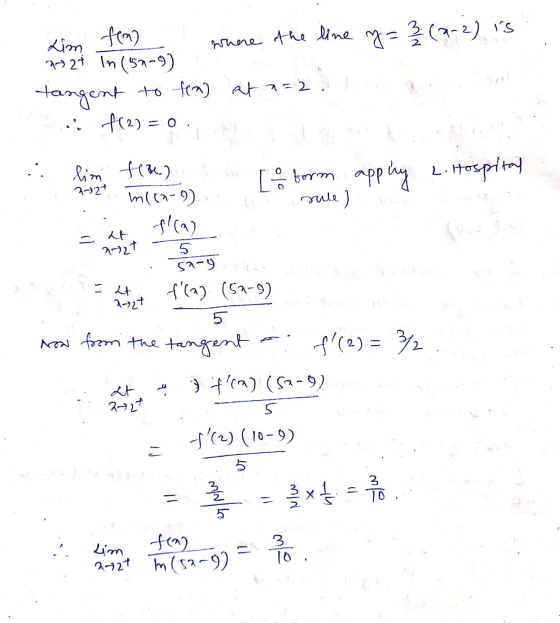
1. Evaluate each limit. If there are indeterminate forms, state them at each step...
Evaluate the limit lim x→5 x^2 −2x−15/ x^2 −25 Evaluate the limit lim x→∞ x^2 +...
Evaluate the limit lim x→5 x^2 −2x−15/ x^2 −25 Evaluate the limit lim x→∞ x^2 + x /x^5 c. Find all points on the graph of f(x) = 2x^3 −x where the tangent line is parallel to the line y = 149x + 7.
1. Express the limit as a derivative and evaluate. 17 lim 16+h-2 lim 2. Calculate y. tan x 1 + co...
 1. Express the limit as a derivative and evaluate. 17 lim 16+h-2 lim 2. Calculate y. tan x 1 + cos x y sin(cos x) y= sec(1 +x2) x cos y + sin 2y xy Use an Implicit Differentiation] 3. Find y" if x, y,6-1. [Use Implicit Differentiation] 4. Find an equation of the tangent to the curve at the given point. 121 12+ 1 [Use Implicit Differentiation] 4. Find the points on the ellipse x2 + tangent line has...
Thank you. - Part 1: Limit of a difference quotient Suppose f(x) = – 5. Evaluate...
 Thank you.
- Part 1: Limit of a difference quotient Suppose f(x) = – 5. Evaluate the limit by using algebra to simplify the difference quotient (in first answer box) and then evaluating the limit (in the second answer box). X - 2 (f(5 + h) – f(5) lim h0 Him ( 15 + ) - 109 ) = lim ( = lim h0 | Part 2: Interpreting the limit of a difference quotient - Part 1: The derivative at...
Thank you.
- Part 1: Limit of a difference quotient Suppose f(x) = – 5. Evaluate the limit by using algebra to simplify the difference quotient (in first answer box) and then evaluating the limit (in the second answer box). X - 2 (f(5 + h) – f(5) lim h0 Him ( 15 + ) - 109 ) = lim ( = lim h0 | Part 2: Interpreting the limit of a difference quotient - Part 1: The derivative at...
Part 1 Limit of a difference quotient 4 Evaluate the limit by using algebra to simplify...
 Part 1 Limit of a difference quotient 4 Evaluate the limit by using algebra to simplify the difference quotient (in first answer box) and then evaluating the limit (in the second answer box). Suppose (2) = - 2 (7+h)-(7) 1-10) lim A0 (0)-0 0 Part 2: Interpreting the limit of a difference quotient The limit of the difference quotient (your second answer) from Part 1 above is (select all that apply). A. the slope of the tangent line to the...
help with questions 1-4 Show all work - give exact simplified values for all answers For...
 help with questions 1-4
Show all work - give exact simplified values for all answers For questions 1 and 2, algebraically find the given limit, if it exists. (8 pts each) 1. 3x 2. 4x2 - 9x - 9 lim lim *4- x2 + 9 *23 2x3 - 7x2 +9 3. (8 pts) Differentiate the given function. Completely factor your final answer. y = 7e-*cos x 4. (9 pts) Find the equation of the tangent line to the graph of...
help with questions 1-4
Show all work - give exact simplified values for all answers For questions 1 and 2, algebraically find the given limit, if it exists. (8 pts each) 1. 3x 2. 4x2 - 9x - 9 lim lim *4- x2 + 9 *23 2x3 - 7x2 +9 3. (8 pts) Differentiate the given function. Completely factor your final answer. y = 7e-*cos x 4. (9 pts) Find the equation of the tangent line to the graph of...
Evaluate it (b) Evaluate the limit lim (Vlog(x)) 10+ Make sure you clearly explain/justify each step...
 Evaluate it
(b) Evaluate the limit lim (Vlog(x)) 10+ Make sure you clearly explain/justify each step in your working.
Evaluate it
(b) Evaluate the limit lim (Vlog(x)) 10+ Make sure you clearly explain/justify each step in your working.
Indeterminate limits are often difficult. Sometimes simplifying the expression allows us to evalu...
 Indeterminate limits are often difficult. Sometimes simplifying the expression allows us to evaluate the limit, but many times there isn't a good way of simplifying. L'Hospital's rule is used to more easily evaluate these indeterminate limits. While this rule doesn't always work or apply, it generally makes a limit easier to evaluate when it does apply. 1. List as many types of indeterminate limits as you can. 2. State l'Hospital's rule in your own words. (There are actually several versions...
1. Evaluate the limit. (Use symbolic notation and fractions where needed. Enter "DNE" if limit does...
1. Evaluate the limit. (Use symbolic notation and fractions where needed. Enter "DNE" if limit does not exist.) lim : x→10 (x−10)/(x2−100)= 2. Evaluate the limit. (Use symbolic notation and fractions where needed.) lim : x→−6 (x^2+13x+42)/(x+6)= 3. Evaluate the limit: lim : x→0 (cot7x)/(csc7x)= 4.Evaluate the limit. (Use symbolic notation and fractions where needed. Enter "DNE" in answer field if limit does not exist.) lim : x→1 [(7/(1−x)) −(14/(1−x^2))]=
3. (5 pts. each) Evaluate the following limits if they exist. If the limit does not...
 3. (5 pts. each) Evaluate the following limits if they exist. If the limit does not exist, then use the Two-Path Test to show that it does not exist. 5x²y (a) lim (x,y)=(0,0) **+3y2 (b) lim (x,y)-(1,-1) 1+xyz
hw help Question 1 For the following limit, choose the correct answer. x2 + 4x -...
 hw help
Question 1 For the following limit, choose the correct answer. x2 + 4x - 7 lim X 00 e 4x + 6 Does L'Hospitals Rule apply to this problem? If so, why? No. Yes. Indeterminate form olo Yes. Indeterminate form For the following limit, choose the correct answer. x² + 4x - 7 lim e 4x + 6 After applying L'Hospital's Rule once, what will you get? 2x + 4 lim O 4 e4x + 6 x² lim...
hw help
Question 1 For the following limit, choose the correct answer. x2 + 4x - 7 lim X 00 e 4x + 6 Does L'Hospitals Rule apply to this problem? If so, why? No. Yes. Indeterminate form olo Yes. Indeterminate form For the following limit, choose the correct answer. x² + 4x - 7 lim e 4x + 6 After applying L'Hospital's Rule once, what will you get? 2x + 4 lim O 4 e4x + 6 x² lim...
 1. Express the limit as a derivative and evaluate. 17 lim 16+h-2 lim 2. Calculate y. tan x 1 + cos x y sin(cos x) y= sec(1 +x2) x cos y + sin 2y xy Use an Implicit Differentiation] 3. Find y" if x, y,6-1. [Use Implicit Differentiation] 4. Find an equation of the tangent to the curve at the given point. 121 12+ 1 [Use Implicit Differentiation] 4. Find the points on the ellipse x2 + tangent line has...
 Thank you.
- Part 1: Limit of a difference quotient Suppose f(x) = – 5. Evaluate the limit by using algebra to simplify the difference quotient (in first answer box) and then evaluating the limit (in the second answer box). X - 2 (f(5 + h) – f(5) lim h0 Him ( 15 + ) - 109 ) = lim ( = lim h0 | Part 2: Interpreting the limit of a difference quotient - Part 1: The derivative at...
Thank you.
- Part 1: Limit of a difference quotient Suppose f(x) = – 5. Evaluate the limit by using algebra to simplify the difference quotient (in first answer box) and then evaluating the limit (in the second answer box). X - 2 (f(5 + h) – f(5) lim h0 Him ( 15 + ) - 109 ) = lim ( = lim h0 | Part 2: Interpreting the limit of a difference quotient - Part 1: The derivative at...
 Part 1 Limit of a difference quotient 4 Evaluate the limit by using algebra to simplify the difference quotient (in first answer box) and then evaluating the limit (in the second answer box). Suppose (2) = - 2 (7+h)-(7) 1-10) lim A0 (0)-0 0 Part 2: Interpreting the limit of a difference quotient The limit of the difference quotient (your second answer) from Part 1 above is (select all that apply). A. the slope of the tangent line to the...
 help with questions 1-4
Show all work - give exact simplified values for all answers For questions 1 and 2, algebraically find the given limit, if it exists. (8 pts each) 1. 3x 2. 4x2 - 9x - 9 lim lim *4- x2 + 9 *23 2x3 - 7x2 +9 3. (8 pts) Differentiate the given function. Completely factor your final answer. y = 7e-*cos x 4. (9 pts) Find the equation of the tangent line to the graph of...
help with questions 1-4
Show all work - give exact simplified values for all answers For questions 1 and 2, algebraically find the given limit, if it exists. (8 pts each) 1. 3x 2. 4x2 - 9x - 9 lim lim *4- x2 + 9 *23 2x3 - 7x2 +9 3. (8 pts) Differentiate the given function. Completely factor your final answer. y = 7e-*cos x 4. (9 pts) Find the equation of the tangent line to the graph of...
 Evaluate it
(b) Evaluate the limit lim (Vlog(x)) 10+ Make sure you clearly explain/justify each step in your working.
Evaluate it
(b) Evaluate the limit lim (Vlog(x)) 10+ Make sure you clearly explain/justify each step in your working.
 Indeterminate limits are often difficult. Sometimes simplifying the expression allows us to evaluate the limit, but many times there isn't a good way of simplifying. L'Hospital's rule is used to more easily evaluate these indeterminate limits. While this rule doesn't always work or apply, it generally makes a limit easier to evaluate when it does apply. 1. List as many types of indeterminate limits as you can. 2. State l'Hospital's rule in your own words. (There are actually several versions...
 3. (5 pts. each) Evaluate the following limits if they exist. If the limit does not exist, then use the Two-Path Test to show that it does not exist. 5x²y (a) lim (x,y)=(0,0) **+3y2 (b) lim (x,y)-(1,-1) 1+xyz
 hw help
Question 1 For the following limit, choose the correct answer. x2 + 4x - 7 lim X 00 e 4x + 6 Does L'Hospitals Rule apply to this problem? If so, why? No. Yes. Indeterminate form olo Yes. Indeterminate form For the following limit, choose the correct answer. x² + 4x - 7 lim e 4x + 6 After applying L'Hospital's Rule once, what will you get? 2x + 4 lim O 4 e4x + 6 x² lim...
hw help
Question 1 For the following limit, choose the correct answer. x2 + 4x - 7 lim X 00 e 4x + 6 Does L'Hospitals Rule apply to this problem? If so, why? No. Yes. Indeterminate form olo Yes. Indeterminate form For the following limit, choose the correct answer. x² + 4x - 7 lim e 4x + 6 After applying L'Hospital's Rule once, what will you get? 2x + 4 lim O 4 e4x + 6 x² lim...
Most questions answered within 3 hours.
-
Where is the error in this code sequence?
String s1 = "Hello";
String s2 = "ello";...
asked 10 months ago -
Financial data for Joel de Paris, Inc., for last year
follow:
Joel de Paris, Inc.
Balance...
asked 10 months ago -
Consider this reaction:
Al2(SO4)3 (aq)+ BaCl3
(aq) Al2Cl6 (aq)- +
3BaSO4(s) . What is the...
asked 10 months ago -
Suppose that Savneet is considering increasing her
recent random sample from 20 car rentals to 40...
asked 10 months ago -
Trucks arrive at an unloading terminal at an average rate of 120
per hour.
Trucks arrive...
asked 10 months ago -
Why are methanol and ethanol completely soluble in water while
octanol is not very little soluble....
asked 10 months ago -
A facilities manager at a university reads in a research report
that the mean amount of...
asked 10 months ago -
When the CuSO4 is rehydrated by adding water to the anhydrous
compound, is this an endothermic...
asked 10 months ago -
A ray of sunlight is passing from diamond into crown glass; the
angle of incidence is...
asked 10 months ago -
A block of mass 0.249 kg is placed on top of a light, vertical
spring of...
asked 10 months ago -
how do the kidneys compensate in the presences of acidosis
a) trigger hyperventilate
b) reserve acid...
asked 10 months ago -
Question 501 pts
The rental rate of capital to the firm increases. Which of the
following...
asked 10 months ago