
Homework Answers
In the short run ,if the aggregate demand decreases at all price levels but the aggregate supply stays the same ,then aggregatedemand curve shifts to the left , as a result, the employment level will be lower (because equilibrium output decreases) and the inflation rate will be lower (because equilibrium price decreases.)
Add Answer to:
QUESTION 40 Fill in the blanks below. Possible options are given in the parentheses after each...
QUESTION 3 Fill in the blanks below. Possible options are given in the parentheses after each...
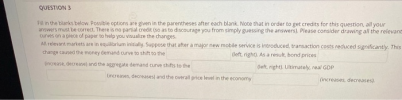 QUESTION 3 Fill in the blanks below. Possible options are given in the parentheses after each blank. Note that in order to get credits for this question, all your answers must be correct. There is no partial credit (so as to discourage you from simply guessing the answers). Please consider drawing all the relevant curves on a plece of paper to help you visualize the changes All relevant markets are in equilibrium initially. Suppose that after a major new mobile...
QUESTION 28 3 points Save Answer Fill in the blanks below. Possible options are given in...
 QUESTION 28 3 points Save Answer Fill in the blanks below. Possible options are given in the parentheses after each blank. Note that in order to get credits for this question, all your answers must be correct. There is no partial credit (so as to discourage you from simply guessing the answers). Please consider drawing all the relevant curves on a piece of paper to help you visualize the changes. Suppose all relevant markets are in equilibrium. Now, the Fed...
Fill in the blanks to make the following statements correct:(options are in the brackets) Beginning with...
Fill in the blanks to make the following statements correct:(options are in the brackets) Beginning with output equal to potential, suppose there is a drop in business confidence and investment falls. This is a____ (supply/demand) shock to the Canadian economy, which shifts the__ (AD/AS) curve to the___ (right/left) and creates ____ (a recessionary/ an inflationary) gap. Units costs will start to___(rise/fall) and the__ (AD/AS) curve will shift ____ (rightward/leftward) . Long-run equilibrium will (slowly) be restored at ___ (actual/potential)output and...
This Question: 1 pt 7 of 15 (0 complete) This Quiz: 15 pts possible The International...
 This Question: 1 pt 7 of 15 (0 complete) This Quiz: 15 pts possible The International Monetary Fund's World Economic Outlook database provides the data given in the table for India in 2004, 2005, and 2006 囲Click the icon to vew the table. The numbers in the table are consistent with O A. O B. O C. O D. increases in long-run and short-run aggregate supply and even larger decreases in aggregate demand decreases in long-run and short-run aggregate supply...
The options for the first fill in the blank are less or more. The options for...
 The options for the first fill
in the blank are less or more. The options for the second and 3rd
option are producing the same amount of shrimp and earrning
positive profit,entering the industry, producing more shrimp and
earning profit,exiting the industry,producing the shrimp and
running at a loss, or producing the same amount of shrimp and
running at a loss. The option for the last fill in the blank are
shrimp populations grow large enough to support more firms,...
The options for the first fill
in the blank are less or more. The options for the second and 3rd
option are producing the same amount of shrimp and earrning
positive profit,entering the industry, producing more shrimp and
earning profit,exiting the industry,producing the shrimp and
running at a loss, or producing the same amount of shrimp and
running at a loss. The option for the last fill in the blank are
shrimp populations grow large enough to support more firms,...
32. The rational expectations hypotheses implies that discretionary macroeconomic policy is: a. relatively effective in both...
32. The rational expectations hypotheses implies that discretionary macroeconomic policy is: a. relatively effective in both the short run and long run b. relatively effective in the short run but ineffective in the long run c. relatively ineffective in both the short run and long run d. effective in the long run since decision makers will continually make predictable, systematic errors 33. The modern view of the Phillips curve suggests that a. when inflation is less than anticipated, unemployment will...
Check And < Question 11 of 13 > The graphs below illustrate an initial equilibrium for...
 Check And < Question 11 of 13 > The graphs below illustrate an initial equilibrium for the economy. Suppose that investment spending falls. Use the graphs to show the new positions of aggregate demand (AD), short-run aggregate supply (SRAS), and long-run aggregate supply (LRAS) in both the short-run and the long-run, as well as the short-run and long-run equilibria resulting from this change. Then answer what happens to the price level and GDP. Short-run graph SRAS Short-run equilibrium Aggregate price...
We have discussed two models that describe the relationship between inflation and economic growth. Which of the followi...
We have discussed two models that describe the relationship between inflation and economic growth. Which of the following is a property of the New Keynesian Model but NOT the Real Business Cycle (RBC) Model? Monetary policy has no effect on long run economic growth Recessions can be caused by a fall in aggregate demand. Prices are fully flexible in both the short and long run. All the above are properties of the RBC model. None of the above are properties...
Help with graph, fill in the blanks and drop downs.Drop Downs:1. more/less2. higher/lower...
 Help with graph, fill in the blanks and drop downs.Drop Downs:1. more/less2. higher/lower3. (short-run change in output):no change/decrease/increase4. (long-run change in price level):same/lower/higher than/as initial expectations5. (long-run change in output):no change/decrease/increase4. The rational expectations model Suppose the U.S. economy is in equilibrium at a potential output of $10 trillion so that unemployment is at the natural rate. At the beginning of the year, the Federal Reserve announces that its monetary policy will aim to maintain output at potential output and sustain...
Economics: 1) Why is it possible to change real economic factors in the short run simply...
Economics: 1) Why is it possible to change real economic factors in the short run simply by printing and distributing more money? 2) Explain why a stable 5% inflation rate can be preferable to one that averages 4% but varies between 1-7% regularly. 3) Explain the difference between active and passive monetary policy. 4) Suppose the economy is in long-run equilibrium, with real GDP at $16 trillion and the unemployment rate at 5%, Now assume that the central bank unexpectedly...
 QUESTION 3 Fill in the blanks below. Possible options are given in the parentheses after each blank. Note that in order to get credits for this question, all your answers must be correct. There is no partial credit (so as to discourage you from simply guessing the answers). Please consider drawing all the relevant curves on a plece of paper to help you visualize the changes All relevant markets are in equilibrium initially. Suppose that after a major new mobile...
 QUESTION 28 3 points Save Answer Fill in the blanks below. Possible options are given in the parentheses after each blank. Note that in order to get credits for this question, all your answers must be correct. There is no partial credit (so as to discourage you from simply guessing the answers). Please consider drawing all the relevant curves on a piece of paper to help you visualize the changes. Suppose all relevant markets are in equilibrium. Now, the Fed...
 This Question: 1 pt 7 of 15 (0 complete) This Quiz: 15 pts possible The International Monetary Fund's World Economic Outlook database provides the data given in the table for India in 2004, 2005, and 2006 囲Click the icon to vew the table. The numbers in the table are consistent with O A. O B. O C. O D. increases in long-run and short-run aggregate supply and even larger decreases in aggregate demand decreases in long-run and short-run aggregate supply...
 The options for the first fill
in the blank are less or more. The options for the second and 3rd
option are producing the same amount of shrimp and earrning
positive profit,entering the industry, producing more shrimp and
earning profit,exiting the industry,producing the shrimp and
running at a loss, or producing the same amount of shrimp and
running at a loss. The option for the last fill in the blank are
shrimp populations grow large enough to support more firms,...
The options for the first fill
in the blank are less or more. The options for the second and 3rd
option are producing the same amount of shrimp and earrning
positive profit,entering the industry, producing more shrimp and
earning profit,exiting the industry,producing the shrimp and
running at a loss, or producing the same amount of shrimp and
running at a loss. The option for the last fill in the blank are
shrimp populations grow large enough to support more firms,...
 Check And < Question 11 of 13 > The graphs below illustrate an initial equilibrium for the economy. Suppose that investment spending falls. Use the graphs to show the new positions of aggregate demand (AD), short-run aggregate supply (SRAS), and long-run aggregate supply (LRAS) in both the short-run and the long-run, as well as the short-run and long-run equilibria resulting from this change. Then answer what happens to the price level and GDP. Short-run graph SRAS Short-run equilibrium Aggregate price...
 Help with graph, fill in the blanks and drop downs.Drop Downs:1. more/less2. higher/lower3. (short-run change in output):no change/decrease/increase4. (long-run change in price level):same/lower/higher than/as initial expectations5. (long-run change in output):no change/decrease/increase4. The rational expectations model Suppose the U.S. economy is in equilibrium at a potential output of $10 trillion so that unemployment is at the natural rate. At the beginning of the year, the Federal Reserve announces that its monetary policy will aim to maintain output at potential output and sustain...
Most questions answered within 3 hours.
-
Where is the error in this code sequence?
String s1 = "Hello";
String s2 = "ello";...
asked 10 months ago -
Financial data for Joel de Paris, Inc., for last year
follow:
Joel de Paris, Inc.
Balance...
asked 10 months ago -
Consider this reaction:
Al2(SO4)3 (aq)+ BaCl3
(aq) Al2Cl6 (aq)- +
3BaSO4(s) . What is the...
asked 10 months ago -
Suppose that Savneet is considering increasing her
recent random sample from 20 car rentals to 40...
asked 10 months ago -
Trucks arrive at an unloading terminal at an average rate of 120
per hour.
Trucks arrive...
asked 10 months ago -
Why are methanol and ethanol completely soluble in water while
octanol is not very little soluble....
asked 10 months ago -
A facilities manager at a university reads in a research report
that the mean amount of...
asked 10 months ago -
When the CuSO4 is rehydrated by adding water to the anhydrous
compound, is this an endothermic...
asked 10 months ago -
A ray of sunlight is passing from diamond into crown glass; the
angle of incidence is...
asked 10 months ago -
A block of mass 0.249 kg is placed on top of a light, vertical
spring of...
asked 10 months ago -
how do the kidneys compensate in the presences of acidosis
a) trigger hyperventilate
b) reserve acid...
asked 10 months ago -
Question 501 pts
The rental rate of capital to the firm increases. Which of the
following...
asked 10 months ago