
Homework Answers
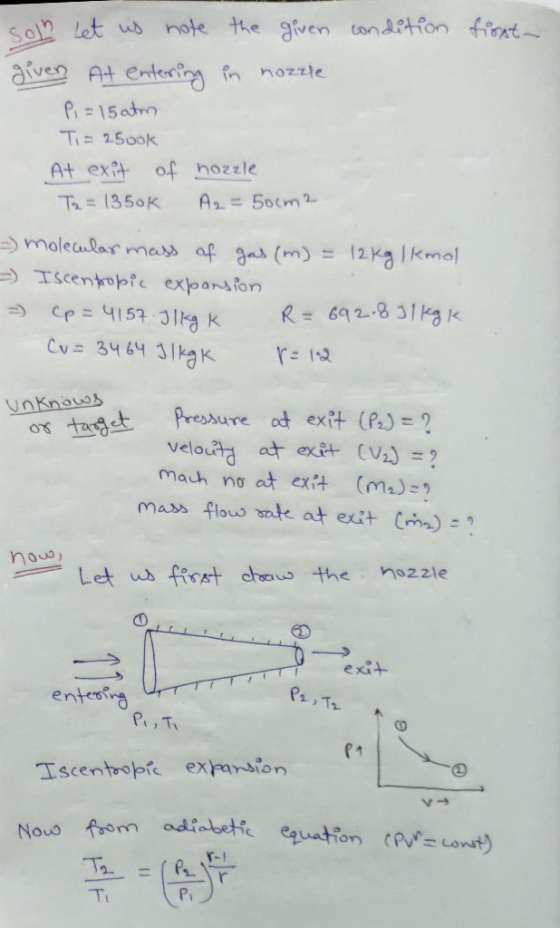

 feel free to ask any
query...
feel free to ask any
query...
Thank you!!!!
Add Answer to:
Consider the flow through a rocket engine nozzle. In the combustion chamber, the gas which results...
estion 9- Ramjet Operation (15 Points): You are asked to calculate the operational parameters of an ideal ramjet engine. flame holder combustion zone Me inlet diffuser nozzle e- Nozzle exit throa...
 estion 9- Ramjet Operation (15 Points): You are asked to calculate the operational parameters of an ideal ramjet engine. flame holder combustion zone Me inlet diffuser nozzle e- Nozzle exit throat-M-1 Normal shock wave Ramjet 3-Burner exit 2- Diffuser exit 00 K. Flight altitude is 10 knm Flight Mach number is 2.0. Burner exit temperature is 17 Make the following assumptions: Assume that the Mach number in the combustor is zero (stations 2 and 3) Ignore pressure losses in the...
Air flows through a converging-diverging nozzle/diffuser. Assuming isentropic flow, air as an ideal gas, and constant...
 Air flows through a converging-diverging nozzle/diffuser. Assuming isentropic flow, air as an ideal gas, and constant specific heats determine the state at several locations the system. Solve using equations rather than with the tables. Note: The specific heat ratio and gas constant for air are given as k=1.4 and R=0.287 kJ/kg-K respectively. --Given Values-- Inlet Temperature: T1 (K) = 353 Inlet pressure: Pl (kPa) = 546 Inlet Velocity: V1 (m/s) = 61 Area at nozzle inlet: A1 (cm^2) = 7.24...
Air flows through a converging-diverging nozzle/diffuser. Assuming isentropic flow, air as an ideal gas, and constant...
 Air flows through a converging-diverging nozzle/diffuser. Assuming isentropic flow, air as an ideal gas, and constant specific heats determine the state at several locations in the system. Note: The specific heat ratio and gas constant for air are given as k=1.4 and R=0.287 kJ/kg-K respectively. --Given Values-- Inlet Temperature: T1 (K) = 360 Inlet pressure: P1 (kPa) = 583 Inlet Velocity: V1 (m/s) = 105 Area at inlet (cm^2) = 8.2 Mach number at the exit = 1.86 a) Determine...
Air flows through a converging-diverging nozzle/diffuser. Assuming isentropic flow, air as an ideal gas, and constant...
Air flows through a converging-diverging nozzle/diffuser. Assuming isentropic flow, air as an ideal gas, and constant specific heats determine the state at several locations in the system. Solve using equations rather than with the tables. Note: The specific heat ratio and gas constant for air are given as k=1.4 and R=0.287 kJ/kg-K respectively. --Given Values-- Inlet Temperature: T1 (K) = 321 Inlet pressure: P1 (kPa) = 588 Inlet Velocity: V1 (m/s) = 97 Area at nozzle inlet: A1 (cm^2) =...
Air flows through a converging-diverging nozzle/diffuser. Assuming isentropic flow, air as an ideal gas, and constant...
 Air flows through a converging-diverging nozzle/diffuser. Assuming isentropic flow, air as an ideal gas, and constant specific heats determine the state at several locations in the system. Solve using equations rather than with the tables. Note: The specific heat ratio and gas constant for air are given as k=1.4 and R=0.287 kJ/kg-K respectively. --Given Values-- Inlet Temperature: T1 (K) 370 Inlet pressure: P1 (kPa) = 576 Inlet Velocity: V1 (m/s) - 106 Area at nozzle inlet: A1 (cm^2) = 8.32...
Air flows through a converging-diverging nozzle/diffuser. Assuming isentropic flow, air as an ideal gas, and constant...
 Air flows through a converging-diverging nozzle/diffuser. Assuming isentropic flow, air as an ideal gas, and constant specific heats determine the state at several locations in the system. Note: The specific heat ratio and gas constant for air are given as k=1.4 and R=0.287 kJ/kg-K respectively. --Given Values-- Inlet Temperature: T1 (K) = 338 Inlet pressure: P1 (kPa) = 555 Inlet Velocity: V1 (m/s) = 121 Area at inlet (cm^2) = 9 Mach number at the exit = 1.56 a) Determine...
In a low-speed rocket engine, a gas of density p flows out of a combustion chamber,...
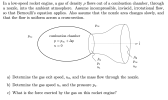 In a low-speed rocket engine, a gas of density p flows out of a combustion chamber, through a nozzle, into the ambient atmosphere. Assume incompressible, inviscid, irrotational flow, so that Bernoulli's equation applies. Also assume that the nozzle area changes slowly, and that the flow is uniform across a cross-section. Poo Poo combustion chamber p= Poo + Ap u= 0 --- î poo U2 a) Determine the gas exit speed, U2, and the mass flow through the nozzle. c) What...
Air flows through a converging-diverging nozzle/diffuser. Assuming isentropic flow, air as an ideal gas, and constant...
 Air flows through a converging-diverging nozzle/diffuser. Assuming isentropic flow, air as an ideal gas, and constant specific heats determine the state at several locations in the system. Solve using equations rather than with the tables. Note: The specific heat ratio and gas constant for air are given as k=1.4 and R=0.287 kJ/kg-K respectively. --Given Values-- Inlet Temperature: T1 (K) = 348 Inlet pressure: P1 (kPa) = 544 Inlet Velocity: V1 (m/s) = 122 Area at nozzle inlet: A1 (cm^2) =...
Poblem Comergini sentropie regim (no shock waves) Consider isentropic flow through a converging-diverging nozzle. The exit...
 Poblem Comergini sentropie regim (no shock waves) Consider isentropic flow through a converging-diverging nozzle. The exit area of the nozzle is , and the throat area of the nozzle is . The air entering the nozzle has stagnation conditions: , and Use Figure D.1 or Table D (a) Calculate the mass flow rate for choked flow (that is, sonic flow at the throat). Hints: See Section 11.7, use Figure D.1 to find density and temperature at M 1 (throat), find...
Air flows through a converging-diverging nozzle/diffuser. Assuming isentropic flow, air as an ideal gas, and constant...
 Air flows through a converging-diverging nozzle/diffuser. Assuming isentropic flow, air as an ideal gas, and constant specific heats determine the state at several locations in the system. So equations rather than with the tables. Note: The specific heat ratio and gas constant for air are given as k=1.4 and R=0.287 kJ/kg-K respectively. --Given Values-- Inlet Temperature: T1 (K) = 348 Inlet pressure: P1 (kPa) = 544 Inlet Velocity: V1 (m/s) = 122 Area at nozzle inlet: A1 (cm^2) = 8.81...
 estion 9- Ramjet Operation (15 Points): You are asked to calculate the operational parameters of an ideal ramjet engine. flame holder combustion zone Me inlet diffuser nozzle e- Nozzle exit throat-M-1 Normal shock wave Ramjet 3-Burner exit 2- Diffuser exit 00 K. Flight altitude is 10 knm Flight Mach number is 2.0. Burner exit temperature is 17 Make the following assumptions: Assume that the Mach number in the combustor is zero (stations 2 and 3) Ignore pressure losses in the...
 Air flows through a converging-diverging nozzle/diffuser. Assuming isentropic flow, air as an ideal gas, and constant specific heats determine the state at several locations the system. Solve using equations rather than with the tables. Note: The specific heat ratio and gas constant for air are given as k=1.4 and R=0.287 kJ/kg-K respectively. --Given Values-- Inlet Temperature: T1 (K) = 353 Inlet pressure: Pl (kPa) = 546 Inlet Velocity: V1 (m/s) = 61 Area at nozzle inlet: A1 (cm^2) = 7.24...
 Air flows through a converging-diverging nozzle/diffuser. Assuming isentropic flow, air as an ideal gas, and constant specific heats determine the state at several locations in the system. Note: The specific heat ratio and gas constant for air are given as k=1.4 and R=0.287 kJ/kg-K respectively. --Given Values-- Inlet Temperature: T1 (K) = 360 Inlet pressure: P1 (kPa) = 583 Inlet Velocity: V1 (m/s) = 105 Area at inlet (cm^2) = 8.2 Mach number at the exit = 1.86 a) Determine...
 Air flows through a converging-diverging nozzle/diffuser. Assuming isentropic flow, air as an ideal gas, and constant specific heats determine the state at several locations in the system. Solve using equations rather than with the tables. Note: The specific heat ratio and gas constant for air are given as k=1.4 and R=0.287 kJ/kg-K respectively. --Given Values-- Inlet Temperature: T1 (K) 370 Inlet pressure: P1 (kPa) = 576 Inlet Velocity: V1 (m/s) - 106 Area at nozzle inlet: A1 (cm^2) = 8.32...
 Air flows through a converging-diverging nozzle/diffuser. Assuming isentropic flow, air as an ideal gas, and constant specific heats determine the state at several locations in the system. Note: The specific heat ratio and gas constant for air are given as k=1.4 and R=0.287 kJ/kg-K respectively. --Given Values-- Inlet Temperature: T1 (K) = 338 Inlet pressure: P1 (kPa) = 555 Inlet Velocity: V1 (m/s) = 121 Area at inlet (cm^2) = 9 Mach number at the exit = 1.56 a) Determine...
 In a low-speed rocket engine, a gas of density p flows out of a combustion chamber, through a nozzle, into the ambient atmosphere. Assume incompressible, inviscid, irrotational flow, so that Bernoulli's equation applies. Also assume that the nozzle area changes slowly, and that the flow is uniform across a cross-section. Poo Poo combustion chamber p= Poo + Ap u= 0 --- î poo U2 a) Determine the gas exit speed, U2, and the mass flow through the nozzle. c) What...
 Air flows through a converging-diverging nozzle/diffuser. Assuming isentropic flow, air as an ideal gas, and constant specific heats determine the state at several locations in the system. Solve using equations rather than with the tables. Note: The specific heat ratio and gas constant for air are given as k=1.4 and R=0.287 kJ/kg-K respectively. --Given Values-- Inlet Temperature: T1 (K) = 348 Inlet pressure: P1 (kPa) = 544 Inlet Velocity: V1 (m/s) = 122 Area at nozzle inlet: A1 (cm^2) =...
 Poblem Comergini sentropie regim (no shock waves) Consider isentropic flow through a converging-diverging nozzle. The exit area of the nozzle is , and the throat area of the nozzle is . The air entering the nozzle has stagnation conditions: , and Use Figure D.1 or Table D (a) Calculate the mass flow rate for choked flow (that is, sonic flow at the throat). Hints: See Section 11.7, use Figure D.1 to find density and temperature at M 1 (throat), find...
 Air flows through a converging-diverging nozzle/diffuser. Assuming isentropic flow, air as an ideal gas, and constant specific heats determine the state at several locations in the system. So equations rather than with the tables. Note: The specific heat ratio and gas constant for air are given as k=1.4 and R=0.287 kJ/kg-K respectively. --Given Values-- Inlet Temperature: T1 (K) = 348 Inlet pressure: P1 (kPa) = 544 Inlet Velocity: V1 (m/s) = 122 Area at nozzle inlet: A1 (cm^2) = 8.81...
Most questions answered within 3 hours.
-
Where is the error in this code sequence?
String s1 = "Hello";
String s2 = "ello";...
asked 11 months ago -
Financial data for Joel de Paris, Inc., for last year
follow:
Joel de Paris, Inc.
Balance...
asked 11 months ago -
Consider this reaction:
Al2(SO4)3 (aq)+ BaCl3
(aq) Al2Cl6 (aq)- +
3BaSO4(s) . What is the...
asked 11 months ago -
Suppose that Savneet is considering increasing her
recent random sample from 20 car rentals to 40...
asked 11 months ago -
Trucks arrive at an unloading terminal at an average rate of 120
per hour.
Trucks arrive...
asked 11 months ago -
Why are methanol and ethanol completely soluble in water while
octanol is not very little soluble....
asked 11 months ago -
A facilities manager at a university reads in a research report
that the mean amount of...
asked 11 months ago -
When the CuSO4 is rehydrated by adding water to the anhydrous
compound, is this an endothermic...
asked 11 months ago -
A ray of sunlight is passing from diamond into crown glass; the
angle of incidence is...
asked 11 months ago -
A block of mass 0.249 kg is placed on top of a light, vertical
spring of...
asked 11 months ago -
how do the kidneys compensate in the presences of acidosis
a) trigger hyperventilate
b) reserve acid...
asked 11 months ago -
Question 501 pts
The rental rate of capital to the firm increases. Which of the
following...
asked 11 months ago