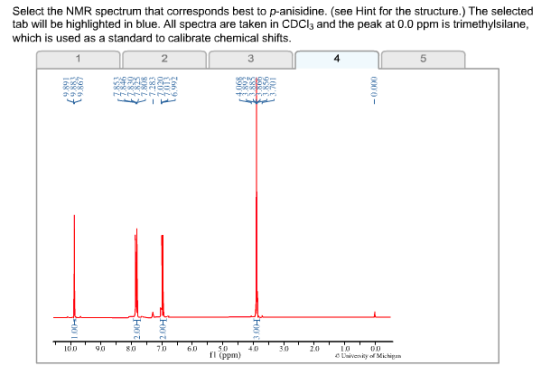
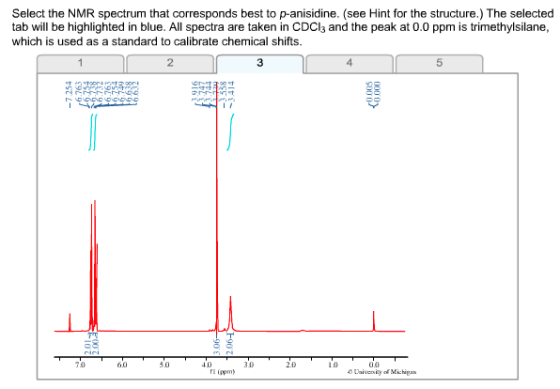
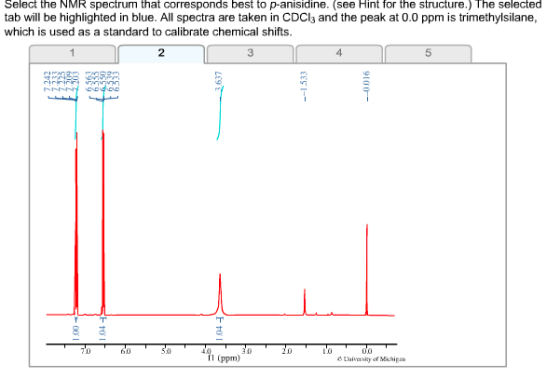
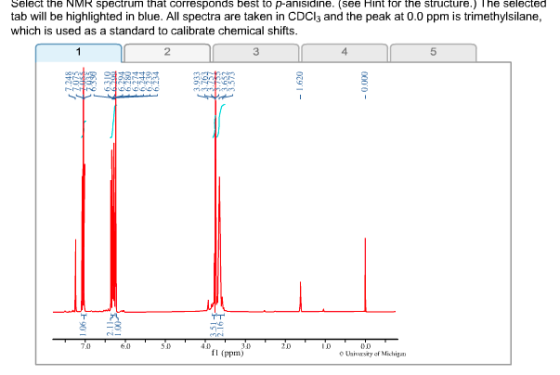
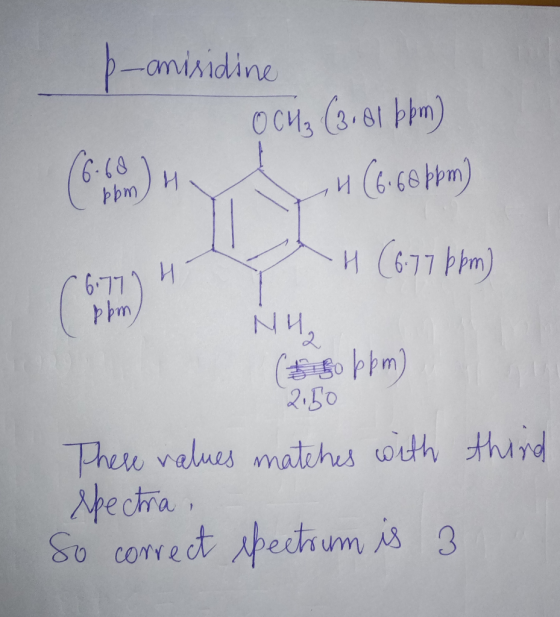
Select the NMR spectrum that corresponds best to p-anisidine. (see Hint for the structure.) The selected tab will be highlighted in blue. All spectra are taken in CDCl3 and the peak at 0.0 ppm is trimethylsilane, which is used as a standard to calibrate chemical shifts.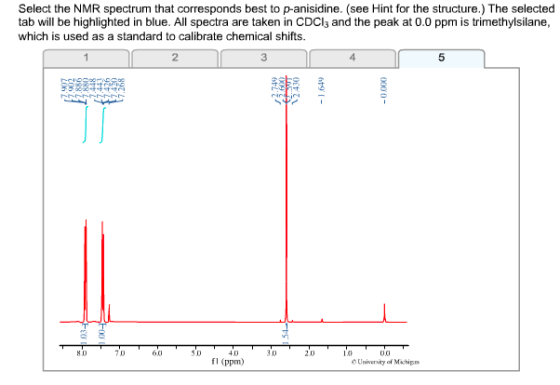
Homework Answers
Add Answer to:
Select the NMR spectrum that corresponds best to p-anisidine. (see Hint for the structure.) The selected...
Select the NMR spectrum that corresponds best to m-anisidine
 Select the NMR spectrum that corresponds best to m-anisidine
Select the IR spectrum that corresponds best to 3-hydroxy-2-butanone. (See the Hint for the structure.) Key...
 Select the IR spectrum that corresponds best to
3-hydroxy-2-butanone. (See the Hint for the structure.) Key
absorptions are marked on the spectra.
Select the IR spectrum that corresponds best to 3-hydroxy-2-butanone. (See the Hint for the structure. ) Key absorptions are marked on the spectra. Select the IR spectrum that corresponds best to 3-hydroxy-2-butanone. (See the Hint for the structure. ) Key absorptions are marked on the spectra. Wavenumber (cm-1) Select the IR spectrum that corresponds best to 3-hydroxy-2-butanone. (See...
Select the IR spectrum that corresponds best to
3-hydroxy-2-butanone. (See the Hint for the structure.) Key
absorptions are marked on the spectra.
Select the IR spectrum that corresponds best to 3-hydroxy-2-butanone. (See the Hint for the structure. ) Key absorptions are marked on the spectra. Select the IR spectrum that corresponds best to 3-hydroxy-2-butanone. (See the Hint for the structure. ) Key absorptions are marked on the spectra. Wavenumber (cm-1) Select the IR spectrum that corresponds best to 3-hydroxy-2-butanone. (See...
Select the IR spectrum that corresponds best to 3-hydroxy-2-butanone. (See the Hint for the structure.) Key...
 Select the IR spectrum that corresponds best to
3-hydroxy-2-butanone. (See the Hint for the structure.) Key
absorptions are marked on the spectra.
Select the IR spectrum that corresponds best to 3-hydroxy-2-butanone. (See the Hint for the structure.) Key absorptions are marked on the spectra. 0.9 1 0.8 0.7 C 0.6 0.5 0.4 0.3 3180 0.2 1660 1630 0.1 3360 1000 2000 4000 3000 Wavenumber (cm
Select the IR spectrum that corresponds best to
3-hydroxy-2-butanone. (See the Hint for the structure.) Key
absorptions are marked on the spectra.
Select the IR spectrum that corresponds best to 3-hydroxy-2-butanone. (See the Hint for the structure.) Key absorptions are marked on the spectra. 0.9 1 0.8 0.7 C 0.6 0.5 0.4 0.3 3180 0.2 1660 1630 0.1 3360 1000 2000 4000 3000 Wavenumber (cm
Draw the structure of the compound C6H4Br2 that might exhibit the 13C-NMR spectrum below. Impurity peaks...
 Draw the structure of the compound
C6H4Br2 that
might exhibit the 13C-NMR spectrum below. Impurity peaks
are omitted from the peak list. The triplet at 77 ppm is
CDCl3.
Draw the structure of the compound CGH_Br2 that might exhibit the 13 C-NMR spectrum below. Impurity peaks are omitted from the peak list. The triplet at 77 ppm is CDC12. Flash Installation and Troubleshooting Used with permission from Aldrich Chemical Co., Inc. Solvent CDC13 Shift 134.1 131.0 130.1 122.9 Chemical shift:...
Draw the structure of the compound
C6H4Br2 that
might exhibit the 13C-NMR spectrum below. Impurity peaks
are omitted from the peak list. The triplet at 77 ppm is
CDCl3.
Draw the structure of the compound CGH_Br2 that might exhibit the 13 C-NMR spectrum below. Impurity peaks are omitted from the peak list. The triplet at 77 ppm is CDC12. Flash Installation and Troubleshooting Used with permission from Aldrich Chemical Co., Inc. Solvent CDC13 Shift 134.1 131.0 130.1 122.9 Chemical shift:...
The 1H NMR spectra corresponds to an alcohol with the molecular formula C5H12O. Deduce the structure...
 The 1H NMR spectra corresponds to an alcohol with the molecular
formula C5H12O. Deduce the structure from the spectra.
com/Ibiscms/mod/ibis view.php?id 3077567 O 10/17/2016 08:30 AM A 0/100 Gradebook Print Calculator Periodic Table Question 2 of 5 Map Organic Chemistry w.H. Freeman and Company presented by Sapling Learning The H NMR spectra corresponds to an alcohol with the molecular formula CsH2O.Deduce the structure from the spectra. H NMR 6 H 3H 1 H 2 H 09 0.8 0.7 15 1,4...
The 1H NMR spectra corresponds to an alcohol with the molecular
formula C5H12O. Deduce the structure from the spectra.
com/Ibiscms/mod/ibis view.php?id 3077567 O 10/17/2016 08:30 AM A 0/100 Gradebook Print Calculator Periodic Table Question 2 of 5 Map Organic Chemistry w.H. Freeman and Company presented by Sapling Learning The H NMR spectra corresponds to an alcohol with the molecular formula CsH2O.Deduce the structure from the spectra. H NMR 6 H 3H 1 H 2 H 09 0.8 0.7 15 1,4...
Give the structure that corresponds to the following molecular formula and 1H NMR spectrum: Organic Chemistry...
 Give the structure that corresponds to the following molecular
formula and 1H NMR spectrum:
Organic Chemistry Roberts & Company Publishers presented by Sapling Leaming Map Mare Loudon Give the structure that corresponds to the following molecular formula and 'H NMR spectrum chemical shift, Hz 2400 2100 1800 1500 1200 300 C7Hso click to edit 11238 CTH160 7473 1275 H3 CH3 H3 disappears afte D2O shake chemical shift, ppm(Ö) The magenta numbers in the spectrum are the relative integrals in arbitrary...
Give the structure that corresponds to the following molecular
formula and 1H NMR spectrum:
Organic Chemistry Roberts & Company Publishers presented by Sapling Leaming Map Mare Loudon Give the structure that corresponds to the following molecular formula and 'H NMR spectrum chemical shift, Hz 2400 2100 1800 1500 1200 300 C7Hso click to edit 11238 CTH160 7473 1275 H3 CH3 H3 disappears afte D2O shake chemical shift, ppm(Ö) The magenta numbers in the spectrum are the relative integrals in arbitrary...
Draw the structure of the compound C10H12O that exhibits the 13C-NMR spectrum and DEPT data below. Impurity peaks are omitted from the DEPT data list. The triplet at 77 ppm is CDCl3. Draw the structu...
 Draw the structure of the compound
C10H12O that exhibits the
13C-NMR spectrum and DEPT data below. Impurity peaks are
omitted from the DEPT data list. The triplet at 77 ppm is
CDCl3.
Draw the structure of the compound C10H120 that exhibits the 13C-NMR spectrum and DEPT data below. Impurity peaks are omitted from the DEPT data list. The triplet at 77 ppm is CDCl Used with p n from Aldrich Chemical Co., Inc. Solvent CDCls Shift DEPT 90 DEPT 135...
Draw the structure of the compound
C10H12O that exhibits the
13C-NMR spectrum and DEPT data below. Impurity peaks are
omitted from the DEPT data list. The triplet at 77 ppm is
CDCl3.
Draw the structure of the compound C10H120 that exhibits the 13C-NMR spectrum and DEPT data below. Impurity peaks are omitted from the DEPT data list. The triplet at 77 ppm is CDCl Used with p n from Aldrich Chemical Co., Inc. Solvent CDCls Shift DEPT 90 DEPT 135...
The following involves a question related to a spectrum of two samples. I am confused as...
 The following involves a question related to a spectrum of two
samples. I am confused as to how I am supposed to take the H-NMR
spectrum and determine the mass of the specified compound.
Thanks
2) Shown below are two spectra of N-phenylbenzylamine in CDCl3. In spectrum B, 2.1 mg of p- dimethoxybenzene has been added to the sample. The resonances of p-dimethoxybenzene have chemical shifts of 6.9 and 3.8 ppm a) The peak integration represents area under the peaks....
The following involves a question related to a spectrum of two
samples. I am confused as to how I am supposed to take the H-NMR
spectrum and determine the mass of the specified compound.
Thanks
2) Shown below are two spectra of N-phenylbenzylamine in CDCl3. In spectrum B, 2.1 mg of p- dimethoxybenzene has been added to the sample. The resonances of p-dimethoxybenzene have chemical shifts of 6.9 and 3.8 ppm a) The peak integration represents area under the peaks....
please answer all 6 points breakout. (a-f) 13. (16 pts) Compound P was a pleasant smelling,...
 please answer all 6 points breakout. (a-f)
13. (16 pts) Compound P was a pleasant smelling, colorless liquid with a boiling point of 218 degrees C. It had no effect on either red or blue litmus paper. A mass spectrum of Compound showed a molecular ion at 134 with a base peak at 105. When an ir spectrum was taken as a liquid film of Compound P, an intense peak was observed at 1683 cm. Both proton nmr and carbon-13...
please answer all 6 points breakout. (a-f)
13. (16 pts) Compound P was a pleasant smelling, colorless liquid with a boiling point of 218 degrees C. It had no effect on either red or blue litmus paper. A mass spectrum of Compound showed a molecular ion at 134 with a base peak at 105. When an ir spectrum was taken as a liquid film of Compound P, an intense peak was observed at 1683 cm. Both proton nmr and carbon-13...
NMR for CH3OC(CH2OCH3)3 Construct a simulated 1H NMR spectrum, Including proton Integrations, for CH3OC(CH2OCH3)3 (see Hint)....
 NMR for CH3OC(CH2OCH3)3
Construct a simulated 1H NMR spectrum, Including proton Integrations, for CH3OC(CH2OCH3)3 (see Hint). Drag the appropriate splitting patterns to the approximate chemical shift positions; place the integration values in the small bins above the associated chemical shift. Splitting patterns and integrations may be used more than once, or not at all, as needed. Likewise, some bins might remain blank. Note that peak heights are arbitrary and do not indicate proton integrations.
NMR for CH3OC(CH2OCH3)3
Construct a simulated 1H NMR spectrum, Including proton Integrations, for CH3OC(CH2OCH3)3 (see Hint). Drag the appropriate splitting patterns to the approximate chemical shift positions; place the integration values in the small bins above the associated chemical shift. Splitting patterns and integrations may be used more than once, or not at all, as needed. Likewise, some bins might remain blank. Note that peak heights are arbitrary and do not indicate proton integrations.
 Select the NMR spectrum that corresponds best to m-anisidine
 Select the IR spectrum that corresponds best to
3-hydroxy-2-butanone. (See the Hint for the structure.) Key
absorptions are marked on the spectra.
Select the IR spectrum that corresponds best to 3-hydroxy-2-butanone. (See the Hint for the structure. ) Key absorptions are marked on the spectra. Select the IR spectrum that corresponds best to 3-hydroxy-2-butanone. (See the Hint for the structure. ) Key absorptions are marked on the spectra. Wavenumber (cm-1) Select the IR spectrum that corresponds best to 3-hydroxy-2-butanone. (See...
Select the IR spectrum that corresponds best to
3-hydroxy-2-butanone. (See the Hint for the structure.) Key
absorptions are marked on the spectra.
Select the IR spectrum that corresponds best to 3-hydroxy-2-butanone. (See the Hint for the structure. ) Key absorptions are marked on the spectra. Select the IR spectrum that corresponds best to 3-hydroxy-2-butanone. (See the Hint for the structure. ) Key absorptions are marked on the spectra. Wavenumber (cm-1) Select the IR spectrum that corresponds best to 3-hydroxy-2-butanone. (See...
 Select the IR spectrum that corresponds best to
3-hydroxy-2-butanone. (See the Hint for the structure.) Key
absorptions are marked on the spectra.
Select the IR spectrum that corresponds best to 3-hydroxy-2-butanone. (See the Hint for the structure.) Key absorptions are marked on the spectra. 0.9 1 0.8 0.7 C 0.6 0.5 0.4 0.3 3180 0.2 1660 1630 0.1 3360 1000 2000 4000 3000 Wavenumber (cm
Select the IR spectrum that corresponds best to
3-hydroxy-2-butanone. (See the Hint for the structure.) Key
absorptions are marked on the spectra.
Select the IR spectrum that corresponds best to 3-hydroxy-2-butanone. (See the Hint for the structure.) Key absorptions are marked on the spectra. 0.9 1 0.8 0.7 C 0.6 0.5 0.4 0.3 3180 0.2 1660 1630 0.1 3360 1000 2000 4000 3000 Wavenumber (cm
 Draw the structure of the compound
C6H4Br2 that
might exhibit the 13C-NMR spectrum below. Impurity peaks
are omitted from the peak list. The triplet at 77 ppm is
CDCl3.
Draw the structure of the compound CGH_Br2 that might exhibit the 13 C-NMR spectrum below. Impurity peaks are omitted from the peak list. The triplet at 77 ppm is CDC12. Flash Installation and Troubleshooting Used with permission from Aldrich Chemical Co., Inc. Solvent CDC13 Shift 134.1 131.0 130.1 122.9 Chemical shift:...
Draw the structure of the compound
C6H4Br2 that
might exhibit the 13C-NMR spectrum below. Impurity peaks
are omitted from the peak list. The triplet at 77 ppm is
CDCl3.
Draw the structure of the compound CGH_Br2 that might exhibit the 13 C-NMR spectrum below. Impurity peaks are omitted from the peak list. The triplet at 77 ppm is CDC12. Flash Installation and Troubleshooting Used with permission from Aldrich Chemical Co., Inc. Solvent CDC13 Shift 134.1 131.0 130.1 122.9 Chemical shift:...
 The 1H NMR spectra corresponds to an alcohol with the molecular
formula C5H12O. Deduce the structure from the spectra.
com/Ibiscms/mod/ibis view.php?id 3077567 O 10/17/2016 08:30 AM A 0/100 Gradebook Print Calculator Periodic Table Question 2 of 5 Map Organic Chemistry w.H. Freeman and Company presented by Sapling Learning The H NMR spectra corresponds to an alcohol with the molecular formula CsH2O.Deduce the structure from the spectra. H NMR 6 H 3H 1 H 2 H 09 0.8 0.7 15 1,4...
The 1H NMR spectra corresponds to an alcohol with the molecular
formula C5H12O. Deduce the structure from the spectra.
com/Ibiscms/mod/ibis view.php?id 3077567 O 10/17/2016 08:30 AM A 0/100 Gradebook Print Calculator Periodic Table Question 2 of 5 Map Organic Chemistry w.H. Freeman and Company presented by Sapling Learning The H NMR spectra corresponds to an alcohol with the molecular formula CsH2O.Deduce the structure from the spectra. H NMR 6 H 3H 1 H 2 H 09 0.8 0.7 15 1,4...
 Give the structure that corresponds to the following molecular
formula and 1H NMR spectrum:
Organic Chemistry Roberts & Company Publishers presented by Sapling Leaming Map Mare Loudon Give the structure that corresponds to the following molecular formula and 'H NMR spectrum chemical shift, Hz 2400 2100 1800 1500 1200 300 C7Hso click to edit 11238 CTH160 7473 1275 H3 CH3 H3 disappears afte D2O shake chemical shift, ppm(Ö) The magenta numbers in the spectrum are the relative integrals in arbitrary...
Give the structure that corresponds to the following molecular
formula and 1H NMR spectrum:
Organic Chemistry Roberts & Company Publishers presented by Sapling Leaming Map Mare Loudon Give the structure that corresponds to the following molecular formula and 'H NMR spectrum chemical shift, Hz 2400 2100 1800 1500 1200 300 C7Hso click to edit 11238 CTH160 7473 1275 H3 CH3 H3 disappears afte D2O shake chemical shift, ppm(Ö) The magenta numbers in the spectrum are the relative integrals in arbitrary...
 Draw the structure of the compound
C10H12O that exhibits the
13C-NMR spectrum and DEPT data below. Impurity peaks are
omitted from the DEPT data list. The triplet at 77 ppm is
CDCl3.
Draw the structure of the compound C10H120 that exhibits the 13C-NMR spectrum and DEPT data below. Impurity peaks are omitted from the DEPT data list. The triplet at 77 ppm is CDCl Used with p n from Aldrich Chemical Co., Inc. Solvent CDCls Shift DEPT 90 DEPT 135...
Draw the structure of the compound
C10H12O that exhibits the
13C-NMR spectrum and DEPT data below. Impurity peaks are
omitted from the DEPT data list. The triplet at 77 ppm is
CDCl3.
Draw the structure of the compound C10H120 that exhibits the 13C-NMR spectrum and DEPT data below. Impurity peaks are omitted from the DEPT data list. The triplet at 77 ppm is CDCl Used with p n from Aldrich Chemical Co., Inc. Solvent CDCls Shift DEPT 90 DEPT 135...
 The following involves a question related to a spectrum of two
samples. I am confused as to how I am supposed to take the H-NMR
spectrum and determine the mass of the specified compound.
Thanks
2) Shown below are two spectra of N-phenylbenzylamine in CDCl3. In spectrum B, 2.1 mg of p- dimethoxybenzene has been added to the sample. The resonances of p-dimethoxybenzene have chemical shifts of 6.9 and 3.8 ppm a) The peak integration represents area under the peaks....
The following involves a question related to a spectrum of two
samples. I am confused as to how I am supposed to take the H-NMR
spectrum and determine the mass of the specified compound.
Thanks
2) Shown below are two spectra of N-phenylbenzylamine in CDCl3. In spectrum B, 2.1 mg of p- dimethoxybenzene has been added to the sample. The resonances of p-dimethoxybenzene have chemical shifts of 6.9 and 3.8 ppm a) The peak integration represents area under the peaks....
 please answer all 6 points breakout. (a-f)
13. (16 pts) Compound P was a pleasant smelling, colorless liquid with a boiling point of 218 degrees C. It had no effect on either red or blue litmus paper. A mass spectrum of Compound showed a molecular ion at 134 with a base peak at 105. When an ir spectrum was taken as a liquid film of Compound P, an intense peak was observed at 1683 cm. Both proton nmr and carbon-13...
please answer all 6 points breakout. (a-f)
13. (16 pts) Compound P was a pleasant smelling, colorless liquid with a boiling point of 218 degrees C. It had no effect on either red or blue litmus paper. A mass spectrum of Compound showed a molecular ion at 134 with a base peak at 105. When an ir spectrum was taken as a liquid film of Compound P, an intense peak was observed at 1683 cm. Both proton nmr and carbon-13...
 NMR for CH3OC(CH2OCH3)3
Construct a simulated 1H NMR spectrum, Including proton Integrations, for CH3OC(CH2OCH3)3 (see Hint). Drag the appropriate splitting patterns to the approximate chemical shift positions; place the integration values in the small bins above the associated chemical shift. Splitting patterns and integrations may be used more than once, or not at all, as needed. Likewise, some bins might remain blank. Note that peak heights are arbitrary and do not indicate proton integrations.
NMR for CH3OC(CH2OCH3)3
Construct a simulated 1H NMR spectrum, Including proton Integrations, for CH3OC(CH2OCH3)3 (see Hint). Drag the appropriate splitting patterns to the approximate chemical shift positions; place the integration values in the small bins above the associated chemical shift. Splitting patterns and integrations may be used more than once, or not at all, as needed. Likewise, some bins might remain blank. Note that peak heights are arbitrary and do not indicate proton integrations.
Most questions answered within 3 hours.
-
Where is the error in this code sequence?
String s1 = "Hello";
String s2 = "ello";...
asked 10 months ago -
Financial data for Joel de Paris, Inc., for last year
follow:
Joel de Paris, Inc.
Balance...
asked 10 months ago -
Consider this reaction:
Al2(SO4)3 (aq)+ BaCl3
(aq) Al2Cl6 (aq)- +
3BaSO4(s) . What is the...
asked 10 months ago -
Suppose that Savneet is considering increasing her
recent random sample from 20 car rentals to 40...
asked 10 months ago -
Trucks arrive at an unloading terminal at an average rate of 120
per hour.
Trucks arrive...
asked 10 months ago -
Why are methanol and ethanol completely soluble in water while
octanol is not very little soluble....
asked 10 months ago -
A facilities manager at a university reads in a research report
that the mean amount of...
asked 10 months ago -
When the CuSO4 is rehydrated by adding water to the anhydrous
compound, is this an endothermic...
asked 10 months ago -
A ray of sunlight is passing from diamond into crown glass; the
angle of incidence is...
asked 10 months ago -
A block of mass 0.249 kg is placed on top of a light, vertical
spring of...
asked 10 months ago -
how do the kidneys compensate in the presences of acidosis
a) trigger hyperventilate
b) reserve acid...
asked 10 months ago -
Question 501 pts
The rental rate of capital to the firm increases. Which of the
following...
asked 10 months ago