
Homework Answers

![Page Date: / / Hence azzarding to given aft bŷ 47 = 8 + f +12 q=1 til ath=2 + री Early ort at ә ज 92 they 20 (ory] - } [z - o](http://img.homeworklib.com/questions/05d8ace0-1bca-11ec-800b-9d6e8c95cc65.png?x-oss-process=image/resize,w_560)
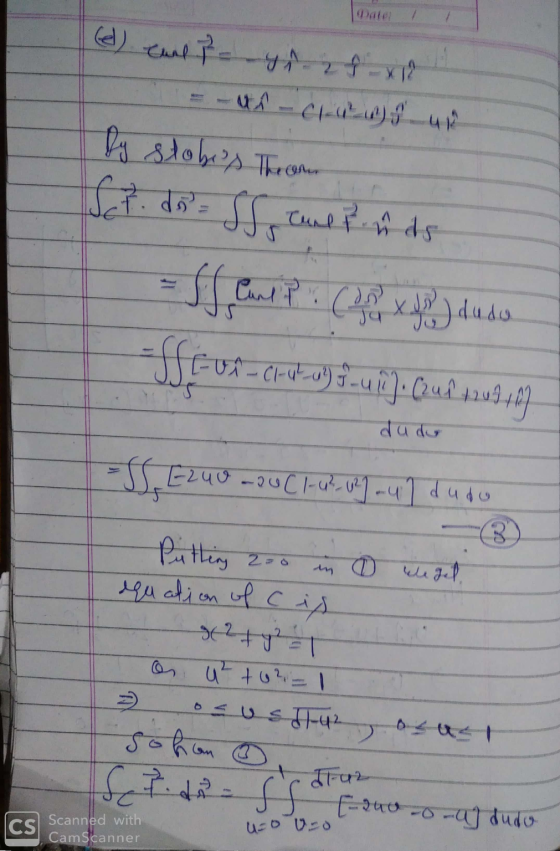
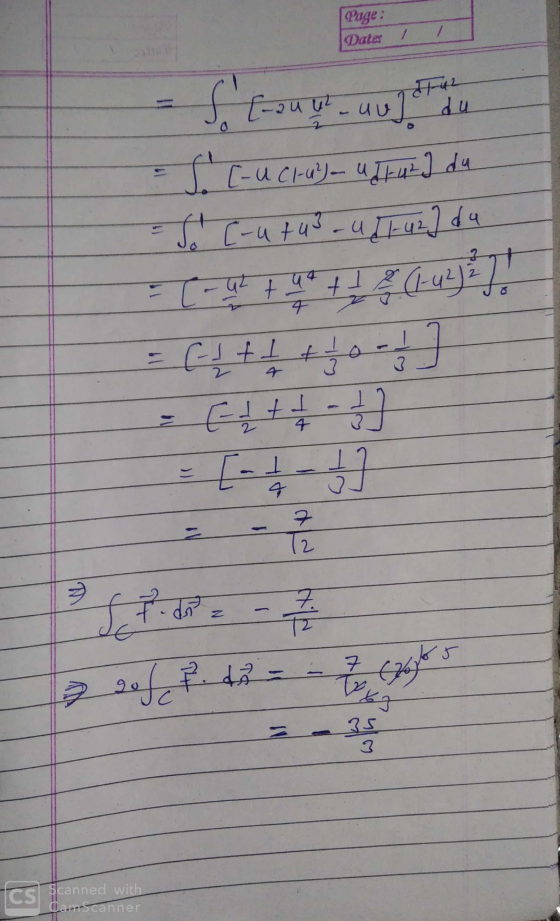
10. Stokes' Theorem and Surface Integrals of Vector Fields a. Stokes' Theorem: F dr- b. Let S be the surface of the paraboloid z 4-x2-y2 and C is the trace of S in the xy-plane. Draw a sk...
 10. Stokes' Theorem and Surface Integrals of Vector Fields a. Stokes' Theorem: F dr- b. Let S be the surface of the paraboloid z 4-x2-y2 and C is the trace of S in the xy-plane. Draw a sketch of curve C in the xy-plane. Let F(x,y,z) = <2z, x, y?». Compute the curl (F) c. d. Find a parametrization of the surface S: G(u,v)- Compute N(u,v) e. Use Stokes' Theorem to computec F dr
10. Stokes' Theorem and Surface Integrals...
10. Stokes' Theorem and Surface Integrals of Vector Fields a. Stokes' Theorem: F dr- b. Let S be the surface of the paraboloid z 4-x2-y2 and C is the trace of S in the xy-plane. Draw a sketch of curve C in the xy-plane. Let F(x,y,z) = <2z, x, y?». Compute the curl (F) c. d. Find a parametrization of the surface S: G(u,v)- Compute N(u,v) e. Use Stokes' Theorem to computec F dr
10. Stokes' Theorem and Surface Integrals...
10. Stokes' Theorem and Surfac e Integrals of Vector Fields a. Stokes' Theorem: F-dr= b. Let S be th ky-plane. Draw a sketch of curve C in the xy-plane. et be the surface of the paraboloi...
 10. Stokes' Theorem and Surfac e Integrals of Vector Fields a. Stokes' Theorem: F-dr= b. Let S be th ky-plane. Draw a sketch of curve C in the xy-plane. et be the surface of the paraboloid z 4-x-y and Cis the trace of S in the c Let Fox.y.z) <2z, x, y>, Compute the curl (F) d. Find a parametrization of the surface S: G(u,v)- Compute N(u,v) F-dr Use Stokes' Theorem to compute , e.
10. Stokes' Theorem and Surfac...
10. Stokes' Theorem and Surfac e Integrals of Vector Fields a. Stokes' Theorem: F-dr= b. Let S be th ky-plane. Draw a sketch of curve C in the xy-plane. et be the surface of the paraboloid z 4-x-y and Cis the trace of S in the c Let Fox.y.z) <2z, x, y>, Compute the curl (F) d. Find a parametrization of the surface S: G(u,v)- Compute N(u,v) F-dr Use Stokes' Theorem to compute , e.
10. Stokes' Theorem and Surfac...
10. Stokes Theorem and Surface Integrals of Vector Fields a Stokes Theorem:J F dr- b. Let S be the surface of the paraboloid z 4-x2-y2 and C is the trace of S in the xy-plane. Draw a sketch of cu...
 10. Stokes Theorem and Surface Integrals of Vector Fields a Stokes Theorem:J F dr- b. Let S be the surface of the paraboloid z 4-x2-y2 and C is the trace of S in the xy-plane. Draw a sketch of curve C in the xy-plane. Let F(x,y,z) = <2z, x, y, Compute the curl (F) c. d. Find a parametrization of the surface S: G(u,v)ーーーーーーーーーーーーー Compute N(u,v) e. Use Stokes' Theorem to compute Jc F dr
10. Stokes Theorem and Surface...
10. Stokes Theorem and Surface Integrals of Vector Fields a Stokes Theorem:J F dr- b. Let S be the surface of the paraboloid z 4-x2-y2 and C is the trace of S in the xy-plane. Draw a sketch of curve C in the xy-plane. Let F(x,y,z) = <2z, x, y, Compute the curl (F) c. d. Find a parametrization of the surface S: G(u,v)ーーーーーーーーーーーーー Compute N(u,v) e. Use Stokes' Theorem to compute Jc F dr
10. Stokes Theorem and Surface...
5. Let F (y”, 2xy + €35, 3yes-). Find the curl V F. Is the vector...
 5. Let F (y”, 2xy + €35, 3yes-). Find the curl V F. Is the vector field F conservative? If so, find a potential function, and use the Fundamental Theorem of Line Integrals (FTLI) to evaluate the vector line integral ScF. dr along any path from (0,0,0) to (1,1,1). 6. Compute the Curl x F = Q. - P, of the vector field F = (x4, xy), and use Green's theorem to evaluate the circulation (flow, work) $ex* dx +...
7. Find (a) the curl and (b) the divergence of the vector field F(x, y, z)=...
 7. Find (a) the curl and (b) the divergence of the vector field F(x, y, z)= e' sin yi+e' cos yj+zk F.de where is the curve of intersection of the plane : = 5 - x and the cylinder rº + y2 = 9. 8. Use Stokes Theorem to evaluate F(x, y, - ) = xyi +2=j+3yk
(c) Let F be the vector field on R given by F(x, y, z) = (2x...
 (c) Let F be the vector field on R given by F(x, y, z) = (2x +3y, z, 3y + z). (i) Calculate the divergence of F and the curl of F (ii) Let V be the region in IR enclosed by the plane I +2y +z S denote the closed surface that is the boundary of this region V. Sketch a picture of V and S. Then, using the Divergence Theorem, or otherwise, calculate 3 and the XY, YZ...
(23 pts) Let F(x, y, z) = ?x + y, x + y, x2 + y2?,...
 (23 pts) Let F(x, y, z) = ?x + y, x + y, x2 + y2?, S be the top
hemisphere of the unit sphere oriented upward, and C the unit
circle in the xy-plane with positive orientation.
(a) Compute div(F) and curl(F).
(b) Is F conservative? Briefly explain.
(c) Use Stokes’ Theorem to compute ? F · dr by converting it to
a surface integral. (The integral is easy if C
you set it up correctly)
4. (23 pts)...
(23 pts) Let F(x, y, z) = ?x + y, x + y, x2 + y2?, S be the top
hemisphere of the unit sphere oriented upward, and C the unit
circle in the xy-plane with positive orientation.
(a) Compute div(F) and curl(F).
(b) Is F conservative? Briefly explain.
(c) Use Stokes’ Theorem to compute ? F · dr by converting it to
a surface integral. (The integral is easy if C
you set it up correctly)
4. (23 pts)...
9. [15 Points) Let C be the boundary of the triangle with vertices (1, 1), (2,...
 9. [15 Points) Let C be the boundary of the triangle with vertices (1, 1), (2, 3) and (2, 1), oriented positively i.e. counterclockwise). Let F be the vector field F(1, y) = (e* + y²)i + (ry + cos y)j. Compute the line integral F. dr. 10. (15 Points) Let S be the portion of the paraboloid z = 1-rº-ythat lies on and above the plane z = 0. S is oriented by the normal directed upwards. If F...
Consider the vector field F(x, y, z) -(z,2x, 3y) and the surface z- /9 - x2 -y2 (an upper hemisph...
 Consider the vector field F(x, y, z) -(z,2x, 3y) and the surface z- /9 - x2 -y2 (an upper hemisphere of radius 3). (a) Compute the flux of the curl of F across the surface (with upward pointing unit normal vector N). That is, compute actually do the surface integral here. V x F dS. Note: I want you to b) Use Stokes' theorem to compute the integral from part (a) as a circulation integral (c) Use Green's theorem (ie...
C is the curve of intersection of the paraboloid z (++y and the plane z 2x+2. 2. Evaluate [ F -dr using Stokes' Theorem. Choose the simplest surface with boundary curve C and orient it upward....
 C is the curve of intersection of the paraboloid z (++y and the plane z 2x+2. 2. Evaluate [ F -dr using Stokes' Theorem. Choose the simplest surface with boundary curve C and orient it upward.
C is the curve of intersection of the paraboloid z (++y and the plane z 2x+2. 2. Evaluate [ F -dr using Stokes' Theorem. Choose the simplest surface with boundary curve C and orient it upward.
C is the curve of intersection of the paraboloid z (++y and the plane z 2x+2. 2. Evaluate [ F -dr using Stokes' Theorem. Choose the simplest surface with boundary curve C and orient it upward.
 10. Stokes' Theorem and Surface Integrals of Vector Fields a. Stokes' Theorem: F dr- b. Let S be the surface of the paraboloid z 4-x2-y2 and C is the trace of S in the xy-plane. Draw a sketch of curve C in the xy-plane. Let F(x,y,z) = <2z, x, y?». Compute the curl (F) c. d. Find a parametrization of the surface S: G(u,v)- Compute N(u,v) e. Use Stokes' Theorem to computec F dr
10. Stokes' Theorem and Surface Integrals...
10. Stokes' Theorem and Surface Integrals of Vector Fields a. Stokes' Theorem: F dr- b. Let S be the surface of the paraboloid z 4-x2-y2 and C is the trace of S in the xy-plane. Draw a sketch of curve C in the xy-plane. Let F(x,y,z) = <2z, x, y?». Compute the curl (F) c. d. Find a parametrization of the surface S: G(u,v)- Compute N(u,v) e. Use Stokes' Theorem to computec F dr
10. Stokes' Theorem and Surface Integrals...
 10. Stokes' Theorem and Surfac e Integrals of Vector Fields a. Stokes' Theorem: F-dr= b. Let S be th ky-plane. Draw a sketch of curve C in the xy-plane. et be the surface of the paraboloid z 4-x-y and Cis the trace of S in the c Let Fox.y.z) <2z, x, y>, Compute the curl (F) d. Find a parametrization of the surface S: G(u,v)- Compute N(u,v) F-dr Use Stokes' Theorem to compute , e.
10. Stokes' Theorem and Surfac...
10. Stokes' Theorem and Surfac e Integrals of Vector Fields a. Stokes' Theorem: F-dr= b. Let S be th ky-plane. Draw a sketch of curve C in the xy-plane. et be the surface of the paraboloid z 4-x-y and Cis the trace of S in the c Let Fox.y.z) <2z, x, y>, Compute the curl (F) d. Find a parametrization of the surface S: G(u,v)- Compute N(u,v) F-dr Use Stokes' Theorem to compute , e.
10. Stokes' Theorem and Surfac...
 10. Stokes Theorem and Surface Integrals of Vector Fields a Stokes Theorem:J F dr- b. Let S be the surface of the paraboloid z 4-x2-y2 and C is the trace of S in the xy-plane. Draw a sketch of curve C in the xy-plane. Let F(x,y,z) = <2z, x, y, Compute the curl (F) c. d. Find a parametrization of the surface S: G(u,v)ーーーーーーーーーーーーー Compute N(u,v) e. Use Stokes' Theorem to compute Jc F dr
10. Stokes Theorem and Surface...
10. Stokes Theorem and Surface Integrals of Vector Fields a Stokes Theorem:J F dr- b. Let S be the surface of the paraboloid z 4-x2-y2 and C is the trace of S in the xy-plane. Draw a sketch of curve C in the xy-plane. Let F(x,y,z) = <2z, x, y, Compute the curl (F) c. d. Find a parametrization of the surface S: G(u,v)ーーーーーーーーーーーーー Compute N(u,v) e. Use Stokes' Theorem to compute Jc F dr
10. Stokes Theorem and Surface...
 5. Let F (y”, 2xy + €35, 3yes-). Find the curl V F. Is the vector field F conservative? If so, find a potential function, and use the Fundamental Theorem of Line Integrals (FTLI) to evaluate the vector line integral ScF. dr along any path from (0,0,0) to (1,1,1). 6. Compute the Curl x F = Q. - P, of the vector field F = (x4, xy), and use Green's theorem to evaluate the circulation (flow, work) $ex* dx +...
 7. Find (a) the curl and (b) the divergence of the vector field F(x, y, z)= e' sin yi+e' cos yj+zk F.de where is the curve of intersection of the plane : = 5 - x and the cylinder rº + y2 = 9. 8. Use Stokes Theorem to evaluate F(x, y, - ) = xyi +2=j+3yk
 (c) Let F be the vector field on R given by F(x, y, z) = (2x +3y, z, 3y + z). (i) Calculate the divergence of F and the curl of F (ii) Let V be the region in IR enclosed by the plane I +2y +z S denote the closed surface that is the boundary of this region V. Sketch a picture of V and S. Then, using the Divergence Theorem, or otherwise, calculate 3 and the XY, YZ...
 (23 pts) Let F(x, y, z) = ?x + y, x + y, x2 + y2?, S be the top
hemisphere of the unit sphere oriented upward, and C the unit
circle in the xy-plane with positive orientation.
(a) Compute div(F) and curl(F).
(b) Is F conservative? Briefly explain.
(c) Use Stokes’ Theorem to compute ? F · dr by converting it to
a surface integral. (The integral is easy if C
you set it up correctly)
4. (23 pts)...
(23 pts) Let F(x, y, z) = ?x + y, x + y, x2 + y2?, S be the top
hemisphere of the unit sphere oriented upward, and C the unit
circle in the xy-plane with positive orientation.
(a) Compute div(F) and curl(F).
(b) Is F conservative? Briefly explain.
(c) Use Stokes’ Theorem to compute ? F · dr by converting it to
a surface integral. (The integral is easy if C
you set it up correctly)
4. (23 pts)...
 9. [15 Points) Let C be the boundary of the triangle with vertices (1, 1), (2, 3) and (2, 1), oriented positively i.e. counterclockwise). Let F be the vector field F(1, y) = (e* + y²)i + (ry + cos y)j. Compute the line integral F. dr. 10. (15 Points) Let S be the portion of the paraboloid z = 1-rº-ythat lies on and above the plane z = 0. S is oriented by the normal directed upwards. If F...
 Consider the vector field F(x, y, z) -(z,2x, 3y) and the surface z- /9 - x2 -y2 (an upper hemisphere of radius 3). (a) Compute the flux of the curl of F across the surface (with upward pointing unit normal vector N). That is, compute actually do the surface integral here. V x F dS. Note: I want you to b) Use Stokes' theorem to compute the integral from part (a) as a circulation integral (c) Use Green's theorem (ie...
 C is the curve of intersection of the paraboloid z (++y and the plane z 2x+2. 2. Evaluate [ F -dr using Stokes' Theorem. Choose the simplest surface with boundary curve C and orient it upward.
C is the curve of intersection of the paraboloid z (++y and the plane z 2x+2. 2. Evaluate [ F -dr using Stokes' Theorem. Choose the simplest surface with boundary curve C and orient it upward.
C is the curve of intersection of the paraboloid z (++y and the plane z 2x+2. 2. Evaluate [ F -dr using Stokes' Theorem. Choose the simplest surface with boundary curve C and orient it upward.
Most questions answered within 3 hours.
-
Where is the error in this code sequence?
String s1 = "Hello";
String s2 = "ello";...
asked 11 months ago -
Financial data for Joel de Paris, Inc., for last year
follow:
Joel de Paris, Inc.
Balance...
asked 11 months ago -
Consider this reaction:
Al2(SO4)3 (aq)+ BaCl3
(aq) Al2Cl6 (aq)- +
3BaSO4(s) . What is the...
asked 11 months ago -
Suppose that Savneet is considering increasing her
recent random sample from 20 car rentals to 40...
asked 11 months ago -
Trucks arrive at an unloading terminal at an average rate of 120
per hour.
Trucks arrive...
asked 11 months ago -
Why are methanol and ethanol completely soluble in water while
octanol is not very little soluble....
asked 11 months ago -
A facilities manager at a university reads in a research report
that the mean amount of...
asked 11 months ago -
When the CuSO4 is rehydrated by adding water to the anhydrous
compound, is this an endothermic...
asked 11 months ago -
A ray of sunlight is passing from diamond into crown glass; the
angle of incidence is...
asked 11 months ago -
A block of mass 0.249 kg is placed on top of a light, vertical
spring of...
asked 11 months ago -
how do the kidneys compensate in the presences of acidosis
a) trigger hyperventilate
b) reserve acid...
asked 11 months ago -
Question 501 pts
The rental rate of capital to the firm increases. Which of the
following...
asked 11 months ago