
Homework Answers
Rutherford, in his experiment bombard a thin gold plate by positively charged alpha particles. He looked for alpha particles with scattered with large deflection. The scattering cross section can be calculated using Born Approximation assuming Yukawa potential as the interaction between two charged particle.
One can see that the result obtained by Born approximation exactly matches with results obtained from classical scattering theory.
Again, after the advancement of quantum field theory, any scattering problem could be solved using greens function approach and LSZ reduction formula.
Hence, The right option will be the fourth one, "All of the above".
Add Answer to:
Rutherford scattering describes scattering between two charged particles. How can this be derived? a) Classical scattering...
In Rutherford scattering of alpha particles by a gold foil, large deflections can occasionally be observed...
In Rutherford scattering of alpha particles by a gold foil, large deflections can occasionally be observed because: a) a single alpha particle can be scattered many times in encounters with many atoms. b) the alpha particle can be deflected by the many atomic electrons of the gold. c) the wave nature of the alpha particles causes interference effects. d) none of the above.
Use the following information to answer the next question. In the Rutherford alpha particle scattering experiment,...
 Use the following information to answer the next question. In the Rutherford alpha particle scattering experiment, some alpha particles were deflected coming straight back from the gold foil. When an alpha particle is emitted by the radium sample, it has a kinetic energy of 1.0 x 10⁻²² J. The electric potential energy of a charged particle in a radial electric field is modelled as kq192 Ер r Numerical Response 2. The maximum acceleration of an alpha particle at its closest...
5. The following statements related to classical particles, bosons and fermions are true a. Their spin...
 5. The following statements related to classical particles, bosons and fermions are true a. Their spin states do not matter for the distinction. b. fermions have half integer spin. c. All are indistinguishable. d. None are indistinguishable. e. Only classical particles can, in principle, be distinguished from each other. f. Classical particles are always spin 1. 6. The pressures of gases at the same temperature and density made of classical particles, fermions or bosons have these characteristics a. The pressure...
Which of the following best describes the classical description of matter? a. All pieces of matter...
Which of the following best describes the classical description of matter? a. All pieces of matter have characteristics of both waves and particles. b. Knowing the position of a particle exactly means that we know nothing about its momentum. c. We can predict a probable trajectory for a ball thrown into the air, but we cannot predict the exact trajectory. d. Energies and motions are continuous and predictable.
Which property is observed when a beam of charged particles is fired into a magnetic field?...
 Which property is observed when a beam of charged particles is fired into a magnetic field? If the beam of charged particles is parallel to the magnetic field, no deflection will occur. The maximum deflection happens when the beam is perpendicular to the magnetic field. The magnitude of the magnetic deflecting force is directly proportional to the magnitude of the charge on each particle. The magnetic deflecting force is always perpendicular to the direction of travel of the charge and...
Coulomb's Law Tutorial Learning Goal: To understand how to calculate forces between charged particles, particularly the...
 Coulomb's Law Tutorial Learning Goal: To understand how to calculate forces between charged particles, particularly the dependence on the sign of the charges and the distance between them. Coulomb's law describes the force that two charged particles exert on each other (by Newton's third law, those two forces must be equal and opposite). The force P21 exerted by particle 2 (with charge q2) on particle 1 (with charge qu)is proportional to the charge of each particle and inversely proportional to...
Imagine three electrically charged particles, all within five centimeters of each other. Assume that the space...
Imagine three electrically charged particles, all within five centimeters of each other. Assume that the space around the charged particles is a vacuum. 5) Which options below are true? A) The strength of the total electric field extremely far away from the collection of particles is close to zero. B) Electric field vectors only exist in the space right next to the charged particles. C) The electric force on a negatively charged target particle a small distance away from the...
Two equal positively charged particles are at opposite corners of a trapezoid as shown in the...
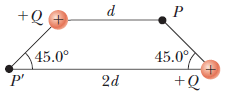 Two equal positively charged particles are at opposite corners of a trapezoid as shown in the figure below. (Use the following asnecessary: Q, d, ke.)(a) Find a symbolic expression for the total electric field at the point P.(b) Find a symbolic expression for the total electric field at the point P'.
Two identical charged particles enter a uniform magnetic field. The velocity vector of each particle is...
Two identical charged particles enter a uniform magnetic field. The velocity vector of each particle is perpendicular to the magnetic field. If particle 2 has a speed that is twice that of particle 1, how do the periods of their circular motion compare (T1/T2)? a) 1 b) 1/2 c) 1 d) 2 e) 4
trying for last time :( Can anyone please help and explain how to do this task...
 trying for last time :( Can anyone please help and explain how
to do this task ? Thank you
Q4 (QUANTUM IDEAL GASES) Is the statement "Given a two-spinless-fermion system, and two orbitals o labeled by quantum numbers a, b, the two-body wavefunction (1,2 represent the particle variables) V (1, 2) = 0a(1)$a (2) - 06(1)$6(2) +0a(1)º(2) - 06(1)$a(2) correctly describes a possible state of the system” true or false ? Explain your answer (0.5p). 4b) Consider a Fermi gas...
trying for last time :( Can anyone please help and explain how
to do this task ? Thank you
Q4 (QUANTUM IDEAL GASES) Is the statement "Given a two-spinless-fermion system, and two orbitals o labeled by quantum numbers a, b, the two-body wavefunction (1,2 represent the particle variables) V (1, 2) = 0a(1)$a (2) - 06(1)$6(2) +0a(1)º(2) - 06(1)$a(2) correctly describes a possible state of the system” true or false ? Explain your answer (0.5p). 4b) Consider a Fermi gas...
 Use the following information to answer the next question. In the Rutherford alpha particle scattering experiment, some alpha particles were deflected coming straight back from the gold foil. When an alpha particle is emitted by the radium sample, it has a kinetic energy of 1.0 x 10⁻²² J. The electric potential energy of a charged particle in a radial electric field is modelled as kq192 Ер r Numerical Response 2. The maximum acceleration of an alpha particle at its closest...
 5. The following statements related to classical particles, bosons and fermions are true a. Their spin states do not matter for the distinction. b. fermions have half integer spin. c. All are indistinguishable. d. None are indistinguishable. e. Only classical particles can, in principle, be distinguished from each other. f. Classical particles are always spin 1. 6. The pressures of gases at the same temperature and density made of classical particles, fermions or bosons have these characteristics a. The pressure...
 Which property is observed when a beam of charged particles is fired into a magnetic field? If the beam of charged particles is parallel to the magnetic field, no deflection will occur. The maximum deflection happens when the beam is perpendicular to the magnetic field. The magnitude of the magnetic deflecting force is directly proportional to the magnitude of the charge on each particle. The magnetic deflecting force is always perpendicular to the direction of travel of the charge and...
 Coulomb's Law Tutorial Learning Goal: To understand how to calculate forces between charged particles, particularly the dependence on the sign of the charges and the distance between them. Coulomb's law describes the force that two charged particles exert on each other (by Newton's third law, those two forces must be equal and opposite). The force P21 exerted by particle 2 (with charge q2) on particle 1 (with charge qu)is proportional to the charge of each particle and inversely proportional to...
 Two equal positively charged particles are at opposite corners of a trapezoid as shown in the figure below. (Use the following asnecessary: Q, d, ke.)(a) Find a symbolic expression for the total electric field at the point P.(b) Find a symbolic expression for the total electric field at the point P'.
 trying for last time :( Can anyone please help and explain how
to do this task ? Thank you
Q4 (QUANTUM IDEAL GASES) Is the statement "Given a two-spinless-fermion system, and two orbitals o labeled by quantum numbers a, b, the two-body wavefunction (1,2 represent the particle variables) V (1, 2) = 0a(1)$a (2) - 06(1)$6(2) +0a(1)º(2) - 06(1)$a(2) correctly describes a possible state of the system” true or false ? Explain your answer (0.5p). 4b) Consider a Fermi gas...
trying for last time :( Can anyone please help and explain how
to do this task ? Thank you
Q4 (QUANTUM IDEAL GASES) Is the statement "Given a two-spinless-fermion system, and two orbitals o labeled by quantum numbers a, b, the two-body wavefunction (1,2 represent the particle variables) V (1, 2) = 0a(1)$a (2) - 06(1)$6(2) +0a(1)º(2) - 06(1)$a(2) correctly describes a possible state of the system” true or false ? Explain your answer (0.5p). 4b) Consider a Fermi gas...
Most questions answered within 3 hours.
-
Where is the error in this code sequence?
String s1 = "Hello";
String s2 = "ello";...
asked 10 months ago -
Financial data for Joel de Paris, Inc., for last year
follow:
Joel de Paris, Inc.
Balance...
asked 10 months ago -
Consider this reaction:
Al2(SO4)3 (aq)+ BaCl3
(aq) Al2Cl6 (aq)- +
3BaSO4(s) . What is the...
asked 10 months ago -
Suppose that Savneet is considering increasing her
recent random sample from 20 car rentals to 40...
asked 10 months ago -
Trucks arrive at an unloading terminal at an average rate of 120
per hour.
Trucks arrive...
asked 10 months ago -
Why are methanol and ethanol completely soluble in water while
octanol is not very little soluble....
asked 10 months ago -
A facilities manager at a university reads in a research report
that the mean amount of...
asked 10 months ago -
When the CuSO4 is rehydrated by adding water to the anhydrous
compound, is this an endothermic...
asked 10 months ago -
A ray of sunlight is passing from diamond into crown glass; the
angle of incidence is...
asked 10 months ago -
A block of mass 0.249 kg is placed on top of a light, vertical
spring of...
asked 10 months ago -
how do the kidneys compensate in the presences of acidosis
a) trigger hyperventilate
b) reserve acid...
asked 10 months ago -
Question 501 pts
The rental rate of capital to the firm increases. Which of the
following...
asked 10 months ago