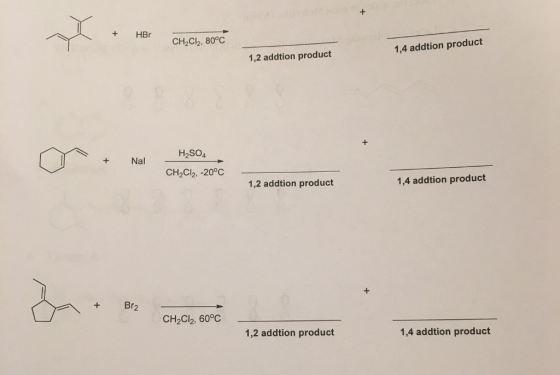
Give the 1,2 addition product and the 1,4 addition product from the MOST SUBSTITUTED double bond.
Homework Answers

Add Answer to:
Give the 1,2 addition product and the 1,4 addition product from
the MOST SUBSTITUTED double bond....
Draw (in bond line formula) the 1,2- and the 1,4-product of the following reaction with one...
 Draw (in bond line formula) the 1,2- and the 1,4-product of the
following reaction with one equivalent HBr(aq).
1,2-product HBr K 1,4-product
Draw (in bond line formula) the 1,2- and the 1,4-product of the
following reaction with one equivalent HBr(aq).
1,2-product HBr K 1,4-product
A. Double bonds that are connected by a single bond are said to be conjugated. For...
 A. Double bonds that are connected by a single bond are said to be conjugated. For each molecule below, indicate how many conjugated double bonds are present in each molecule. HO OH bro HO B. One feature that distinguishes conjugated dienes from isolated dienes is that the C-C bond joining the two double bonds is unusually short. For each of the molecules in Part A, indicate which C-C single bond(s) might be shorter than expected. C. Some reactions of conjugated...
ASAP 6.(8) a. The 1,2 addition product of the reaction is shown. Draw the 1,4 addition...
 ASAP
6.(8) a. The 1,2 addition product of the reaction is shown. Draw the 1,4 addition product. HBr 1,2 1,4 b. Which is more stable? Circle one: the 1,2 product, the 1.4 product. c. Which product is favored at low temperatures? Circle one: the 1.2 product, the 14 product d. "The proximity effect is used to account for the formation of which product? Circle one: the 1,2 product, the 1.4 product. 7. (5) The pesticide chlordane, sold starting in 1948,...
ASAP
6.(8) a. The 1,2 addition product of the reaction is shown. Draw the 1,4 addition product. HBr 1,2 1,4 b. Which is more stable? Circle one: the 1,2 product, the 1.4 product. c. Which product is favored at low temperatures? Circle one: the 1.2 product, the 14 product d. "The proximity effect is used to account for the formation of which product? Circle one: the 1,2 product, the 1.4 product. 7. (5) The pesticide chlordane, sold starting in 1948,...
4. Write the 1,2 and 1,4 products of addition of HBr to 1,3-hexadiene. Write the complete...
 4. Write the 1,2 and 1,4 products of addition of HBr to 1,3-hexadiene. Write the complete stepwise mechanism. Which product is the major if the reaction is taking place at 40°C? (4 points)
Draw the major 1,2- and 1,4-addition products obtained in the reaction shown. Assume that both are...
 Draw the major 1,2- and 1,4-addition products obtained in the reaction shown. Assume that both are derived from the most stable carbocation intermediate. +HBr You do not have to consider stereochemistry. You do not have to explicitly draw H atoms. If the 1,2- and 1,4- addition products are the same due to symmetry, only draw one structure. Draw one structure per sketcher. Add additional sketchers using the drop-down menu in the bottom right corner. Separate multiple products using the +...
Organocuprates predominantly react to give 1,4-addition products with a,ß-unsaturated carbonyl species, while Grignard reagents often add...
 Organocuprates predominantly react to give 1,4-addition products with a,ß-unsaturated carbonyl species, while Grignard reagents often add to the carbonyl, in a process referred to as 1,2-addition. To increase the yield of 1,4-addition products, Cul is added to convert an easily prepared Grignard reagent into an organocuprate reagent in situ. MgBr Cul, THF, -30°C For this reaction draw the structure of the 1,2-addition product prepared without Cul , including stereochemistry, assuming that the major product is derived from the more stable...
Organocuprates predominantly react to give 1,4-addition products with a.ß-unsaturated carbonyl species, while Grignard reagents often add...
 Organocuprates predominantly react to give 1,4-addition products with a.ß-unsaturated carbonyl species, while Grignard reagents often add to the carbonyl, in a process referred to as 1,2-addition. To increase the yield of 1,4-addition products, Cul is added to convert an easily prepared Grignard reagent into an organocuprate reagent in situ. Sa MgBr Cul, THF, -30°C For this reaction draw the structure of the 1,2-addition product prepared without Cul, including stereochemistry, assuming that the major product is derived from the more stable...
сн, Нас 12-addition products (direct addition) CH2 CH3 Н,с Н-с CH CI HCI CH2 Cн Н.с 1,4-addition products (conjuga...
 сн, Нас 12-addition products (direct addition) CH2 CH3 Н,с Н-с CH CI HCI CH2 Cн Н.с 1,4-addition products (conjugate addition) Cн CH3 Нас Н.С CI Electrophilic addition to an alkene proceeds via Markovnikov regiochemistry due to the formation of the more stable carbocation intermediate. In the case of conjugated dienes, that is dienes that are separated by one sigma bond, the carbocation that is formed is stabilized additionally by resonance. Addition of the nucleophile to the carbocation intermediate can therefore...
What is the major product of the following reaction? (1,2 vs 1,4 addition) HCl 40°C CI...
 What is the major product of the following reaction? (1,2 vs 1,4 addition) HCl 40°C CI OCI
a 0 b 4. (10) Explain why a reacts with HBr to give b as the...
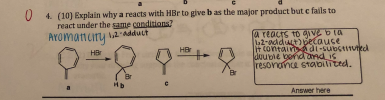 a 0 b 4. (10) Explain why a reacts with HBr to give b as the major product but c fails to react under the same conditions? Aromancity 1,2-adduct (a reacts to give bia b2-adduct) because HBr HBr it contains adi-substituted double bond and is resonance stabilized. 1 Br Hb Answer here
 Draw (in bond line formula) the 1,2- and the 1,4-product of the
following reaction with one equivalent HBr(aq).
1,2-product HBr K 1,4-product
Draw (in bond line formula) the 1,2- and the 1,4-product of the
following reaction with one equivalent HBr(aq).
1,2-product HBr K 1,4-product
 A. Double bonds that are connected by a single bond are said to be conjugated. For each molecule below, indicate how many conjugated double bonds are present in each molecule. HO OH bro HO B. One feature that distinguishes conjugated dienes from isolated dienes is that the C-C bond joining the two double bonds is unusually short. For each of the molecules in Part A, indicate which C-C single bond(s) might be shorter than expected. C. Some reactions of conjugated...
 ASAP
6.(8) a. The 1,2 addition product of the reaction is shown. Draw the 1,4 addition product. HBr 1,2 1,4 b. Which is more stable? Circle one: the 1,2 product, the 1.4 product. c. Which product is favored at low temperatures? Circle one: the 1.2 product, the 14 product d. "The proximity effect is used to account for the formation of which product? Circle one: the 1,2 product, the 1.4 product. 7. (5) The pesticide chlordane, sold starting in 1948,...
ASAP
6.(8) a. The 1,2 addition product of the reaction is shown. Draw the 1,4 addition product. HBr 1,2 1,4 b. Which is more stable? Circle one: the 1,2 product, the 1.4 product. c. Which product is favored at low temperatures? Circle one: the 1.2 product, the 14 product d. "The proximity effect is used to account for the formation of which product? Circle one: the 1,2 product, the 1.4 product. 7. (5) The pesticide chlordane, sold starting in 1948,...
 4. Write the 1,2 and 1,4 products of addition of HBr to 1,3-hexadiene. Write the complete stepwise mechanism. Which product is the major if the reaction is taking place at 40°C? (4 points)
 Draw the major 1,2- and 1,4-addition products obtained in the reaction shown. Assume that both are derived from the most stable carbocation intermediate. +HBr You do not have to consider stereochemistry. You do not have to explicitly draw H atoms. If the 1,2- and 1,4- addition products are the same due to symmetry, only draw one structure. Draw one structure per sketcher. Add additional sketchers using the drop-down menu in the bottom right corner. Separate multiple products using the +...
 Organocuprates predominantly react to give 1,4-addition products with a,ß-unsaturated carbonyl species, while Grignard reagents often add to the carbonyl, in a process referred to as 1,2-addition. To increase the yield of 1,4-addition products, Cul is added to convert an easily prepared Grignard reagent into an organocuprate reagent in situ. MgBr Cul, THF, -30°C For this reaction draw the structure of the 1,2-addition product prepared without Cul , including stereochemistry, assuming that the major product is derived from the more stable...
 Organocuprates predominantly react to give 1,4-addition products with a.ß-unsaturated carbonyl species, while Grignard reagents often add to the carbonyl, in a process referred to as 1,2-addition. To increase the yield of 1,4-addition products, Cul is added to convert an easily prepared Grignard reagent into an organocuprate reagent in situ. Sa MgBr Cul, THF, -30°C For this reaction draw the structure of the 1,2-addition product prepared without Cul, including stereochemistry, assuming that the major product is derived from the more stable...
 сн, Нас 12-addition products (direct addition) CH2 CH3 Н,с Н-с CH CI HCI CH2 Cн Н.с 1,4-addition products (conjugate addition) Cн CH3 Нас Н.С CI Electrophilic addition to an alkene proceeds via Markovnikov regiochemistry due to the formation of the more stable carbocation intermediate. In the case of conjugated dienes, that is dienes that are separated by one sigma bond, the carbocation that is formed is stabilized additionally by resonance. Addition of the nucleophile to the carbocation intermediate can therefore...
 What is the major product of the following reaction? (1,2 vs 1,4 addition) HCl 40°C CI OCI
 a 0 b 4. (10) Explain why a reacts with HBr to give b as the major product but c fails to react under the same conditions? Aromancity 1,2-adduct (a reacts to give bia b2-adduct) because HBr HBr it contains adi-substituted double bond and is resonance stabilized. 1 Br Hb Answer here
Most questions answered within 3 hours.
-
Where is the error in this code sequence?
String s1 = "Hello";
String s2 = "ello";...
asked 11 months ago -
Financial data for Joel de Paris, Inc., for last year
follow:
Joel de Paris, Inc.
Balance...
asked 11 months ago -
Consider this reaction:
Al2(SO4)3 (aq)+ BaCl3
(aq) Al2Cl6 (aq)- +
3BaSO4(s) . What is the...
asked 11 months ago -
Suppose that Savneet is considering increasing her
recent random sample from 20 car rentals to 40...
asked 11 months ago -
Trucks arrive at an unloading terminal at an average rate of 120
per hour.
Trucks arrive...
asked 11 months ago -
Why are methanol and ethanol completely soluble in water while
octanol is not very little soluble....
asked 11 months ago -
A facilities manager at a university reads in a research report
that the mean amount of...
asked 11 months ago -
When the CuSO4 is rehydrated by adding water to the anhydrous
compound, is this an endothermic...
asked 11 months ago -
A ray of sunlight is passing from diamond into crown glass; the
angle of incidence is...
asked 11 months ago -
A block of mass 0.249 kg is placed on top of a light, vertical
spring of...
asked 11 months ago -
how do the kidneys compensate in the presences of acidosis
a) trigger hyperventilate
b) reserve acid...
asked 11 months ago -
Question 501 pts
The rental rate of capital to the firm increases. Which of the
following...
asked 11 months ago