
Homework Answers
(a) X: number of flips till he gets a tails
P(X=1)= P(tails in one toss of a coin) =1/2
P(X=2) = P(heads in 1st toss, tails in 2nd ) = (1/2)*(1/2)=(1/2)2
P(X=3) = P(heads in 1st and 2nd toss, tails in 3rd toss)= (1/2)2*(1/2)=(1/2)3
And so on..
And Y = X2
Hence, we obtain the pmf of X and Y as follows
|
X |
1 |
2 |
3 |
4 |
So on |
|
Y |
1 |
4 |
9 |
16 |
So on |
|
Probability |
1/2 |
(1/2)2 |
(1/2)3 |
(1/2)4 |
So on |
P( Y >10) = 1- P( Y ? 10) = 1- (P( Y =1) + P(Y= 4) + P( Y=9))
= 1- (7/8)
= 1/8 = 0.125
(b) 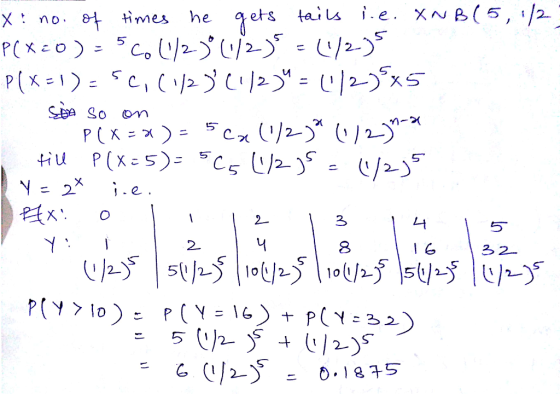
jimothy is more likely to score more than 10 points than timothy since 0.125<0.1875.
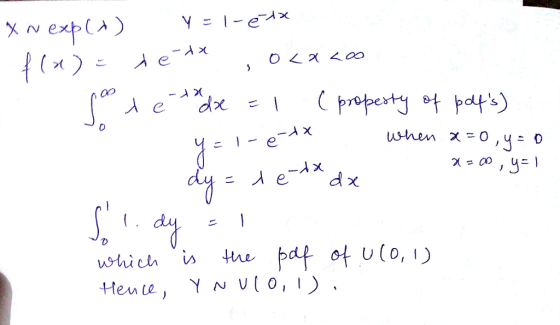
(c)
Add Answer to:
8. General Functions of Random Variables. a) Timothy will fip a fair coin until he gets...
A fair coin is tossed until heads appears four times. a) Find the probability that it...
A fair coin is tossed until heads appears four times. a) Find the probability that it took exactly 10 flips. b) Find the probability that it took at least10 flips. c) Let Y be the number of tails that occur. Find the pmf of Y.
A fair coin is flipped until the first head appears. Let X= the total number of times the coin is...
A fair coin is flipped until the first head appears. Let X= the total number of times the coin is flipped. Find E(x). Hint:if the first flip is tails, this "game" restarts.
3. (PMF – 8 points) Consider a sequence of independent trials of fair coin tossing. Let...
 3. (PMF – 8 points) Consider a sequence of independent trials of fair coin tossing. Let X denote a random variable that indicates the number of coin tosses you tried until you get heads for the first time and let y denote a random variable that indicates the number of coin tosses you tried until you get tails for the first time. For example, X = 1 and Y = 2 if you get heads on the first try and...
Question 2 Suppose you have a fair coin (a coin is considered fair if there is...
 Question 2 Suppose you have a fair coin (a coin is considered fair if there is an equal probability of being heads or tails after a flip). In other words, each coin flip i follows an independent Bernoulli distribution X Ber(1/2). Define the random variable X, as: i if coin flip i results in heads 10 if coin flip i results in tails a. Suppose you flip the coin n = 10 times. Define the number of heads you observe...
of a fair coin. Also use the binomial formula and compare the two probabilities. For the...
 of a fair coin. Also use the binomial formula and compare the two probabilities. For the normal approximation use z (x-H)/a, then use the tables, and for the binomial use (n C x) "(1-0) . Given heads is a success when we flip a coin, a six when we roll a die, and getting an ace when we select a card from a 52-card deck. Find the mean and std. deviation of the total number of successes when we (a)...
2. (8 Marks - 2 points each) Suppose you toss a fair coin four times. Let...
 2. (8 Marks - 2 points each) Suppose you toss a fair coin four times. Let the random variable X be the number of tails (T) obtained. Also, let E and V denote the mean and variance respectively. a) Compute E(X) and V(X). b) Compute E(5X - 6) and V (6 +5X).
A fair coin is tossed 20 times. Let X be the number of heads thrown in...
A fair coin is tossed 20 times. Let X be the number of heads thrown in the first 10 tosses, and let Y be the number of heads tossed in the last 10 tosses. Find the conditional probability that X = 6, given that X + Y = 10.
A fair coin is tossed 20 times. Let X be the number of heads thrown in...
A fair coin is tossed 20 times. Let X be the number of heads thrown in the first 10 tosses, and let Y be the number of heads tossed in the last 10 tosses. Find the conditional probability that X = 6, given that X + Y = 10.
One gambler flips a fair coin in three separate times. Letting a random variable X represent...
One gambler flips a fair coin in three separate times. Letting a random variable X represent his winnings in the following way: He loses $1 if he gets no heads in three flips; he wins $1, $2, and $3 if he obtains 1, 2, or 3 heads, respectively. (a) Find the probability mass function of X. (b) Find the probability density function of X. (c) Find the cumulative distribution function of X. (d) Find the probability that he wins more...
c) d) 120 200 10) We flip a fair coin 4 times. Define a random variable...
 c) d) 120 200 10) We flip a fair coin 4 times. Define a random variable X = number of heads we obtain. Thus X=0,1,2,3, or 4 If p(x) denotes the probability function for X, find p(3). a) 1/16 b) 2/16 c) 3/16 d) 4/16 5/16
 3. (PMF – 8 points) Consider a sequence of independent trials of fair coin tossing. Let X denote a random variable that indicates the number of coin tosses you tried until you get heads for the first time and let y denote a random variable that indicates the number of coin tosses you tried until you get tails for the first time. For example, X = 1 and Y = 2 if you get heads on the first try and...
 Question 2 Suppose you have a fair coin (a coin is considered fair if there is an equal probability of being heads or tails after a flip). In other words, each coin flip i follows an independent Bernoulli distribution X Ber(1/2). Define the random variable X, as: i if coin flip i results in heads 10 if coin flip i results in tails a. Suppose you flip the coin n = 10 times. Define the number of heads you observe...
 of a fair coin. Also use the binomial formula and compare the two probabilities. For the normal approximation use z (x-H)/a, then use the tables, and for the binomial use (n C x) "(1-0) . Given heads is a success when we flip a coin, a six when we roll a die, and getting an ace when we select a card from a 52-card deck. Find the mean and std. deviation of the total number of successes when we (a)...
 2. (8 Marks - 2 points each) Suppose you toss a fair coin four times. Let the random variable X be the number of tails (T) obtained. Also, let E and V denote the mean and variance respectively. a) Compute E(X) and V(X). b) Compute E(5X - 6) and V (6 +5X).
 c) d) 120 200 10) We flip a fair coin 4 times. Define a random variable X = number of heads we obtain. Thus X=0,1,2,3, or 4 If p(x) denotes the probability function for X, find p(3). a) 1/16 b) 2/16 c) 3/16 d) 4/16 5/16
Most questions answered within 3 hours.
-
Where is the error in this code sequence?
String s1 = "Hello";
String s2 = "ello";...
asked 10 months ago -
Financial data for Joel de Paris, Inc., for last year
follow:
Joel de Paris, Inc.
Balance...
asked 10 months ago -
Consider this reaction:
Al2(SO4)3 (aq)+ BaCl3
(aq) Al2Cl6 (aq)- +
3BaSO4(s) . What is the...
asked 10 months ago -
Suppose that Savneet is considering increasing her
recent random sample from 20 car rentals to 40...
asked 10 months ago -
Trucks arrive at an unloading terminal at an average rate of 120
per hour.
Trucks arrive...
asked 10 months ago -
Why are methanol and ethanol completely soluble in water while
octanol is not very little soluble....
asked 10 months ago -
A facilities manager at a university reads in a research report
that the mean amount of...
asked 10 months ago -
When the CuSO4 is rehydrated by adding water to the anhydrous
compound, is this an endothermic...
asked 10 months ago -
A ray of sunlight is passing from diamond into crown glass; the
angle of incidence is...
asked 10 months ago -
A block of mass 0.249 kg is placed on top of a light, vertical
spring of...
asked 10 months ago -
how do the kidneys compensate in the presences of acidosis
a) trigger hyperventilate
b) reserve acid...
asked 10 months ago -
Question 501 pts
The rental rate of capital to the firm increases. Which of the
following...
asked 10 months ago