
Homework Answers
Answer 1 : We have drawn the tryptic digestion fragments resulting from the polypeptide i.e. N'- ERGDEWKTHR - C'
which is shown as follows :
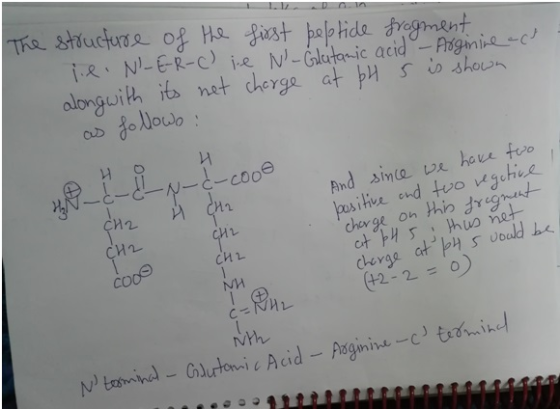
(1) The first fragment would be : N'- ER - C'
The structure of fragment 1 showing the net charge at pH 5 is shown as follows :
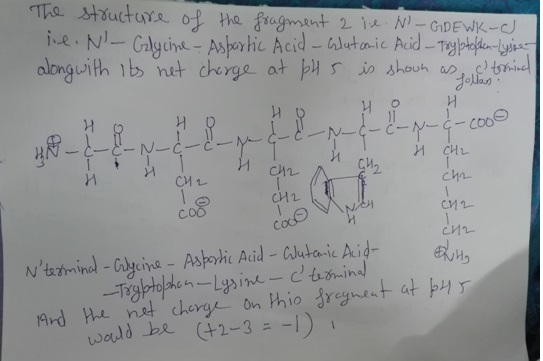
(2) The second fragment would be : N'- GDEWK - C'
The structure of fragment 2 showing the net charge at pH 5 is shown as follows :
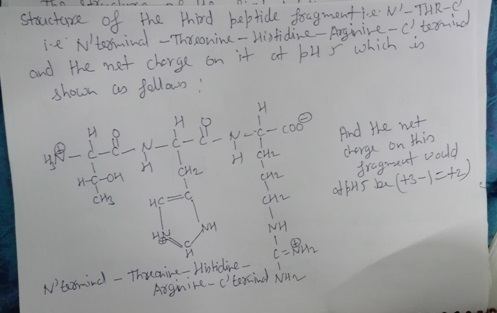
(3) The third fragment would be : N'- THR - C'
The structure of fragment 3 showing the net charge at pH 5 is shown as follows :
This is due to the fact that as we know that enzyme trypsin
cleave peptides on the C-terminal side of lysine (K) and arginine
(R) amino acid residues and thus frees its  carboxyl group which then generate two fragment at the site of
action of the trypsin enzyme. The one fragment would be containing
free
carboxyl group of lysine (K) and arginine (R) amino acid residues
and the other fragment contain the free
amino group of amino acid residues which was present next to the
lysine (K) and arginine (R) amino acid residues present in the
polypeptides.
carboxyl group which then generate two fragment at the site of
action of the trypsin enzyme. The one fragment would be containing
free
carboxyl group of lysine (K) and arginine (R) amino acid residues
and the other fragment contain the free
amino group of amino acid residues which was present next to the
lysine (K) and arginine (R) amino acid residues present in the
polypeptides.
Thus, the fragment resulting from the the tryptic digestion of the polypeptide i.e. N'- ERGDEWKTHR - C' is shown as follows :
(1) The first fragment would be : N'- ER - C'
(2) The second fragment would be : N'- GDEWK - C'
(3) The third fragment would be : N'- THR - C'
We have provided the scheme for how these fragments would be purified from one another at pH 5 is shown as follows :
So for that now let us see the net charge on each fragment which is shown as follows :
(1) The first fragment i.e. N'- ER - C' net charge at pH 5 would be : zero
(2) The second fragment i.e. N'- GDEWK - C' net charge at pH 5 would be : - 1.
(3) The third fragment i.e. N'- THR - C' net charge at pH 5 would be : + 2
Thus since as we see above there is difference in the net charge of each fragment at pH 5. So, we can purify these fragment by use of the Ion exchange chromatography whose pattern is shown as follows :
(1) We can separate the fragment 3 i.e. N'- THR - C' by use of cation exchange chromatography i.e. a type of Ion exchange chromatography since the the fragment 3 i.e. N'- THR - C' carries net charge of +2 at pH 5.
(2) We can separate the fragment 2 i.e. N'- GDEWK - C' by use of anion exchange chromatography i.e. a type of Ion exchange chromatography since the the fragment 2 i.e. N'- GDEWK - C' carries net charge of - 1 at pH 5.
(3) And the solution left (eluted) of the peptide fragment after the cation exchange chromatography and anion exchange chromatography would be of the fragment 1 i.e. N'- ER - C' which carries the net charge 0 at pH 5; thus not purified by cation exchange chromatography and anion exchange chromatography.
Thus, in this way, we have provided the scheme for how these fragments would be purified from one another at pH 5.
Add Answer to:
Show your work to get credit. 1. Draw the tryptic digestion fragments resulting from the polypeptide....
Deduce the primary structure of the polypeptide described: 1) N-terminal residue analysis Result: Isoleucine 2) Protease...
 Deduce the primary structure of the polypeptide described: 1) N-terminal residue analysis Result: Isoleucine 2) Protease digestion followed by Edman degradation sequencing (refer to textbook for specificity information). A) Trypsin Results: T-1 T-2 T-3 TGVDIQCCSTDNCNPFPTR VDLGCAATCPTVK DCPNGHVCYTK CEITPDITSK TWCDAFCSIR T-4 T-5 T-7 T-8 T-9 T-10 T-11 IR K P R R B) Chymotrypsin Results: C-1 C-2 C-3 CSIRGKRVDLGCAATCPTVKTGVDIQCCSTDNCNPE ITPDITSKDCPNGHVCY PTRKRP CDAF TKTW IRCE C-5 C-6 To answer the question, place the polypeptide fragments resulting from chymotrypsin digestion in the appropriate...
1 and 2 On Calculations you must SHOW YOUR WORK to get credit. s the concentration...
 1
and 2
On Calculations you must SHOW YOUR WORK to get credit. s the concentration (M) of hydronium ions in a solution at 25°C with pH 3.529? Report with correct significant figures. (10 points) What is the Ksp of MgF2 if its molar solubility is 2.65x10⁻⁴ M? (10 points)
1
and 2
On Calculations you must SHOW YOUR WORK to get credit. s the concentration (M) of hydronium ions in a solution at 25°C with pH 3.529? Report with correct significant figures. (10 points) What is the Ksp of MgF2 if its molar solubility is 2.65x10⁻⁴ M? (10 points)
4) Show your work to get full credit. (a) How much in g) sodium acetate (CH3COONa)...
 4) Show your work to get full credit. (a) How much in g) sodium acetate (CH3COONa) must be added to 100 mL 0.1 M CH3COOH solution to prepare a buffer solution with pH 4.90? (assume no change in volume) (b) What will be the pH of the final solution if 2.50 x 10 mol HCl solution is added to the buffer solution above? (c) What will be the pH of the solution if 2.00 x 10 mol NaOH solution is...
Recitation Work - 5 In order to get full credit, you need to show all your...
 Recitation Work - 5 In order to get full credit, you need to
show all your work.
question 1.
A force Fx = cx^3 (c = 3.0 N/m^3) acts on an object with mass 40
kg that is sliding along a rough horizontal floor (x-axis) with
coefficient of kinetic friction of 0.2. A) What is the work done by
the force Fx on this object as it slides from x1 = 0.0 m to x2 =
6.0 m?
B) What...
Recitation Work - 5 In order to get full credit, you need to
show all your work.
question 1.
A force Fx = cx^3 (c = 3.0 N/m^3) acts on an object with mass 40
kg that is sliding along a rough horizontal floor (x-axis) with
coefficient of kinetic friction of 0.2. A) What is the work done by
the force Fx on this object as it slides from x1 = 0.0 m to x2 =
6.0 m?
B) What...
Show your work as much as possible below each question to get full credit (Le, you...
 Show your work as much as possible below each question to get full credit (Le, you should provide information about PV: FV. PMT, I/Y, N ... before writing down your answer) 1. What is the present value of the following cash flow stream at a rate of 8.0%? Years: CFs: $2,450 $3,175 $4,400 2. You would like to travel in South America 5 years from now, and you can save $3,100 per year, beginning one year from today. You plan...
Instructions You must show you work and/or explain your reasoning to receive credit for a problem....
 Instructions You must show you work and/or explain your reasoning to receive credit for a problem. Answers must be written in LaTeX and submitted in Canvas as a compiled PDF. You can use the LaTeX file of the course notes, homework solutions, and examples in Canvas as a guide for how to write the needed expressions in LaTeX. For the birthday problem simulation, please submit a Python script as a separate attachment in your homework submission. Problem 1 Three high...
[Part B: Short Answers-Show your work to receive full credit. 5 pts.] 1. If there are...
 [Part B: Short Answers-Show your work to receive full credit. 5 pts.] 1. If there are 20 goods in an economy, then we have fifty prices in a monetary economy. However, if it is the case in a barter economy, then how many prices one needs to know in order to exchange one good for another?
You must show all work to get full credit 1) A rock is thrown down from...
 You must show all work to get full credit 1) A rock is thrown down from the top of a building with an initial velocity of 14.7 m/sec. The building has a height of 19.6 m. (10 points) a) How long does it take for the rock to reach the ground? b) With what velocity does the rock hit the ground? c) What is the average velocity of the rock?
Part 2: You MUST SHOW YOUR WORK TO GET ANY CREDIT A. Problem 1 Consider the...
 Part 2: You MUST SHOW YOUR WORK TO GET ANY CREDIT A. Problem 1 Consider the following hypotheses: Ho: ps 0.24 VS Ha: p0.24 Given that JS-0277 n. 130, and a-0.05, answer te fllowingqu i ex: a) Determine the test statistic for this test b) Determine the type I error for this test e) Determine the test critical value. d) Determine the test statistic value for this test c) Determine the p-value for this test What conclusion should be drawn?
Show all work. Label and clearly explain your answer. This is very important. 1) You must...
Show all work. Label and clearly explain your answer. This is very important. 1) You must explain how you arrived at your answer in order to get full credit. 2) If you do show your work, and your answer is wrong, you can still earn a substantial amount of credit depending on how serious the error is. 3) If your answer is wrong, and you don't show your work, you will get a zero. Sarcosuchus Corporation offers very short-term loans...
 Deduce the primary structure of the polypeptide described: 1) N-terminal residue analysis Result: Isoleucine 2) Protease digestion followed by Edman degradation sequencing (refer to textbook for specificity information). A) Trypsin Results: T-1 T-2 T-3 TGVDIQCCSTDNCNPFPTR VDLGCAATCPTVK DCPNGHVCYTK CEITPDITSK TWCDAFCSIR T-4 T-5 T-7 T-8 T-9 T-10 T-11 IR K P R R B) Chymotrypsin Results: C-1 C-2 C-3 CSIRGKRVDLGCAATCPTVKTGVDIQCCSTDNCNPE ITPDITSKDCPNGHVCY PTRKRP CDAF TKTW IRCE C-5 C-6 To answer the question, place the polypeptide fragments resulting from chymotrypsin digestion in the appropriate...
 1
and 2
On Calculations you must SHOW YOUR WORK to get credit. s the concentration (M) of hydronium ions in a solution at 25°C with pH 3.529? Report with correct significant figures. (10 points) What is the Ksp of MgF2 if its molar solubility is 2.65x10⁻⁴ M? (10 points)
1
and 2
On Calculations you must SHOW YOUR WORK to get credit. s the concentration (M) of hydronium ions in a solution at 25°C with pH 3.529? Report with correct significant figures. (10 points) What is the Ksp of MgF2 if its molar solubility is 2.65x10⁻⁴ M? (10 points)
 4) Show your work to get full credit. (a) How much in g) sodium acetate (CH3COONa) must be added to 100 mL 0.1 M CH3COOH solution to prepare a buffer solution with pH 4.90? (assume no change in volume) (b) What will be the pH of the final solution if 2.50 x 10 mol HCl solution is added to the buffer solution above? (c) What will be the pH of the solution if 2.00 x 10 mol NaOH solution is...
 Recitation Work - 5 In order to get full credit, you need to
show all your work.
question 1.
A force Fx = cx^3 (c = 3.0 N/m^3) acts on an object with mass 40
kg that is sliding along a rough horizontal floor (x-axis) with
coefficient of kinetic friction of 0.2. A) What is the work done by
the force Fx on this object as it slides from x1 = 0.0 m to x2 =
6.0 m?
B) What...
Recitation Work - 5 In order to get full credit, you need to
show all your work.
question 1.
A force Fx = cx^3 (c = 3.0 N/m^3) acts on an object with mass 40
kg that is sliding along a rough horizontal floor (x-axis) with
coefficient of kinetic friction of 0.2. A) What is the work done by
the force Fx on this object as it slides from x1 = 0.0 m to x2 =
6.0 m?
B) What...
 Show your work as much as possible below each question to get full credit (Le, you should provide information about PV: FV. PMT, I/Y, N ... before writing down your answer) 1. What is the present value of the following cash flow stream at a rate of 8.0%? Years: CFs: $2,450 $3,175 $4,400 2. You would like to travel in South America 5 years from now, and you can save $3,100 per year, beginning one year from today. You plan...
 Instructions You must show you work and/or explain your reasoning to receive credit for a problem. Answers must be written in LaTeX and submitted in Canvas as a compiled PDF. You can use the LaTeX file of the course notes, homework solutions, and examples in Canvas as a guide for how to write the needed expressions in LaTeX. For the birthday problem simulation, please submit a Python script as a separate attachment in your homework submission. Problem 1 Three high...
 [Part B: Short Answers-Show your work to receive full credit. 5 pts.] 1. If there are 20 goods in an economy, then we have fifty prices in a monetary economy. However, if it is the case in a barter economy, then how many prices one needs to know in order to exchange one good for another?
 You must show all work to get full credit 1) A rock is thrown down from the top of a building with an initial velocity of 14.7 m/sec. The building has a height of 19.6 m. (10 points) a) How long does it take for the rock to reach the ground? b) With what velocity does the rock hit the ground? c) What is the average velocity of the rock?
 Part 2: You MUST SHOW YOUR WORK TO GET ANY CREDIT A. Problem 1 Consider the following hypotheses: Ho: ps 0.24 VS Ha: p0.24 Given that JS-0277 n. 130, and a-0.05, answer te fllowingqu i ex: a) Determine the test statistic for this test b) Determine the type I error for this test e) Determine the test critical value. d) Determine the test statistic value for this test c) Determine the p-value for this test What conclusion should be drawn?
Most questions answered within 3 hours.
-
Where is the error in this code sequence?
String s1 = "Hello";
String s2 = "ello";...
asked 10 months ago -
Financial data for Joel de Paris, Inc., for last year
follow:
Joel de Paris, Inc.
Balance...
asked 10 months ago -
Consider this reaction:
Al2(SO4)3 (aq)+ BaCl3
(aq) Al2Cl6 (aq)- +
3BaSO4(s) . What is the...
asked 10 months ago -
Suppose that Savneet is considering increasing her
recent random sample from 20 car rentals to 40...
asked 10 months ago -
Trucks arrive at an unloading terminal at an average rate of 120
per hour.
Trucks arrive...
asked 10 months ago -
Why are methanol and ethanol completely soluble in water while
octanol is not very little soluble....
asked 10 months ago -
A facilities manager at a university reads in a research report
that the mean amount of...
asked 10 months ago -
When the CuSO4 is rehydrated by adding water to the anhydrous
compound, is this an endothermic...
asked 10 months ago -
A ray of sunlight is passing from diamond into crown glass; the
angle of incidence is...
asked 10 months ago -
A block of mass 0.249 kg is placed on top of a light, vertical
spring of...
asked 10 months ago -
how do the kidneys compensate in the presences of acidosis
a) trigger hyperventilate
b) reserve acid...
asked 10 months ago -
Question 501 pts
The rental rate of capital to the firm increases. Which of the
following...
asked 10 months ago