(Problem C-9.34, page 397 of the text) Given a heap H and a key k, give an algorithm to compute all the entries in H having keys less than or equal to k. For example, given the heap in figure 9.12a and query k=7, the algorithm should report the entries with keys 2, 4, 5, 6, and 7 (but not necessarily in this order). Your algorithm should run in time proportional to the number of entries returned, and should not modify the heap.
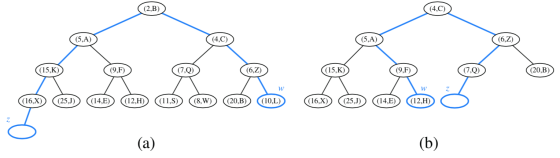
Figure 9.12: Two cases of updating the last node in a complete binary tree after operation insert or remove. Node w is the last node before operation insert or after operation remove. Node z is the last node after operation insert or before operation remove.
Homework Answers
Request Answer!
We need at least 10 more requests to produce the answer.
0 / 10 have requested this problem solution
The more requests, the faster the answer.
Add Answer to:
(Problem C-9.34, page 397 of the text) Given a heap H and a key
k, give...
Let T be a heap storing n keys. Give an efficient algorithm for reporting all the...
 Let T be a heap storing n keys. Give an efficient algorithm for
reporting all
the keys in T that are smaller than or equal to a given query key x
(which is
not necessarily in T). For example, given the heap of Figure 5.6
and query key
x = 7, the algorithm should report 4, 5, 6, 7. Note that the keys
do not need to be
reported in sorted order. Ideally, your algorithm should run in
O(k) time,...
Let T be a heap storing n keys. Give an efficient algorithm for
reporting all
the keys in T that are smaller than or equal to a given query key x
(which is
not necessarily in T). For example, given the heap of Figure 5.6
and query key
x = 7, the algorithm should report 4, 5, 6, 7. Note that the keys
do not need to be
reported in sorted order. Ideally, your algorithm should run in
O(k) time,...
Using C++, data structures, C++ STL, inputs and expected outputs are shown below. Max Heap Heap...
 Using C++, data structures, C++ STL, inputs and expected
outputs are shown below.
Max Heap Heap is a specialized tree-based data structure that satisfies the heap property: if P is a parent node of C, then the key (the value) of P is either > (in a max heap) or s (in a min heap) the key of C. The node at the "top" of the heap (with no parents) is called the root node. In binary-tree based heap, it...
Using C++, data structures, C++ STL, inputs and expected
outputs are shown below.
Max Heap Heap is a specialized tree-based data structure that satisfies the heap property: if P is a parent node of C, then the key (the value) of P is either > (in a max heap) or s (in a min heap) the key of C. The node at the "top" of the heap (with no parents) is called the root node. In binary-tree based heap, it...
PROGRAM DESCRIPTION Using the given class definitions for either C++, create a minimum heap that stores...
PROGRAM DESCRIPTION Using the given class definitions for either C++, create a minimum heap that stores integers and and implements a minimum priority queue. (Your program can be "hard coded" for integers - it does not need to use templates, generics, or polymorphism.) Your data structure must always store its internal data as a heap. Your toString function should return a string with the heap values as a comma separated list, also including the size of the heap as well....
Data Structures using C BuildHeap and Heap Sort In preparation: If you have not done so...
 Data Structures using C
BuildHeap and Heap Sort In preparation: If you have not done so already, you should complete Worksheet 33 to leam more about the heap data structure. In some applications it is useful to void buildHeap (struct dyArray heap) { initialize a Heap with an existing vector int max = dy Array Size(heap); int i; of values. The values are not assumed for (i = max/2-1; i >= 0; i--) to be organized into a heap, and...
Data Structures using C
BuildHeap and Heap Sort In preparation: If you have not done so already, you should complete Worksheet 33 to leam more about the heap data structure. In some applications it is useful to void buildHeap (struct dyArray heap) { initialize a Heap with an existing vector int max = dy Array Size(heap); int i; of values. The values are not assumed for (i = max/2-1; i >= 0; i--) to be organized into a heap, and...
Major Homework #2 Implement a C program major_hw2.c to solve the 15-puzzle problem using the A*...
Major Homework #2 Implement a C program major_hw2.c to solve the 15-puzzle problem using the A* search algorithm. 1. Objectives • To gain more experience on using pointers and linked lists in C programs. • To learn how to solve problems using state space search and A* search algorithm. 2. Background A* search and 15-puzzle problem have been introduced in the class. For more information, please read the wiki page of 15-puzzle problem at https://en.wikipedia.org/wiki/15_puzzle, and the wiki page of...
Major Homework #2 Implement a C program major_hw2.c to solve the 15-puzzle problem using the A* s...
Major Homework #2 Implement a C program major_hw2.c to solve the 15-puzzle problem using the A* search algorithm. Please include pictures that the code runs and shows the different states as it reaches goal state please. 1. Objectives • To gain more experience on using pointers and linked lists in C programs. • To learn how to solve problems using state space search and A* search algorithm. 2. Background A* search and 15-puzzle problem have been introduced in the class....
Comparing the insertion and removing performance between ALPQueue with HeapPQueue. Requirements: ...
Comparing the insertion and removing performance between ALPQueue with HeapPQueue. Requirements: 1/ Task1: implement a concrete ALPQueue class (an ArrayList based priority queue) that extends the AbstractPQueue discussed in the class, along with PQueue.java, ArrayList.java, List.java, PQEntry.java , EntryComparitor.java, and OutOfRangeException.java given in the class (any other implementation of above classes that are not compatible with List interface and AbstractPQueue class will not receive any credit). 2/ Task2: implement a concrete HeapPQueue class (a Heap based priority queue) that extends...
Comparing the insertion and removing performance between ALPQueue with HeapPQueue. Requirements: 1/ Task1: implement a concrete...
Comparing the insertion and removing performance between ALPQueue with HeapPQueue. Requirements: 1/ Task1: implement a concrete ALPQueue class (an ArrayList based priority queue) that extends the AbstractPQueue discussed in the class, along with PQueue.java, ArrayList.java, List.java, PQEntry.java , EntryComparitor.java, and OutOfRangeException.java given in the class (any other implementation of above classes that are not compatible with List interface and AbstractPQueue class will not receive any credit). 2/ Task2: implement a concrete HeapPQueue class (a Heap based priority queue) that extends...
Hello, I have some errors in my C++ code when I try to debug it. I...
 Hello, I have some errors in my C++ code when I try to debug it.
I tried to follow the requirements stated below:
Code:
// Linked.h
#ifndef INTLINKEDQUEUE
#define INTLINKEDQUEUE
#include <iostream>
usingnamespace std;
class IntLinkedQueue
{
private: struct Node {
int data;
Node *next;
};
Node *front; // -> first item
Node *rear; // -> last item
Node *p; // traversal position
Node *pp ; // previous position
int size; // number of elements in the queue
public:
IntLinkedQueue();...
Hello, I have some errors in my C++ code when I try to debug it.
I tried to follow the requirements stated below:
Code:
// Linked.h
#ifndef INTLINKEDQUEUE
#define INTLINKEDQUEUE
#include <iostream>
usingnamespace std;
class IntLinkedQueue
{
private: struct Node {
int data;
Node *next;
};
Node *front; // -> first item
Node *rear; // -> last item
Node *p; // traversal position
Node *pp ; // previous position
int size; // number of elements in the queue
public:
IntLinkedQueue();...
I've posted 3 classes after the instruction that were given at start You will implement and...
I've posted 3 classes after the instruction that were given at start You will implement and test a PriorityQueue class, where the items of the priority queue are stored on a linked list. The material from Ch1 ~ 8 of the textbook can help you tremendously. You can get a lot of good information about implementing this assignment from chapter 8. There are couple notes about this assignment. 1. Using structure Node with a pointer point to Node structure to...
 Let T be a heap storing n keys. Give an efficient algorithm for
reporting all
the keys in T that are smaller than or equal to a given query key x
(which is
not necessarily in T). For example, given the heap of Figure 5.6
and query key
x = 7, the algorithm should report 4, 5, 6, 7. Note that the keys
do not need to be
reported in sorted order. Ideally, your algorithm should run in
O(k) time,...
Let T be a heap storing n keys. Give an efficient algorithm for
reporting all
the keys in T that are smaller than or equal to a given query key x
(which is
not necessarily in T). For example, given the heap of Figure 5.6
and query key
x = 7, the algorithm should report 4, 5, 6, 7. Note that the keys
do not need to be
reported in sorted order. Ideally, your algorithm should run in
O(k) time,...
 Using C++, data structures, C++ STL, inputs and expected
outputs are shown below.
Max Heap Heap is a specialized tree-based data structure that satisfies the heap property: if P is a parent node of C, then the key (the value) of P is either > (in a max heap) or s (in a min heap) the key of C. The node at the "top" of the heap (with no parents) is called the root node. In binary-tree based heap, it...
Using C++, data structures, C++ STL, inputs and expected
outputs are shown below.
Max Heap Heap is a specialized tree-based data structure that satisfies the heap property: if P is a parent node of C, then the key (the value) of P is either > (in a max heap) or s (in a min heap) the key of C. The node at the "top" of the heap (with no parents) is called the root node. In binary-tree based heap, it...
 Data Structures using C
BuildHeap and Heap Sort In preparation: If you have not done so already, you should complete Worksheet 33 to leam more about the heap data structure. In some applications it is useful to void buildHeap (struct dyArray heap) { initialize a Heap with an existing vector int max = dy Array Size(heap); int i; of values. The values are not assumed for (i = max/2-1; i >= 0; i--) to be organized into a heap, and...
Data Structures using C
BuildHeap and Heap Sort In preparation: If you have not done so already, you should complete Worksheet 33 to leam more about the heap data structure. In some applications it is useful to void buildHeap (struct dyArray heap) { initialize a Heap with an existing vector int max = dy Array Size(heap); int i; of values. The values are not assumed for (i = max/2-1; i >= 0; i--) to be organized into a heap, and...
 Hello, I have some errors in my C++ code when I try to debug it.
I tried to follow the requirements stated below:
Code:
// Linked.h
#ifndef INTLINKEDQUEUE
#define INTLINKEDQUEUE
#include <iostream>
usingnamespace std;
class IntLinkedQueue
{
private: struct Node {
int data;
Node *next;
};
Node *front; // -> first item
Node *rear; // -> last item
Node *p; // traversal position
Node *pp ; // previous position
int size; // number of elements in the queue
public:
IntLinkedQueue();...
Hello, I have some errors in my C++ code when I try to debug it.
I tried to follow the requirements stated below:
Code:
// Linked.h
#ifndef INTLINKEDQUEUE
#define INTLINKEDQUEUE
#include <iostream>
usingnamespace std;
class IntLinkedQueue
{
private: struct Node {
int data;
Node *next;
};
Node *front; // -> first item
Node *rear; // -> last item
Node *p; // traversal position
Node *pp ; // previous position
int size; // number of elements in the queue
public:
IntLinkedQueue();...
Most questions answered within 3 hours.
-
Where is the error in this code sequence?
String s1 = "Hello";
String s2 = "ello";...
asked 11 months ago -
Financial data for Joel de Paris, Inc., for last year
follow:
Joel de Paris, Inc.
Balance...
asked 11 months ago -
Consider this reaction:
Al2(SO4)3 (aq)+ BaCl3
(aq) Al2Cl6 (aq)- +
3BaSO4(s) . What is the...
asked 11 months ago -
Suppose that Savneet is considering increasing her
recent random sample from 20 car rentals to 40...
asked 11 months ago -
Trucks arrive at an unloading terminal at an average rate of 120
per hour.
Trucks arrive...
asked 11 months ago -
Why are methanol and ethanol completely soluble in water while
octanol is not very little soluble....
asked 11 months ago -
A facilities manager at a university reads in a research report
that the mean amount of...
asked 11 months ago -
When the CuSO4 is rehydrated by adding water to the anhydrous
compound, is this an endothermic...
asked 11 months ago -
A ray of sunlight is passing from diamond into crown glass; the
angle of incidence is...
asked 11 months ago -
A block of mass 0.249 kg is placed on top of a light, vertical
spring of...
asked 11 months ago -
how do the kidneys compensate in the presences of acidosis
a) trigger hyperventilate
b) reserve acid...
asked 11 months ago -
Question 501 pts
The rental rate of capital to the firm increases. Which of the
following...
asked 11 months ago