
Homework Answers


You are designing an LED dimmer that controls the light intensity through PWM. The LED circuit...
You are designing an LED dimmer that controls the light intensity through PWM. The LED circuit draws 500 mA when on at 12V. The normal operating condition is 60% duty cycle and switching at 10 kHz. You are between using the BCP56-16T1G BJT and MGSF1N03LT1G MOSFET (assume you are driving with 10V) as a low-side switch. Which device would be best to use from an efficiency perspective (accounting only for conduction and switching loss)? Why?
Problem 5 Given the following circuit, assume the following parameters VBB IV, RB 220 k, RC...
 Problem 5 Given the following circuit, assume the following parameters VBB IV, RB 220 k, RC = 2 k, VCC= 10 V, VBE(on)-0.7 V, and B 200 a) Calculate the base, collector, and emitter currents and the C-E voltage, also, calculate the transistor power dissipation b) What transistor configuration does the circuit resemble? Vcc=10V RC=2k Rg=220 kQ VCE VBB= 1V o + VRE IB
24. For the circuit shown find the current flowing through the 50Ω Resistor (R) R1-200 10V...
 24. For the circuit shown find the current flowing through the 50Ω Resistor (R) R1-200 10V R2-300 R3:500 R4-200
(6) A blue LED with a forward voltage drop of 3.5V is to be energized from a 12 volt battery. To light the blue LED to ful brightness requires a current of 20 mA through the LED. The blue LED has a p...
 (6) A blue LED with a forward voltage drop of 3.5V is to be energized from a 12 volt battery. To light the blue LED to ful brightness requires a current of 20 mA through the LED. The blue LED has a peak inverse voltage rating of 5 V. i) Draw the circuit dingram of the arrangement you will use to light the LED to full brightness. (ii What is the value of the resistor you will use in your...
to create a circuit which drives a controlled current through an LED with an input voltage,...
 to create a circuit which drives a controlled current through an
LED with an
input voltage, Vref.The design performed here is a low power
circuit (at most 15 mA
ows through the LED) which will be scaled up to a high
powered version (300 mA) for your major project.
The voltage drop across the resistor should be large enough for
the feedback voltage to not
be signicantly e ected by noise.
The resistance should be large enough for parasitic resistance...
to create a circuit which drives a controlled current through an
LED with an
input voltage, Vref.The design performed here is a low power
circuit (at most 15 mA
ows through the LED) which will be scaled up to a high
powered version (300 mA) for your major project.
The voltage drop across the resistor should be large enough for
the feedback voltage to not
be signicantly e ected by noise.
The resistance should be large enough for parasitic resistance...
6. Assume that at t-0 there is no current through the inductor and no voltage across...
 6. Assume that at t-0 there is no current through the inductor and no voltage across the capacitors. (a) Find Voul (s) for t>0 b) Find vu) for>0 80 mF ー)10V 1 H 80 mF Vo
How much work is done by a resistor in 2 seconds, as a 10V current passes...
How much work is done by a resistor in 2 seconds, as a 10V current passes through it at 2 columbs per second?
An electron is accelerated through a potential difference of 10V. What is the momentum of the...
An electron is accelerated through a potential difference of 10V. What is the momentum of the particle after the acceleration? What is the electron's de Broglie wavelength? Do we need to worry about relativistic corrections for this equation? Explain why or why not. Describe how two events which are simultaneous in one frame of reference(S) can be seen as occurring at different times in another inertial reference frame, moving at a high velocity relative to S.
B= 0 VCC=10V The emitter current of Q1 is: Rc 315 A) 365 A B) 965...
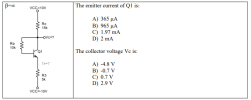 B= 0 VCC=10V The emitter current of Q1 is: Rc 315 A) 365 A B) 965 A C) 1.97 mA D) 2 mA OVc=? 10K The collector voltage Vc is: R3 A) -4.8 V B) -0.7 V C) 0.7 V D) 2.9 V w VCC=-100
Assume that the forward voltage drop across each LED is 2 volts. Determine the current through...
 Assume that the forward voltage drop across each LED is 2 volts. Determine the current through resistor R when the low-side transistor switch is off in cutoff. +12V B=1002 100_2 ova transistor OFF
 Problem 5 Given the following circuit, assume the following parameters VBB IV, RB 220 k, RC = 2 k, VCC= 10 V, VBE(on)-0.7 V, and B 200 a) Calculate the base, collector, and emitter currents and the C-E voltage, also, calculate the transistor power dissipation b) What transistor configuration does the circuit resemble? Vcc=10V RC=2k Rg=220 kQ VCE VBB= 1V o + VRE IB
 24. For the circuit shown find the current flowing through the 50Ω Resistor (R) R1-200 10V R2-300 R3:500 R4-200
 (6) A blue LED with a forward voltage drop of 3.5V is to be energized from a 12 volt battery. To light the blue LED to ful brightness requires a current of 20 mA through the LED. The blue LED has a peak inverse voltage rating of 5 V. i) Draw the circuit dingram of the arrangement you will use to light the LED to full brightness. (ii What is the value of the resistor you will use in your...
 to create a circuit which drives a controlled current through an
LED with an
input voltage, Vref.The design performed here is a low power
circuit (at most 15 mA
ows through the LED) which will be scaled up to a high
powered version (300 mA) for your major project.
The voltage drop across the resistor should be large enough for
the feedback voltage to not
be signicantly e ected by noise.
The resistance should be large enough for parasitic resistance...
to create a circuit which drives a controlled current through an
LED with an
input voltage, Vref.The design performed here is a low power
circuit (at most 15 mA
ows through the LED) which will be scaled up to a high
powered version (300 mA) for your major project.
The voltage drop across the resistor should be large enough for
the feedback voltage to not
be signicantly e ected by noise.
The resistance should be large enough for parasitic resistance...
 6. Assume that at t-0 there is no current through the inductor and no voltage across the capacitors. (a) Find Voul (s) for t>0 b) Find vu) for>0 80 mF ー)10V 1 H 80 mF Vo
 B= 0 VCC=10V The emitter current of Q1 is: Rc 315 A) 365 A B) 965 A C) 1.97 mA D) 2 mA OVc=? 10K The collector voltage Vc is: R3 A) -4.8 V B) -0.7 V C) 0.7 V D) 2.9 V w VCC=-100
 Assume that the forward voltage drop across each LED is 2 volts. Determine the current through resistor R when the low-side transistor switch is off in cutoff. +12V B=1002 100_2 ova transistor OFF
Most questions answered within 3 hours.
-
Where is the error in this code sequence?
String s1 = "Hello";
String s2 = "ello";...
asked 10 months ago -
Financial data for Joel de Paris, Inc., for last year
follow:
Joel de Paris, Inc.
Balance...
asked 10 months ago -
Consider this reaction:
Al2(SO4)3 (aq)+ BaCl3
(aq) Al2Cl6 (aq)- +
3BaSO4(s) . What is the...
asked 10 months ago -
Suppose that Savneet is considering increasing her
recent random sample from 20 car rentals to 40...
asked 10 months ago -
Trucks arrive at an unloading terminal at an average rate of 120
per hour.
Trucks arrive...
asked 10 months ago -
Why are methanol and ethanol completely soluble in water while
octanol is not very little soluble....
asked 10 months ago -
A facilities manager at a university reads in a research report
that the mean amount of...
asked 10 months ago -
When the CuSO4 is rehydrated by adding water to the anhydrous
compound, is this an endothermic...
asked 10 months ago -
A ray of sunlight is passing from diamond into crown glass; the
angle of incidence is...
asked 10 months ago -
A block of mass 0.249 kg is placed on top of a light, vertical
spring of...
asked 10 months ago -
how do the kidneys compensate in the presences of acidosis
a) trigger hyperventilate
b) reserve acid...
asked 10 months ago -
Question 501 pts
The rental rate of capital to the firm increases. Which of the
following...
asked 10 months ago