
Homework Answers
Add Answer to:
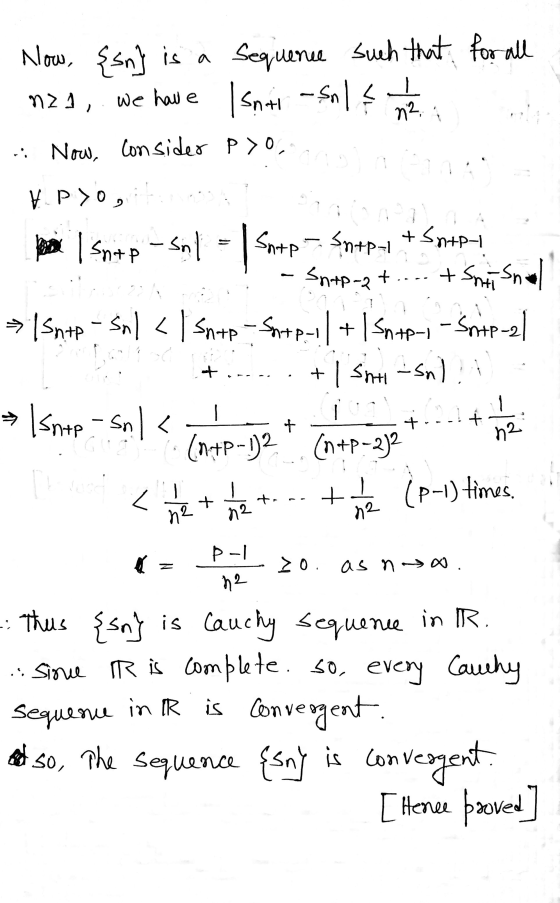
Suppose (Sn) is a sequence such that, for all n 1, we have 1 Sn+1 –...
a. 1 4. Let Sn =EX=1 Show that In(n+1) < Sn S 1+In n b. Show...
 a. 1 4. Let Sn =EX=1 Show that In(n+1) < Sn S 1+In n b. Show that {an} = {Sn - In n} Show that sequence {an} converges C.
Problem 2 Show that if the sequence of numbers (an)n-1 satisfies Inlan) < oo, then the...
 Problem 2 Show that if the sequence of numbers (an)n-1 satisfies Inlan) < oo, then the series In ancos(nx) converges uniformly on [0, 27). This means, the partial sums Sn(x) = ) ancos(nx) define a sequence of functions {sn} = that converges uniformly on [0, 271]. Hint: First show that the sequence is Cauchy with respect to || · ||00.
1. Let {n} be a sequence of non negative real numbers, and suppose that limnan =...
 1. Let {n} be a sequence of non negative real numbers, and suppose that limnan = 0 and 11 + x2 + ... + In <oo. lim sup - n-00 Prove that the sequence x + x + ... + converges and determine its limit. Hint: Start by trying to determine lim supno Yn. What can you say about lim infn- Yn? 3 ) for all n Expanded Hint: First, show that given any e > 0 we have (...
In questions 1-8, find the limit of the sequence. sin n cos n 2. 37 /n sin n 3. 4. cos rn 5. /n sin n o cos n n! 9. If c is a positive real number and lan) is a sequence such that for all inte...
 In questions 1-8, find the limit of the sequence. sin n cos n 2. 37 /n sin n 3. 4. cos rn 5. /n sin n o cos n n! 9. If c is a positive real number and lan) is a sequence such that for all integer n > 0, prove that limn →00 (an)/n-0. 10. If a > 0, prove that limn+ (sin n)/n 0 Theorem 6.9 Suppose that the sequence lan) is monotonic. Then ta, only if...
Suppose that and are Cauchy sequences. Show that the sequence is also Cauchy. Sn We were...
Suppose that and are Cauchy sequences. Show that the sequence is also Cauchy. Sn We were unable to transcribe this image(Sn-tn
Suppose that a sequence {Zn} satisfies Izn+1-Znl < 2-n for all n e N. Prove that...
 Suppose that a sequence {Zn} satisfies Izn+1-Znl < 2-n for all n e N. Prove that {z.) is Cauchy. Is this result true under the condition Irn +1-Fml < rt Let xi = 1 and xn +1 = (Zn + 1)/3 for all n e N. Find the first five terms in this sequence. Use induction to show that rn > 1/2 for all n and find the limit N. Prove that this sequence is non-increasing, convergent,
Show that a bounded and monotone sequence converges. Here a sequence is called monotone, if it...
 Show that a bounded and monotone sequence converges. Here a
sequence
is called monotone, if it is either monotone increasing, that is
for all
or monotone decreasing, in which case
for all
.
in Sn=1 An+1 > an neN an+1 < an We were unable to transcribe this image
Show that a bounded and monotone sequence converges. Here a
sequence
is called monotone, if it is either monotone increasing, that is
for all
or monotone decreasing, in which case
for all
.
in Sn=1 An+1 > an neN an+1 < an We were unable to transcribe this image
Find the imin and limsup oP the followi uences denoted lou Sn n+1 (b) sn = n (1+(-4)^) + n.)((-1)...
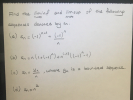 Find the imin and limsup oP the followi uences denoted lou Sn n+1 (b) sn = n (1+(-4)^) + n.)((-1) ) (c) sn=봬 , where ynis - bounded (d) sn =n2. sequence.
Find the imin and limsup oP the followi uences denoted lou Sn n+1 (b) sn = n (1+(-4)^) + n.)((-1) ) (c) sn=봬 , where ynis - bounded (d) sn =n2. sequence.
Find the imin and limsup oP the followi uences denoted lou Sn n+1 (b) sn = n (1+(-4)^) + n.)((-1) ) (c) sn=봬 , where ynis - bounded (d) sn =n2. sequence.
3.) Let ak E R with ak > 0 for all k E N. Suppose Σ㎞iak...
 3.) Let ak E R with ak > 0 for all k E N. Suppose Σ㎞iak converges. Show that Σί1bk (By definition, for a sequence (ck), we say liCkoo if, for all M ER with Hint: Show that there exists (Ni))ไ1 with N > Nj for all j E N, such that bk there exists a sequence (bk)k of real numbers such that lim converges = oo and M >0, there exists N E N such that ck > M...
4. Suppose (fr)nen is a sequence of functions on [0, 1] such that each fn is...
 4. Suppose (fr)nen is a sequence of functions on [0, 1] such that each fn is differentiable on (0,1) and f(x) < 1 for all x € (0,1) and n e N. (a) If (fn (0))nen converges to a number A, prove that lim sup|fn(x) = 1+|A| for all x € [0, 1]. n-too : (b) Suppose that (fr) converges uniformly on [0, 1] to a function F : [0, 1] + R. Is F necessarily differentiable on (0,1)? If...
 a. 1 4. Let Sn =EX=1 Show that In(n+1) < Sn S 1+In n b. Show that {an} = {Sn - In n} Show that sequence {an} converges C.
 Problem 2 Show that if the sequence of numbers (an)n-1 satisfies Inlan) < oo, then the series In ancos(nx) converges uniformly on [0, 27). This means, the partial sums Sn(x) = ) ancos(nx) define a sequence of functions {sn} = that converges uniformly on [0, 271]. Hint: First show that the sequence is Cauchy with respect to || · ||00.
 1. Let {n} be a sequence of non negative real numbers, and suppose that limnan = 0 and 11 + x2 + ... + In <oo. lim sup - n-00 Prove that the sequence x + x + ... + converges and determine its limit. Hint: Start by trying to determine lim supno Yn. What can you say about lim infn- Yn? 3 ) for all n Expanded Hint: First, show that given any e > 0 we have (...
 In questions 1-8, find the limit of the sequence. sin n cos n 2. 37 /n sin n 3. 4. cos rn 5. /n sin n o cos n n! 9. If c is a positive real number and lan) is a sequence such that for all integer n > 0, prove that limn →00 (an)/n-0. 10. If a > 0, prove that limn+ (sin n)/n 0 Theorem 6.9 Suppose that the sequence lan) is monotonic. Then ta, only if...
 Suppose that a sequence {Zn} satisfies Izn+1-Znl < 2-n for all n e N. Prove that {z.) is Cauchy. Is this result true under the condition Irn +1-Fml < rt Let xi = 1 and xn +1 = (Zn + 1)/3 for all n e N. Find the first five terms in this sequence. Use induction to show that rn > 1/2 for all n and find the limit N. Prove that this sequence is non-increasing, convergent,
 Show that a bounded and monotone sequence converges. Here a
sequence
is called monotone, if it is either monotone increasing, that is
for all
or monotone decreasing, in which case
for all
.
in Sn=1 An+1 > an neN an+1 < an We were unable to transcribe this image
Show that a bounded and monotone sequence converges. Here a
sequence
is called monotone, if it is either monotone increasing, that is
for all
or monotone decreasing, in which case
for all
.
in Sn=1 An+1 > an neN an+1 < an We were unable to transcribe this image
 Find the imin and limsup oP the followi uences denoted lou Sn n+1 (b) sn = n (1+(-4)^) + n.)((-1) ) (c) sn=봬 , where ynis - bounded (d) sn =n2. sequence.
Find the imin and limsup oP the followi uences denoted lou Sn n+1 (b) sn = n (1+(-4)^) + n.)((-1) ) (c) sn=봬 , where ynis - bounded (d) sn =n2. sequence.
Find the imin and limsup oP the followi uences denoted lou Sn n+1 (b) sn = n (1+(-4)^) + n.)((-1) ) (c) sn=봬 , where ynis - bounded (d) sn =n2. sequence.
 3.) Let ak E R with ak > 0 for all k E N. Suppose Σ㎞iak converges. Show that Σί1bk (By definition, for a sequence (ck), we say liCkoo if, for all M ER with Hint: Show that there exists (Ni))ไ1 with N > Nj for all j E N, such that bk there exists a sequence (bk)k of real numbers such that lim converges = oo and M >0, there exists N E N such that ck > M...
 4. Suppose (fr)nen is a sequence of functions on [0, 1] such that each fn is differentiable on (0,1) and f(x) < 1 for all x € (0,1) and n e N. (a) If (fn (0))nen converges to a number A, prove that lim sup|fn(x) = 1+|A| for all x € [0, 1]. n-too : (b) Suppose that (fr) converges uniformly on [0, 1] to a function F : [0, 1] + R. Is F necessarily differentiable on (0,1)? If...
Most questions answered within 3 hours.
-
Where is the error in this code sequence?
String s1 = "Hello";
String s2 = "ello";...
asked 10 months ago -
Financial data for Joel de Paris, Inc., for last year
follow:
Joel de Paris, Inc.
Balance...
asked 10 months ago -
Consider this reaction:
Al2(SO4)3 (aq)+ BaCl3
(aq) Al2Cl6 (aq)- +
3BaSO4(s) . What is the...
asked 10 months ago -
Suppose that Savneet is considering increasing her
recent random sample from 20 car rentals to 40...
asked 10 months ago -
Trucks arrive at an unloading terminal at an average rate of 120
per hour.
Trucks arrive...
asked 10 months ago -
Why are methanol and ethanol completely soluble in water while
octanol is not very little soluble....
asked 10 months ago -
A facilities manager at a university reads in a research report
that the mean amount of...
asked 10 months ago -
When the CuSO4 is rehydrated by adding water to the anhydrous
compound, is this an endothermic...
asked 10 months ago -
A ray of sunlight is passing from diamond into crown glass; the
angle of incidence is...
asked 10 months ago -
A block of mass 0.249 kg is placed on top of a light, vertical
spring of...
asked 10 months ago -
how do the kidneys compensate in the presences of acidosis
a) trigger hyperventilate
b) reserve acid...
asked 10 months ago -
Question 501 pts
The rental rate of capital to the firm increases. Which of the
following...
asked 10 months ago