
Homework Answers
Add Answer to:
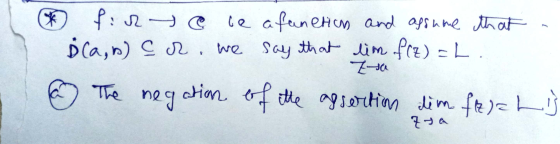
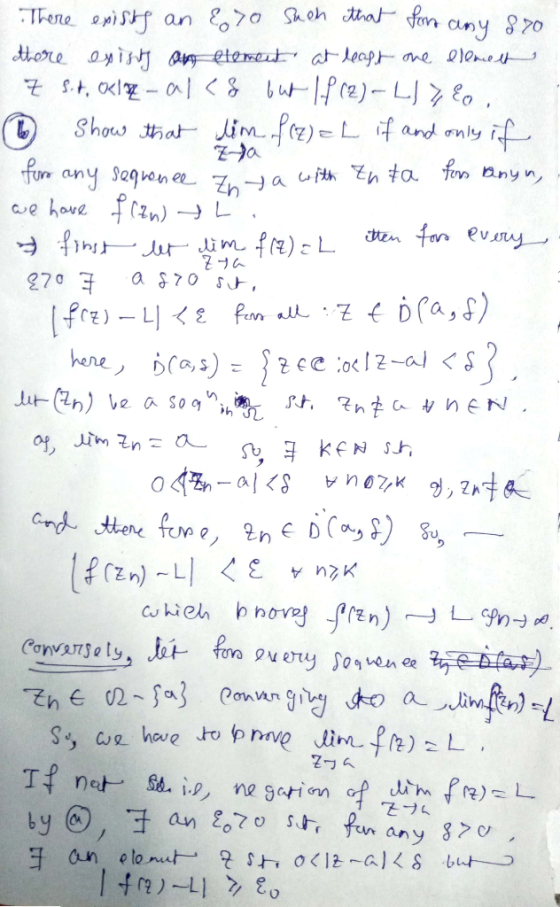
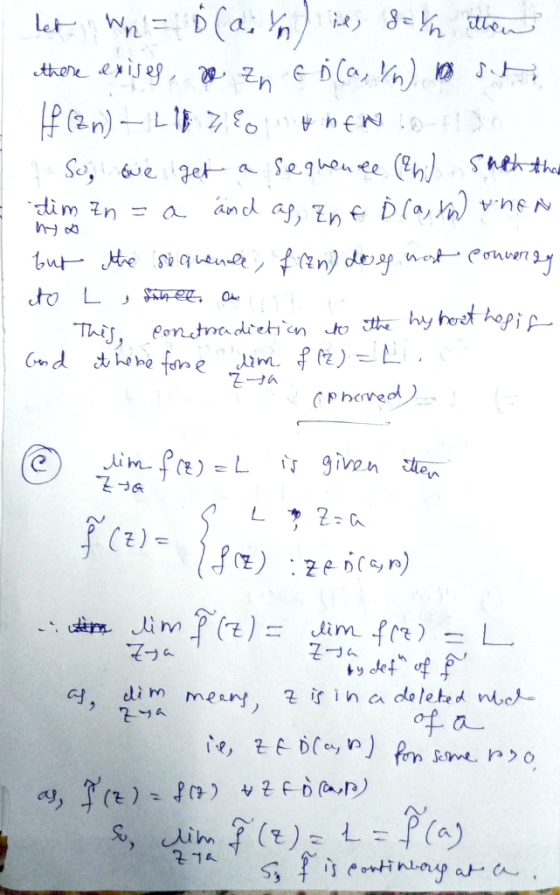
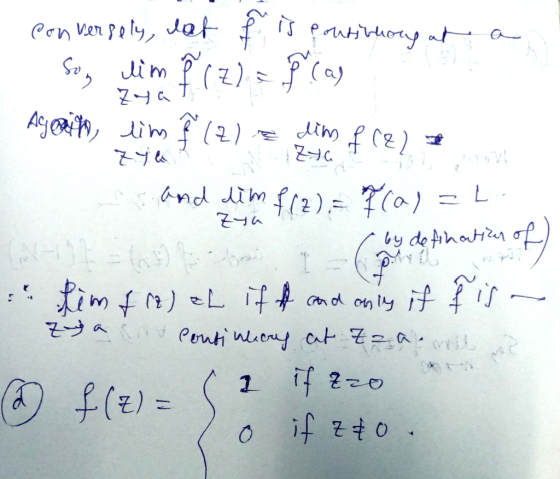
(Limit of functions) Let f : 2-» C be a function, and assume that D(a, r)...
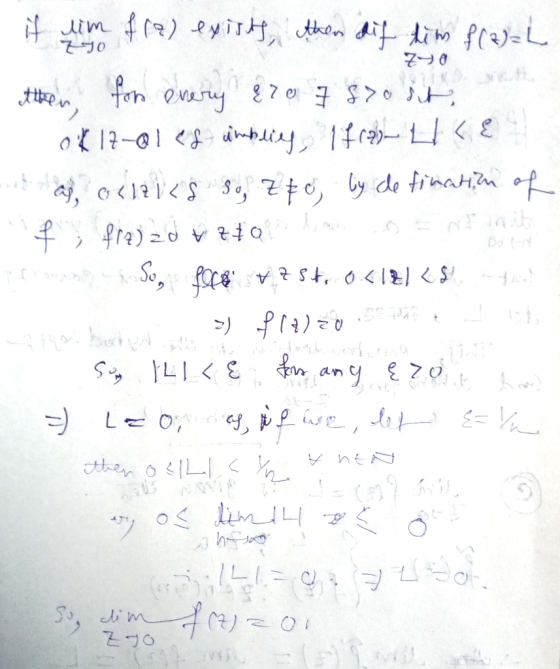
2. Let f: R R be a continuous function. Suppose that f is differentiable on R\{0} and that there exists an L e R such that lim,of,(z) = L. Prove that f is differentiable at 1-0 with f,(0) = L. (Hint:...
 2. Let f: R R be a continuous function. Suppose that f is differentiable on R\{0} and that there exists an L e R such that lim,of,(z) = L. Prove that f is differentiable at 1-0 with f,(0) = L. (Hint: Use the definition of derivative and then use mean value theorem)
2. Let f: R R be a continuous function. Suppose that f is differentiable on R\{0} and that there exists an L e R such that lim,of,(z) =...
2. Let f: R R be a continuous function. Suppose that f is differentiable on R\{0} and that there exists an L e R such that lim,of,(z) = L. Prove that f is differentiable at 1-0 with f,(0) = L. (Hint: Use the definition of derivative and then use mean value theorem)
2. Let f: R R be a continuous function. Suppose that f is differentiable on R\{0} and that there exists an L e R such that lim,of,(z) =...
Real analysis 10 11 12 13 please (r 2 4.1 Limit of Function 129 se f: E → R, p is a limit point of E, and li...
 Real analysis
10 11 12 13 please
(r 2 4.1 Limit of Function 129 se f: E → R, p is a limit point of E, and limf(x)-L. Prove that lim)ILI. h If, in addition, )o for all x E E, prove that lim b. Prove that lim (f(x))"-L" for each n E N. ethe limit theorems, examples, and previous exercises to find each of the following limits. State which theo- rems, examples, or exercises are used in each case....
Real analysis
10 11 12 13 please
(r 2 4.1 Limit of Function 129 se f: E → R, p is a limit point of E, and limf(x)-L. Prove that lim)ILI. h If, in addition, )o for all x E E, prove that lim b. Prove that lim (f(x))"-L" for each n E N. ethe limit theorems, examples, and previous exercises to find each of the following limits. State which theo- rems, examples, or exercises are used in each case....
Suppose f : D → R is a function and a ∈ R, and that...
4. Suppose f : D → R is a function and a ∈ R, and that for some β > 0, D contains (a-β, a + β)-{a} = (a-β, a) U (a, a + β). Prove that limx→a f(x) = L if and only if for all ε > 0 there exists δ > 0 such that if 0 < lx-al < δ and x ∈ D, then If(x) - L| < εDefinition: Suppose f : D → R is a function, a...
4. (a) Let A [0, oo) and let f.g:AR be functions which are continuous at 0 and are such that f(0) 9(0)-1. Show that there exists some δ > 0 such that ifTE 0,d) then (b) Consider the function 0 l i...
 4. (a) Let A [0, oo) and let f.g:AR be functions which are continuous at 0 and are such that f(0) 9(0)-1. Show that there exists some δ > 0 such that ifTE 0,d) then (b) Consider the function 0 l if z e R is rational, if zER is irrational f(z) Show that limfr) does not exists for any ceR.
4. (a) Let A [0, oo) and let f.g:AR be functions which are continuous at 0 and are such...
4. (a) Let A [0, oo) and let f.g:AR be functions which are continuous at 0 and are such that f(0) 9(0)-1. Show that there exists some δ > 0 such that ifTE 0,d) then (b) Consider the function 0 l if z e R is rational, if zER is irrational f(z) Show that limfr) does not exists for any ceR.
4. (a) Let A [0, oo) and let f.g:AR be functions which are continuous at 0 and are such...
Let f.9: A + R and assume that f is a bounded on A, that is...
 Let f.9: A + R and assume that f is a bounded on A, that is there exists an M > 0 satisfying \,f(x) < M for all 2 E A. Prove using the definition that if for some c E A we have limz+c9(x) = 0, then limz+c92)f(x) = 0 as well. (19 pts)
Let f : [a, b] → R and xo e (a,b). Assume that f is continuous...
 Let f : [a, b] → R and xo e (a,b). Assume that f is continuous
on [a,b] \{x0} and lim x approaches too x0 f(x) = L (L is finite)
exists. Show that f is Riemann integrable.
1. (20 pts) Let f : [a, b] R and to € (a,b). Assume that f is continuous on [a, b]\{ro} and limz-ro f (x) = L (L is finite) exists. Show that f is Riemann integrable. Hint: We split it into...
Let f : [a, b] → R and xo e (a,b). Assume that f is continuous
on [a,b] \{x0} and lim x approaches too x0 f(x) = L (L is finite)
exists. Show that f is Riemann integrable.
1. (20 pts) Let f : [a, b] R and to € (a,b). Assume that f is continuous on [a, b]\{ro} and limz-ro f (x) = L (L is finite) exists. Show that f is Riemann integrable. Hint: We split it into...
3. Let f: R+R be a function. (a) Assume that f is Riemann integrable on [a,...
 3. Let f: R+R be a function. (a) Assume that f is Riemann integrable on [a, b] by some a < b in R. Does there always exist a differentiable function F:RR such that F' = f? Provide either a counterexample or a proof. (b) Assume that f is differentiable, f'(x) > 1 for every x ER, f(0) = 0. Show that f(x) > x for every x > 0. (c) Assume that f(x) = 2:13 + x. Show that...
(2) Let f : Rn → R be a C2 function. Suppose a sequence (zk) converges to x*, where the Hessian H...
 (2) Let f : Rn → R be a C2 function. Suppose a sequence (zk) converges to x*, where the Hessian Hf(z.) is positive definite. Let ▽ := ▽f(xk)メ0, Hfk := H f(zk), dkー-Bİigfe, and :=-[Hfel-ı▽fk for each k, where each matrix Bk is ll(Be-Hfe)del = 0 if and only if ei adtive lim lidt dall =0. (11 points)
(2) Let f : Rn → R be a C2 function. Suppose a sequence (zk) converges to x*, where the Hessian...
(2) Let f : Rn → R be a C2 function. Suppose a sequence (zk) converges to x*, where the Hessian Hf(z.) is positive definite. Let ▽ := ▽f(xk)メ0, Hfk := H f(zk), dkー-Bİigfe, and :=-[Hfel-ı▽fk for each k, where each matrix Bk is ll(Be-Hfe)del = 0 if and only if ei adtive lim lidt dall =0. (11 points)
(2) Let f : Rn → R be a C2 function. Suppose a sequence (zk) converges to x*, where the Hessian...
+20 Problem 7. Let f :D + R, xo be an accumulation point of D and...
 +20 Problem 7. Let f :D + R, xo be an accumulation point of D and assume lim f(x) = L. Use the e-8 definition of the limit (not theorems or results from class or the text) to prove the following: (a) The function f is “bounded near xo”: there is an M ER and a 8 >0 such that for x E D, 0 < l< – xo<8 = \f(x) < M. Hint: compare with the proof that a...
1-> X- Let f :S → R and g:S → R be functions and c be...
 1-> X- Let f :S → R and g:S → R be functions and c be a cluster point. Assume lim f (x), lim g(x) exists. Using the definition of the limit prove the following lim(af (x) + Bg(x)) =a lim f(x) + Blim g(x) for any a,ßeR xc XC X-> b. lim( f(x))} = (lim f(x)) f(x) lim f (x) c. If (Vxe S)g(x) # () and lim g(x)() then prove lim X-C XC 10 g(x) lim g(x) X-C
 2. Let f: R R be a continuous function. Suppose that f is differentiable on R\{0} and that there exists an L e R such that lim,of,(z) = L. Prove that f is differentiable at 1-0 with f,(0) = L. (Hint: Use the definition of derivative and then use mean value theorem)
2. Let f: R R be a continuous function. Suppose that f is differentiable on R\{0} and that there exists an L e R such that lim,of,(z) =...
2. Let f: R R be a continuous function. Suppose that f is differentiable on R\{0} and that there exists an L e R such that lim,of,(z) = L. Prove that f is differentiable at 1-0 with f,(0) = L. (Hint: Use the definition of derivative and then use mean value theorem)
2. Let f: R R be a continuous function. Suppose that f is differentiable on R\{0} and that there exists an L e R such that lim,of,(z) =...
 Real analysis
10 11 12 13 please
(r 2 4.1 Limit of Function 129 se f: E → R, p is a limit point of E, and limf(x)-L. Prove that lim)ILI. h If, in addition, )o for all x E E, prove that lim b. Prove that lim (f(x))"-L" for each n E N. ethe limit theorems, examples, and previous exercises to find each of the following limits. State which theo- rems, examples, or exercises are used in each case....
Real analysis
10 11 12 13 please
(r 2 4.1 Limit of Function 129 se f: E → R, p is a limit point of E, and limf(x)-L. Prove that lim)ILI. h If, in addition, )o for all x E E, prove that lim b. Prove that lim (f(x))"-L" for each n E N. ethe limit theorems, examples, and previous exercises to find each of the following limits. State which theo- rems, examples, or exercises are used in each case....
 4. (a) Let A [0, oo) and let f.g:AR be functions which are continuous at 0 and are such that f(0) 9(0)-1. Show that there exists some δ > 0 such that ifTE 0,d) then (b) Consider the function 0 l if z e R is rational, if zER is irrational f(z) Show that limfr) does not exists for any ceR.
4. (a) Let A [0, oo) and let f.g:AR be functions which are continuous at 0 and are such...
4. (a) Let A [0, oo) and let f.g:AR be functions which are continuous at 0 and are such that f(0) 9(0)-1. Show that there exists some δ > 0 such that ifTE 0,d) then (b) Consider the function 0 l if z e R is rational, if zER is irrational f(z) Show that limfr) does not exists for any ceR.
4. (a) Let A [0, oo) and let f.g:AR be functions which are continuous at 0 and are such...
 Let f.9: A + R and assume that f is a bounded on A, that is there exists an M > 0 satisfying \,f(x) < M for all 2 E A. Prove using the definition that if for some c E A we have limz+c9(x) = 0, then limz+c92)f(x) = 0 as well. (19 pts)
 Let f : [a, b] → R and xo e (a,b). Assume that f is continuous
on [a,b] \{x0} and lim x approaches too x0 f(x) = L (L is finite)
exists. Show that f is Riemann integrable.
1. (20 pts) Let f : [a, b] R and to € (a,b). Assume that f is continuous on [a, b]\{ro} and limz-ro f (x) = L (L is finite) exists. Show that f is Riemann integrable. Hint: We split it into...
Let f : [a, b] → R and xo e (a,b). Assume that f is continuous
on [a,b] \{x0} and lim x approaches too x0 f(x) = L (L is finite)
exists. Show that f is Riemann integrable.
1. (20 pts) Let f : [a, b] R and to € (a,b). Assume that f is continuous on [a, b]\{ro} and limz-ro f (x) = L (L is finite) exists. Show that f is Riemann integrable. Hint: We split it into...
 3. Let f: R+R be a function. (a) Assume that f is Riemann integrable on [a, b] by some a < b in R. Does there always exist a differentiable function F:RR such that F' = f? Provide either a counterexample or a proof. (b) Assume that f is differentiable, f'(x) > 1 for every x ER, f(0) = 0. Show that f(x) > x for every x > 0. (c) Assume that f(x) = 2:13 + x. Show that...
 (2) Let f : Rn → R be a C2 function. Suppose a sequence (zk) converges to x*, where the Hessian Hf(z.) is positive definite. Let ▽ := ▽f(xk)メ0, Hfk := H f(zk), dkー-Bİigfe, and :=-[Hfel-ı▽fk for each k, where each matrix Bk is ll(Be-Hfe)del = 0 if and only if ei adtive lim lidt dall =0. (11 points)
(2) Let f : Rn → R be a C2 function. Suppose a sequence (zk) converges to x*, where the Hessian...
(2) Let f : Rn → R be a C2 function. Suppose a sequence (zk) converges to x*, where the Hessian Hf(z.) is positive definite. Let ▽ := ▽f(xk)メ0, Hfk := H f(zk), dkー-Bİigfe, and :=-[Hfel-ı▽fk for each k, where each matrix Bk is ll(Be-Hfe)del = 0 if and only if ei adtive lim lidt dall =0. (11 points)
(2) Let f : Rn → R be a C2 function. Suppose a sequence (zk) converges to x*, where the Hessian...
 +20 Problem 7. Let f :D + R, xo be an accumulation point of D and assume lim f(x) = L. Use the e-8 definition of the limit (not theorems or results from class or the text) to prove the following: (a) The function f is “bounded near xo”: there is an M ER and a 8 >0 such that for x E D, 0 < l< – xo<8 = \f(x) < M. Hint: compare with the proof that a...
 1-> X- Let f :S → R and g:S → R be functions and c be a cluster point. Assume lim f (x), lim g(x) exists. Using the definition of the limit prove the following lim(af (x) + Bg(x)) =a lim f(x) + Blim g(x) for any a,ßeR xc XC X-> b. lim( f(x))} = (lim f(x)) f(x) lim f (x) c. If (Vxe S)g(x) # () and lim g(x)() then prove lim X-C XC 10 g(x) lim g(x) X-C
Most questions answered within 3 hours.
-
Where is the error in this code sequence?
String s1 = "Hello";
String s2 = "ello";...
asked 10 months ago -
Financial data for Joel de Paris, Inc., for last year
follow:
Joel de Paris, Inc.
Balance...
asked 10 months ago -
Consider this reaction:
Al2(SO4)3 (aq)+ BaCl3
(aq) Al2Cl6 (aq)- +
3BaSO4(s) . What is the...
asked 10 months ago -
Suppose that Savneet is considering increasing her
recent random sample from 20 car rentals to 40...
asked 10 months ago -
Trucks arrive at an unloading terminal at an average rate of 120
per hour.
Trucks arrive...
asked 10 months ago -
Why are methanol and ethanol completely soluble in water while
octanol is not very little soluble....
asked 10 months ago -
A facilities manager at a university reads in a research report
that the mean amount of...
asked 10 months ago -
When the CuSO4 is rehydrated by adding water to the anhydrous
compound, is this an endothermic...
asked 10 months ago -
A ray of sunlight is passing from diamond into crown glass; the
angle of incidence is...
asked 10 months ago -
A block of mass 0.249 kg is placed on top of a light, vertical
spring of...
asked 10 months ago -
how do the kidneys compensate in the presences of acidosis
a) trigger hyperventilate
b) reserve acid...
asked 10 months ago -
Question 501 pts
The rental rate of capital to the firm increases. Which of the
following...
asked 10 months ago