
Homework Answers
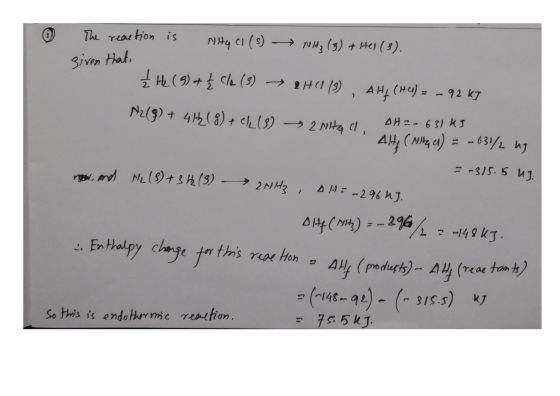
Add Answer to:
Unit 8.3: Energy in Chemical Reactions Item 10 Part A Calculate the enthalpy change for the...
A chemist measures the enthalpy change AH during the following reaction: 3 CH , Br(g) +...
 A chemist measures the enthalpy change AH during the following reaction: 3 CH , Br(g) + NH3(9)– (CH3),N(I) + 3 HBr(g) AH=73. kJ Use this information to complete the table below. Round each of your answers to the nearest kJ/mol. reaction AH 9CH, Br(s) + 3NH, 6) Х 5 ? 3(CH),N(1) + 9H Br(e) (CH),N(1) + 3H Br(e) 3CH, Br(e) + NH,G) 6CH, Br(g) + 2NH, (8) 2(CH), N() + 6H Br(e)
The specific heat of iron is 0.450 J/g°C 1127 Chapter 6 Discussion Problems 1. How much energy must be transferred t...
 The specific heat of iron is 0.450 J/g°C
1127 Chapter 6 Discussion Problems 1. How much energy must be transferred to raise the temperature of a cup of coffee (250 mL) from 20.5°C 10 95.6°C? Assume density and specific heat is the same as Water 4.16 Ig/ml 2. An 38.5 g piece of iron with temperature 78.8°C is placed in a beaker containing 244 g of water at 18.8°C. When thermal equilibrium is reached, what is the final temperature? Assume...
The specific heat of iron is 0.450 J/g°C
1127 Chapter 6 Discussion Problems 1. How much energy must be transferred to raise the temperature of a cup of coffee (250 mL) from 20.5°C 10 95.6°C? Assume density and specific heat is the same as Water 4.16 Ig/ml 2. An 38.5 g piece of iron with temperature 78.8°C is placed in a beaker containing 244 g of water at 18.8°C. When thermal equilibrium is reached, what is the final temperature? Assume...
10. Given the thermochemical data below, what is the change in enthalpy when 10.0 g of...
 10. Given the thermochemical data below, what is the change in enthalpy when 10.0 g of H, are reacted? N; (g) + 3H2(g) → 2NH, (g): AH = -91.2 kJ (A) -452 kJ (B) +452 kJ (C) -151 kJ (D) -1357 kJ 11. Which of the following is NOT a state function? 1. Heat 2. Change in enthalpy 3. Change in internal energy 4. Change in pressure (A) 1 only (B) 2 only (C) 2 and 3 (D) 1 and...
Express the enthalpy in kJ Acceptable units Acceptable units X C Get Homework Help With +...
 Express the enthalpy in kJ
Acceptable units Acceptable units X C Get Homework Help With + X um.ecollege.com/course.html?courseld-15350726&OpenVellumHMAC=c1df59a153217665a9f9526c8fe3a8b9# 10001 Course Home <Chapter 6 Exercise 6.82 - Enhanced - with Feedback < 24 of 34 Calculate A H for the following reaction: CH (g)+ 4C2(g) CC4(g) + 4HCI (g) given these reactions and their AH values: C(s) C(s) + 2C12(g) 2H2(g) CH4(g), CCL(g), AH=-74.6 kJ AH-95.7 kJ H2(g) + Cl2(g) 2HCI(g), AH=-184.6 kJ Express the enthalpy in kilojoules to one decimal...
Express the enthalpy in kJ
Acceptable units Acceptable units X C Get Homework Help With + X um.ecollege.com/course.html?courseld-15350726&OpenVellumHMAC=c1df59a153217665a9f9526c8fe3a8b9# 10001 Course Home <Chapter 6 Exercise 6.82 - Enhanced - with Feedback < 24 of 34 Calculate A H for the following reaction: CH (g)+ 4C2(g) CC4(g) + 4HCI (g) given these reactions and their AH values: C(s) C(s) + 2C12(g) 2H2(g) CH4(g), CCL(g), AH=-74.6 kJ AH-95.7 kJ H2(g) + Cl2(g) 2HCI(g), AH=-184.6 kJ Express the enthalpy in kilojoules to one decimal...
10. Given the following table: Compound NO: (g) N:O (g) AHP (J mol) AGP (J mol) 51.84 33.85 9.66 98.29 For t...
 10. Given the following table: Compound NO: (g) N:O (g) AHP (J mol) AGP (J mol) 51.84 33.85 9.66 98.29 For the reaction: N:Oa (g) eo 2NO: (g) (a) Use the information in the Table to calculate AG for the reaction (b) Use the information in the Table to calculate AH" for the reaction (c) Calculate K, at 25 C. (d) Calculate K, at 1600 °C. (Assume AH to be temperature independent) (e) Calculate the degree of dissociation, a, of...
16.52 Balance each of the following unbalanced equations for cell reactions in acidic conditions, then calculate...
 16.52 Balance each of the following unbalanced equations for cell reactions in acidic conditions, then calculate the standard cell emf, and decide whether the equation is written in the direction of spontaneous reaction. (a) Sn2+ (aq) + Ag(s) > Sn(s) + Ag+ (aq) (b) Al(s) + Sn4+ (aq) → Sn²+ (aq) + AP+ (aq) (C) CIO3+ (aq) + Ce3+ (aq) —Cl(aq) + Ce++ (aq) (d) Cu(s) + NO3 (aq) —> Cu2+ (aq) + NO(g) 16 .1 APPENDIX F standard Reduction...
Calculate the standard free-energy change and the equilibrium constant Kc for the following reaction at 25°C....
 Calculate the standard free-energy change and the equilibrium constant Kc for the following reaction at 25°C. See Appendix C for data. Fe(s) + Cu2+ (aq) = Fe2+ (aq) + Cu(s) Find equilibrium constan + K at 25°C Appendix C Thermodynamic Quantities for Substances and Ions at 25°C Substance or lon AH; (kJ/mol) AG; (kJ/mol (J/mol-K) 20.87 Substance or lon Ba(OH),(s) ΔΗ: (kJ/mol) -946.3 --3342.2 AG (kJ/mol) -859.3 -2793 (J/mol K) 107.1 427 Ba(OH), 8H,O(s) BaSO (8) - 1473.2 -1362.3 132.2...
4. Only ideal processes can be thermodynamically "reversible." Why can rear proce y can real process...
 4. Only ideal processes can be thermodynamically "reversible." Why can rear proce y can real processes not be? 5. Consider the following reactions. (Note: if this were an exam we would give you an excerpt on tabular data from Appendix 4 (Table A4.3). 2Fe(s) + 3Cla(s) 2FeCl(s) N2H4(8) + H2(g) + 2NH3(g) (a) Would you expect the entropy change for the above reaction to be >0, <0, or no (small)? Justify your answer. (d) Would you expect the entropy change...
 A chemist measures the enthalpy change AH during the following reaction: 3 CH , Br(g) + NH3(9)– (CH3),N(I) + 3 HBr(g) AH=73. kJ Use this information to complete the table below. Round each of your answers to the nearest kJ/mol. reaction AH 9CH, Br(s) + 3NH, 6) Х 5 ? 3(CH),N(1) + 9H Br(e) (CH),N(1) + 3H Br(e) 3CH, Br(e) + NH,G) 6CH, Br(g) + 2NH, (8) 2(CH), N() + 6H Br(e)
 The specific heat of iron is 0.450 J/g°C
1127 Chapter 6 Discussion Problems 1. How much energy must be transferred to raise the temperature of a cup of coffee (250 mL) from 20.5°C 10 95.6°C? Assume density and specific heat is the same as Water 4.16 Ig/ml 2. An 38.5 g piece of iron with temperature 78.8°C is placed in a beaker containing 244 g of water at 18.8°C. When thermal equilibrium is reached, what is the final temperature? Assume...
The specific heat of iron is 0.450 J/g°C
1127 Chapter 6 Discussion Problems 1. How much energy must be transferred to raise the temperature of a cup of coffee (250 mL) from 20.5°C 10 95.6°C? Assume density and specific heat is the same as Water 4.16 Ig/ml 2. An 38.5 g piece of iron with temperature 78.8°C is placed in a beaker containing 244 g of water at 18.8°C. When thermal equilibrium is reached, what is the final temperature? Assume...
 10. Given the thermochemical data below, what is the change in enthalpy when 10.0 g of H, are reacted? N; (g) + 3H2(g) → 2NH, (g): AH = -91.2 kJ (A) -452 kJ (B) +452 kJ (C) -151 kJ (D) -1357 kJ 11. Which of the following is NOT a state function? 1. Heat 2. Change in enthalpy 3. Change in internal energy 4. Change in pressure (A) 1 only (B) 2 only (C) 2 and 3 (D) 1 and...
 Express the enthalpy in kJ
Acceptable units Acceptable units X C Get Homework Help With + X um.ecollege.com/course.html?courseld-15350726&OpenVellumHMAC=c1df59a153217665a9f9526c8fe3a8b9# 10001 Course Home <Chapter 6 Exercise 6.82 - Enhanced - with Feedback < 24 of 34 Calculate A H for the following reaction: CH (g)+ 4C2(g) CC4(g) + 4HCI (g) given these reactions and their AH values: C(s) C(s) + 2C12(g) 2H2(g) CH4(g), CCL(g), AH=-74.6 kJ AH-95.7 kJ H2(g) + Cl2(g) 2HCI(g), AH=-184.6 kJ Express the enthalpy in kilojoules to one decimal...
Express the enthalpy in kJ
Acceptable units Acceptable units X C Get Homework Help With + X um.ecollege.com/course.html?courseld-15350726&OpenVellumHMAC=c1df59a153217665a9f9526c8fe3a8b9# 10001 Course Home <Chapter 6 Exercise 6.82 - Enhanced - with Feedback < 24 of 34 Calculate A H for the following reaction: CH (g)+ 4C2(g) CC4(g) + 4HCI (g) given these reactions and their AH values: C(s) C(s) + 2C12(g) 2H2(g) CH4(g), CCL(g), AH=-74.6 kJ AH-95.7 kJ H2(g) + Cl2(g) 2HCI(g), AH=-184.6 kJ Express the enthalpy in kilojoules to one decimal...
 10. Given the following table: Compound NO: (g) N:O (g) AHP (J mol) AGP (J mol) 51.84 33.85 9.66 98.29 For the reaction: N:Oa (g) eo 2NO: (g) (a) Use the information in the Table to calculate AG for the reaction (b) Use the information in the Table to calculate AH" for the reaction (c) Calculate K, at 25 C. (d) Calculate K, at 1600 °C. (Assume AH to be temperature independent) (e) Calculate the degree of dissociation, a, of...
 16.52 Balance each of the following unbalanced equations for cell reactions in acidic conditions, then calculate the standard cell emf, and decide whether the equation is written in the direction of spontaneous reaction. (a) Sn2+ (aq) + Ag(s) > Sn(s) + Ag+ (aq) (b) Al(s) + Sn4+ (aq) → Sn²+ (aq) + AP+ (aq) (C) CIO3+ (aq) + Ce3+ (aq) —Cl(aq) + Ce++ (aq) (d) Cu(s) + NO3 (aq) —> Cu2+ (aq) + NO(g) 16 .1 APPENDIX F standard Reduction...
 Calculate the standard free-energy change and the equilibrium constant Kc for the following reaction at 25°C. See Appendix C for data. Fe(s) + Cu2+ (aq) = Fe2+ (aq) + Cu(s) Find equilibrium constan + K at 25°C Appendix C Thermodynamic Quantities for Substances and Ions at 25°C Substance or lon AH; (kJ/mol) AG; (kJ/mol (J/mol-K) 20.87 Substance or lon Ba(OH),(s) ΔΗ: (kJ/mol) -946.3 --3342.2 AG (kJ/mol) -859.3 -2793 (J/mol K) 107.1 427 Ba(OH), 8H,O(s) BaSO (8) - 1473.2 -1362.3 132.2...
 4. Only ideal processes can be thermodynamically "reversible." Why can rear proce y can real processes not be? 5. Consider the following reactions. (Note: if this were an exam we would give you an excerpt on tabular data from Appendix 4 (Table A4.3). 2Fe(s) + 3Cla(s) 2FeCl(s) N2H4(8) + H2(g) + 2NH3(g) (a) Would you expect the entropy change for the above reaction to be >0, <0, or no (small)? Justify your answer. (d) Would you expect the entropy change...
Most questions answered within 3 hours.
-
Where is the error in this code sequence?
String s1 = "Hello";
String s2 = "ello";...
asked 11 months ago -
Financial data for Joel de Paris, Inc., for last year
follow:
Joel de Paris, Inc.
Balance...
asked 11 months ago -
Consider this reaction:
Al2(SO4)3 (aq)+ BaCl3
(aq) Al2Cl6 (aq)- +
3BaSO4(s) . What is the...
asked 11 months ago -
Suppose that Savneet is considering increasing her
recent random sample from 20 car rentals to 40...
asked 11 months ago -
Trucks arrive at an unloading terminal at an average rate of 120
per hour.
Trucks arrive...
asked 11 months ago -
Why are methanol and ethanol completely soluble in water while
octanol is not very little soluble....
asked 11 months ago -
A facilities manager at a university reads in a research report
that the mean amount of...
asked 11 months ago -
When the CuSO4 is rehydrated by adding water to the anhydrous
compound, is this an endothermic...
asked 11 months ago -
A ray of sunlight is passing from diamond into crown glass; the
angle of incidence is...
asked 11 months ago -
A block of mass 0.249 kg is placed on top of a light, vertical
spring of...
asked 11 months ago -
how do the kidneys compensate in the presences of acidosis
a) trigger hyperventilate
b) reserve acid...
asked 11 months ago -
Question 501 pts
The rental rate of capital to the firm increases. Which of the
following...
asked 11 months ago