What factors govern the success of addition of H2O to a double bond? (Organic chemistry I)
Homework Answers
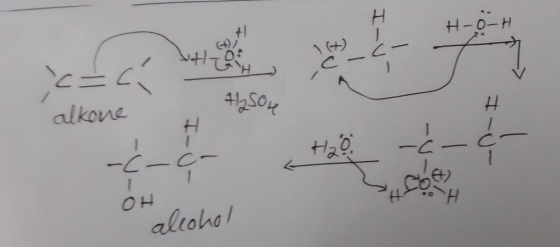
A:- Water molecule is exists as HO^+ and which donates a proton towards double bond, the double bond split and form a carbocation. H2O is as a neutral nucleophile, H2O. Because oxygen atom has two lone pairs and overlap to carbocation. Finally which form an alcohol by releasing a proton towards H2O.
Add Answer to:
What factors govern the success of addition of H2O to a double
bond? (Organic chemistry I)
ORGANIC CHEMISTRY QUESTION 5 PART A-------- Describe a chemical test for the identification of a double...
ORGANIC CHEMISTRY QUESTION 5 PART A-------- Describe a chemical test for the identification of a double bond in an organic molecule. PART B-------- During the reflux in Part B, the reaction smokes. What is the substance responsible for the smoke? (It would help if you looked at the complete reaction.) PART C------- The reaction of 17.0 g of 1,2-dibromo-1,2-diphenylethane with 1.12 g of KOH giving 6.32 g of diphenylacetylene. What is the % yield of this reaction?
how do I determine where the double bond will go and if this is sn1 or...
 how do I determine where the double bond will go and if this is sn1
or sn2
9. Predict the major organic products of the following reactions: (21 points) 1) Hg(OAC)2 > H2O 2) NaBHA CH,OH H2O LOCH но KOH KotBu HBr
how do I determine where the double bond will go and if this is sn1
or sn2
9. Predict the major organic products of the following reactions: (21 points) 1) Hg(OAC)2 > H2O 2) NaBHA CH,OH H2O LOCH но KOH KotBu HBr
Please help with all these questions in detail. This is related to the organic chemistry lab,...
 Please help with all these questions in detail. This is
related to the organic chemistry lab, Bromination of an
Alkene.
Post-lab Questions: 1. Explain/show how conjugation of a double bond with a carbonyl affects the vibrational frequency of the carbonyl. How was this demonstrated in our specific system? The melting point of the material from part A was lower than the expected 204 'C for the anti- addition product but significantly higher than 95 'C, the melting point of the...
Please help with all these questions in detail. This is
related to the organic chemistry lab, Bromination of an
Alkene.
Post-lab Questions: 1. Explain/show how conjugation of a double bond with a carbonyl affects the vibrational frequency of the carbonyl. How was this demonstrated in our specific system? The melting point of the material from part A was lower than the expected 204 'C for the anti- addition product but significantly higher than 95 'C, the melting point of the...
Organie Chemistry Organic Chem . Organic Nomenclature Chemistry Organic Chemistry Problems Of Alkenes Name Joshelyo Palma...
 Organie Chemistry Organic Chem . Organic Nomenclature Chemistry Organic Chemistry Problems Of Alkenes Name Joshelyo Palma Dato Problem 1: Are the following alkenes circle the carbon.carbon double bond and clearly indicate if the alkene is cis, trans or neither? Problem 2: Use the labels E and Z to best describe the stereochemistry of the alkenes below. а) ОН NH2 HN, с Problem 3: Using IUPAC rules name the following molecules. wawa (E) 2-hexene (26,45)-2,4-hexadiene (27,4E-2, 4-hexadiene (2.5, us)-4-methyl-2-hexe Organic Chemistry...
The addition of hydrogen to an organic compound or the decrease in carbon-oxygen bond is called...
The addition of hydrogen to an organic compound or the decrease in carbon-oxygen bond is called what?
a) There are several reagents that can be used to effect addition to a double bond,...
 a) There are several reagents that can be used to effect
addition to a double bond, including: acid and water,
oxymercuration--demercuration reagents, and
hydroboration--oxidation reagents. Inspect the final product and
select all the reasons why oxymercuration--demercuration was chosen
to effect the following transformation instead of the other
reagents.
b) Complete the mechanism for the reaction by adding curved
arrows. The reagents chosen for the transformation are: 1)
Hg(OAc)2, THF, H2O and 2) NaBH4, OH
a) There are several reagents that can be used to effect
addition to a double bond, including: acid and water,
oxymercuration--demercuration reagents, and
hydroboration--oxidation reagents. Inspect the final product and
select all the reasons why oxymercuration--demercuration was chosen
to effect the following transformation instead of the other
reagents.
b) Complete the mechanism for the reaction by adding curved
arrows. The reagents chosen for the transformation are: 1)
Hg(OAc)2, THF, H2O and 2) NaBH4, OH
An enzyme that aids in the addition of a group to a double bond is a)...
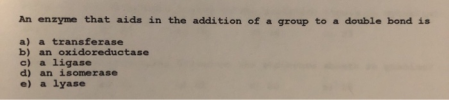 An enzyme that aids in the addition of a group to a double bond is a) a transferase b) an oxidoreductase c) a ligase d) an isomerase e) a lyase
ORGANIC CHEMISTRY I PRACTICE EXERCISE
 ORGANIC CHEMISTRY I PRACTICE EXERCISE Alkene reactions and mechanisms FOR QUESTIONS 1-24, GIVE THE MAJOR ORGANIC PRODUCT OF THE REACTION, PAYING PARTICULAR ATTENTION TO REGIO- AND STEREOCHEMICAL OUTCOMES
ORGANIC CHEMISTRY: I need all the steps, studying for a test currently. Each of the following...
 ORGANIC CHEMISTRY: I need all the steps, studying for a
test currently.
Each of the following involves an oxidative cleavage or electrophilic addition. For each reaction, draw the major expected organic product. Also write a few sentences to explain what is occurring in each reaction 1. KMnO_4 NaOH, H_2 O 2. Neutralization 1. O_3 (ozone) & (CH_3)_2 S Cl_2 and rightarrow insert solvent Br_2 and rightarrow insert solvent
ORGANIC CHEMISTRY: I need all the steps, studying for a
test currently.
Each of the following involves an oxidative cleavage or electrophilic addition. For each reaction, draw the major expected organic product. Also write a few sentences to explain what is occurring in each reaction 1. KMnO_4 NaOH, H_2 O 2. Neutralization 1. O_3 (ozone) & (CH_3)_2 S Cl_2 and rightarrow insert solvent Br_2 and rightarrow insert solvent
This is an organic chemistry question regarding the Diels-Alder reaction. The problems are 16.22 and 16.18....
 This is an organic chemistry question regarding the
Diels-Alder reaction. The problems are 16.22 and 16.18. I would
like to know if I did these correctly. If I did not, could someone
help me go through the process?
er reaction Conjugation, Resonance and Dienes Chapter 16 dienophile react in a Diels-Alder CH3 C. 16.18 Draw the product formed when each diene and Problem 16.18 COOCH3 15 Specific Rules Governing the Diels-Alder Reaction 16.13A Diene Reactivity Rule [1] The diene can...
This is an organic chemistry question regarding the
Diels-Alder reaction. The problems are 16.22 and 16.18. I would
like to know if I did these correctly. If I did not, could someone
help me go through the process?
er reaction Conjugation, Resonance and Dienes Chapter 16 dienophile react in a Diels-Alder CH3 C. 16.18 Draw the product formed when each diene and Problem 16.18 COOCH3 15 Specific Rules Governing the Diels-Alder Reaction 16.13A Diene Reactivity Rule [1] The diene can...
 how do I determine where the double bond will go and if this is sn1
or sn2
9. Predict the major organic products of the following reactions: (21 points) 1) Hg(OAC)2 > H2O 2) NaBHA CH,OH H2O LOCH но KOH KotBu HBr
how do I determine where the double bond will go and if this is sn1
or sn2
9. Predict the major organic products of the following reactions: (21 points) 1) Hg(OAC)2 > H2O 2) NaBHA CH,OH H2O LOCH но KOH KotBu HBr
 Please help with all these questions in detail. This is
related to the organic chemistry lab, Bromination of an
Alkene.
Post-lab Questions: 1. Explain/show how conjugation of a double bond with a carbonyl affects the vibrational frequency of the carbonyl. How was this demonstrated in our specific system? The melting point of the material from part A was lower than the expected 204 'C for the anti- addition product but significantly higher than 95 'C, the melting point of the...
Please help with all these questions in detail. This is
related to the organic chemistry lab, Bromination of an
Alkene.
Post-lab Questions: 1. Explain/show how conjugation of a double bond with a carbonyl affects the vibrational frequency of the carbonyl. How was this demonstrated in our specific system? The melting point of the material from part A was lower than the expected 204 'C for the anti- addition product but significantly higher than 95 'C, the melting point of the...
 Organie Chemistry Organic Chem . Organic Nomenclature Chemistry Organic Chemistry Problems Of Alkenes Name Joshelyo Palma Dato Problem 1: Are the following alkenes circle the carbon.carbon double bond and clearly indicate if the alkene is cis, trans or neither? Problem 2: Use the labels E and Z to best describe the stereochemistry of the alkenes below. а) ОН NH2 HN, с Problem 3: Using IUPAC rules name the following molecules. wawa (E) 2-hexene (26,45)-2,4-hexadiene (27,4E-2, 4-hexadiene (2.5, us)-4-methyl-2-hexe Organic Chemistry...
 a) There are several reagents that can be used to effect
addition to a double bond, including: acid and water,
oxymercuration--demercuration reagents, and
hydroboration--oxidation reagents. Inspect the final product and
select all the reasons why oxymercuration--demercuration was chosen
to effect the following transformation instead of the other
reagents.
b) Complete the mechanism for the reaction by adding curved
arrows. The reagents chosen for the transformation are: 1)
Hg(OAc)2, THF, H2O and 2) NaBH4, OH
a) There are several reagents that can be used to effect
addition to a double bond, including: acid and water,
oxymercuration--demercuration reagents, and
hydroboration--oxidation reagents. Inspect the final product and
select all the reasons why oxymercuration--demercuration was chosen
to effect the following transformation instead of the other
reagents.
b) Complete the mechanism for the reaction by adding curved
arrows. The reagents chosen for the transformation are: 1)
Hg(OAc)2, THF, H2O and 2) NaBH4, OH
 An enzyme that aids in the addition of a group to a double bond is a) a transferase b) an oxidoreductase c) a ligase d) an isomerase e) a lyase
 ORGANIC CHEMISTRY I PRACTICE EXERCISE Alkene reactions and mechanisms FOR QUESTIONS 1-24, GIVE THE MAJOR ORGANIC PRODUCT OF THE REACTION, PAYING PARTICULAR ATTENTION TO REGIO- AND STEREOCHEMICAL OUTCOMES
 ORGANIC CHEMISTRY: I need all the steps, studying for a
test currently.
Each of the following involves an oxidative cleavage or electrophilic addition. For each reaction, draw the major expected organic product. Also write a few sentences to explain what is occurring in each reaction 1. KMnO_4 NaOH, H_2 O 2. Neutralization 1. O_3 (ozone) & (CH_3)_2 S Cl_2 and rightarrow insert solvent Br_2 and rightarrow insert solvent
ORGANIC CHEMISTRY: I need all the steps, studying for a
test currently.
Each of the following involves an oxidative cleavage or electrophilic addition. For each reaction, draw the major expected organic product. Also write a few sentences to explain what is occurring in each reaction 1. KMnO_4 NaOH, H_2 O 2. Neutralization 1. O_3 (ozone) & (CH_3)_2 S Cl_2 and rightarrow insert solvent Br_2 and rightarrow insert solvent
 This is an organic chemistry question regarding the
Diels-Alder reaction. The problems are 16.22 and 16.18. I would
like to know if I did these correctly. If I did not, could someone
help me go through the process?
er reaction Conjugation, Resonance and Dienes Chapter 16 dienophile react in a Diels-Alder CH3 C. 16.18 Draw the product formed when each diene and Problem 16.18 COOCH3 15 Specific Rules Governing the Diels-Alder Reaction 16.13A Diene Reactivity Rule [1] The diene can...
This is an organic chemistry question regarding the
Diels-Alder reaction. The problems are 16.22 and 16.18. I would
like to know if I did these correctly. If I did not, could someone
help me go through the process?
er reaction Conjugation, Resonance and Dienes Chapter 16 dienophile react in a Diels-Alder CH3 C. 16.18 Draw the product formed when each diene and Problem 16.18 COOCH3 15 Specific Rules Governing the Diels-Alder Reaction 16.13A Diene Reactivity Rule [1] The diene can...
Most questions answered within 3 hours.
-
Where is the error in this code sequence?
String s1 = "Hello";
String s2 = "ello";...
asked 11 months ago -
Financial data for Joel de Paris, Inc., for last year
follow:
Joel de Paris, Inc.
Balance...
asked 11 months ago -
Consider this reaction:
Al2(SO4)3 (aq)+ BaCl3
(aq) Al2Cl6 (aq)- +
3BaSO4(s) . What is the...
asked 11 months ago -
Suppose that Savneet is considering increasing her
recent random sample from 20 car rentals to 40...
asked 11 months ago -
Trucks arrive at an unloading terminal at an average rate of 120
per hour.
Trucks arrive...
asked 11 months ago -
Why are methanol and ethanol completely soluble in water while
octanol is not very little soluble....
asked 11 months ago -
A facilities manager at a university reads in a research report
that the mean amount of...
asked 11 months ago -
When the CuSO4 is rehydrated by adding water to the anhydrous
compound, is this an endothermic...
asked 11 months ago -
A ray of sunlight is passing from diamond into crown glass; the
angle of incidence is...
asked 11 months ago -
A block of mass 0.249 kg is placed on top of a light, vertical
spring of...
asked 11 months ago -
how do the kidneys compensate in the presences of acidosis
a) trigger hyperventilate
b) reserve acid...
asked 11 months ago -
Question 501 pts
The rental rate of capital to the firm increases. Which of the
following...
asked 11 months ago