At a certain temperature, initial rate data for the decomposition of gaseous N2O5 are as follows:...
At a certain temperature, initial rate data for the decomposition of gaseous N2O5 are as follows:
|
Experiment Initial [N2O5] Initial Rate of Decomposition of N2O5
|
a) What is the rate law
b) What is the value of the rate constant, including the proper units?
c) What is the initial rate of decomposition of N2O5 when its initial concentration is 0.030M?
Homework Answers
![a) AssumE THE RATE LAW TO BE 6 SUBSTITUTE m= 1 in Ep. ③ - RATE =k (N2O3] - 0 6.8x10⁵ m = k (00040 19) mis ORDER OF REACTION W](http://img.homeworklib.com/questions/9ae38870-238f-11ec-9661-b74eef3e3683.png?x-oss-process=image/resize,w_560)
Add Answer to:
At a certain temperature, initial rate data for the
decomposition of gaseous N2O5 are as
follows:...
The rate law for the decomposition of N2O5 is rate = k[N2O5] If k = 1.0...
The rate law for the decomposition of N2O5 is rate = k[N2O5] If k = 1.0 x 10⁻⁵ s-1, what is the reaction rate when the N2O5 concentration is 0.0091 mol L-1? 2.The decomposition of acetaldehyde, CH3CHO, was determined to be a second order reaction with a rate constant of 0.0771 M-1 s-1. If the initial concentration of acetaldehyde is 0.301 M , what will the concentration be after selected reaction times? a. What will the CH3CHO concentration be after...
The gas phase decomposition of N2O5(g) àNO3(g) + NO2(g) is studied at a certain temperature, giving the...
The gas phase decomposition of N2O5(g) àNO3(g) + NO2(g) is studied at a certain temperature, giving the following data: Time (s) [N2O5] (M) 0.0 1.000 50.0 0.677 100.0 0.458 150.0 0.310 200.0 0.210 Is the overall order of reaction zeroth, first or second order? What is the rate constant (include units)? Calculate half-life (in s) for this reaction given the initial concentration in the table. What is the concentration of N2O5 (in M) at 250. s?
The decomposition of N2O5 in carbon tetrachloride proceeds as follows: 2N2O5→4NO2+O2 The rate law is first...
The decomposition of N2O5 in carbon tetrachloride proceeds as follows: 2N2O5→4NO2+O2 The rate law is first order in N2O5. At 64*C the rate constant is 4.82 ×10^−3s^−1 The rate law is 4.82x10⁻³s-1 [N2O5] The rate of rxn when [N2O5]=2.40x10^-2 M is 1.16x10^-4 M/s What happens to the rate when the concentration of N2O5 is doubled? What about halved? The answers are NOT 9.64x10^-3 and 2.41x10^-3 M/s
Be sure to answer all parts. For the decomposition of gaseous dinitrogen pentaoxide, 2 N2O5(g)→4 NO2(g)...
Be sure to answer all parts. For the decomposition of gaseous dinitrogen pentaoxide, 2 N2O5(g)→4 NO2(g) + O2(g) the rate constant is k = 2.8 × 10⁻³ s−1 at 60°C. The initial concentration of N2O5 is 2.32 mol/L. (a) What is [N2O5] after 5.00 min? mol L (b) What fraction of the N2O5 has decomposed after 5.00 min?
The decomposition of N2O5 in carbon tetrachloride proceeds as follows: What is the rate of reaction...
 The decomposition of N2O5 in carbon tetrachloride proceeds as follows: What is the rate of reaction when N205] = 0.0270? Express the rate in molarity per second to three significant figures. 2N2O3 + 4NO2 + O2 The rate law is first order in N2O5. At 64 °C the rate constant is 4.82 x 10⁻³ 3-1 IV AP R O 2 ? You may want to reference (Pages 576 - 581) Section 14.3 while completing this problem. rate = M /S...
10. Initial rate data have been determined at a certain temperature for the gaseous reaction: 2NO...
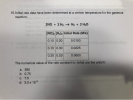 10. Initial rate data have been determined at a certain temperature for the gaseous reaction: 2NO + 2 H2 → N2 + 2 H20 [NO], [Hz]. Initial Rate (M/s) 0.10 0.20 0.0150 0.10 0.30 0.0225 0.20 0.20 0.0600 The numerical value of the rate constant is: (what are the units?) a. 380 b. 0.75 c. 7.5 d. 3.0 x 10⁻³
Consider this initial-rate data at a certain temperature for the reaction described by 2NO2(g)+O3(g) ----> N2O5(g)...
Consider this initial-rate data at a certain temperature for the reaction described by 2NO2(g)+O3(g) ----> N2O5(g) + O2(g) [NO2]0 (M) [O3]0(M) Initial rate (M/s) 0.650 0.800 2.47x10^4 1.10 0.800 4.18x10^4 1.76 1.40 11.70x10^4 Determine the value and units of the rate constant. K=_____
The rate constant for the first-order decomposition of N2O5 is 2.81×10⁻² s−1 at 20∘C. If the...
The rate constant for the first-order decomposition of N2O5 is 2.81×10⁻² s−1 at 20∘C. If the initial concentration of N2O5 is 2.50 M, what is the [N2O5] after 100 seconds?
The decomposition of N2O5 proceeds according to the following equation 2 N2O5(g) → 4 NO2(g) +...
The decomposition of N2O5 proceeds according to the following equation 2 N2O5(g) → 4 NO2(g) + O2(g). The rate constant, k, for the reaction at 298 K is 2.20 x 10⁻³ min-1. If a reaction is set up in a vessel at 298 K, with an initial concentration of 0.278 mol L-1; what is the concentration of reactant N2O5(g) in mol/L after 40.2 minutes? Report your answer without units
The decomposition of N2O5 in the gas phase was studied at constant temperature. 2 N 2O5(g)...
The decomposition of N2O5 in the gas phase was studied at constant temperature. 2 N 2O5(g) → 4 NO2(g) + O2(g) The following results were collected: [N 2O5] Time (s) 0.1000 0 0.0707 50 0.0500 100 0.0250 200 0.0125 300 0.00625 400 (a) Determine the rate law and calculate the value of k. (b) Determine the concentration of N2O5(g) at 250 s. Does your calculated answer make sense? Justify your answer. (c) Determine the concentration of N2O5(g) at 600...
 The decomposition of N2O5 in carbon tetrachloride proceeds as follows: What is the rate of reaction when N205] = 0.0270? Express the rate in molarity per second to three significant figures. 2N2O3 + 4NO2 + O2 The rate law is first order in N2O5. At 64 °C the rate constant is 4.82 x 10⁻³ 3-1 IV AP R O 2 ? You may want to reference (Pages 576 - 581) Section 14.3 while completing this problem. rate = M /S...
 10. Initial rate data have been determined at a certain temperature for the gaseous reaction: 2NO + 2 H2 → N2 + 2 H20 [NO], [Hz]. Initial Rate (M/s) 0.10 0.20 0.0150 0.10 0.30 0.0225 0.20 0.20 0.0600 The numerical value of the rate constant is: (what are the units?) a. 380 b. 0.75 c. 7.5 d. 3.0 x 10⁻³
Most questions answered within 3 hours.
-
Where is the error in this code sequence?
String s1 = "Hello";
String s2 = "ello";...
asked 10 months ago -
Financial data for Joel de Paris, Inc., for last year
follow:
Joel de Paris, Inc.
Balance...
asked 10 months ago -
Consider this reaction:
Al2(SO4)3 (aq)+ BaCl3
(aq) Al2Cl6 (aq)- +
3BaSO4(s) . What is the...
asked 10 months ago -
Suppose that Savneet is considering increasing her
recent random sample from 20 car rentals to 40...
asked 10 months ago -
Trucks arrive at an unloading terminal at an average rate of 120
per hour.
Trucks arrive...
asked 10 months ago -
Why are methanol and ethanol completely soluble in water while
octanol is not very little soluble....
asked 10 months ago -
A facilities manager at a university reads in a research report
that the mean amount of...
asked 10 months ago -
When the CuSO4 is rehydrated by adding water to the anhydrous
compound, is this an endothermic...
asked 10 months ago -
A ray of sunlight is passing from diamond into crown glass; the
angle of incidence is...
asked 10 months ago -
A block of mass 0.249 kg is placed on top of a light, vertical
spring of...
asked 10 months ago -
how do the kidneys compensate in the presences of acidosis
a) trigger hyperventilate
b) reserve acid...
asked 10 months ago -
Question 501 pts
The rental rate of capital to the firm increases. Which of the
following...
asked 10 months ago