
Homework Answers

Add Answer to:
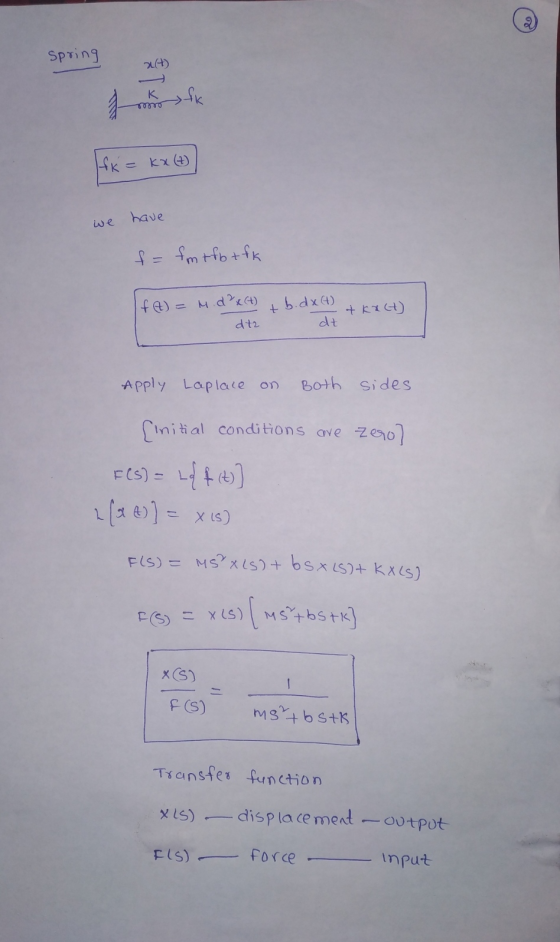
Fit p643 4 Derive the transfer f Mechanical system Fina. function in Drow block diagram of...
4. Block Diagrams (a) Consider a causal LTI system with transfer function Show the direct-form block diagram of Hi(s) b) Consider a causal LTI system with transfer function H282+4s -6 H (s) = 2 Show...
 4. Block Diagrams (a) Consider a causal LTI system with transfer function Show the direct-form block diagram of Hi(s) b) Consider a causal LTI system with transfer function H282+4s -6 H (s) = 2 Show the direct-form block diagram of Hi(s) (c) Now observe that to draw a block diagram as a cascaded combination of two 1st order subsystems. (d) Finally, use partial fraction expansion to express this system as a sum of individual poles and observe that you can...
4. Block Diagrams (a) Consider a causal LTI system with transfer function H(s)2 Show the direct-form block diagram of Hi(s) (b) Consider a causal LTI system with transfer function 2s2 +4s -6 H(s)- Sh...
 4. Block Diagrams (a) Consider a causal LTI system with transfer function H(s)2 Show the direct-form block diagram of Hi(s) (b) Consider a causal LTI system with transfer function 2s2 +4s -6 H(s)- Show the direct-form block diagram of Hi(s) c) Now observe that to draw a block diagram as a cascaded combination of two 1st order subsystems. d) Finally, use partial fraction expansion to express this system as a sum of individual poles and observe that you can draw...
QI. The block diagram representing a mechanical system is shown in Figure 1(a). The desired set...
 QI. The block diagram representing a mechanical system is shown in Figure 1(a). The desired set point to controllers is r(t) = 50. The system vibrates as shown in Figure 1(b). (1) Find the transfer function of C(s) /R(s) by reducing the block diagram (in) Determine the value of a and b (ii) Find the steady state error of the system Figure 1(a) Time (seconds) Figure 1(b) ANSWER Transfer function, 0.12b +0.12 0.12as +012bs + 0.125 + 1 () Mp....
Find the transfer function (X1/F) for the mechanical system shown below
 Find the transfer function (X/F) for the mechanical system shown below
4) for the system given block diagram below; a) find the transfer function of the control...
 4) for the system given block diagram below; a) find the transfer function of the control system. B) calculate and & values and explain what kind of dynamic behavior the system exhibits. c) if the unit digit effect is made in R (s ), infer the response equality of the system. 0.025 5 0.2.8+1 0.5-5+1 C($)
(1) For Figure 1, reduce the block diagram to the transfer function level. (2) For Figure...
 (1) For Figure 1, reduce the block diagram to the transfer function level. (2) For Figure 2, also reduce the block diagram to the transfer function level. (3) For Figure 3, again reduce the block diagram to the transfer function level. (4) For Figure 4, reduce the block diagram to the unity feedback loop level. Frgura 3 Ris) Hs Frere y Fes S8-12 K3 Kur
(1) For Figure 1, reduce the block diagram to the transfer function level. (2) For...
(1) For Figure 1, reduce the block diagram to the transfer function level. (2) For Figure 2, also reduce the block diagram to the transfer function level. (3) For Figure 3, again reduce the block diagram to the transfer function level. (4) For Figure 4, reduce the block diagram to the unity feedback loop level. Frgura 3 Ris) Hs Frere y Fes S8-12 K3 Kur
(1) For Figure 1, reduce the block diagram to the transfer function level. (2) For...
Question) The transfer function of the system given in the block diagram below a) Find with...
 Question) The transfer function of the system given in
the block diagram below
a) Find with the block diagram reduction method?
b) Find by Routh-Hurwitz stability analysis method?
NOTE: Draw option b on the flow diagram and solve it.
R(S) C(s) GA G3 G H
Question) The transfer function of the system given in
the block diagram below
a) Find with the block diagram reduction method?
b) Find by Routh-Hurwitz stability analysis method?
NOTE: Draw option b on the flow diagram and solve it.
R(S) C(s) GA G3 G H
1) Write a Matlab program for the following block diagram: a) to derive its closed-loop transfer function. b) to find and plot the poles-zeros of closed-loop transfer function. s+2s+3 R(s) → Y(s)...
 1) Write a Matlab program for the following block diagram: a) to derive its closed-loop transfer function. b) to find and plot the poles-zeros of closed-loop transfer function. s+2s+3 R(s) → Y(s) 2s+3 2 +2s +5 15 Automatic Control Systen
1) Write a Matlab program for the following block diagram: a) to derive its closed-loop transfer function. b) to find and plot the poles-zeros of closed-loop transfer function. s+2s+3 R(s) → Y(s) 2s+3 2 +2s +5 15 Automatic Control Systen
1) Write a Matlab program for the following block diagram: a) to derive its closed-loop transfer function. b) to find and plot the poles-zeros of closed-loop transfer function. s+2s+3 R(s) → Y(s) 2s+3 2 +2s +5 15 Automatic Control Systen
For a Mechanical Engineering System Dynamics class 1. 4 C(s) 1 S A system has a...
 For a Mechanical Engineering
System Dynamics class
1. 4 C(s) 1 S A system has a block diagram as shown. The input is R(s) and the output is C(s). a) Using only the block diagram reduction method*, R(s) find the transfer function of the system. b) Determine the characteristic function and the order of the system. c) Find the characteristic roots of the system. d) Find the natural frequency of the system. Find the damped natural frequency of the system....
For a Mechanical Engineering
System Dynamics class
1. 4 C(s) 1 S A system has a block diagram as shown. The input is R(s) and the output is C(s). a) Using only the block diagram reduction method*, R(s) find the transfer function of the system. b) Determine the characteristic function and the order of the system. c) Find the characteristic roots of the system. d) Find the natural frequency of the system. Find the damped natural frequency of the system....
5. Find the transfer function X (3) F(s) and X:(5) F(s) for the mechanical system below...
 5. Find the transfer function X (3) F(s) and X:(5) F(s) for the mechanical system below Kj = 4 N/m *(1) K2 = 5 N/m 00002 0000 = 3 N-s/m M =1 kg|fv2 = 3 N-s/m M2 = 2 kg Svz = 2 N-s/m E
 4. Block Diagrams (a) Consider a causal LTI system with transfer function Show the direct-form block diagram of Hi(s) b) Consider a causal LTI system with transfer function H282+4s -6 H (s) = 2 Show the direct-form block diagram of Hi(s) (c) Now observe that to draw a block diagram as a cascaded combination of two 1st order subsystems. (d) Finally, use partial fraction expansion to express this system as a sum of individual poles and observe that you can...
 4. Block Diagrams (a) Consider a causal LTI system with transfer function H(s)2 Show the direct-form block diagram of Hi(s) (b) Consider a causal LTI system with transfer function 2s2 +4s -6 H(s)- Show the direct-form block diagram of Hi(s) c) Now observe that to draw a block diagram as a cascaded combination of two 1st order subsystems. d) Finally, use partial fraction expansion to express this system as a sum of individual poles and observe that you can draw...
 QI. The block diagram representing a mechanical system is shown in Figure 1(a). The desired set point to controllers is r(t) = 50. The system vibrates as shown in Figure 1(b). (1) Find the transfer function of C(s) /R(s) by reducing the block diagram (in) Determine the value of a and b (ii) Find the steady state error of the system Figure 1(a) Time (seconds) Figure 1(b) ANSWER Transfer function, 0.12b +0.12 0.12as +012bs + 0.125 + 1 () Mp....
 4) for the system given block diagram below; a) find the transfer function of the control system. B) calculate and & values and explain what kind of dynamic behavior the system exhibits. c) if the unit digit effect is made in R (s ), infer the response equality of the system. 0.025 5 0.2.8+1 0.5-5+1 C($)
 (1) For Figure 1, reduce the block diagram to the transfer function level. (2) For Figure 2, also reduce the block diagram to the transfer function level. (3) For Figure 3, again reduce the block diagram to the transfer function level. (4) For Figure 4, reduce the block diagram to the unity feedback loop level. Frgura 3 Ris) Hs Frere y Fes S8-12 K3 Kur
(1) For Figure 1, reduce the block diagram to the transfer function level. (2) For...
(1) For Figure 1, reduce the block diagram to the transfer function level. (2) For Figure 2, also reduce the block diagram to the transfer function level. (3) For Figure 3, again reduce the block diagram to the transfer function level. (4) For Figure 4, reduce the block diagram to the unity feedback loop level. Frgura 3 Ris) Hs Frere y Fes S8-12 K3 Kur
(1) For Figure 1, reduce the block diagram to the transfer function level. (2) For...
 Question) The transfer function of the system given in
the block diagram below
a) Find with the block diagram reduction method?
b) Find by Routh-Hurwitz stability analysis method?
NOTE: Draw option b on the flow diagram and solve it.
R(S) C(s) GA G3 G H
Question) The transfer function of the system given in
the block diagram below
a) Find with the block diagram reduction method?
b) Find by Routh-Hurwitz stability analysis method?
NOTE: Draw option b on the flow diagram and solve it.
R(S) C(s) GA G3 G H
 1) Write a Matlab program for the following block diagram: a) to derive its closed-loop transfer function. b) to find and plot the poles-zeros of closed-loop transfer function. s+2s+3 R(s) → Y(s) 2s+3 2 +2s +5 15 Automatic Control Systen
1) Write a Matlab program for the following block diagram: a) to derive its closed-loop transfer function. b) to find and plot the poles-zeros of closed-loop transfer function. s+2s+3 R(s) → Y(s) 2s+3 2 +2s +5 15 Automatic Control Systen
1) Write a Matlab program for the following block diagram: a) to derive its closed-loop transfer function. b) to find and plot the poles-zeros of closed-loop transfer function. s+2s+3 R(s) → Y(s) 2s+3 2 +2s +5 15 Automatic Control Systen
 For a Mechanical Engineering
System Dynamics class
1. 4 C(s) 1 S A system has a block diagram as shown. The input is R(s) and the output is C(s). a) Using only the block diagram reduction method*, R(s) find the transfer function of the system. b) Determine the characteristic function and the order of the system. c) Find the characteristic roots of the system. d) Find the natural frequency of the system. Find the damped natural frequency of the system....
For a Mechanical Engineering
System Dynamics class
1. 4 C(s) 1 S A system has a block diagram as shown. The input is R(s) and the output is C(s). a) Using only the block diagram reduction method*, R(s) find the transfer function of the system. b) Determine the characteristic function and the order of the system. c) Find the characteristic roots of the system. d) Find the natural frequency of the system. Find the damped natural frequency of the system....
 5. Find the transfer function X (3) F(s) and X:(5) F(s) for the mechanical system below Kj = 4 N/m *(1) K2 = 5 N/m 00002 0000 = 3 N-s/m M =1 kg|fv2 = 3 N-s/m M2 = 2 kg Svz = 2 N-s/m E
Most questions answered within 3 hours.
-
Where is the error in this code sequence?
String s1 = "Hello";
String s2 = "ello";...
asked 10 months ago -
Financial data for Joel de Paris, Inc., for last year
follow:
Joel de Paris, Inc.
Balance...
asked 10 months ago -
Consider this reaction:
Al2(SO4)3 (aq)+ BaCl3
(aq) Al2Cl6 (aq)- +
3BaSO4(s) . What is the...
asked 10 months ago -
Suppose that Savneet is considering increasing her
recent random sample from 20 car rentals to 40...
asked 10 months ago -
Trucks arrive at an unloading terminal at an average rate of 120
per hour.
Trucks arrive...
asked 10 months ago -
Why are methanol and ethanol completely soluble in water while
octanol is not very little soluble....
asked 10 months ago -
A facilities manager at a university reads in a research report
that the mean amount of...
asked 10 months ago -
When the CuSO4 is rehydrated by adding water to the anhydrous
compound, is this an endothermic...
asked 10 months ago -
A ray of sunlight is passing from diamond into crown glass; the
angle of incidence is...
asked 10 months ago -
A block of mass 0.249 kg is placed on top of a light, vertical
spring of...
asked 10 months ago -
how do the kidneys compensate in the presences of acidosis
a) trigger hyperventilate
b) reserve acid...
asked 10 months ago -
Question 501 pts
The rental rate of capital to the firm increases. Which of the
following...
asked 10 months ago