
Homework Answers
Request Answer!
We need at least 10 more requests to produce the answer.
0 / 10 have requested this problem solution
The more requests, the faster the answer.
Add Answer to:
1) The farmer sells apples in a perfectly competitive market at a price of $1/pound. The...
please i want it typed please Styles 14. The Vague Fabric Company sells cotton fabric in...
 please i want it typed please
Styles 14. The Vague Fabric Company sells cotton fabric in a perfectly competitive market at a price of $4 per yard. Its marginal cost, average variable cost, and average total cost curves can be seen below. price MC ATC d=MR AVC Find the profit-maximizing level of output and mark it q* Shade in the area of profit earned by the firm. Is it positive or negative? How do you know? 15. The Binkle Binder...
please i want it typed please
Styles 14. The Vague Fabric Company sells cotton fabric in a perfectly competitive market at a price of $4 per yard. Its marginal cost, average variable cost, and average total cost curves can be seen below. price MC ATC d=MR AVC Find the profit-maximizing level of output and mark it q* Shade in the area of profit earned by the firm. Is it positive or negative? How do you know? 15. The Binkle Binder...
Price, cost ATC AVC Quantity Based on the graph the supply curve for the perfectly competitive...
 Price, cost ATC AVC Quantity Based on the graph the supply curve for the perfectly competitive firm depicted is most accurately represented by the segment: O O O O Price, cost Quantity Based on the graph above a perfectly competitive firm would never continue operations in short run if the price dropped to which segment of the marginal cost curve? O CE O AD O AC Осо
Will, Jill, and Phil are all wheat farmers. The wheat industry is perfectly (purely) competitive. The first chart shows how much each farmer produces at different price levels. The second chart shows each farmer's minimum average total cost (ATC), average
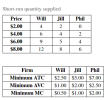 Will, Jill, and Phil are all wheat farmers. The wheat industry is perfectly (purely) competitive. The first chart shows how much each farmer produces at different price levels. The second chart shows each farmer's minimum average total cost (ATC), average variable cost (AVC), and marginal cost (MC).
Sonya and Leah operate a small firm in a perfectly competitive market, the diagram illustrates its...
 Sonya and Leah operate a small firm in a perfectly competitive
market, the diagram illustrates its MC, ATC, AVC and MR
curves.
1. What is their current average revenue per unit?
2. What is their profit maximizing level of output and
profit?
3. If the market clearing price drops to $10.00 per unit,
should they continue to produce in the short run if they wish to
maximize their economic profits (or minimize its economic losses)?
Explain.
4. What is their...
Sonya and Leah operate a small firm in a perfectly competitive
market, the diagram illustrates its MC, ATC, AVC and MR
curves.
1. What is their current average revenue per unit?
2. What is their profit maximizing level of output and
profit?
3. If the market clearing price drops to $10.00 per unit,
should they continue to produce in the short run if they wish to
maximize their economic profits (or minimize its economic losses)?
Explain.
4. What is their...
For a perfectly competitive market made up of firms represented in the graph below, what is...
 For a perfectly competitive market made up of firms represented in the graph below, what is the long run equilibrium price of the good? Cost ($) MC ATC AVC $16 $14 $12 $10 Quantity $14 $10 $12 $16 For a perfectly competitive market made up of firms represented in the graph below, if the price is $14, Cost ($) MC ATC $16 AVC - $14 $12 $10 Quantity The firm is operating at its minimum long run average total cost....
A watermelon farmer is operating in a perfectly competitive market. The market price of watermelon is...
A watermelon farmer is operating in a perfectly competitive market. The market price of watermelon is $5 per pound and each farmer produces 1,000 pounds per week. The average variable cost per unit is $3 per pound and the average fixed cost per unit is $1. a. What is a watermelon farmer’s profit in the short run? Explain. b. What happens to the total number of farms in the long run? Why? c. If technology reduces the cost of watermelon...
Assume that apples are produced in a perfectly competitive market. Grande’s Orchard is a typical firm...
Assume that apples are produced in a perfectly competitive market. Grande’s Orchard is a typical firm that grows and sells apples. Currently, Grande earns zero economic profit, and the market price of apples is $10 per bushel. (a) Draw a correctly labeled graph showing Grande’s demand curve, average total cost curve, and marginal cost curve, and show the profit-maximizing quantity, labeled QG . (b) Suppose an increase in the popularity of apple cider increases the demand for apples. How will...
Suppose the market for apples is perfectly competitive. The short-run average total cost and marginal cost...
 Suppose the market for apples is perfectly competitive. The short-run average total cost and marginal cost of growing apples for an individual grower are illustrated in the figure to the right. 10- 9- Assume that the market price for apples is $5.50 per box. What is the profit-maximizing quantity for apple growers to produce? boxes. (Enter your response as an integer.) 8- C 7- MC co Price (dollars per box) 5- 4- ATC 3- 2- 1 O- 10 90 100...
Please answer the following 3 questions: QUESTION 1 In the short run, the perfectly competitive firm...
 Please answer the following 3 questions:
QUESTION 1 In the short run, the perfectly competitive firm will always earn an economic profit when P MC. P ATC. P > AVC P > ATC. QUESTION 2 The demand curve faced by a perfectly competitive industry is horizontal slopes upward. has no slope. slopes downward. QUESTION 3 The short-run supply curve of a perfect competitor is its marginal revenue curve. its marginal cost curve equal to or above the minimum point on...
Please answer the following 3 questions:
QUESTION 1 In the short run, the perfectly competitive firm will always earn an economic profit when P MC. P ATC. P > AVC P > ATC. QUESTION 2 The demand curve faced by a perfectly competitive industry is horizontal slopes upward. has no slope. slopes downward. QUESTION 3 The short-run supply curve of a perfect competitor is its marginal revenue curve. its marginal cost curve equal to or above the minimum point on...
18. In a perfectly competitive market, individual firms set: A) prices and quantities B) neither prices...
 18. In a perfectly competitive market, individual firms set: A) prices and quantities B) neither prices nor quantities. C) quantiies but not prices D) prices but not quantities 19. The perfectly competitive firm faces a perfectly elastic demand curve because A) t has the ability to set the price and force everyone to buy at that price. it has no ability to control price. B) C) t doesn't; it faces a perfectly inelastic demand curve D) it doesn't; everyone knows...
 please i want it typed please
Styles 14. The Vague Fabric Company sells cotton fabric in a perfectly competitive market at a price of $4 per yard. Its marginal cost, average variable cost, and average total cost curves can be seen below. price MC ATC d=MR AVC Find the profit-maximizing level of output and mark it q* Shade in the area of profit earned by the firm. Is it positive or negative? How do you know? 15. The Binkle Binder...
please i want it typed please
Styles 14. The Vague Fabric Company sells cotton fabric in a perfectly competitive market at a price of $4 per yard. Its marginal cost, average variable cost, and average total cost curves can be seen below. price MC ATC d=MR AVC Find the profit-maximizing level of output and mark it q* Shade in the area of profit earned by the firm. Is it positive or negative? How do you know? 15. The Binkle Binder...
 Price, cost ATC AVC Quantity Based on the graph the supply curve for the perfectly competitive firm depicted is most accurately represented by the segment: O O O O Price, cost Quantity Based on the graph above a perfectly competitive firm would never continue operations in short run if the price dropped to which segment of the marginal cost curve? O CE O AD O AC Осо
 Sonya and Leah operate a small firm in a perfectly competitive
market, the diagram illustrates its MC, ATC, AVC and MR
curves.
1. What is their current average revenue per unit?
2. What is their profit maximizing level of output and
profit?
3. If the market clearing price drops to $10.00 per unit,
should they continue to produce in the short run if they wish to
maximize their economic profits (or minimize its economic losses)?
Explain.
4. What is their...
Sonya and Leah operate a small firm in a perfectly competitive
market, the diagram illustrates its MC, ATC, AVC and MR
curves.
1. What is their current average revenue per unit?
2. What is their profit maximizing level of output and
profit?
3. If the market clearing price drops to $10.00 per unit,
should they continue to produce in the short run if they wish to
maximize their economic profits (or minimize its economic losses)?
Explain.
4. What is their...
 For a perfectly competitive market made up of firms represented in the graph below, what is the long run equilibrium price of the good? Cost ($) MC ATC AVC $16 $14 $12 $10 Quantity $14 $10 $12 $16 For a perfectly competitive market made up of firms represented in the graph below, if the price is $14, Cost ($) MC ATC $16 AVC - $14 $12 $10 Quantity The firm is operating at its minimum long run average total cost....
 Suppose the market for apples is perfectly competitive. The short-run average total cost and marginal cost of growing apples for an individual grower are illustrated in the figure to the right. 10- 9- Assume that the market price for apples is $5.50 per box. What is the profit-maximizing quantity for apple growers to produce? boxes. (Enter your response as an integer.) 8- C 7- MC co Price (dollars per box) 5- 4- ATC 3- 2- 1 O- 10 90 100...
 Please answer the following 3 questions:
QUESTION 1 In the short run, the perfectly competitive firm will always earn an economic profit when P MC. P ATC. P > AVC P > ATC. QUESTION 2 The demand curve faced by a perfectly competitive industry is horizontal slopes upward. has no slope. slopes downward. QUESTION 3 The short-run supply curve of a perfect competitor is its marginal revenue curve. its marginal cost curve equal to or above the minimum point on...
Please answer the following 3 questions:
QUESTION 1 In the short run, the perfectly competitive firm will always earn an economic profit when P MC. P ATC. P > AVC P > ATC. QUESTION 2 The demand curve faced by a perfectly competitive industry is horizontal slopes upward. has no slope. slopes downward. QUESTION 3 The short-run supply curve of a perfect competitor is its marginal revenue curve. its marginal cost curve equal to or above the minimum point on...
 18. In a perfectly competitive market, individual firms set: A) prices and quantities B) neither prices nor quantities. C) quantiies but not prices D) prices but not quantities 19. The perfectly competitive firm faces a perfectly elastic demand curve because A) t has the ability to set the price and force everyone to buy at that price. it has no ability to control price. B) C) t doesn't; it faces a perfectly inelastic demand curve D) it doesn't; everyone knows...
Most questions answered within 3 hours.
-
Where is the error in this code sequence?
String s1 = "Hello";
String s2 = "ello";...
asked 10 months ago -
Financial data for Joel de Paris, Inc., for last year
follow:
Joel de Paris, Inc.
Balance...
asked 10 months ago -
Consider this reaction:
Al2(SO4)3 (aq)+ BaCl3
(aq) Al2Cl6 (aq)- +
3BaSO4(s) . What is the...
asked 10 months ago -
Suppose that Savneet is considering increasing her
recent random sample from 20 car rentals to 40...
asked 10 months ago -
Trucks arrive at an unloading terminal at an average rate of 120
per hour.
Trucks arrive...
asked 10 months ago -
Why are methanol and ethanol completely soluble in water while
octanol is not very little soluble....
asked 10 months ago -
A facilities manager at a university reads in a research report
that the mean amount of...
asked 10 months ago -
When the CuSO4 is rehydrated by adding water to the anhydrous
compound, is this an endothermic...
asked 10 months ago -
A ray of sunlight is passing from diamond into crown glass; the
angle of incidence is...
asked 10 months ago -
A block of mass 0.249 kg is placed on top of a light, vertical
spring of...
asked 10 months ago -
how do the kidneys compensate in the presences of acidosis
a) trigger hyperventilate
b) reserve acid...
asked 10 months ago -
Question 501 pts
The rental rate of capital to the firm increases. Which of the
following...
asked 10 months ago