Suppose a company had an initial investment of $50,000. The cash flow for the next five...
Suppose a company had an initial investment of $50,000. The cash flow for the next five years are $14,000, $13,000, $13,000, $19,000, and $14,000, respectively. The interest rate is 5%. Enter your answer rounded to 2 DECIMAL PLACES.
What is the discounted payback period?
If the firm requires a discounted payback periods 4 years or less, will the project be accepted?
| Yes | OR. | No |
Homework Answers
Calculation of discounted pay back period:
Calculation of discounted and cumulative cashflows:
Year. Cashflow. PVF@5%. Pv of cashflow
1. $14,000. 0.95. $13,300
2. $13,000. 0.91. $11,830
3. $13,000. 0.86. $11,180
4. $19,000. 0.82. $15,580
5. $14,000. 0.78. $10,920
Cumulative cashflow
$13,300
$25,130
$36,310
$51,890
$62,810
Discounted payback period =
Years before full recovery+(unrecovered cost at the start of the year/cashflow during the year)
Years before full recovery = 3
Unrecovered cost at the start of the year = $13,690 i.e.($50,000-36,310)
Cash flow during the year = $15,580
Substitute values in formula
Discounted payback period :
3+($13,690/$15,580) = 3.88 years
So discounted payback period of the project = 3.88 years
b. If the firm requires discounted payback period of 4 yrs or less then it is advisable to accept the project, because projects discounted payback period is 3.88 yrs which is less than 4 yrs.
So the answer is YES.
.
Add Answer to:
Suppose a company had an initial investment of $50,000. The cash
flow for the next five...
Suppose a company had an initial investment of $50,000. The cash flow for the next five...
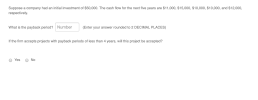 Suppose a company had an initial investment of $50,000. The cash flow for the next five years are $11,000, $15,000, $10,000, $10,000, and $12,000, respectively. What is the payback period? Number (Enter your answer rounded to 2 DECIMAL PLACES) If the firm accepts projects with payback periods of less than 4 years, will this project be accepted? Yes No
Project Ell requires an initial investment of $50,000 and the produces annual cash flows of $30,000,...
Project Ell requires an initial investment of $50,000 and the produces annual cash flows of $30,000, $25,000, and $15,000. Project Ess requires an initial investment of $60,000 and then produces annual cash flows of $25,000 per year for the next ten years. The company ranks projects by their payback periods.
J&E Enterprises is considering and investment which produces no cash flows for the first year. In...
 J&E Enterprises is considering and investment which produces
no cash flows for the first year. In the second year, the cash
inflow is $47,000. This inflow will increase to $198,000 and then
$226,000 for the following two years, respectively, before ceasing
permanently. The initial investment will cost $318,000. The firm
requires a 15.5 percent rate of return and has a required
discounted payback period of three years. Should the project be
accepted? Why or why not? show all work
Year...
J&E Enterprises is considering and investment which produces
no cash flows for the first year. In the second year, the cash
inflow is $47,000. This inflow will increase to $198,000 and then
$226,000 for the following two years, respectively, before ceasing
permanently. The initial investment will cost $318,000. The firm
requires a 15.5 percent rate of return and has a required
discounted payback period of three years. Should the project be
accepted? Why or why not? show all work
Year...
Suppose your firm is considering Investing in a project with the cash flows shown below, that...
 Suppose your firm is considering Investing in a project with the cash flows shown below, that the required rate of return on projects of this risk class is 11 percent, and that the maximum allowable payback and discounted payback statistics for your company are 3 and 3.5 years, respectively. Cash flow: $235,000 $65,800 $14,000 $141,000 $122,000 $81,200 Use the payback decision rule to evaluate this project. (Round your answer to 2 decimal places.) Payback years Should the project be accepted...
An investment project has annual cash inflows of $4,000, $4,900, $6,100, and $5,300, for the next...
 An investment project has annual cash inflows of $4,000, $4,900, $6,100, and $5,300, for the next four years, respectively. The discount rate is 13 percent. What is the discounted payback period for these cash flows if the initial cost is $6,700? (Do not round intermediate calculations and round your answer to 2 decimal places, e.g., 32.16.) Discounted payback period years What is the discounted payback period for these cash flows if the initial cost is $8,800? (Do not round intermediate...
Suppose your firm is considering investing in a project with the cash flow shown below, that...
Suppose your firm is considering investing in a project with the cash flow shown below, that the required rate of return on projects of this risk class is 11%, and that the maximum allowable payback and discounted payback statistics for your company are 3 and 3.5 years, respectively Time 0 1 2 3 4 5 Cash flow -$235,000 $65,800 $84,000 $141,000 $122,000 $81,200 . Use the discounted payback decision rule to evaluate this project; should it be accepted or rejected?...
An investment project has annual cash inflows of $4,900, $3,400, $4,600, and $3,800, for the next...
 An investment project has annual cash inflows of $4,900, $3,400, $4,600, and $3,800, for the next four years, respectively. The discount rate is 13 percent. intermediate calculations and round your answer to 2 decimal places, e.g., 32.16.) Discounted payback period years What is the discounted payback period for these cash flows if the initial cost is $7,300? (Do not round intermediate calculations and round your answer to 2 decimal places, e.g., 32.16.) Discounted payback period years What is the discounted...
An investment project has annual cash inflows of $5,000, $3,300, $4,500, and $3,700, for the next...
 An investment project has annual cash inflows of $5,000, $3,300, $4,500, and $3,700, for the next four years, respectively. The discount rate is 14 percent. a. What is the discounted payback period for these cash flows if the initial cost is $5,100? (Do not round intermediate calculations and round your answer to 2 decimal places, e.g., 32.16.) b. What is the discounted payback period for these cash flows if the initial cost is $7,200? (Do not round intermediate calculations and...
Payback period The Ball Shoe Company is considering an investment project that requires an initial investment...
 Payback period The Ball Shoe Company is considering an investment project that requires an initial investment of $542,000 and returns after-tax cash inflows of $75,000 per year for 10 years. The firm has a maximum acceptable payback period of 8 years. a. Determine the payback period for this project. b. Should the company accept the project? a. The payback period for this project is years. (Round to two decimal places.) Enter your answer in the answer box and then click...
A project has a service life of five years with the initial investment outlay of $200,000....
A project has a service life of five years with the initial investment outlay of $200,000. If the discounted payback period occurs at the end of the project service life (say five years) at an interest rate of 10%, which of the following statements is true? A-The discounted payback period occurs at the end of project service life. B-The NPV of the project may equal or be greater than 0. C-We should invest in the project D-All of the above.
 Suppose a company had an initial investment of $50,000. The cash flow for the next five years are $11,000, $15,000, $10,000, $10,000, and $12,000, respectively. What is the payback period? Number (Enter your answer rounded to 2 DECIMAL PLACES) If the firm accepts projects with payback periods of less than 4 years, will this project be accepted? Yes No
 J&E Enterprises is considering and investment which produces
no cash flows for the first year. In the second year, the cash
inflow is $47,000. This inflow will increase to $198,000 and then
$226,000 for the following two years, respectively, before ceasing
permanently. The initial investment will cost $318,000. The firm
requires a 15.5 percent rate of return and has a required
discounted payback period of three years. Should the project be
accepted? Why or why not? show all work
Year...
J&E Enterprises is considering and investment which produces
no cash flows for the first year. In the second year, the cash
inflow is $47,000. This inflow will increase to $198,000 and then
$226,000 for the following two years, respectively, before ceasing
permanently. The initial investment will cost $318,000. The firm
requires a 15.5 percent rate of return and has a required
discounted payback period of three years. Should the project be
accepted? Why or why not? show all work
Year...
 Suppose your firm is considering Investing in a project with the cash flows shown below, that the required rate of return on projects of this risk class is 11 percent, and that the maximum allowable payback and discounted payback statistics for your company are 3 and 3.5 years, respectively. Cash flow: $235,000 $65,800 $14,000 $141,000 $122,000 $81,200 Use the payback decision rule to evaluate this project. (Round your answer to 2 decimal places.) Payback years Should the project be accepted...
 An investment project has annual cash inflows of $4,000, $4,900, $6,100, and $5,300, for the next four years, respectively. The discount rate is 13 percent. What is the discounted payback period for these cash flows if the initial cost is $6,700? (Do not round intermediate calculations and round your answer to 2 decimal places, e.g., 32.16.) Discounted payback period years What is the discounted payback period for these cash flows if the initial cost is $8,800? (Do not round intermediate...
 An investment project has annual cash inflows of $4,900, $3,400, $4,600, and $3,800, for the next four years, respectively. The discount rate is 13 percent. intermediate calculations and round your answer to 2 decimal places, e.g., 32.16.) Discounted payback period years What is the discounted payback period for these cash flows if the initial cost is $7,300? (Do not round intermediate calculations and round your answer to 2 decimal places, e.g., 32.16.) Discounted payback period years What is the discounted...
 An investment project has annual cash inflows of $5,000, $3,300, $4,500, and $3,700, for the next four years, respectively. The discount rate is 14 percent. a. What is the discounted payback period for these cash flows if the initial cost is $5,100? (Do not round intermediate calculations and round your answer to 2 decimal places, e.g., 32.16.) b. What is the discounted payback period for these cash flows if the initial cost is $7,200? (Do not round intermediate calculations and...
 Payback period The Ball Shoe Company is considering an investment project that requires an initial investment of $542,000 and returns after-tax cash inflows of $75,000 per year for 10 years. The firm has a maximum acceptable payback period of 8 years. a. Determine the payback period for this project. b. Should the company accept the project? a. The payback period for this project is years. (Round to two decimal places.) Enter your answer in the answer box and then click...
Most questions answered within 3 hours.
-
Where is the error in this code sequence?
String s1 = "Hello";
String s2 = "ello";...
asked 11 months ago -
Financial data for Joel de Paris, Inc., for last year
follow:
Joel de Paris, Inc.
Balance...
asked 11 months ago -
Consider this reaction:
Al2(SO4)3 (aq)+ BaCl3
(aq) Al2Cl6 (aq)- +
3BaSO4(s) . What is the...
asked 11 months ago -
Suppose that Savneet is considering increasing her
recent random sample from 20 car rentals to 40...
asked 11 months ago -
Trucks arrive at an unloading terminal at an average rate of 120
per hour.
Trucks arrive...
asked 11 months ago -
Why are methanol and ethanol completely soluble in water while
octanol is not very little soluble....
asked 11 months ago -
A facilities manager at a university reads in a research report
that the mean amount of...
asked 11 months ago -
When the CuSO4 is rehydrated by adding water to the anhydrous
compound, is this an endothermic...
asked 11 months ago -
A ray of sunlight is passing from diamond into crown glass; the
angle of incidence is...
asked 11 months ago -
A block of mass 0.249 kg is placed on top of a light, vertical
spring of...
asked 11 months ago -
how do the kidneys compensate in the presences of acidosis
a) trigger hyperventilate
b) reserve acid...
asked 11 months ago -
Question 501 pts
The rental rate of capital to the firm increases. Which of the
following...
asked 11 months ago