Solve the Following
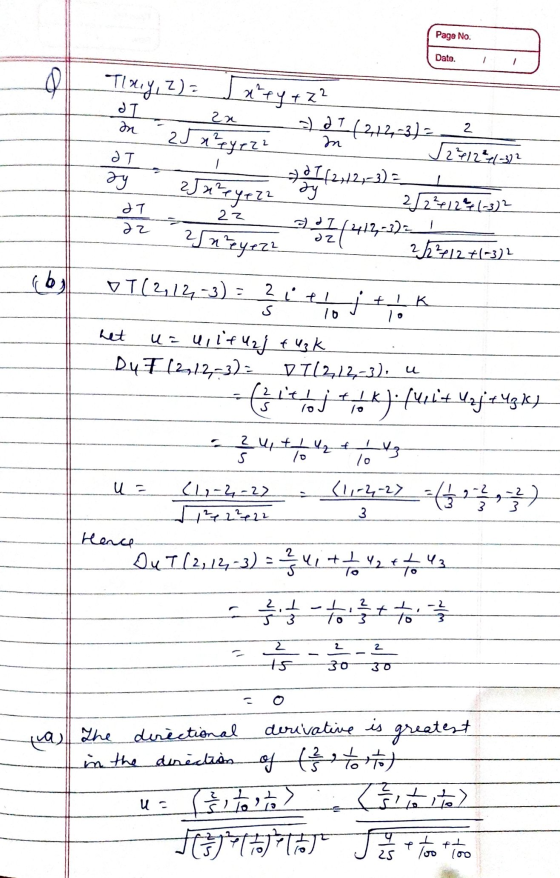
The Scalar field  gives the temperature at a given point.
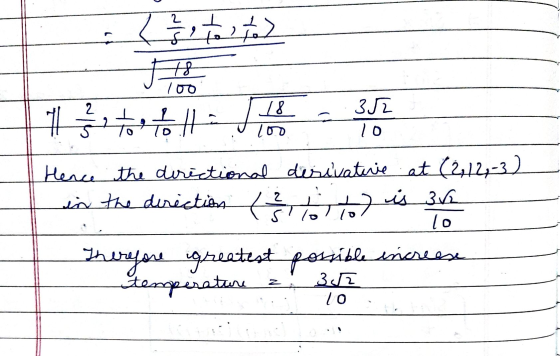
a.) The temperature at (2,12,-3) is only 5 degrees Celsius. In what direction should you move to experience the greatest possible increase in temperature, and what is the rate of change.
b.) At (2,12,-3), what is the rate of change (directional
derivative) if it goes in the direction 
Homework Answers
Add Answer to:
Solve the Following
The Scalar field
gives the temperature at a given point.
a.) The temperature...
A scalar function f : which is never zero has the properties and Evaluate the integral...
 A scalar function f :
which is never zero has the properties
and
Evaluate the integral
where
is the surface of the unit sphere
and
means the directional derivative of f in the direction of the
outward pointing unit normal on
.
R? → R We were unable to transcribe this imageWe were unable to transcribe this imageWe were unable to transcribe this imageWe were unable to transcribe this imageWe were unable to transcribe this imageWe were unable to transcribe...
A scalar function f :
which is never zero has the properties
and
Evaluate the integral
where
is the surface of the unit sphere
and
means the directional derivative of f in the direction of the
outward pointing unit normal on
.
R? → R We were unable to transcribe this imageWe were unable to transcribe this imageWe were unable to transcribe this imageWe were unable to transcribe this imageWe were unable to transcribe this imageWe were unable to transcribe...
Question If a) Find the angle between b) Find a scalar projection and a vector projection...
 Question
If
a) Find the angle between
b) Find a scalar projection and a vector projection of
We were unable to transcribe this imageWe were unable to transcribe this imageWe were unable to transcribe this image
Question
If
a) Find the angle between
b) Find a scalar projection and a vector projection of
We were unable to transcribe this imageWe were unable to transcribe this imageWe were unable to transcribe this image
A) The following vector field State whether the divergence of at point A is positive, negati...
 a)
The following vector field
State whether the divergence of
at point A is positive, negative or zero.
b) Say if the rotational of
at point B is a null vector, which points in the direction of the
z-axis or points in the negative direction of z.
We were unable to transcribe this image履 2 0 2 4 We were unable to transcribe this imageWe were unable to transcribe this image
履 2 0 2 4
a)
The following vector field
State whether the divergence of
at point A is positive, negative or zero.
b) Say if the rotational of
at point B is a null vector, which points in the direction of the
z-axis or points in the negative direction of z.
We were unable to transcribe this image履 2 0 2 4 We were unable to transcribe this imageWe were unable to transcribe this image
履 2 0 2 4
Please help solve this, using the equation to get through the problem. Additional information: where the...
 Please help solve this, using the equation
to get through the problem.
Additional information:
where the initial position
, the initial speed
The above differential equation can also be written as:
If
, there is light damping where the solution has the form ( where r
and w are two positive constants)
or
If
there is heavy damping where,
where
and
are two positive constants
If
there is critical damping where,
where r is a positive constant
d'y dy ma...
Please help solve this, using the equation
to get through the problem.
Additional information:
where the initial position
, the initial speed
The above differential equation can also be written as:
If
, there is light damping where the solution has the form ( where r
and w are two positive constants)
or
If
there is heavy damping where,
where
and
are two positive constants
If
there is critical damping where,
where r is a positive constant
d'y dy ma...
Problem 22.17 (Multistep) A coil of wire is connected to a power supply, and a current...
 Problem 22.17 (Multistep)
A coil of wire is connected to a power supply, and a current
runs in the coil. A single loop of wire is located near the coil,
with its axis on the same line as the axis of the coil. The radius
of the loop is 3 cm.
At time t1 the magnetic field at the center of the loop, due to the
coil, is 0.6 T, in the direction shown in the diagram; the current
in...
Problem 22.17 (Multistep)
A coil of wire is connected to a power supply, and a current
runs in the coil. A single loop of wire is located near the coil,
with its axis on the same line as the axis of the coil. The radius
of the loop is 3 cm.
At time t1 the magnetic field at the center of the loop, due to the
coil, is 0.6 T, in the direction shown in the diagram; the current
in...
After integration of the "Law" for unsteady state conduction you find the temperature profile to be:...
 After integration of the "Law" for unsteady state conduction you
find the temperature profile to be:
T(x)=a+bx2+cx3
Where T is in K and x is in m.
a) what are the units for a, b, and c.
b)if qdot=1000 W/m3 , rho= 1600 kg/m3 ,
k=40 W/(m K), and Cp = 4 kJ/(kg K) waht is the rate of change of
the temperature as a function of time? (T/t)
We were unable to transcribe this imageWe were unable to transcribe...
After integration of the "Law" for unsteady state conduction you
find the temperature profile to be:
T(x)=a+bx2+cx3
Where T is in K and x is in m.
a) what are the units for a, b, and c.
b)if qdot=1000 W/m3 , rho= 1600 kg/m3 ,
k=40 W/(m K), and Cp = 4 kJ/(kg K) waht is the rate of change of
the temperature as a function of time? (T/t)
We were unable to transcribe this imageWe were unable to transcribe...
A fence is to be constructed over the quarter circle given by for , on which...
 A fence is to be constructed over the quarter circle given by
for
, on which the height at the point (x,y) is given by
. Compute a path integral of the form
to find the surface area of the fence. (Let's only worry about
one side of the fence.)
c(t) =< acost, asint > 0<t s fr,y) = rey We were unable to transcribe this image
A fence is to be constructed over the quarter circle given by
for
, on which the height at the point (x,y) is given by
. Compute a path integral of the form
to find the surface area of the fence. (Let's only worry about
one side of the fence.)
c(t) =< acost, asint > 0<t s fr,y) = rey We were unable to transcribe this image
Solve for for and for . Determine and and look at their magnitudes. Note that when...
 Solve
for
for
and
for
. Determine
and
and look at their magnitudes. Note that when
, we are looking at the backward heat equation and given the
magnitude of
, what can you say about the solution to the backward heat
equation?
Ut = u (0,t) = u(1,t) = 0 We were unable to transcribe this imageu(3,0) = 10-8 sin(1072) Ο < < u(1,3) (1, -3) t= -3 We were unable to transcribe this image
Solve
for
for
and
for
. Determine
and
and look at their magnitudes. Note that when
, we are looking at the backward heat equation and given the
magnitude of
, what can you say about the solution to the backward heat
equation?
Ut = u (0,t) = u(1,t) = 0 We were unable to transcribe this imageu(3,0) = 10-8 sin(1072) Ο < < u(1,3) (1, -3) t= -3 We were unable to transcribe this image
1) The SI unit of pressure is a. torr b. mmMg (millimeters of mercury) d. Pa...
1) The SI unit of pressure is a. torr b. mmMg (millimeters of mercury) d. Pa (Pascal) e. bar . . 2) What is the key difference between a barometer and a manometer? a. barometers are automated pressure measuring devices, while manometers are hand-operated (hence the prefix "man-") b. barometers are an older term for manometer c. barometers measure atmospheric pressure while manometers measure the pressures of a sample . . 3) Often during a storm pressure will drop. If...
Problem 23.29 (Multistep) An accelerated electron An electron is initially at rest. At time t1=0 it...
 Problem 23.29 (Multistep)
An accelerated electron
An electron is initially at rest. At time t1=0 it is accelerated
upward with an acceleration of a= 1 × 10¹⁹
m/s2 for a very short time (this large acceleration is
possible because the electron has a very small mass). We make
observations at location A, x= 16 meters from the electron
(see the figure).
Part 1
(a) At time t2= 1 ns (1 × 10⁻⁹ s), what is the magnitude
and direction of...
Problem 23.29 (Multistep)
An accelerated electron
An electron is initially at rest. At time t1=0 it is accelerated
upward with an acceleration of a= 1 × 10¹⁹
m/s2 for a very short time (this large acceleration is
possible because the electron has a very small mass). We make
observations at location A, x= 16 meters from the electron
(see the figure).
Part 1
(a) At time t2= 1 ns (1 × 10⁻⁹ s), what is the magnitude
and direction of...
 A scalar function f :
which is never zero has the properties
and
Evaluate the integral
where
is the surface of the unit sphere
and
means the directional derivative of f in the direction of the
outward pointing unit normal on
.
R? → R We were unable to transcribe this imageWe were unable to transcribe this imageWe were unable to transcribe this imageWe were unable to transcribe this imageWe were unable to transcribe this imageWe were unable to transcribe...
A scalar function f :
which is never zero has the properties
and
Evaluate the integral
where
is the surface of the unit sphere
and
means the directional derivative of f in the direction of the
outward pointing unit normal on
.
R? → R We were unable to transcribe this imageWe were unable to transcribe this imageWe were unable to transcribe this imageWe were unable to transcribe this imageWe were unable to transcribe this imageWe were unable to transcribe...
 Question
If
a) Find the angle between
b) Find a scalar projection and a vector projection of
We were unable to transcribe this imageWe were unable to transcribe this imageWe were unable to transcribe this image
Question
If
a) Find the angle between
b) Find a scalar projection and a vector projection of
We were unable to transcribe this imageWe were unable to transcribe this imageWe were unable to transcribe this image
 a)
The following vector field
State whether the divergence of
at point A is positive, negative or zero.
b) Say if the rotational of
at point B is a null vector, which points in the direction of the
z-axis or points in the negative direction of z.
We were unable to transcribe this image履 2 0 2 4 We were unable to transcribe this imageWe were unable to transcribe this image
履 2 0 2 4
a)
The following vector field
State whether the divergence of
at point A is positive, negative or zero.
b) Say if the rotational of
at point B is a null vector, which points in the direction of the
z-axis or points in the negative direction of z.
We were unable to transcribe this image履 2 0 2 4 We were unable to transcribe this imageWe were unable to transcribe this image
履 2 0 2 4
 Please help solve this, using the equation
to get through the problem.
Additional information:
where the initial position
, the initial speed
The above differential equation can also be written as:
If
, there is light damping where the solution has the form ( where r
and w are two positive constants)
or
If
there is heavy damping where,
where
and
are two positive constants
If
there is critical damping where,
where r is a positive constant
d'y dy ma...
Please help solve this, using the equation
to get through the problem.
Additional information:
where the initial position
, the initial speed
The above differential equation can also be written as:
If
, there is light damping where the solution has the form ( where r
and w are two positive constants)
or
If
there is heavy damping where,
where
and
are two positive constants
If
there is critical damping where,
where r is a positive constant
d'y dy ma...
 Problem 22.17 (Multistep)
A coil of wire is connected to a power supply, and a current
runs in the coil. A single loop of wire is located near the coil,
with its axis on the same line as the axis of the coil. The radius
of the loop is 3 cm.
At time t1 the magnetic field at the center of the loop, due to the
coil, is 0.6 T, in the direction shown in the diagram; the current
in...
Problem 22.17 (Multistep)
A coil of wire is connected to a power supply, and a current
runs in the coil. A single loop of wire is located near the coil,
with its axis on the same line as the axis of the coil. The radius
of the loop is 3 cm.
At time t1 the magnetic field at the center of the loop, due to the
coil, is 0.6 T, in the direction shown in the diagram; the current
in...
 After integration of the "Law" for unsteady state conduction you
find the temperature profile to be:
T(x)=a+bx2+cx3
Where T is in K and x is in m.
a) what are the units for a, b, and c.
b)if qdot=1000 W/m3 , rho= 1600 kg/m3 ,
k=40 W/(m K), and Cp = 4 kJ/(kg K) waht is the rate of change of
the temperature as a function of time? (T/t)
We were unable to transcribe this imageWe were unable to transcribe...
After integration of the "Law" for unsteady state conduction you
find the temperature profile to be:
T(x)=a+bx2+cx3
Where T is in K and x is in m.
a) what are the units for a, b, and c.
b)if qdot=1000 W/m3 , rho= 1600 kg/m3 ,
k=40 W/(m K), and Cp = 4 kJ/(kg K) waht is the rate of change of
the temperature as a function of time? (T/t)
We were unable to transcribe this imageWe were unable to transcribe...
 A fence is to be constructed over the quarter circle given by
for
, on which the height at the point (x,y) is given by
. Compute a path integral of the form
to find the surface area of the fence. (Let's only worry about
one side of the fence.)
c(t) =< acost, asint > 0<t s fr,y) = rey We were unable to transcribe this image
A fence is to be constructed over the quarter circle given by
for
, on which the height at the point (x,y) is given by
. Compute a path integral of the form
to find the surface area of the fence. (Let's only worry about
one side of the fence.)
c(t) =< acost, asint > 0<t s fr,y) = rey We were unable to transcribe this image
 Solve
for
for
and
for
. Determine
and
and look at their magnitudes. Note that when
, we are looking at the backward heat equation and given the
magnitude of
, what can you say about the solution to the backward heat
equation?
Ut = u (0,t) = u(1,t) = 0 We were unable to transcribe this imageu(3,0) = 10-8 sin(1072) Ο < < u(1,3) (1, -3) t= -3 We were unable to transcribe this image
Solve
for
for
and
for
. Determine
and
and look at their magnitudes. Note that when
, we are looking at the backward heat equation and given the
magnitude of
, what can you say about the solution to the backward heat
equation?
Ut = u (0,t) = u(1,t) = 0 We were unable to transcribe this imageu(3,0) = 10-8 sin(1072) Ο < < u(1,3) (1, -3) t= -3 We were unable to transcribe this image
Most questions answered within 3 hours.
-
Where is the error in this code sequence?
String s1 = "Hello";
String s2 = "ello";...
asked 11 months ago -
Financial data for Joel de Paris, Inc., for last year
follow:
Joel de Paris, Inc.
Balance...
asked 11 months ago -
Consider this reaction:
Al2(SO4)3 (aq)+ BaCl3
(aq) Al2Cl6 (aq)- +
3BaSO4(s) . What is the...
asked 11 months ago -
Suppose that Savneet is considering increasing her
recent random sample from 20 car rentals to 40...
asked 11 months ago -
Trucks arrive at an unloading terminal at an average rate of 120
per hour.
Trucks arrive...
asked 11 months ago -
Why are methanol and ethanol completely soluble in water while
octanol is not very little soluble....
asked 11 months ago -
A facilities manager at a university reads in a research report
that the mean amount of...
asked 11 months ago -
When the CuSO4 is rehydrated by adding water to the anhydrous
compound, is this an endothermic...
asked 11 months ago -
A ray of sunlight is passing from diamond into crown glass; the
angle of incidence is...
asked 11 months ago -
A block of mass 0.249 kg is placed on top of a light, vertical
spring of...
asked 11 months ago -
how do the kidneys compensate in the presences of acidosis
a) trigger hyperventilate
b) reserve acid...
asked 11 months ago -
Question 501 pts
The rental rate of capital to the firm increases. Which of the
following...
asked 11 months ago