Two particle state
Two Particle State problem, measurement of total angular momentum, finding probabilities, action of lowering operator
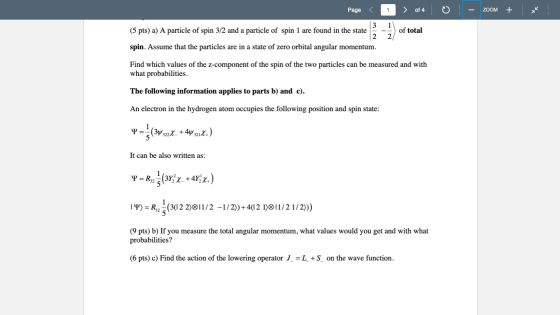
a) A particle of spin \(3 / 2\) and a particle of spin 1 are found in the state \(\left|\frac{3}{2}-\frac{1}{2}\right\rangle\) of total spin. Assume that the particles are in a state of zero orbital angular momentum.
Find which values of the z-component of the spin of the two particles can be measured and with what probabilities.
The following information applies to parts \(\mathbf{b}\) ) and \(\mathbf{c}\) ).
An electron in the hydrogen atom occupies the following position and spin state:
$$ \Psi=\frac{1}{5}\left(3 \psi_{322} \chi_{-}+4 \psi_{321} \chi_{+}\right) $$
It can be also written as:
$$ \begin{aligned} &\Psi=R_{32} \frac{1}{5}\left(3 Y_{2}^{2} \chi_{-}+4 Y_{2}^{1} \chi_{+}\right) \\ &\left.\left.|\Psi\rangle=R_{32} \frac{1}{5}(3(122\rangle \otimes|1 / 2-1 / 2\rangle)+4(121\rangle \otimes|1 / 21 / 2\rangle\right)\right) \end{aligned} $$
b) If you measure the total angular momentum, what values would you get and with what probabilities?
c) Find the action of the lowering operator \(J_{-}=L_{-}+S_{-}\)on the wave function.
Homework Answers


A particle initially in the state has the position-space wavefunction
 A particle initially in the state \(|\psi\rangle\) has the position-space wavefunction$$ \psi(x)=N e^{-x^{2} / 8 a^{2}} $$(a) What is the normalization coefficient \(N\) ?(b) The state is then altered. Find the position-space wavefunction of the altered state$$ \left|\psi^{\prime}\right\rangle=e^{-i p c / A}|\psi\rangle $$(c) Calculate the expectation values of \((\ell)\), for both \(|\psi\rangle\) and \(\left|\psi^{\prime}\right\rangle\).
2. Addition of Angular Momentum a) (8pts) Given two spin 1/2 particles, what are the four possibilities for their spin configuration? Put your answer in terms of states such as | 11). where the f...
 2. Addition of Angular Momentum a) (8pts) Given two spin 1/2 particles, what are the four possibilities for their spin configuration? Put your answer in terms of states such as | 11). where the first arrow denotes the z-component of the particle's spin. Identify the m values for each state. b)(7pts) If you apply the lowering operator to a state you get Apply the two-state lowering operator S--S(,) +S(), where sti) acts on the first state and S acts on...
The one-dimensional Schrindinger wave equation for a particle in a potential field
The one-dimensional Schrindinger wave equation for a particle in a potential field \(V=\) \(\frac{1}{2} k x^{2}\) is$$ -\frac{h^{2}}{2 m} \frac{d^{2} \psi}{d x^{2}}+\frac{1}{2} k x^{2} \psi=E \psi(x) $$(a) Lsing \(\xi=\alpha x\) and a constant \(\lambda\), we have$$ a=\left(\frac{m k}{A^{2}}\right)^{1 / 4}, \quad A=\frac{2 L}{A}\left(\frac{m}{k}\right)^{1 / 2} $$show that$$ \frac{d^{2} y(\xi)}{d \xi^{2}}+\left(\lambda-\xi^{2}\right) \psi(\xi)=0 $$(b) Substituting$$ \psi(\xi)=y(\xi) e^{2} / 2 $$show that \(y(t)\) satisfies the Hermite di fferential equation.
System A consists of two spin-1/2 particles, and has a four-dimensional Hilbert space. 1. Write down...
 System A consists of two spin-1/2 particles, and has a four-dimensional Hilbert space. 1. Write down a basis for the Hilbert space of two spin-1/2 particles. 2. Calculate the matrix of the angular momentum operator, Sfot = (ŜA, ŠA, ŜA) for system A, in the basis of question 4A.1, and express them in this basis. 3. Calculate the square of the total angular momentum of system A , Spotl?, and express this operator in the basis of question 4A.1. 4....
I have the first method complete, but I can't figure out thesecond method. I have...
 I have the first method complete, but I can't figure out the
second method Could
someone please show how to use the second method?2. Find the unit step response of:$$ \begin{aligned} \dot{\overrightarrow{\mathbf{x}}}(t) &=\left[\begin{array}{cc} 0 & 1 \\ -2 & -2 \end{array}\right] \overrightarrow{\mathbf{x}}(t)+\left[\begin{array}{l} 1 \\ 1 \end{array}\right] u(t) \\ y(t) &=\left[\begin{array}{cc} 2 & 3 \end{array}\right] \overrightarrow{\mathbf{x}}(t) \end{aligned} $$by two methods (1): transfer function and then (2) \(y(t)=\mathbf{C} e^{\mathbf{A} t} \overrightarrow{\mathbf{x}}(0)+\mathbf{C} \int_{0}^{t} e^{\mathbf{A}(t-\tau)} \mathbf{B} u(\tau) d \tau+\mathbf{D} u(t)\). Re-member that the Laplace...
I have the first method complete, but I can't figure out the
second method Could
someone please show how to use the second method?2. Find the unit step response of:$$ \begin{aligned} \dot{\overrightarrow{\mathbf{x}}}(t) &=\left[\begin{array}{cc} 0 & 1 \\ -2 & -2 \end{array}\right] \overrightarrow{\mathbf{x}}(t)+\left[\begin{array}{l} 1 \\ 1 \end{array}\right] u(t) \\ y(t) &=\left[\begin{array}{cc} 2 & 3 \end{array}\right] \overrightarrow{\mathbf{x}}(t) \end{aligned} $$by two methods (1): transfer function and then (2) \(y(t)=\mathbf{C} e^{\mathbf{A} t} \overrightarrow{\mathbf{x}}(0)+\mathbf{C} \int_{0}^{t} e^{\mathbf{A}(t-\tau)} \mathbf{B} u(\tau) d \tau+\mathbf{D} u(t)\). Re-member that the Laplace...
3. (6 points) Measurements on a two-particle state Consider the state for a system of two...
 3. (6 points) Measurements on a two-particle state Consider the state for a system of two spin-1/2 particles, (2]+).I+)2 +1-)[+)2-1-)1-)2). (a) Show that this state is normalized. (b) What is the probability of measuring S: (the z-component of spin for particle 1) to be +h/2? After this measurement is made with this result, what is the state of the system? If we make a measurement in this new state, what is now the probability of measuring S3 = +h/2? (e)...
b 2. Suppose a spin-2 particle is in the state that particle. 2,0) + 2,1) Find...
 b 2. Suppose a spin-2 particle is in the state that particle. 2,0) + 2,1) Find the expectation value of S, for D 3. In the t spin-1/2 basis, consider the two operators 2 1 12d B- (2 i A= ni 2 (a) Find the commutator [A, B (b) Suppose we measure a number of particles in state |t), using A and B. Find the average values (A) and (B) from these measurements. (c) Use the uncertainty principle to find...
The normalized wave function for a hydrogen atom in the 2s state is
 ( 25 marks) The normalized wave function for a hydrogen atom in the \(2 s\) state is$$ \psi_{2 s}(r)=\frac{1}{\sqrt{32 \pi a^{3}}}\left(2-\frac{r}{a}\right) e^{-r / 2 a} $$where \(a\) is the Bohr radius. (a) In the Bohr model, the distance between the electron and the nucleus in the \(n=2\) state is exactly \(4 a\). Calculate the probability that an electron in the \(2 s\) state will be found at a distance less than \(4 a\) from the nucleus. (b) At what value...
Consider the heat conduction problem
 5. If \(f(x)=\left\{\begin{array}{cc}0 & -2<x<0 \\ x & 0<x<2\end{array} \quad\right.\)is periodio of period 4 , and whose Fourier series is given by \(\frac{a_{0}}{2}+\sum_{n=1}^{2}\left[a_{n} \cos \left(\frac{n \pi}{2} x\right)+b_{n} \sin \left(\frac{n \pi}{2} x\right)\right], \quad\) find \(a_{n}\)A. \(\frac{2}{n^{2} \pi^{2}}\)B. \(\frac{(-1)^{n}-1}{n^{2} \pi^{2}}\)C. \(\frac{4}{n^{2} \pi^{2}}\)D. \(\frac{2}{n \pi}\)\(\mathbf{E}_{1} \frac{2\left((-1)^{n}-1\right)}{n^{2} \pi^{2}}\)F. \(\frac{4}{n \pi}\)6. Let \(f(x)-2 x-l\) on \([0,2]\). The Fourier sine series for \(f(x)\) is \(\sum_{w}^{n} b_{n} \sin \left(\frac{n \pi}{2} x\right)\), What is \(b, ?\)A. \(\frac{4}{3 \pi}\)B. \(\frac{2}{\pi}\)C. \(\frac{4}{\pi}\)D. \(\frac{-4}{3 \pi}\)E. \(\frac{-2}{\pi}\)F. \(\frac{-4}{\pi}\)7. Let \(f(x)\) be periodic...
5. A particle in the harmonic oscillator potential has the initial wave function Psi(x, 0) = A[\psi_{0}(x) + \psi_{1}(x)] for some constant A. Here to and ₁ are the normalized ground state and the first excited state wavefunctions of the harmonic oscill
 5. A particle in the harmonic oscillator potential has the initial wave function Psi(x, 0) = A[\psi_{0}(x) + \psi_{1}(x)] for some constant A. Here to and ₁ are the normalized ground state and the first excited state wavefunctions of the harmonic oscillator, respectively. (a) Normalize (r, 0). (b) Find the wavefunction (r, t) at a later time t and hence evaluate (x, t) 2. Leave your answers involving expressions in to and ₁. c) sing the following normalized expression of...
 A particle initially in the state \(|\psi\rangle\) has the position-space wavefunction$$ \psi(x)=N e^{-x^{2} / 8 a^{2}} $$(a) What is the normalization coefficient \(N\) ?(b) The state is then altered. Find the position-space wavefunction of the altered state$$ \left|\psi^{\prime}\right\rangle=e^{-i p c / A}|\psi\rangle $$(c) Calculate the expectation values of \((\ell)\), for both \(|\psi\rangle\) and \(\left|\psi^{\prime}\right\rangle\).
 2. Addition of Angular Momentum a) (8pts) Given two spin 1/2 particles, what are the four possibilities for their spin configuration? Put your answer in terms of states such as | 11). where the first arrow denotes the z-component of the particle's spin. Identify the m values for each state. b)(7pts) If you apply the lowering operator to a state you get Apply the two-state lowering operator S--S(,) +S(), where sti) acts on the first state and S acts on...
 System A consists of two spin-1/2 particles, and has a four-dimensional Hilbert space. 1. Write down a basis for the Hilbert space of two spin-1/2 particles. 2. Calculate the matrix of the angular momentum operator, Sfot = (ŜA, ŠA, ŜA) for system A, in the basis of question 4A.1, and express them in this basis. 3. Calculate the square of the total angular momentum of system A , Spotl?, and express this operator in the basis of question 4A.1. 4....
 I have the first method complete, but I can't figure out the
second method Could
someone please show how to use the second method?2. Find the unit step response of:$$ \begin{aligned} \dot{\overrightarrow{\mathbf{x}}}(t) &=\left[\begin{array}{cc} 0 & 1 \\ -2 & -2 \end{array}\right] \overrightarrow{\mathbf{x}}(t)+\left[\begin{array}{l} 1 \\ 1 \end{array}\right] u(t) \\ y(t) &=\left[\begin{array}{cc} 2 & 3 \end{array}\right] \overrightarrow{\mathbf{x}}(t) \end{aligned} $$by two methods (1): transfer function and then (2) \(y(t)=\mathbf{C} e^{\mathbf{A} t} \overrightarrow{\mathbf{x}}(0)+\mathbf{C} \int_{0}^{t} e^{\mathbf{A}(t-\tau)} \mathbf{B} u(\tau) d \tau+\mathbf{D} u(t)\). Re-member that the Laplace...
I have the first method complete, but I can't figure out the
second method Could
someone please show how to use the second method?2. Find the unit step response of:$$ \begin{aligned} \dot{\overrightarrow{\mathbf{x}}}(t) &=\left[\begin{array}{cc} 0 & 1 \\ -2 & -2 \end{array}\right] \overrightarrow{\mathbf{x}}(t)+\left[\begin{array}{l} 1 \\ 1 \end{array}\right] u(t) \\ y(t) &=\left[\begin{array}{cc} 2 & 3 \end{array}\right] \overrightarrow{\mathbf{x}}(t) \end{aligned} $$by two methods (1): transfer function and then (2) \(y(t)=\mathbf{C} e^{\mathbf{A} t} \overrightarrow{\mathbf{x}}(0)+\mathbf{C} \int_{0}^{t} e^{\mathbf{A}(t-\tau)} \mathbf{B} u(\tau) d \tau+\mathbf{D} u(t)\). Re-member that the Laplace...
 3. (6 points) Measurements on a two-particle state Consider the state for a system of two spin-1/2 particles, (2]+).I+)2 +1-)[+)2-1-)1-)2). (a) Show that this state is normalized. (b) What is the probability of measuring S: (the z-component of spin for particle 1) to be +h/2? After this measurement is made with this result, what is the state of the system? If we make a measurement in this new state, what is now the probability of measuring S3 = +h/2? (e)...
 b 2. Suppose a spin-2 particle is in the state that particle. 2,0) + 2,1) Find the expectation value of S, for D 3. In the t spin-1/2 basis, consider the two operators 2 1 12d B- (2 i A= ni 2 (a) Find the commutator [A, B (b) Suppose we measure a number of particles in state |t), using A and B. Find the average values (A) and (B) from these measurements. (c) Use the uncertainty principle to find...
Most questions answered within 3 hours.
-
Where is the error in this code sequence?
String s1 = "Hello";
String s2 = "ello";...
asked 11 months ago -
Financial data for Joel de Paris, Inc., for last year
follow:
Joel de Paris, Inc.
Balance...
asked 11 months ago -
Consider this reaction:
Al2(SO4)3 (aq)+ BaCl3
(aq) Al2Cl6 (aq)- +
3BaSO4(s) . What is the...
asked 11 months ago -
Suppose that Savneet is considering increasing her
recent random sample from 20 car rentals to 40...
asked 11 months ago -
Trucks arrive at an unloading terminal at an average rate of 120
per hour.
Trucks arrive...
asked 11 months ago -
Why are methanol and ethanol completely soluble in water while
octanol is not very little soluble....
asked 11 months ago -
A facilities manager at a university reads in a research report
that the mean amount of...
asked 11 months ago -
When the CuSO4 is rehydrated by adding water to the anhydrous
compound, is this an endothermic...
asked 11 months ago -
A ray of sunlight is passing from diamond into crown glass; the
angle of incidence is...
asked 11 months ago -
A block of mass 0.249 kg is placed on top of a light, vertical
spring of...
asked 11 months ago -
how do the kidneys compensate in the presences of acidosis
a) trigger hyperventilate
b) reserve acid...
asked 11 months ago -
Question 501 pts
The rental rate of capital to the firm increases. Which of the
following...
asked 11 months ago