
Homework Answers
Add Answer to:
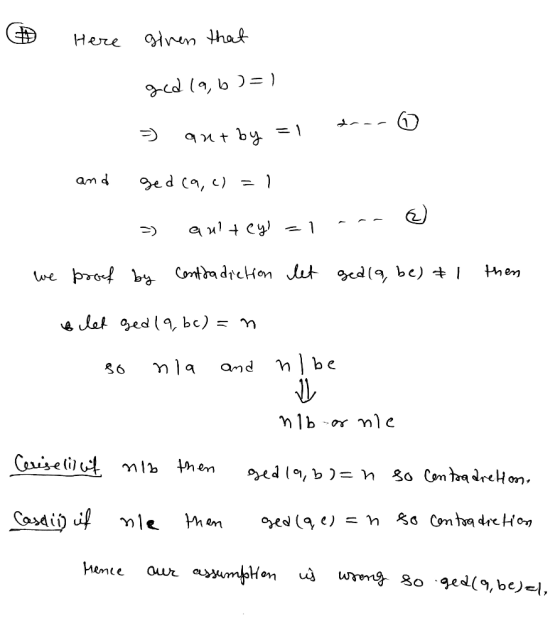
Show that gcd(a, b) = 1 and gcd(a, c) = 1 imply that ged(a, bc) =...
(a) If a | bc, show that a | b*gcd(a,c). (b) If a, b are coprime integers and c | at and c | bt, show that c | t. (c) If...
(a) If a | bc, show that a | b*gcd(a,c). (b) If a, b are coprime integers and c | at and c | bt, show that c | t. (c) If a, b, c are integers with a, c coprime, prove that gcd(ab, c) = gcd(b, c).
Recall that: ged: NN → N gcd(a,0) = a. gcd(a,b) = gcd(b, mod(a,b)), if b >...
 Recall that: ged: NN → N gcd(a,0) = a. gcd(a,b) = gcd(b, mod(a,b)), if b > 0. and mod : Nx (N – {0}) ► N mod(a,b) = a if a <b. mod(a,b) = mod(a - b,b), if a > b. and fib: N → N fib(0) = 0 fib(1) = 1 fib(n) | if n >1=fib(n − 1) +fib(n - 2) Prove the following by induction. you cannot use any extra lemmas or existing results. Vn e N, ged(fib(n...
2,3,4,5,6 please 2. Use the Euclidean algorithm to find the following: a gcd(100, 101) b. ged(2482,...
 2,3,4,5,6 please
2. Use the Euclidean algorithm to find the following: a gcd(100, 101) b. ged(2482, 7633) 3. Prove that if a = bq+r, then ged(a, b) = ged(b,r). such that sa tb ged(a,b) for the following pairs 4. Use Bézout's theorem to find 8 and a. 33, 44 b. 101, 203 c. 10001, 13422 5. Prove by induction that if p is prime and plaja... An, then pla, for at least one Q. (Hint: use n = 2 as...
2,3,4,5,6 please
2. Use the Euclidean algorithm to find the following: a gcd(100, 101) b. ged(2482, 7633) 3. Prove that if a = bq+r, then ged(a, b) = ged(b,r). such that sa tb ged(a,b) for the following pairs 4. Use Bézout's theorem to find 8 and a. 33, 44 b. 101, 203 c. 10001, 13422 5. Prove by induction that if p is prime and plaja... An, then pla, for at least one Q. (Hint: use n = 2 as...
9. The following C-like code calculates the greatest common divisor (GCD) of the two 8-bit positi...
 9. The following C-like code calculates the greatest common divisor (GCD) of the two 8-bit positive integers a and b (Aside: This is Euclid's algorithm from 300 BC). Complete the HLSM for the code (Answers are case sensitive) Inputs: byte a, byte b, bit go Outputs: byte gcd, bit done GCD while (1) ( while (!go); done 0 while (a!-b){ if(a>b){ a-a b else gcd-a done 1 Inputs: go (bit), a, b (8 bits) Outputs: done (bit), ged (8 bits)...
need help!!! plz write clearly # 2. Let a and b be non-zero coprime integers. Show...
 need help!!! plz write clearly
# 2. Let a and b be non-zero coprime integers. Show that (a) For any dia, god(d, b) = l. (b) For any cE Z, gcd(a,ged(a, bc)
need help!!! plz write clearly
# 2. Let a and b be non-zero coprime integers. Show that (a) For any dia, god(d, b) = l. (b) For any cE Z, gcd(a,ged(a, bc)
1 For each of the following pairs of numbers a and b, calculate and find integers...
 1 For each of the following pairs of numbers a and b, calculate and find integers r and s such ged (a; b) by Eucledian algorithm that gcd(a; b) = ra + sb. ia= 203, b-91 ii a = 21, b=8 2 Prove that for n 2 1,2+2+2+2* +...+2 -2n+1 -2 3 Prove that Vn 2 1,8" -3 is divisible by 5. 4 Prove that + n(n+1) = nnīYn E N where N is the set of all positive integers....
This Question must be proven using mathematical induction 1: procedure GCD(a, b: positive integers) 2 if...
 This Question must be proven using mathematical induction
1: procedure GCD(a, b: positive integers) 2 if a b then return a 3: 4: else if a b then 5: return GCD (a -b, b) 6: else return GCD(a,b-a) 8: end procedure Let P(a, b) be the statement: GCD(a, b)-ged(a,b). Prove that P(a, b) is true for all positive integer a and b.
This Question must be proven using mathematical induction
1: procedure GCD(a, b: positive integers) 2 if a b then return a 3: 4: else if a b then 5: return GCD (a -b, b) 6: else return GCD(a,b-a) 8: end procedure Let P(a, b) be the statement: GCD(a, b)-ged(a,b). Prove that P(a, b) is true for all positive integer a and b.
coding in c programming Functions & Arrays Q1) The greatest common divisor (GCD) of two Integers...
 coding in c programming
Functions & Arrays Q1) The greatest common divisor (GCD) of two Integers (of which at least one is nonzero) is the largest positive integer that divides the numbers. Write a C function ged that accepts two integers and returns 1 if both the integers are zero, otherwise it returns their GCD. Write a C program (that includes the function ged) which accepts two integers and prints their GCD. Sample output: Enter two integers: 0 0 At...
coding in c programming
Functions & Arrays Q1) The greatest common divisor (GCD) of two Integers (of which at least one is nonzero) is the largest positive integer that divides the numbers. Write a C function ged that accepts two integers and returns 1 if both the integers are zero, otherwise it returns their GCD. Write a C program (that includes the function ged) which accepts two integers and prints their GCD. Sample output: Enter two integers: 0 0 At...
(A) If d=gcd(a,b) and m=lcm(a,b), prove that dm=|ab|. (B) Show that lcm(a,b)=ab if and only if...
(A) If d=gcd(a,b) and m=lcm(a,b), prove that dm=|ab|. (B) Show that lcm(a,b)=ab if and only if gcd(a,b)=1 (C) Prove that gcd(a,c)=gcd(b,c)=1 if and only if gcd(ab,c)=1 for integers a, b, and c. (Abstract Algebra)
Use R language to program Problem 1: Greatest Common Divisor (GCD) Please write two functions, g...
 Use R language to program
Problem 1: Greatest Common Divisor (GCD) Please write two functions, g edi ) and gcdr , which both take two integers a, b and calculates their greatest common divisor (GCD) using the Euclidean algorithm gcdi () should do so using iteration while gcdr () should use recursion. Then write a third function, gcd(), which takes two integers a, band an optional third argument nethod which takes a charater string containing either "iterative" or "recursive", with...
Use R language to program
Problem 1: Greatest Common Divisor (GCD) Please write two functions, g edi ) and gcdr , which both take two integers a, b and calculates their greatest common divisor (GCD) using the Euclidean algorithm gcdi () should do so using iteration while gcdr () should use recursion. Then write a third function, gcd(), which takes two integers a, band an optional third argument nethod which takes a charater string containing either "iterative" or "recursive", with...
 Recall that: ged: NN → N gcd(a,0) = a. gcd(a,b) = gcd(b, mod(a,b)), if b > 0. and mod : Nx (N – {0}) ► N mod(a,b) = a if a <b. mod(a,b) = mod(a - b,b), if a > b. and fib: N → N fib(0) = 0 fib(1) = 1 fib(n) | if n >1=fib(n − 1) +fib(n - 2) Prove the following by induction. you cannot use any extra lemmas or existing results. Vn e N, ged(fib(n...
 2,3,4,5,6 please
2. Use the Euclidean algorithm to find the following: a gcd(100, 101) b. ged(2482, 7633) 3. Prove that if a = bq+r, then ged(a, b) = ged(b,r). such that sa tb ged(a,b) for the following pairs 4. Use Bézout's theorem to find 8 and a. 33, 44 b. 101, 203 c. 10001, 13422 5. Prove by induction that if p is prime and plaja... An, then pla, for at least one Q. (Hint: use n = 2 as...
2,3,4,5,6 please
2. Use the Euclidean algorithm to find the following: a gcd(100, 101) b. ged(2482, 7633) 3. Prove that if a = bq+r, then ged(a, b) = ged(b,r). such that sa tb ged(a,b) for the following pairs 4. Use Bézout's theorem to find 8 and a. 33, 44 b. 101, 203 c. 10001, 13422 5. Prove by induction that if p is prime and plaja... An, then pla, for at least one Q. (Hint: use n = 2 as...
 9. The following C-like code calculates the greatest common divisor (GCD) of the two 8-bit positive integers a and b (Aside: This is Euclid's algorithm from 300 BC). Complete the HLSM for the code (Answers are case sensitive) Inputs: byte a, byte b, bit go Outputs: byte gcd, bit done GCD while (1) ( while (!go); done 0 while (a!-b){ if(a>b){ a-a b else gcd-a done 1 Inputs: go (bit), a, b (8 bits) Outputs: done (bit), ged (8 bits)...
 need help!!! plz write clearly
# 2. Let a and b be non-zero coprime integers. Show that (a) For any dia, god(d, b) = l. (b) For any cE Z, gcd(a,ged(a, bc)
need help!!! plz write clearly
# 2. Let a and b be non-zero coprime integers. Show that (a) For any dia, god(d, b) = l. (b) For any cE Z, gcd(a,ged(a, bc)
 1 For each of the following pairs of numbers a and b, calculate and find integers r and s such ged (a; b) by Eucledian algorithm that gcd(a; b) = ra + sb. ia= 203, b-91 ii a = 21, b=8 2 Prove that for n 2 1,2+2+2+2* +...+2 -2n+1 -2 3 Prove that Vn 2 1,8" -3 is divisible by 5. 4 Prove that + n(n+1) = nnīYn E N where N is the set of all positive integers....
 This Question must be proven using mathematical induction
1: procedure GCD(a, b: positive integers) 2 if a b then return a 3: 4: else if a b then 5: return GCD (a -b, b) 6: else return GCD(a,b-a) 8: end procedure Let P(a, b) be the statement: GCD(a, b)-ged(a,b). Prove that P(a, b) is true for all positive integer a and b.
This Question must be proven using mathematical induction
1: procedure GCD(a, b: positive integers) 2 if a b then return a 3: 4: else if a b then 5: return GCD (a -b, b) 6: else return GCD(a,b-a) 8: end procedure Let P(a, b) be the statement: GCD(a, b)-ged(a,b). Prove that P(a, b) is true for all positive integer a and b.
 coding in c programming
Functions & Arrays Q1) The greatest common divisor (GCD) of two Integers (of which at least one is nonzero) is the largest positive integer that divides the numbers. Write a C function ged that accepts two integers and returns 1 if both the integers are zero, otherwise it returns their GCD. Write a C program (that includes the function ged) which accepts two integers and prints their GCD. Sample output: Enter two integers: 0 0 At...
coding in c programming
Functions & Arrays Q1) The greatest common divisor (GCD) of two Integers (of which at least one is nonzero) is the largest positive integer that divides the numbers. Write a C function ged that accepts two integers and returns 1 if both the integers are zero, otherwise it returns their GCD. Write a C program (that includes the function ged) which accepts two integers and prints their GCD. Sample output: Enter two integers: 0 0 At...
 Use R language to program
Problem 1: Greatest Common Divisor (GCD) Please write two functions, g edi ) and gcdr , which both take two integers a, b and calculates their greatest common divisor (GCD) using the Euclidean algorithm gcdi () should do so using iteration while gcdr () should use recursion. Then write a third function, gcd(), which takes two integers a, band an optional third argument nethod which takes a charater string containing either "iterative" or "recursive", with...
Use R language to program
Problem 1: Greatest Common Divisor (GCD) Please write two functions, g edi ) and gcdr , which both take two integers a, b and calculates their greatest common divisor (GCD) using the Euclidean algorithm gcdi () should do so using iteration while gcdr () should use recursion. Then write a third function, gcd(), which takes two integers a, band an optional third argument nethod which takes a charater string containing either "iterative" or "recursive", with...
Most questions answered within 3 hours.
-
Where is the error in this code sequence?
String s1 = "Hello";
String s2 = "ello";...
asked 11 months ago -
Financial data for Joel de Paris, Inc., for last year
follow:
Joel de Paris, Inc.
Balance...
asked 11 months ago -
Consider this reaction:
Al2(SO4)3 (aq)+ BaCl3
(aq) Al2Cl6 (aq)- +
3BaSO4(s) . What is the...
asked 11 months ago -
Suppose that Savneet is considering increasing her
recent random sample from 20 car rentals to 40...
asked 11 months ago -
Trucks arrive at an unloading terminal at an average rate of 120
per hour.
Trucks arrive...
asked 11 months ago -
Why are methanol and ethanol completely soluble in water while
octanol is not very little soluble....
asked 11 months ago -
A facilities manager at a university reads in a research report
that the mean amount of...
asked 11 months ago -
When the CuSO4 is rehydrated by adding water to the anhydrous
compound, is this an endothermic...
asked 11 months ago -
A ray of sunlight is passing from diamond into crown glass; the
angle of incidence is...
asked 11 months ago -
A block of mass 0.249 kg is placed on top of a light, vertical
spring of...
asked 11 months ago -
how do the kidneys compensate in the presences of acidosis
a) trigger hyperventilate
b) reserve acid...
asked 11 months ago -
Question 501 pts
The rental rate of capital to the firm increases. Which of the
following...
asked 11 months ago