
Homework Answers
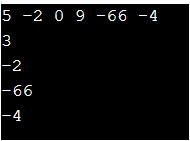
#include <iostream>
#include <vector>

using namespace std;

int main()
{
    vector<int> input;
    vector<int> output;
    int n,k;

    cin>>n;
    for (int i = 1; i <= n; i++) {
        cin>>k;
        input.push_back(k);
    }

    for (int i = 0; i < n; i++){
        if(input[i]<0){
            output.push_back(input[i]);
        }
    }

    cout<<output.size()<<endl;
    for(int i = 0;i<output.size();i++){
        cout<<output[i]<<endl;
    }

    return 0;
}


Add Answer to:
Please write in C++
A list of 6 integers is input into vector listints. Complete the...
[C++] Write a program that reads a list of integers, and outputs those integers in reverse....
[C++] Write a program that reads a list of integers, and outputs those integers in reverse. You must use an array for this lab. The input begins with an integer indicating the number of integers that follow. For coding simplicity, follow each output integer by a space, including the last one. Ex: If the input is: 5 2 4 6 8 10 the output is: 10 8 6 4 2 5 To achieve the above, first read the integers into...
5.35 LAB: Sort a vector Write a program that gets a list of integers from input,...
5.35 LAB: Sort a vector Write a program that gets a list of integers from input, and outputs the integers in ascending order (lowest to highest). The first integer indicates how many numbers are in the list. Assume that the list will always contain less than 20 integers. Ex: If the input is: 5 10 4 39 12 2 the output is: 2 4 10 12 39 For coding simplicity, follow every output value by a space, including the last...
Write a program that first gets a list of integers from the input and adds them...
Write a program that first gets a list of integers from the input and adds them to an array. The input begins with an integer indicating the number of integers that follow (Your program should work for any size of the array). Then, get the last value from the input, and output all integers less than or equal to that value by iterating through the array. Ex: If the input is: Enter the number of integers: 5 Enter integer 1:...
IN JAVA Write a program that first gets a list of integers from input. The input...
IN JAVA Write a program that first gets a list of integers from input. The input begins with an integer indicating the number of integers that follow. Then, get the last value from the input, which indicates a threshold. Output all integers less than or equal to that last threshold value. Assume that the list will always contain fewer than 20 integers. Ex: If the input is: 5 50 60 140 200 75 100 the output is: 50 60 75...
In C++: Write a program that reads a list of integers, and outputs the two smallest...
 In C++: Write a program that reads a list of integers, and outputs the two smallest integers in the list, in ascending order. The list is preceded by an integer indicating how many numbers are in the list. If the input is: 5 10 5 3 21 2, the output is: 2 3 To achieve the above, first read the integers into a vector.
Write a program that first gets a list of integers from input. The input begins with...
Write a program that first gets a list of integers from input. The input begins with an integer indicating the number of integers that follow. Then, get the last value from the input, and output all integers less than or equal to that value. Ex: If the input is: 5 50 60 140 200 75 100 the output is: 50 60 75 The 5 indicates that there are five integers in the list, namely 50, 60, 140, 200, and 75....
Write a complete C++ program using a while loop to read a list of integers ending...
Write a complete C++ program using a while loop to read a list of integers ending with the integer 999. Count and output the number of integers in the list that are greater than 500. If there is no integer in the list that is greater than 500. output (only once) the message that "No integer in the list is greater than 500". Do not use functions.
In C++ Sorted List of User Entered Numbers 2. Write a program that reads in a...
 In C++
Sorted List of User Entered Numbers 2. Write a program that reads in a list of integers into a vector with base type int. Provide the facility to read this vector from an input file. Make sure to ask the user for a filename. The output is a two-column list. The first column is a list of the distinct vector elements. The second column is the count of the number of occurrences for each element. The list should...
In C++
Sorted List of User Entered Numbers 2. Write a program that reads in a list of integers into a vector with base type int. Provide the facility to read this vector from an input file. Make sure to ask the user for a filename. The output is a two-column list. The first column is a list of the distinct vector elements. The second column is the count of the number of occurrences for each element. The list should...
Write a program that reads a list of integers in the range (0 – 49) and prints out the numbers that does not repeat twice
IN PYTHONWrite a program that reads a list of integers in the range (0 – 49) and prints out the numbers that does not repeat twice.The first input of the program is the number of integers contained in this list, followed by the integers contained in the list. Print the numbers in in ascending order.Case 1:INPUT: 5 2 2 3 3 1OUTPUT:1Case 2:INPUT:6 1 2 1 2 2 2OUTPUT:2Case 3:INPUT:4 3 2 1 2OUTPUT: 1 3343 2 1 213
Coral Language Please to thanks Write a program that first gets a list of 5 integers...
Coral Language Please to thanks Write a program that first gets a list of 5 integers from input. Then, get another value from the input, and output all integers less than or equal to that value. Ex: If the input is 50 60 140 200 75 100, the output is: 50 60 75 For coding simplicity, follow every output value by a space, including the last one. Then, output a newline. Such functionality is common on sites like Amazon, where...
 In C++: Write a program that reads a list of integers, and outputs the two smallest integers in the list, in ascending order. The list is preceded by an integer indicating how many numbers are in the list. If the input is: 5 10 5 3 21 2, the output is: 2 3 To achieve the above, first read the integers into a vector.
 In C++
Sorted List of User Entered Numbers 2. Write a program that reads in a list of integers into a vector with base type int. Provide the facility to read this vector from an input file. Make sure to ask the user for a filename. The output is a two-column list. The first column is a list of the distinct vector elements. The second column is the count of the number of occurrences for each element. The list should...
In C++
Sorted List of User Entered Numbers 2. Write a program that reads in a list of integers into a vector with base type int. Provide the facility to read this vector from an input file. Make sure to ask the user for a filename. The output is a two-column list. The first column is a list of the distinct vector elements. The second column is the count of the number of occurrences for each element. The list should...
Most questions answered within 3 hours.
-
Where is the error in this code sequence?
String s1 = "Hello";
String s2 = "ello";...
asked 10 months ago -
Financial data for Joel de Paris, Inc., for last year
follow:
Joel de Paris, Inc.
Balance...
asked 10 months ago -
Consider this reaction:
Al2(SO4)3 (aq)+ BaCl3
(aq) Al2Cl6 (aq)- +
3BaSO4(s) . What is the...
asked 10 months ago -
Suppose that Savneet is considering increasing her
recent random sample from 20 car rentals to 40...
asked 10 months ago -
Trucks arrive at an unloading terminal at an average rate of 120
per hour.
Trucks arrive...
asked 10 months ago -
Why are methanol and ethanol completely soluble in water while
octanol is not very little soluble....
asked 10 months ago -
A facilities manager at a university reads in a research report
that the mean amount of...
asked 10 months ago -
When the CuSO4 is rehydrated by adding water to the anhydrous
compound, is this an endothermic...
asked 10 months ago -
A ray of sunlight is passing from diamond into crown glass; the
angle of incidence is...
asked 10 months ago -
A block of mass 0.249 kg is placed on top of a light, vertical
spring of...
asked 10 months ago -
how do the kidneys compensate in the presences of acidosis
a) trigger hyperventilate
b) reserve acid...
asked 10 months ago -
Question 501 pts
The rental rate of capital to the firm increases. Which of the
following...
asked 10 months ago