
Homework Answers
Add Answer to:
A sound wave a frequency of 20 kHz emerges through a circular opening that has a...
A sound wave with a frequency of 12.6 kHz emerges through a circular opening that has...
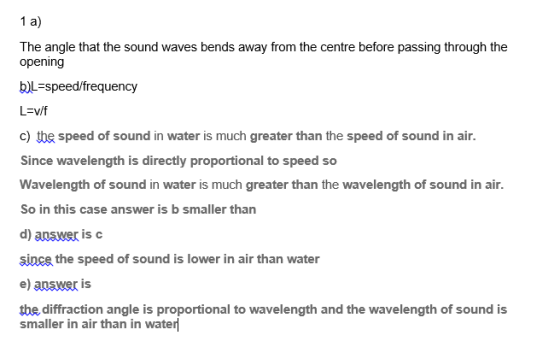
A sound wave with a frequency of 12.6 kHz emerges through a circular opening that has a diameter of 0.217 m. Find the diffraction angle θ when the sound travels (a) in air and (b) in water. (Note: The speed of sound in air is 343 m/s and the speed of sound in water is 1482 m/s.)
A sound wave with a frequency of 12.1 kHz emerges through a circular opening that has...
A sound wave with a frequency of 12.1 kHz emerges through a circular opening that has a diameter of 0.212 m. Find the diffraction angle θ when the sound travels (a) in air and (b) in water. (Note: The speed of sound in air is 343 m/s and the speed of sound in water is 1482 m/s.)
A sound wave in a solid has a frequency of 45.0 kHz and a wavelength of...
A sound wave in a solid has a frequency of 45.0 kHz and a wavelength of 0.333 m. What would be the wave speed, and how much faster is this speed than the speed of sound in air? (The speed of sound in air is 344 m/s.) speed of sound in solid m/s speed of sound in solid speed of sound in air
High-frequency sound waves exhibit less diffraction than low-frequency sound waves do. However, even high frequency sound...
High-frequency sound waves exhibit less diffraction than low-frequency sound waves do. However, even high frequency sound waves exhibit much more diffraction under normal circumstances than do light waves that pass through the same opening. The highest frequency that a healthy ear can typically hear is 2.0 × 10⁴ Hz. Assume that a sound wave with this frequency travels at 342 m/s and passes through a doorway that has a width of 1.2 m. (a) Determine the angle that locates the...
8. A sound wave propagates in air at 27°C with frequency 4.00 kHz. It passes through...
 8. A sound wave propagates in air at 27°C with frequency 4.00 kHz. It passes through a region where the temperature gradually changes and then moves through air at 0°C. Give numerical answers to the fol- lowing questions to the extent possible and state your reasoning about what happens to the wave physically. (a) What happens to the speed of the wave? (b) What happens to its frequency? (c) What happens to its wavelength? Figure P17.7
A 33 kHz sound wave travels in air at v=355 m/s; what is the temperature of...
A 33 kHz sound wave travels in air at v=355 m/s; what is the temperature of the air through which it travels? b) What is its velocity and wavelength? c) Two sound waves arrive at an observer; one is -30 dB quieter than the other which is at 1000 mW/m2. What is the intensity of the quieter one in mW/m2?
10. A sound is transmitted through air (density 1.20 kg/m2) at a velocity of 345 m/s...
 10. A sound is transmitted through air (density 1.20 kg/m2) at a velocity of 345 m/s and then through water (density 1.00 x 10 kg/m2) at a velocity of 1495 m/s. Calculate the acoustic impedance in each medium. What fraction of the sound's intensity will be reflected and transmitted in passing from air to water? What fractions would be reflected and transmitted if the sound traveled from water to air?
Consider a sound wave with a frequency of 306.0 Hz in different materials. Use the following...
Consider a sound wave with a frequency of 306.0 Hz in different materials. Use the following values for the speed of sound in these materials: Air 343 m/s Water 1500 m/s Steel 5960 m/s What is the wavelength of this sound wave in air? What is the wavelength of this sound wave in water? What is the wavelength of this sound wave in steel?
3 questions plzzzzz QUESTION 32 Calculate the frequency of a 2 meter long sound wave as...
 3 questions plzzzzz
QUESTION 32 Calculate the frequency of a 2 meter long sound wave as it travels through the air at a speed of 330 m/s. (do not type the units in your answer). QUESTION 33 A wave with a frequency of 5000 Hz is sent into the body and a signal is received back with a frequency of 4910Hz. What is the Doppler shift? (do not type the units) QUESTION 34 A sound wave is ringing at 6...
3 questions plzzzzz
QUESTION 32 Calculate the frequency of a 2 meter long sound wave as it travels through the air at a speed of 330 m/s. (do not type the units in your answer). QUESTION 33 A wave with a frequency of 5000 Hz is sent into the body and a signal is received back with a frequency of 4910Hz. What is the Doppler shift? (do not type the units) QUESTION 34 A sound wave is ringing at 6...
4. Your ears detect a sound wave with a frequency of 315 Hz and a sound...
4. Your ears detect a sound wave with a frequency of 315 Hz and a sound intensity level of 80 dB. It originated in a vibrating string with a length of 1.9 meters. A) Waves can be longitudinal or transverse. What is the difference between these two kinds of waves? B) This question has one longitudinal wave and one transverse wave. Identify them. C) Recall that the sound you hear from a string is the fundamental frequency, which has a...
 8. A sound wave propagates in air at 27°C with frequency 4.00 kHz. It passes through a region where the temperature gradually changes and then moves through air at 0°C. Give numerical answers to the fol- lowing questions to the extent possible and state your reasoning about what happens to the wave physically. (a) What happens to the speed of the wave? (b) What happens to its frequency? (c) What happens to its wavelength? Figure P17.7
 10. A sound is transmitted through air (density 1.20 kg/m2) at a velocity of 345 m/s and then through water (density 1.00 x 10 kg/m2) at a velocity of 1495 m/s. Calculate the acoustic impedance in each medium. What fraction of the sound's intensity will be reflected and transmitted in passing from air to water? What fractions would be reflected and transmitted if the sound traveled from water to air?
 3 questions plzzzzz
QUESTION 32 Calculate the frequency of a 2 meter long sound wave as it travels through the air at a speed of 330 m/s. (do not type the units in your answer). QUESTION 33 A wave with a frequency of 5000 Hz is sent into the body and a signal is received back with a frequency of 4910Hz. What is the Doppler shift? (do not type the units) QUESTION 34 A sound wave is ringing at 6...
3 questions plzzzzz
QUESTION 32 Calculate the frequency of a 2 meter long sound wave as it travels through the air at a speed of 330 m/s. (do not type the units in your answer). QUESTION 33 A wave with a frequency of 5000 Hz is sent into the body and a signal is received back with a frequency of 4910Hz. What is the Doppler shift? (do not type the units) QUESTION 34 A sound wave is ringing at 6...
Most questions answered within 3 hours.
-
Where is the error in this code sequence?
String s1 = "Hello";
String s2 = "ello";...
asked 11 months ago -
Financial data for Joel de Paris, Inc., for last year
follow:
Joel de Paris, Inc.
Balance...
asked 11 months ago -
Consider this reaction:
Al2(SO4)3 (aq)+ BaCl3
(aq) Al2Cl6 (aq)- +
3BaSO4(s) . What is the...
asked 11 months ago -
Suppose that Savneet is considering increasing her
recent random sample from 20 car rentals to 40...
asked 11 months ago -
Trucks arrive at an unloading terminal at an average rate of 120
per hour.
Trucks arrive...
asked 11 months ago -
Why are methanol and ethanol completely soluble in water while
octanol is not very little soluble....
asked 11 months ago -
A facilities manager at a university reads in a research report
that the mean amount of...
asked 11 months ago -
When the CuSO4 is rehydrated by adding water to the anhydrous
compound, is this an endothermic...
asked 11 months ago -
A ray of sunlight is passing from diamond into crown glass; the
angle of incidence is...
asked 11 months ago -
A block of mass 0.249 kg is placed on top of a light, vertical
spring of...
asked 11 months ago -
how do the kidneys compensate in the presences of acidosis
a) trigger hyperventilate
b) reserve acid...
asked 11 months ago -
Question 501 pts
The rental rate of capital to the firm increases. Which of the
following...
asked 11 months ago