
Homework Answers
Add Answer to:
17. Suppose that (X,Y) has a bivariate normal distribu- zion with parameters diy, x, 0y.p. io...
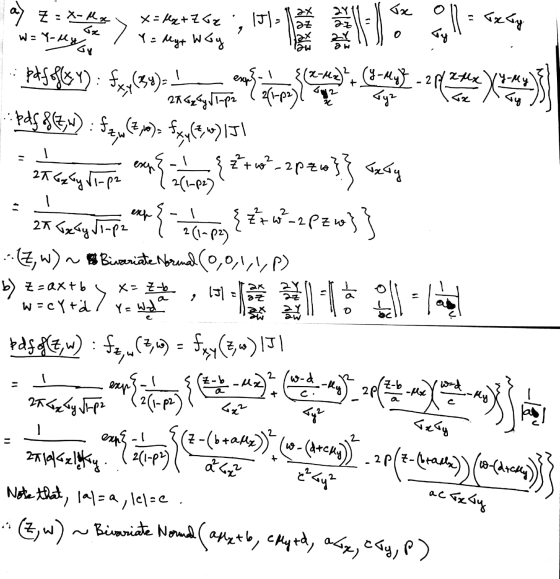
Let X and Y have a bivariate normal distribution with parameters μX = 10, σ2 X = 9, μY = 15, σ2 Y = 16, and ρ = 0. Find (a) P(13.6 < Y < 17.2). (b) E(Y | x). (c) Var(Y | x). (d) P(13.6 < Y &l...
 Let X and Y have a bivariate normal distribution with parameters
μX = 10, σ2 X = 9, μY = 15, σ2 Y = 16, and ρ = 0. Find (a) P(13.6
< Y < 17.2). (b) E(Y | x). (c) Var(Y | x). (d) P(13.6 < Y
< 17.2 | X = 9.1).
4.5-8. Let X and Y have a bivariate normal distribution with parameters Ax-10, σ(-9, Ily-15, σǐ_ 16, and ρ O. Find (a) P(13.6< Y < 17.2)...
Let X and Y have a bivariate normal distribution with parameters
μX = 10, σ2 X = 9, μY = 15, σ2 Y = 16, and ρ = 0. Find (a) P(13.6
< Y < 17.2). (b) E(Y | x). (c) Var(Y | x). (d) P(13.6 < Y
< 17.2 | X = 9.1).
4.5-8. Let X and Y have a bivariate normal distribution with parameters Ax-10, σ(-9, Ily-15, σǐ_ 16, and ρ O. Find (a) P(13.6< Y < 17.2)...
If X and Y have a bivariate normal distribution with parameters mean1,mean2, variance1, variance2and P show...
If X and Y have a bivariate normal distribution with parameters mean1,mean2, variance1, variance2and P show that Z = aX + bY + c is N(a.mean1 + b.mean2 + c, variance1.variance2 + 2abp.variance1.variance2 + b^2.variance2, where a, b, and c are constants. Hint: Use the m.g.f. M(t1 t2) of X and Y to find the m.g.f. of Z.
Suppose (X, Y ) has bivariate normal distribution, E(X) = E(Y ) = 0,V ar(X) =...
 Suppose (X, Y ) has bivariate
normal distribution, E(X) = E(Y ) = 0,V ar(X) = σX2 , V ar(Y ) =
σY2 and Correl(X, Y ) = ρ. Calculate the conditional expectation
E(X2|Y ).
I. Suppose (X,Y) has bivariate normal distribution, E(X) = E(Y) 0, Var(X)-σ , Var(Y) σ and Correl (X,Y)-p. Calculate the conditional expectation ECKY expectation E(X2Y)
Suppose (X, Y ) has bivariate
normal distribution, E(X) = E(Y ) = 0,V ar(X) = σX2 , V ar(Y ) =
σY2 and Correl(X, Y ) = ρ. Calculate the conditional expectation
E(X2|Y ).
I. Suppose (X,Y) has bivariate normal distribution, E(X) = E(Y) 0, Var(X)-σ , Var(Y) σ and Correl (X,Y)-p. Calculate the conditional expectation ECKY expectation E(X2Y)
6. Suppose that X and Y have a bivariate normal distribution with px 1 and y- (a) Order the follo...
 6. Suppose that X and Y have a bivariate normal distribution with px 1 and y- (a) Order the following probabilities from largest to smallest, assuming p >0: P(X 2 (b) Repeat (a) assuming p < 0. (c) Repeat (a) assuming we are interested in (X 0.25) instead of (x 2 2).
6. Suppose that X and Y have a bivariate normal distribution with px 1 and y- (a) Order the following probabilities from largest to smallest, assuming p >0:...
6. Suppose that X and Y have a bivariate normal distribution with px 1 and y- (a) Order the following probabilities from largest to smallest, assuming p >0: P(X 2 (b) Repeat (a) assuming p < 0. (c) Repeat (a) assuming we are interested in (X 0.25) instead of (x 2 2).
6. Suppose that X and Y have a bivariate normal distribution with px 1 and y- (a) Order the following probabilities from largest to smallest, assuming p >0:...
Let X and Y have a bivariate normal distribution with parameters μX = 4, μY =...
Let X and Y have a bivariate normal distribution with parameters μX = 4, μY = 2, σX = 2, σY = 4, and ρ = 1/2. Find two different lines, a(x) and b(x), parallel to and equidistant from E(Y|x), such that P[a(x) < Y < b(x)|X = x] = 0.6827 for all real x.
1. Suppose (x, Y) has bivariate normal distribution, E(x) E(Y)- 0, Var(X) σ , Var(Y) σ...
 1. Suppose (x, Y) has bivariate normal distribution, E(x) E(Y)- 0, Var(X) σ , Var(Y) σ and Correl(X, Y) p. Calculate the conditional expectation E(X2|Y).
4. Let (X,Y) be a bivariate normal random vector with distribution N(u, 2) where -=[ 5...
 4. Let (X,Y) be a bivariate normal random vector with distribution N(u, 2) where -=[ 5 ], = [11] Here -1 <p<1. (a) What is P(X > Y)? (b) Is there a constant c such that X and X +cY are independent?
please help me 6. Suppose X, Y have a bivariate normal distribution with marginal dis- tribution...
 please help me
6. Suppose X, Y have a bivariate normal distribution with marginal dis- tribution X ~ N(0,1) and the conditional distribution of Y given X-x is N(ax + b,a?). (i). What is the marginal distribution of Y? (ii). What is the conditional dist ribut ion of X given Y-y?
please help me
6. Suppose X, Y have a bivariate normal distribution with marginal dis- tribution X ~ N(0,1) and the conditional distribution of Y given X-x is N(ax + b,a?). (i). What is the marginal distribution of Y? (ii). What is the conditional dist ribut ion of X given Y-y?
Suppose that X and Y form a bivariate normal distribution. You are given that E[X] =...
 Suppose that X and Y form a bivariate normal distribution. You are given that E[X] = E[Y] = 0, with o x = 3, 0y = 2. Further, the correlation between X and Y is 0.5. Find P(X<Y + 1).
Suppose that X and Y form a bivariate normal distribution. You are given that E[X] =...
 Suppose that X and Y form a bivariate normal distribution. You are given that E[X] = E[Y] = 0, with o x = 3, 0y = 2. Further, the correlation between X and Y is 0.5. Find P(X<Y + 1).
 Let X and Y have a bivariate normal distribution with parameters
μX = 10, σ2 X = 9, μY = 15, σ2 Y = 16, and ρ = 0. Find (a) P(13.6
< Y < 17.2). (b) E(Y | x). (c) Var(Y | x). (d) P(13.6 < Y
< 17.2 | X = 9.1).
4.5-8. Let X and Y have a bivariate normal distribution with parameters Ax-10, σ(-9, Ily-15, σǐ_ 16, and ρ O. Find (a) P(13.6< Y < 17.2)...
Let X and Y have a bivariate normal distribution with parameters
μX = 10, σ2 X = 9, μY = 15, σ2 Y = 16, and ρ = 0. Find (a) P(13.6
< Y < 17.2). (b) E(Y | x). (c) Var(Y | x). (d) P(13.6 < Y
< 17.2 | X = 9.1).
4.5-8. Let X and Y have a bivariate normal distribution with parameters Ax-10, σ(-9, Ily-15, σǐ_ 16, and ρ O. Find (a) P(13.6< Y < 17.2)...
 Suppose (X, Y ) has bivariate
normal distribution, E(X) = E(Y ) = 0,V ar(X) = σX2 , V ar(Y ) =
σY2 and Correl(X, Y ) = ρ. Calculate the conditional expectation
E(X2|Y ).
I. Suppose (X,Y) has bivariate normal distribution, E(X) = E(Y) 0, Var(X)-σ , Var(Y) σ and Correl (X,Y)-p. Calculate the conditional expectation ECKY expectation E(X2Y)
Suppose (X, Y ) has bivariate
normal distribution, E(X) = E(Y ) = 0,V ar(X) = σX2 , V ar(Y ) =
σY2 and Correl(X, Y ) = ρ. Calculate the conditional expectation
E(X2|Y ).
I. Suppose (X,Y) has bivariate normal distribution, E(X) = E(Y) 0, Var(X)-σ , Var(Y) σ and Correl (X,Y)-p. Calculate the conditional expectation ECKY expectation E(X2Y)
 6. Suppose that X and Y have a bivariate normal distribution with px 1 and y- (a) Order the following probabilities from largest to smallest, assuming p >0: P(X 2 (b) Repeat (a) assuming p < 0. (c) Repeat (a) assuming we are interested in (X 0.25) instead of (x 2 2).
6. Suppose that X and Y have a bivariate normal distribution with px 1 and y- (a) Order the following probabilities from largest to smallest, assuming p >0:...
6. Suppose that X and Y have a bivariate normal distribution with px 1 and y- (a) Order the following probabilities from largest to smallest, assuming p >0: P(X 2 (b) Repeat (a) assuming p < 0. (c) Repeat (a) assuming we are interested in (X 0.25) instead of (x 2 2).
6. Suppose that X and Y have a bivariate normal distribution with px 1 and y- (a) Order the following probabilities from largest to smallest, assuming p >0:...
 1. Suppose (x, Y) has bivariate normal distribution, E(x) E(Y)- 0, Var(X) σ , Var(Y) σ and Correl(X, Y) p. Calculate the conditional expectation E(X2|Y).
 4. Let (X,Y) be a bivariate normal random vector with distribution N(u, 2) where -=[ 5 ], = [11] Here -1 <p<1. (a) What is P(X > Y)? (b) Is there a constant c such that X and X +cY are independent?
 please help me
6. Suppose X, Y have a bivariate normal distribution with marginal dis- tribution X ~ N(0,1) and the conditional distribution of Y given X-x is N(ax + b,a?). (i). What is the marginal distribution of Y? (ii). What is the conditional dist ribut ion of X given Y-y?
please help me
6. Suppose X, Y have a bivariate normal distribution with marginal dis- tribution X ~ N(0,1) and the conditional distribution of Y given X-x is N(ax + b,a?). (i). What is the marginal distribution of Y? (ii). What is the conditional dist ribut ion of X given Y-y?
 Suppose that X and Y form a bivariate normal distribution. You are given that E[X] = E[Y] = 0, with o x = 3, 0y = 2. Further, the correlation between X and Y is 0.5. Find P(X<Y + 1).
 Suppose that X and Y form a bivariate normal distribution. You are given that E[X] = E[Y] = 0, with o x = 3, 0y = 2. Further, the correlation between X and Y is 0.5. Find P(X<Y + 1).
Most questions answered within 3 hours.
-
Where is the error in this code sequence?
String s1 = "Hello";
String s2 = "ello";...
asked 10 months ago -
Financial data for Joel de Paris, Inc., for last year
follow:
Joel de Paris, Inc.
Balance...
asked 10 months ago -
Consider this reaction:
Al2(SO4)3 (aq)+ BaCl3
(aq) Al2Cl6 (aq)- +
3BaSO4(s) . What is the...
asked 10 months ago -
Suppose that Savneet is considering increasing her
recent random sample from 20 car rentals to 40...
asked 10 months ago -
Trucks arrive at an unloading terminal at an average rate of 120
per hour.
Trucks arrive...
asked 10 months ago -
Why are methanol and ethanol completely soluble in water while
octanol is not very little soluble....
asked 10 months ago -
A facilities manager at a university reads in a research report
that the mean amount of...
asked 10 months ago -
When the CuSO4 is rehydrated by adding water to the anhydrous
compound, is this an endothermic...
asked 10 months ago -
A ray of sunlight is passing from diamond into crown glass; the
angle of incidence is...
asked 10 months ago -
A block of mass 0.249 kg is placed on top of a light, vertical
spring of...
asked 10 months ago -
how do the kidneys compensate in the presences of acidosis
a) trigger hyperventilate
b) reserve acid...
asked 10 months ago -
Question 501 pts
The rental rate of capital to the firm increases. Which of the
following...
asked 10 months ago