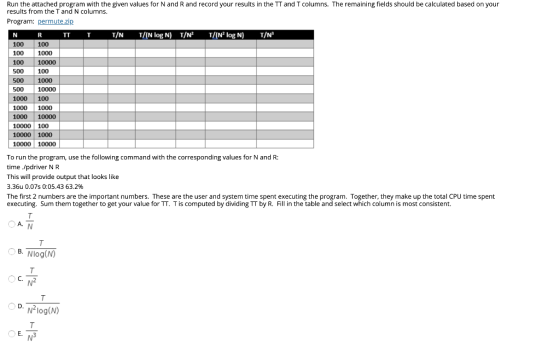
permute zip contains:
makefile:
DIR=${PWD}
ASST=$(notdir ${DIR})
MAINPROG=pdriver
ifneq (,$(findstring MinGW,$(PATH)))
DISTR=MinGW
EXE=.exe
LFLAGS=
else
DISTR=Unix
EXE=
LFLAGS=
endif
#
########################################################################
# Macro definitions for "standard" C and C++ compilations
#
CPPFLAGS=-g -D$(DISTR)
CFLAGS=-g
TARGET=$(MAINPROG)$(EXE)
CPPS=pdriver.cpp permute.cpp
LINK=g++ $(CPPFLAGS)
#
CC=gcc
CXX=g++
#
#
# In most cases, you should not change anything below this
line.
#
# The following is "boilerplate" to set up the standard
compilation
# commands:
#
OBJS=$(CPPS:%.cpp=%.o)
DEPENDENCIES = $(CPPS:%.cpp=%.d)
%.d: %.cpp
touch $@
%.o: %.cpp
$(CXX) $(CPPFLAGS) -MMD -o $@ -c $*.cpp
#
# Targets:
#
all: $(TARGET)
$(TARGET): $(OBJS)
$(LINK) $(FLAGS) -o $(TARGET) $(OBJS) $(LFLAGS)
clean:
-/bin/rm -f *.d *.o $(TARGET)
make.dep: $(DEPENDENCIES)
-cat $(DEPENDENCIES) > $@
include make.dep
pdriver.cpp:
#include
#include
#include
#include

using namespace std;

void permute (int[], int);


int main(int argc, char** argv)
{
  if (argc != 3)
    {
      cerr << "When you run this program, you must supply two parameters.\n"
           << "The first is the size of the array you want to permute.\n"
           << "The second is the number of trials you want to perform.\n"
           << "\n"
           << "For example, if you called this program pdriver, you\n"
           << "might invoke it as:\n"
           << "   pdriver 100 10 \n"
           << "to generate 10 random permutations of 100 elements each."
        << endl;
      return 1;
    }

  int N;
  int trials;

  {
    istringstream arg1 (argv[1]);
    arg1 >> N;

    istringstream arg2 (argv[2]);
    arg2 >> trials;
  }

  int *array = new int[N];

  srand(time(0));
  for (int t = 0; t < trials; t++)
    {
      permute (array, N);
      // for (int i = 0; i < N; ++i) cout << array[i] << ' '; cout << endl;
    }

  return 0;
}
permute.cpp:
#include
#include
#include

using namespace std;

unsigned rnd(unsigned limit)
{
  return rand() % limit;
}

//  Generate a random permutation of the integers from
//  0 .. n-1, storing the results in array a.
//
void permute (int a[], int n)
{
  for (int i = 0; i < n; i++)
    {
      // Guess at a value to put into a[i]
      int guess = rnd(n);
      while (find(a, a+i, guess) != a+i)
        {
    // If it's one that we've already used, guess again.
         guess = rnd(n);
        }
      a[i] = guess;
    }
}Homework Answers
So to complete the above problem, we need to find the time complexity of the permute function.
void permute (int a[], int n)
{
  for (int i = 0; i < n; i++)        //n times
    {
      // Guess at a value to put into a[i]
      int guess = rnd(n);           // Constant
      while (find(a, a+i, guess) != a+i) // Each find request will be proportional to n and finding the guess number which is not present will be of n complexity. So we will have n2 complexity here.
        {
    // If it's one that we've already used, guess again.
         guess = rnd(n);
        }
      a[i] = guess;
    }
}
So in total, the time complexity would be O(n3), Thus
We can say that it would be proportional to 
So the solution is: Option E
Thanks:
Add Answer to:
permute zip contains:
makefile:
DIR=${PWD}
ASST=$(notdir ${DIR})
MAINPROG=pdriver
ifneq (,$(findstring MinGW,$(PATH)))
DISTR=MinGW
EXE=.exe
LFLAGS=
else
DISTR=Unix...
I need Help PLZ. I can't solving this in C program Given is a C program count_primes.c, which is an array Generates 10000 six-digit random numbers and then determines the number of primes in that...
I need Help PLZ. I can't solving this in C program Given is a C program count_primes.c, which is an array Generates 10000 six-digit random numbers and then determines the number of primes in that array. It also measures the time that elapses during the calculation and returns it to the console along with the number of primes it finds. (a) Rewrite the program so that N threads are used to count the primes in the array. Each thread is...
Objectives The purpose of this lab is to help you become familiar with the development environment,...
Objectives The purpose of this lab is to help you become familiar with the development environment, to reinforce the concepts covered in chapter 2, to reinforce the implementation of object oriented concepts in C++, and to reinforce the implementation of operator overloading in C++. Requirements Extend the implementation of the statistician class created in Lab 2 to overload operators +, *, and ==. The extended class definition is given in stats2.h. You need implement the three operator overloading functions in...
Assignment Predator / Prey Objectives Reading from and writing to text files Implementing mathematical formulas in...
Assignment Predator / Prey Objectives Reading from and writing to text files Implementing mathematical formulas in C++ Implementing classes Using vectors Using command line arguments Modifying previously written code Tasks For this project, you will implement a simulation for predicting the future populations for a group of animals that we’ll call prey and their predators. Given the rate at which prey births exceed natural deaths, the rate of predation, the rate at which predator deaths exceeds births without a food...
C++ Binary Search Tree question. I heed help with the level 2 question please, as level...
 C++ Binary Search Tree question. I heed help with the level 2
question please, as level 1 is already completed. I will rate the
answer a 100% thumbs up. I really appreciate the help!. Thank
you!
searching.cpp
#include <getopt.h>
#include <iostream>
#include <sstream>
#include <stdlib.h>
#include <unistd.h>
using namespace std;
// global variable for tree operations
// use to control tree maintenance operations
enum Mode { simple, randomised, avl } mode; // tree type
// returns size of tree
//...
C++ Binary Search Tree question. I heed help with the level 2
question please, as level 1 is already completed. I will rate the
answer a 100% thumbs up. I really appreciate the help!. Thank
you!
searching.cpp
#include <getopt.h>
#include <iostream>
#include <sstream>
#include <stdlib.h>
#include <unistd.h>
using namespace std;
// global variable for tree operations
// use to control tree maintenance operations
enum Mode { simple, randomised, avl } mode; // tree type
// returns size of tree
//...
C++ Binary Search Tree question. I heed help with the level 2 question please, as level...
 C++ Binary Search Tree question. I heed help with the level 2
question please, as level 1 is already completed. I will rate the
answer a 100% thumbs up. I really appreciate the help!. Thank
you!
searching.cpp
#include <getopt.h>
#include <iostream>
#include <sstream>
#include <stdlib.h>
#include <unistd.h>
using namespace std;
// global variable for tree operations
// use to control tree maintenance operations
enum Mode { simple, randomised, avl } mode; // tree type
// returns size of tree
//...
C++ Binary Search Tree question. I heed help with the level 2
question please, as level 1 is already completed. I will rate the
answer a 100% thumbs up. I really appreciate the help!. Thank
you!
searching.cpp
#include <getopt.h>
#include <iostream>
#include <sstream>
#include <stdlib.h>
#include <unistd.h>
using namespace std;
// global variable for tree operations
// use to control tree maintenance operations
enum Mode { simple, randomised, avl } mode; // tree type
// returns size of tree
//...
 C++ Binary Search Tree question. I heed help with the level 2
question please, as level 1 is already completed. I will rate the
answer a 100% thumbs up. I really appreciate the help!. Thank
you!
searching.cpp
#include <getopt.h>
#include <iostream>
#include <sstream>
#include <stdlib.h>
#include <unistd.h>
using namespace std;
// global variable for tree operations
// use to control tree maintenance operations
enum Mode { simple, randomised, avl } mode; // tree type
// returns size of tree
//...
C++ Binary Search Tree question. I heed help with the level 2
question please, as level 1 is already completed. I will rate the
answer a 100% thumbs up. I really appreciate the help!. Thank
you!
searching.cpp
#include <getopt.h>
#include <iostream>
#include <sstream>
#include <stdlib.h>
#include <unistd.h>
using namespace std;
// global variable for tree operations
// use to control tree maintenance operations
enum Mode { simple, randomised, avl } mode; // tree type
// returns size of tree
//...
 C++ Binary Search Tree question. I heed help with the level 2
question please, as level 1 is already completed. I will rate the
answer a 100% thumbs up. I really appreciate the help!. Thank
you!
searching.cpp
#include <getopt.h>
#include <iostream>
#include <sstream>
#include <stdlib.h>
#include <unistd.h>
using namespace std;
// global variable for tree operations
// use to control tree maintenance operations
enum Mode { simple, randomised, avl } mode; // tree type
// returns size of tree
//...
C++ Binary Search Tree question. I heed help with the level 2
question please, as level 1 is already completed. I will rate the
answer a 100% thumbs up. I really appreciate the help!. Thank
you!
searching.cpp
#include <getopt.h>
#include <iostream>
#include <sstream>
#include <stdlib.h>
#include <unistd.h>
using namespace std;
// global variable for tree operations
// use to control tree maintenance operations
enum Mode { simple, randomised, avl } mode; // tree type
// returns size of tree
//...
Most questions answered within 3 hours.
-
Where is the error in this code sequence?
String s1 = "Hello";
String s2 = "ello";...
asked 10 months ago -
Financial data for Joel de Paris, Inc., for last year
follow:
Joel de Paris, Inc.
Balance...
asked 10 months ago -
Consider this reaction:
Al2(SO4)3 (aq)+ BaCl3
(aq) Al2Cl6 (aq)- +
3BaSO4(s) . What is the...
asked 10 months ago -
Suppose that Savneet is considering increasing her
recent random sample from 20 car rentals to 40...
asked 10 months ago -
Trucks arrive at an unloading terminal at an average rate of 120
per hour.
Trucks arrive...
asked 10 months ago -
Why are methanol and ethanol completely soluble in water while
octanol is not very little soluble....
asked 10 months ago -
A facilities manager at a university reads in a research report
that the mean amount of...
asked 10 months ago -
When the CuSO4 is rehydrated by adding water to the anhydrous
compound, is this an endothermic...
asked 10 months ago -
A ray of sunlight is passing from diamond into crown glass; the
angle of incidence is...
asked 10 months ago -
A block of mass 0.249 kg is placed on top of a light, vertical
spring of...
asked 10 months ago -
how do the kidneys compensate in the presences of acidosis
a) trigger hyperventilate
b) reserve acid...
asked 10 months ago -
Question 501 pts
The rental rate of capital to the firm increases. Which of the
following...
asked 10 months ago