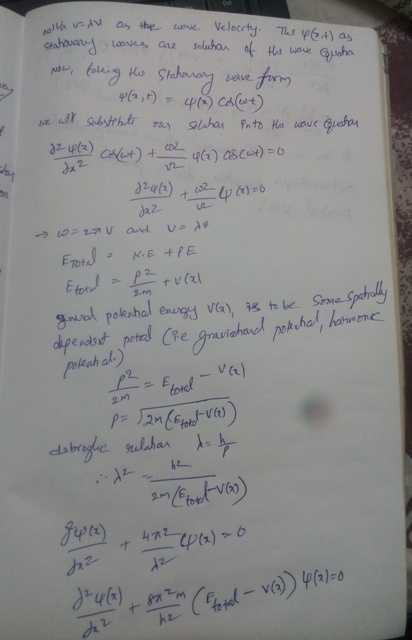
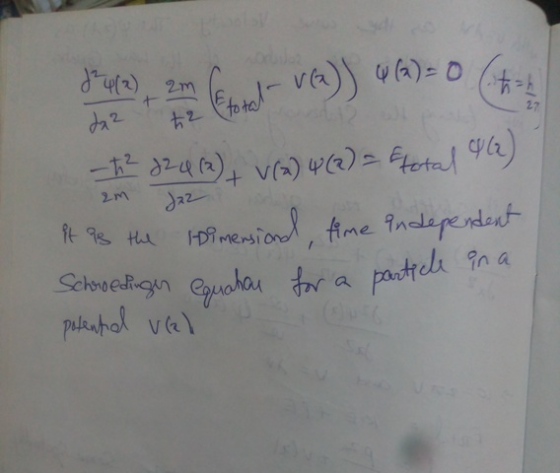
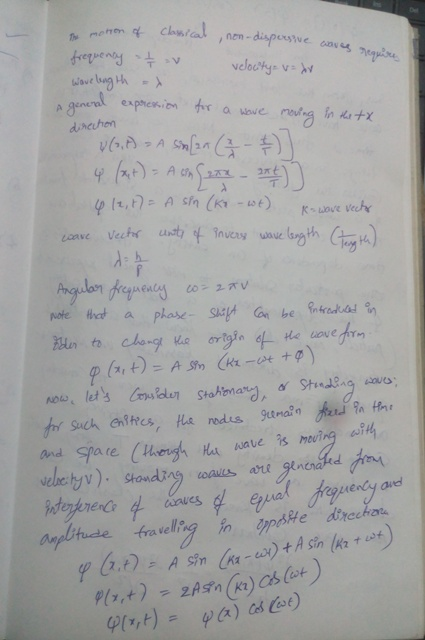
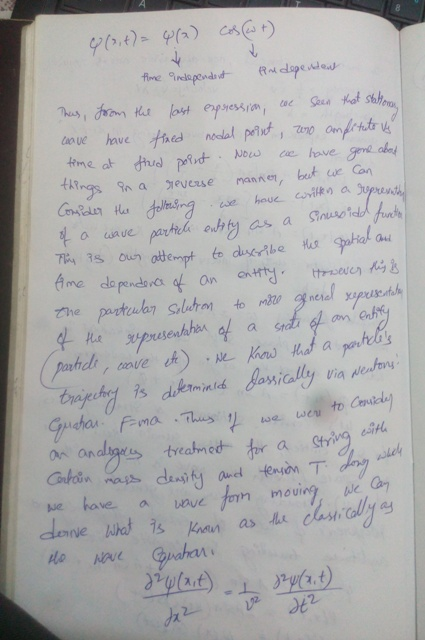
Derive the time-independent Schrödinger equation from the classical nondispersive wave equation and a generic standing wave.
Derive the time-independent Schrödinger equation from the classical nondispersive
wave equation and a generic standing wave.
Homework Answers
Add Answer to:
Derive the time-independent Schrödinger equation from the
classical nondispersive
wave equation and a generic standing wave.
6- Find (obtain, derive) the time-independent Schrödinger equation.
 6- Find (obtain, derive) the time-independent Schrödinger equation.
1 Time-independent Schrödinger equation (TISE) Remember the (one-dimensional) time-independent Schrödinger equation (TISE) for a state (...
 1 Time-independent Schrödinger equation (TISE) Remember the (one-dimensional) time-independent Schrödinger equation (TISE) for a state ( definite energy E: with Now shift the potential energy by a constant: V(x) -> V(x) Vo Show that (a) The allowed energies (El,Ea. . .) are all shifted by Vo (b) The corresponding states (vi (x),P2( r),...) remain the same.
Solve the following problems HW9. Show that the time-independent Schrödinger equation is given by P(x)/(x) =...
 Solve the following problems
HW9. Show that the time-independent Schrödinger equation is given by P(x)/(x) = Eve from the traveling wave equation and the wave function (x./)=v(x)cos or HW10. Example 9.3 Calculation of a normalization factor Given that the wavefunction for the hydrogen atom in the ground state (n = 1) is of the form = Ne , where r is the distance from the nucleus to the electron and do is the Bohr radius, calculate the normalization factor N.
Solve the following problems
HW9. Show that the time-independent Schrödinger equation is given by P(x)/(x) = Eve from the traveling wave equation and the wave function (x./)=v(x)cos or HW10. Example 9.3 Calculation of a normalization factor Given that the wavefunction for the hydrogen atom in the ground state (n = 1) is of the form = Ne , where r is the distance from the nucleus to the electron and do is the Bohr radius, calculate the normalization factor N.
Potential energy function, V(x) = (1/2)mw2x2 Assuming the time-independent Schrödinger equation, show that the following wave...
 Potential energy function,
V(x) = (1/2)mw2x2
Assuming the time-independent Schrödinger equation, show that the following wave functions are solutions describing the one-dimensional harmonic behaviour of a particle of mass m, where ?2-h/v/mK, and where co and ci are constants. Calculate the energies of the particle when it is in wave-functions ?0(x) and V1 (z) What is the general expression for the allowed energies En, corresponding to wave- functions Un(x), of this one-dimensional quantum oscillator? 6 the states corresponding to the...
Potential energy function,
V(x) = (1/2)mw2x2
Assuming the time-independent Schrödinger equation, show that the following wave functions are solutions describing the one-dimensional harmonic behaviour of a particle of mass m, where ?2-h/v/mK, and where co and ci are constants. Calculate the energies of the particle when it is in wave-functions ?0(x) and V1 (z) What is the general expression for the allowed energies En, corresponding to wave- functions Un(x), of this one-dimensional quantum oscillator? 6 the states corresponding to the...
The time-independent Schroedinger equation is given by: − Wave functions that satisfy this equation are called...
 The time-independent Schroedinger equation is given by:
− Wave functions that satisfy this equation are called energy
eigenstates. a) If U=0 for all positions, this represents a free
particle. For a wave function with definite momentum ℏ,, compute E.
b) Is the relationship derived from a) consistent with what we know
from classical mechanics for a free particle? Explain how or how
not. c) Consider the wave function ((^b[j + ^bâj), with A some
number and c, d not equal...
The time-independent Schroedinger equation is given by:
− Wave functions that satisfy this equation are called energy
eigenstates. a) If U=0 for all positions, this represents a free
particle. For a wave function with definite momentum ℏ,, compute E.
b) Is the relationship derived from a) consistent with what we know
from classical mechanics for a free particle? Explain how or how
not. c) Consider the wave function ((^b[j + ^bâj), with A some
number and c, d not equal...
Using Maxwell's equations, derive the expression of the generic wave equation, for a perfect dielectric, and...
Using Maxwell's equations, derive the expression of the generic wave equation, for a perfect dielectric, and a conducting media. Hence derive the expressions for alpha and beta for a perfect dielectric, and a conducting media. alpha - attenuation constant beta - phase constant
2. The hydrogen atom [8 marks] The time-independent Schrödinger equation for the hydrogen atom in...
 2. The hydrogen atom [8 marks] The time-independent Schrödinger equation for the hydrogen atom in the spherical coordinate representation is where ao-top- 0.5298 10-10rn is the Bohr radius, and μ is the electon-proton reduced mass. Here, the square of the angular momentum operator L2 in the spherical coordinate representation is given by: 2 (2.2) sin θー sin θ 00 The form of the Schrödinger equation means that all energy eigenstates separate into radial and angular motion, and we can write...
1. Infinite potential quantum well. (1) Starting from the Schrödinger equation, please derive the...
 1. Infinite potential quantum well. (1) Starting from the Schrödinger equation, please derive the quantized energy levels and wave functions for an infinite potential quantum well of width D 2 nm. (2) Photon emission wavelength: Please calculate the emitted photon wavelength if an electron falls from the n-2 state into n-l state inside this infinite potential quantum well. (3) Heisenberg uncertainty principle: For the n-2 state of an electron inside an infinite potential well, prove that the Heisenberg uncertainty relation...
1. The time-dependent Schrödinger equation The time-dependent Schrödinger equation is -R2 824(1,t) + V (1,t) (1,t)...
 1. The time-dependent Schrödinger equation The time-dependent Schrödinger equation is -R2 824(1,t) + V (1,t) (1,t) = in 2m 0:2 . (a) For V1, t) = 0, show that the wave function (1,t) = A sin (kr - wt) does not satisfy the time- dependent Schrödinger equation. (b) For VI,t) = 0, Show that I, t) = A cos(kr - wt) + i sin (kr - wt) does satisfy this equation. This is a simple demonstration that the wavefunction in...
4. Differential equation. Show that if ψ(x) is a solution of the one-dimensional time-independent Schrödinger equation,...
 4. Differential equation. Show that if ψ(x) is a solution of the one-dimensional time-independent Schrödinger equation, then c ψ(x), where c is an arbitrary complex constant, is also a solution.
 6- Find (obtain, derive) the time-independent Schrödinger equation.
 1 Time-independent Schrödinger equation (TISE) Remember the (one-dimensional) time-independent Schrödinger equation (TISE) for a state ( definite energy E: with Now shift the potential energy by a constant: V(x) -> V(x) Vo Show that (a) The allowed energies (El,Ea. . .) are all shifted by Vo (b) The corresponding states (vi (x),P2( r),...) remain the same.
 Solve the following problems
HW9. Show that the time-independent Schrödinger equation is given by P(x)/(x) = Eve from the traveling wave equation and the wave function (x./)=v(x)cos or HW10. Example 9.3 Calculation of a normalization factor Given that the wavefunction for the hydrogen atom in the ground state (n = 1) is of the form = Ne , where r is the distance from the nucleus to the electron and do is the Bohr radius, calculate the normalization factor N.
Solve the following problems
HW9. Show that the time-independent Schrödinger equation is given by P(x)/(x) = Eve from the traveling wave equation and the wave function (x./)=v(x)cos or HW10. Example 9.3 Calculation of a normalization factor Given that the wavefunction for the hydrogen atom in the ground state (n = 1) is of the form = Ne , where r is the distance from the nucleus to the electron and do is the Bohr radius, calculate the normalization factor N.
 Potential energy function,
V(x) = (1/2)mw2x2
Assuming the time-independent Schrödinger equation, show that the following wave functions are solutions describing the one-dimensional harmonic behaviour of a particle of mass m, where ?2-h/v/mK, and where co and ci are constants. Calculate the energies of the particle when it is in wave-functions ?0(x) and V1 (z) What is the general expression for the allowed energies En, corresponding to wave- functions Un(x), of this one-dimensional quantum oscillator? 6 the states corresponding to the...
Potential energy function,
V(x) = (1/2)mw2x2
Assuming the time-independent Schrödinger equation, show that the following wave functions are solutions describing the one-dimensional harmonic behaviour of a particle of mass m, where ?2-h/v/mK, and where co and ci are constants. Calculate the energies of the particle when it is in wave-functions ?0(x) and V1 (z) What is the general expression for the allowed energies En, corresponding to wave- functions Un(x), of this one-dimensional quantum oscillator? 6 the states corresponding to the...
 The time-independent Schroedinger equation is given by:
− Wave functions that satisfy this equation are called energy
eigenstates. a) If U=0 for all positions, this represents a free
particle. For a wave function with definite momentum ℏ,, compute E.
b) Is the relationship derived from a) consistent with what we know
from classical mechanics for a free particle? Explain how or how
not. c) Consider the wave function ((^b[j + ^bâj), with A some
number and c, d not equal...
The time-independent Schroedinger equation is given by:
− Wave functions that satisfy this equation are called energy
eigenstates. a) If U=0 for all positions, this represents a free
particle. For a wave function with definite momentum ℏ,, compute E.
b) Is the relationship derived from a) consistent with what we know
from classical mechanics for a free particle? Explain how or how
not. c) Consider the wave function ((^b[j + ^bâj), with A some
number and c, d not equal...
 2. The hydrogen atom [8 marks] The time-independent Schrödinger equation for the hydrogen atom in the spherical coordinate representation is where ao-top- 0.5298 10-10rn is the Bohr radius, and μ is the electon-proton reduced mass. Here, the square of the angular momentum operator L2 in the spherical coordinate representation is given by: 2 (2.2) sin θー sin θ 00 The form of the Schrödinger equation means that all energy eigenstates separate into radial and angular motion, and we can write...
 1. Infinite potential quantum well. (1) Starting from the Schrödinger equation, please derive the quantized energy levels and wave functions for an infinite potential quantum well of width D 2 nm. (2) Photon emission wavelength: Please calculate the emitted photon wavelength if an electron falls from the n-2 state into n-l state inside this infinite potential quantum well. (3) Heisenberg uncertainty principle: For the n-2 state of an electron inside an infinite potential well, prove that the Heisenberg uncertainty relation...
 1. The time-dependent Schrödinger equation The time-dependent Schrödinger equation is -R2 824(1,t) + V (1,t) (1,t) = in 2m 0:2 . (a) For V1, t) = 0, show that the wave function (1,t) = A sin (kr - wt) does not satisfy the time- dependent Schrödinger equation. (b) For VI,t) = 0, Show that I, t) = A cos(kr - wt) + i sin (kr - wt) does satisfy this equation. This is a simple demonstration that the wavefunction in...
 4. Differential equation. Show that if ψ(x) is a solution of the one-dimensional time-independent Schrödinger equation, then c ψ(x), where c is an arbitrary complex constant, is also a solution.
Most questions answered within 3 hours.
-
Where is the error in this code sequence?
String s1 = "Hello";
String s2 = "ello";...
asked 11 months ago -
Financial data for Joel de Paris, Inc., for last year
follow:
Joel de Paris, Inc.
Balance...
asked 11 months ago -
Consider this reaction:
Al2(SO4)3 (aq)+ BaCl3
(aq) Al2Cl6 (aq)- +
3BaSO4(s) . What is the...
asked 11 months ago -
Suppose that Savneet is considering increasing her
recent random sample from 20 car rentals to 40...
asked 11 months ago -
Trucks arrive at an unloading terminal at an average rate of 120
per hour.
Trucks arrive...
asked 11 months ago -
Why are methanol and ethanol completely soluble in water while
octanol is not very little soluble....
asked 11 months ago -
A facilities manager at a university reads in a research report
that the mean amount of...
asked 11 months ago -
When the CuSO4 is rehydrated by adding water to the anhydrous
compound, is this an endothermic...
asked 11 months ago -
A ray of sunlight is passing from diamond into crown glass; the
angle of incidence is...
asked 11 months ago -
A block of mass 0.249 kg is placed on top of a light, vertical
spring of...
asked 11 months ago -
how do the kidneys compensate in the presences of acidosis
a) trigger hyperventilate
b) reserve acid...
asked 11 months ago -
Question 501 pts
The rental rate of capital to the firm increases. Which of the
following...
asked 11 months ago