1. Draw a force diagram for a car moving in a straight line at a constant...
1. Draw a force diagram for a car moving in a straight line at a constant velocity (include friction). Then, write out Newton's second law equation for the car in both the X and Y directions.
2. Draw a force diagram for a car accelerating in a curve. (inclue friciton)
Homework Answers
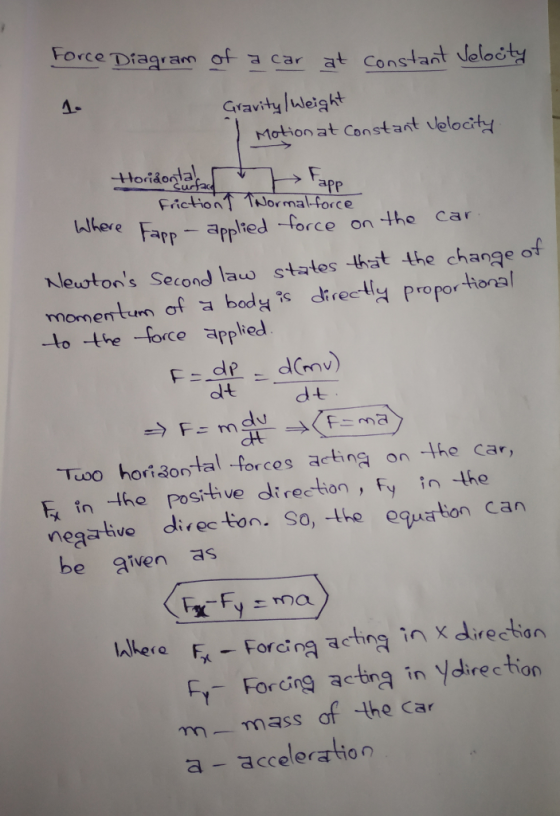
 For the first question,
solution is explained in the first picture
For the first question,
solution is explained in the first picture
For the second question diagram is drawn in the second picture.
Please do find the pictures.
Add Answer to:
1. Draw a force diagram for a car moving in a straight line at a
constant...
A car is moving in a straight line according to the equation s = 1 +...
 A car is moving in a straight line according to the equation s = 1 + 2te , when s is measured in meter and t in second, a) Find the instantaneous velocity and acceleration at t = 2.0 s At what times is the object at rest? c) At what times the net force on the object is zero? [5 mark]
Highway curves are "banked" inward, so gravity assists the car's traction. Suppose another highway curve has...
Highway curves are "banked" inward, so gravity assists the car's traction. Suppose another highway curve has a radius of curvature of 500m. It is banked so that traffic moving at 30m/s can travel around the curve without needing any help from friction. a) Draw a force diagram for a car traveling around this curve at a constant speed. Draw the diagram so that you are looking at the rear of the car. Do not tilt your coordinate axes for this...
Problem A car travels at a constant speed of 29.5 mi/h (13.2 m/s) on a level...
 Problem A car travels at a constant speed of 29.5 mi/h (13.2 m/s) on a level circular turn of radius 46.0 m, as shown in the bird's-eye view in Figure 7.13a. What minimum coefficient of static friction, Aus, between the tires and the roadway will allow the car to make the circular turn without sliding? Strategy In the car's free-body diagram (Fig. 7.13b) the normal direction is vertical and the tangential direction is into the page (step 2). Use Newton's...
If a single constant force acts on an object that moves on a straight line
If a single constant force acts on an object that moves on a straight line, the object's velocity is a linear function of time. The equation v=vi + at gives its velocity v as a function of time, where a is its constant acceleration. What if velocity is instead a linear function of position? Assume that as a particular object moves through a resistive medium, its speed decreases as described by the equation v = vi-vx, where k is a...
Draw a force diagram for a block being pulled with constant velocity up an incline at...
 Draw a force diagram for a block being pulled with constant velocity up an incline at angle theta. Be sure and draw to scale and include friction.
A lawnmower (mass m) is being pushed on rough ground (so there is friction) down a...
 A lawnmower (mass m) is being pushed on rough ground (so there is friction) down a slope. The slope is at an angle theta_1 with respect to level ground and the force applied to the lawnmower makes an angle of theta_2 with respect to the slope as drawn. Draw an accurate force diagram labeling all the forces acting on the mower. Using the x and y coordinates given (+x down the slope and +y up perpendicularly from the slope) write...
A135° 1. 25° Problem #4 Counterweight The 3000 kg cable car shown in figure descends a...
 A135° 1. 25° Problem #4 Counterweight The 3000 kg cable car shown in figure descends a 200 m-high hill. In addition to its brakes, the cable car controls its speed by pulling a 2500 kg 200 m counterweight up the other side of the hill. The rolling friction of both the cable car and the counterweight are negligible. A. Draw the free body diagrams of cable car (call it m ) and the counterweight (call it m2) mass. Draw component...
Consider the block arrangement for the following situations: (a) Block moving upward at constant speed (b) Block moving...
 Consider the block arrangement for the following situations: (a)
Block moving upward at constant speed (b) Block moving downward at
constant speed (c) Block moving upward, speed decreasing (d) Block
moving upward, speed increasing (e) Block stationary
it was like that
i dont understand the question. help.
Example 5.2.1 Sample Problem Block accelerating vertically This first figure shows a vertically moving block on the end of a cord. Example 5.2.1 Figure 1 This second figure gives the vertical velocity component...
Consider the block arrangement for the following situations: (a)
Block moving upward at constant speed (b) Block moving downward at
constant speed (c) Block moving upward, speed decreasing (d) Block
moving upward, speed increasing (e) Block stationary
it was like that
i dont understand the question. help.
Example 5.2.1 Sample Problem Block accelerating vertically This first figure shows a vertically moving block on the end of a cord. Example 5.2.1 Figure 1 This second figure gives the vertical velocity component...
1. Draw a Freebody Diagram of the boat T. pictured to the right. Choose an appropriate...
 1. Draw a Freebody Diagram of the boat T. pictured to the right. Choose an appropriate coordinate system. Write equations for F = mã. The mass of the boat is 2500 kg, the boat is being - lifted with constant velocity, and the rope angles are equal = 60°. What are the magnitude of the tensions T1 and T2 e 2. The picture shows a mass, mi, on a ramp with an angle of 37° to the horizon. It is...
In Case A, an object is moving in a straight line at a constant speed of...
In Case A, an object is moving in a straight line at a constant speed of 9.8 m/s. In Case B, an object is moving in a straight line with a constant acceleration of 9.8 m/s2. Which of the following statements is true? a. A nonzero net external force acts on the object in neither case. b. A nonzero net external force acts on the object in both cases. c. A nonzero net external force acts on the object in...
 A car is moving in a straight line according to the equation s = 1 + 2te , when s is measured in meter and t in second, a) Find the instantaneous velocity and acceleration at t = 2.0 s At what times is the object at rest? c) At what times the net force on the object is zero? [5 mark]
 Problem A car travels at a constant speed of 29.5 mi/h (13.2 m/s) on a level circular turn of radius 46.0 m, as shown in the bird's-eye view in Figure 7.13a. What minimum coefficient of static friction, Aus, between the tires and the roadway will allow the car to make the circular turn without sliding? Strategy In the car's free-body diagram (Fig. 7.13b) the normal direction is vertical and the tangential direction is into the page (step 2). Use Newton's...
 Draw a force diagram for a block being pulled with constant velocity up an incline at angle theta. Be sure and draw to scale and include friction.
 A lawnmower (mass m) is being pushed on rough ground (so there is friction) down a slope. The slope is at an angle theta_1 with respect to level ground and the force applied to the lawnmower makes an angle of theta_2 with respect to the slope as drawn. Draw an accurate force diagram labeling all the forces acting on the mower. Using the x and y coordinates given (+x down the slope and +y up perpendicularly from the slope) write...
 A135° 1. 25° Problem #4 Counterweight The 3000 kg cable car shown in figure descends a 200 m-high hill. In addition to its brakes, the cable car controls its speed by pulling a 2500 kg 200 m counterweight up the other side of the hill. The rolling friction of both the cable car and the counterweight are negligible. A. Draw the free body diagrams of cable car (call it m ) and the counterweight (call it m2) mass. Draw component...
 Consider the block arrangement for the following situations: (a)
Block moving upward at constant speed (b) Block moving downward at
constant speed (c) Block moving upward, speed decreasing (d) Block
moving upward, speed increasing (e) Block stationary
it was like that
i dont understand the question. help.
Example 5.2.1 Sample Problem Block accelerating vertically This first figure shows a vertically moving block on the end of a cord. Example 5.2.1 Figure 1 This second figure gives the vertical velocity component...
Consider the block arrangement for the following situations: (a)
Block moving upward at constant speed (b) Block moving downward at
constant speed (c) Block moving upward, speed decreasing (d) Block
moving upward, speed increasing (e) Block stationary
it was like that
i dont understand the question. help.
Example 5.2.1 Sample Problem Block accelerating vertically This first figure shows a vertically moving block on the end of a cord. Example 5.2.1 Figure 1 This second figure gives the vertical velocity component...
 1. Draw a Freebody Diagram of the boat T. pictured to the right. Choose an appropriate coordinate system. Write equations for F = mã. The mass of the boat is 2500 kg, the boat is being - lifted with constant velocity, and the rope angles are equal = 60°. What are the magnitude of the tensions T1 and T2 e 2. The picture shows a mass, mi, on a ramp with an angle of 37° to the horizon. It is...
Most questions answered within 3 hours.
-
Where is the error in this code sequence?
String s1 = "Hello";
String s2 = "ello";...
asked 10 months ago -
Financial data for Joel de Paris, Inc., for last year
follow:
Joel de Paris, Inc.
Balance...
asked 10 months ago -
Consider this reaction:
Al2(SO4)3 (aq)+ BaCl3
(aq) Al2Cl6 (aq)- +
3BaSO4(s) . What is the...
asked 10 months ago -
Suppose that Savneet is considering increasing her
recent random sample from 20 car rentals to 40...
asked 10 months ago -
Trucks arrive at an unloading terminal at an average rate of 120
per hour.
Trucks arrive...
asked 10 months ago -
Why are methanol and ethanol completely soluble in water while
octanol is not very little soluble....
asked 10 months ago -
A facilities manager at a university reads in a research report
that the mean amount of...
asked 10 months ago -
When the CuSO4 is rehydrated by adding water to the anhydrous
compound, is this an endothermic...
asked 10 months ago -
A ray of sunlight is passing from diamond into crown glass; the
angle of incidence is...
asked 10 months ago -
A block of mass 0.249 kg is placed on top of a light, vertical
spring of...
asked 10 months ago -
how do the kidneys compensate in the presences of acidosis
a) trigger hyperventilate
b) reserve acid...
asked 10 months ago -
Question 501 pts
The rental rate of capital to the firm increases. Which of the
following...
asked 10 months ago