Suppose that you have to silver plate two spoons. The surface area to be plated with...
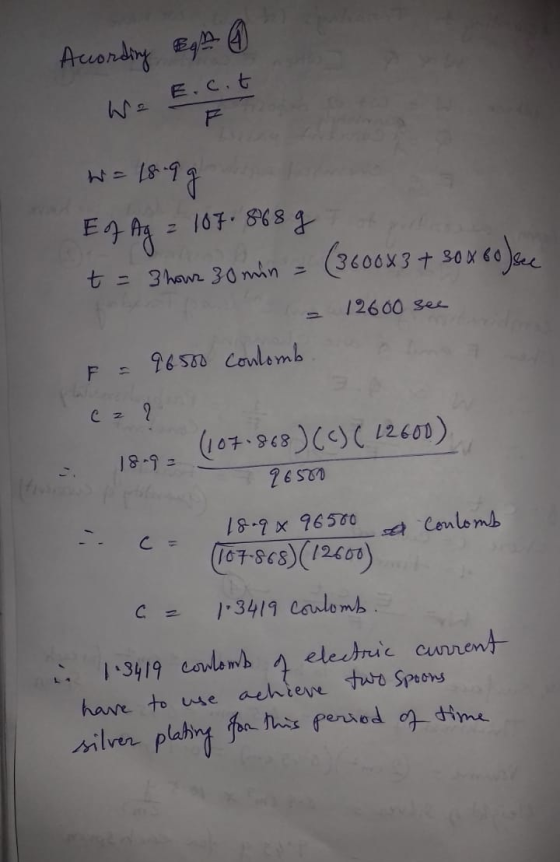
Suppose that you have to silver plate two spoons. The surface area to be plated with silver is 2.0 cm2 for each spoon. The thickness of the silver should be 4.5 mm. Knowing the density of silver as 10.5 g/cm3 and that the plating machine is only available for 3 hours 30 minutes, determine the electric current you have to use to achieve your two spoon silver plating for this period of time.
Homework Answers
![According to Faradays 1st law, we have wa Q [when E constant ] Where W = cut of deposited & quando passed E = Chemical equiv](http://img.homeworklib.com/questions/e639d210-2c8a-11ec-a027-9597fb326d82.png?x-oss-process=image/resize,w_560)
Add Answer to:
Suppose that you have to silver plate two spoons. The surface
area to be plated with...
electrolytic cells An object of jewelry has a surface area of 4.20 cm2. It is to...
 electrolytic cells
An object of jewelry has a surface area of 4.20 cm2. It is to be plated with silver (Ag) to a depth of 30.0 eters, requiring a total of 0.0126 cm3 of Ag. Given the density of silver (10.5 g/cm2), how long will it take to electroplate the silver using an electrolytic cell with the object connected to the cathode, a solution of AgNO3 (aq) and a current of 2.48 mA? Assume 100% cell efficiency.
electrolytic cells
An object of jewelry has a surface area of 4.20 cm2. It is to be plated with silver (Ag) to a depth of 30.0 eters, requiring a total of 0.0126 cm3 of Ag. Given the density of silver (10.5 g/cm2), how long will it take to electroplate the silver using an electrolytic cell with the object connected to the cathode, a solution of AgNO3 (aq) and a current of 2.48 mA? Assume 100% cell efficiency.
To make a parallel plate capacitor, you have available two flat plates of aluminum (area-130 cm"),...
 To make a parallel plate capacitor, you have available two flat plates of aluminum (area-130 cm"), a sheet of paper (thickness-0.10 mm, K-35), a sheet of glass (thickness- 2.0 mm,K-7.0), and a slab of paraffin (thickness-10.0 mm, K-2.0). (a) What is the largest capacitance possible using one of these dielectrics? nF (b) What is the smallest? pF
2. Collectible coins are sometimes plated with gold to enhance their beauty and value. Consider a...
 2. Collectible coins are sometimes plated with gold to enhance their beauty and value. Consider a commemorative quarter-dollar advertised for sale at $4.98. It has a diameter of 24.3 mm, and is completely covered with a layer of pure gold 0.218 um thick. The price of gold is $28.90 per gram; the density is 19.3 g/cm3. The patterns on the faces of the coin and the edge of the coin have a negligible effect on its area. The volume of...
Problem 1 (30pts.): A silver plate of thickness 0.5m and surface area As-1000m2 on each side,...
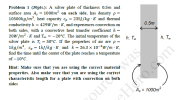 Problem 1 (30pts.): A silver plate of thickness 0.5m and surface area As-1000m2 on each side, has density ρ= 10500kg/m3, heat capacity Cp-235J/kg-K and thermal conductivity k -429W/m - K, and experiences convection on both sides, with a convective heat transfer coefficient h- 20W/m' -K and To-20°C. The initial temperature of the h. T. silver plate is T, - 50°C. If the properties of air are p - 1kg/m3, cp 1kJ/kg K and k- 26.3 x 10⁻³W/m-K, find t of-10°C...
The plates of an ideal air-filled parallel-plate capacitor are 2.0 mm apart and have an area...
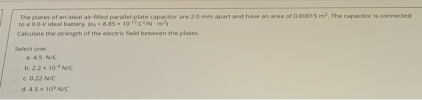 The plates of an ideal air-filled parallel-plate capacitor are 2.0 mm apart and have an area of 0.00015 m². The capacitor is connected to a 9.0.V ideal battery. (€= 8,85 102 c/Nm) Calculate the strength of the electric field between the plates. Select one: a. 4.5 N/C b. 2.2 x 10⁴N/C c. 0.22 N/C d. 4.5 * 103 N/C
Question 1 (CLO 1, PLO 2, C3): A flat plate with a surface area of 0.25...
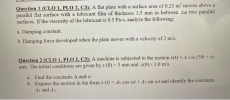 Question 1 (CLO 1, PLO 2, C3): A flat plate with a surface area of 0.25 m moves above a parallel flat surface with a lubricant film of thickness 1.5 mm in between the two parallel surfaces. If the viscosity of the lubricant is 0.5 Pa-s, analyze the following: a. Damping constant b. Damping force developed when the plate moves with a velocity of 2 m/s. Question 2 (CLO 1, PLO 2, C3): A machine is subjected to the motion...
An air-filled capacitor consists of two parallel plates, each with an area of 7.60 cm2, separated...
 An air-filled capacitor consists of two parallel plates, each with an area of 7.60 cm2, separated by a distance of 1.70 mm. A 25.0-V potential difference is applied to these plates. (a) Calculate the electric field between the plates. kV/m (b) Calculate the surface charge density. nC/m2 (c) Calculate the capacitance. pF (d) Calculate the charge on each plate. pC
An air-filled capacitor consists of two parallel plates, each with an area of 7.60 cm2, separated...
 An air-filled capacitor consists of two parallel plates, each with an area of 7.60 cm2, separated by a distance of 2.10 mm. A 25.0-V potential difference is applied to these plates (a) Calculate the electric field between the plates kV/m (b) Calculate the surface charge density. nc/m2 (c) Calculate the capacitance. pF (d) Calculate the charge on each plate pc
The space between the plates of a parallel-plate capacitor, shown below, is filled with two slabs of different dielectric materials
 Problem 5 The space between the plates of a parallel-plate capacitor, shown below, is filled with two slabs of different dielectric materials. The slab at the top has thickness 2d and a relative dielectric constant of er1 = 3 and the one at the bottom has thickness d and a relative dielectric constant of er2 = 2. The capacitor plates have surface area S. a. Assume a total charge of +Q on the top plate and -Q on the bottom plate. Find...
Points: 1 13) Is it possible to have a zero electric potential between two positive charges...
 Points: 1 13) Is it possible to have a zero electric potential between two positive charges along the line joining the two charges? A) Yes, if the two charges are equal in magnitude. B) No, a zero electric potential cannot exist between the two charges. C) Yes, regardless of the magnitude of the two charges. D) cannot be determined without knowing the separation between the two charges E) cannot be determined without knowing the magnitude of the charges Points: 3...
 electrolytic cells
An object of jewelry has a surface area of 4.20 cm2. It is to be plated with silver (Ag) to a depth of 30.0 eters, requiring a total of 0.0126 cm3 of Ag. Given the density of silver (10.5 g/cm2), how long will it take to electroplate the silver using an electrolytic cell with the object connected to the cathode, a solution of AgNO3 (aq) and a current of 2.48 mA? Assume 100% cell efficiency.
electrolytic cells
An object of jewelry has a surface area of 4.20 cm2. It is to be plated with silver (Ag) to a depth of 30.0 eters, requiring a total of 0.0126 cm3 of Ag. Given the density of silver (10.5 g/cm2), how long will it take to electroplate the silver using an electrolytic cell with the object connected to the cathode, a solution of AgNO3 (aq) and a current of 2.48 mA? Assume 100% cell efficiency.
 To make a parallel plate capacitor, you have available two flat plates of aluminum (area-130 cm"), a sheet of paper (thickness-0.10 mm, K-35), a sheet of glass (thickness- 2.0 mm,K-7.0), and a slab of paraffin (thickness-10.0 mm, K-2.0). (a) What is the largest capacitance possible using one of these dielectrics? nF (b) What is the smallest? pF
 2. Collectible coins are sometimes plated with gold to enhance their beauty and value. Consider a commemorative quarter-dollar advertised for sale at $4.98. It has a diameter of 24.3 mm, and is completely covered with a layer of pure gold 0.218 um thick. The price of gold is $28.90 per gram; the density is 19.3 g/cm3. The patterns on the faces of the coin and the edge of the coin have a negligible effect on its area. The volume of...
 Problem 1 (30pts.): A silver plate of thickness 0.5m and surface area As-1000m2 on each side, has density ρ= 10500kg/m3, heat capacity Cp-235J/kg-K and thermal conductivity k -429W/m - K, and experiences convection on both sides, with a convective heat transfer coefficient h- 20W/m' -K and To-20°C. The initial temperature of the h. T. silver plate is T, - 50°C. If the properties of air are p - 1kg/m3, cp 1kJ/kg K and k- 26.3 x 10⁻³W/m-K, find t of-10°C...
 The plates of an ideal air-filled parallel-plate capacitor are 2.0 mm apart and have an area of 0.00015 m². The capacitor is connected to a 9.0.V ideal battery. (€= 8,85 102 c/Nm) Calculate the strength of the electric field between the plates. Select one: a. 4.5 N/C b. 2.2 x 10⁴N/C c. 0.22 N/C d. 4.5 * 103 N/C
 Question 1 (CLO 1, PLO 2, C3): A flat plate with a surface area of 0.25 m moves above a parallel flat surface with a lubricant film of thickness 1.5 mm in between the two parallel surfaces. If the viscosity of the lubricant is 0.5 Pa-s, analyze the following: a. Damping constant b. Damping force developed when the plate moves with a velocity of 2 m/s. Question 2 (CLO 1, PLO 2, C3): A machine is subjected to the motion...
 An air-filled capacitor consists of two parallel plates, each with an area of 7.60 cm2, separated by a distance of 1.70 mm. A 25.0-V potential difference is applied to these plates. (a) Calculate the electric field between the plates. kV/m (b) Calculate the surface charge density. nC/m2 (c) Calculate the capacitance. pF (d) Calculate the charge on each plate. pC
 An air-filled capacitor consists of two parallel plates, each with an area of 7.60 cm2, separated by a distance of 2.10 mm. A 25.0-V potential difference is applied to these plates (a) Calculate the electric field between the plates kV/m (b) Calculate the surface charge density. nc/m2 (c) Calculate the capacitance. pF (d) Calculate the charge on each plate pc
 Points: 1 13) Is it possible to have a zero electric potential between two positive charges along the line joining the two charges? A) Yes, if the two charges are equal in magnitude. B) No, a zero electric potential cannot exist between the two charges. C) Yes, regardless of the magnitude of the two charges. D) cannot be determined without knowing the separation between the two charges E) cannot be determined without knowing the magnitude of the charges Points: 3...
Most questions answered within 3 hours.
-
Where is the error in this code sequence?
String s1 = "Hello";
String s2 = "ello";...
asked 10 months ago -
Financial data for Joel de Paris, Inc., for last year
follow:
Joel de Paris, Inc.
Balance...
asked 10 months ago -
Consider this reaction:
Al2(SO4)3 (aq)+ BaCl3
(aq) Al2Cl6 (aq)- +
3BaSO4(s) . What is the...
asked 10 months ago -
Suppose that Savneet is considering increasing her
recent random sample from 20 car rentals to 40...
asked 10 months ago -
Trucks arrive at an unloading terminal at an average rate of 120
per hour.
Trucks arrive...
asked 10 months ago -
Why are methanol and ethanol completely soluble in water while
octanol is not very little soluble....
asked 10 months ago -
A facilities manager at a university reads in a research report
that the mean amount of...
asked 10 months ago -
When the CuSO4 is rehydrated by adding water to the anhydrous
compound, is this an endothermic...
asked 10 months ago -
A ray of sunlight is passing from diamond into crown glass; the
angle of incidence is...
asked 10 months ago -
A block of mass 0.249 kg is placed on top of a light, vertical
spring of...
asked 10 months ago -
how do the kidneys compensate in the presences of acidosis
a) trigger hyperventilate
b) reserve acid...
asked 10 months ago -
Question 501 pts
The rental rate of capital to the firm increases. Which of the
following...
asked 10 months ago