Would pyridine be faster in a nucleophile aromatic or an electrophilic aromatic reaction? Why?
Would pyridine be faster in a nucleophile aromatic or an electrophilic aromatic reaction? Why?
Homework Answers
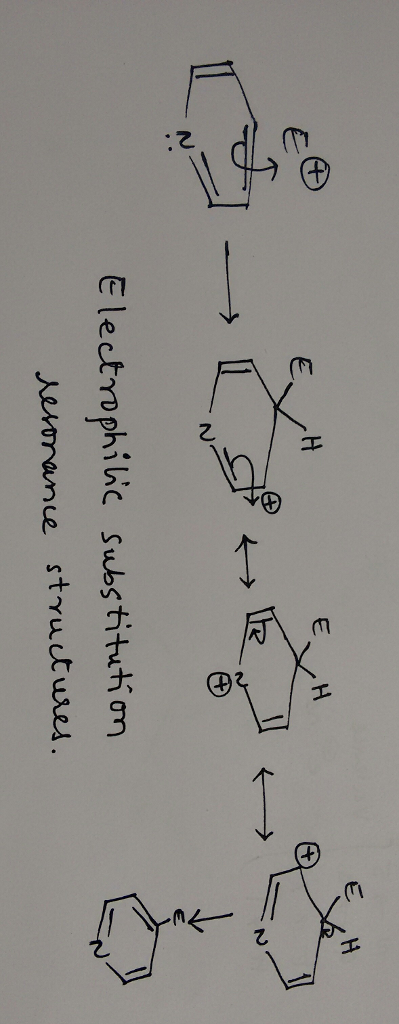
In organic reactions, pyridine behaves both as a tertiary amine, undergoing protonation, alkylation, acylation, and N-oxidation at the nitrogen atom, and as an aromatic compound, undergoing nucleophilic substitutions.
Because of the electronegative nitrogen in the pyridine ring, the molecule is relatively electron deficient. It, therefore, enters less readily electrophilic aromatic substitution reactions, which are characteristic of benzene derivatives.
Add Answer to:
Would pyridine be faster in a nucleophile aromatic or an
electrophilic aromatic reaction? Why?
Why must the sodium hypochlorite in the electrophilic aromatic substitution reaction be added to the reaction...
Why must the sodium hypochlorite in the electrophilic aromatic substitution reaction be added to the reaction mixture in ice?
where would the electrophile end up if the following molecule underwent an electrophilic aromatic substitution reaction....
 where would the electrophile end up if the following molecule
underwent an electrophilic aromatic substitution reaction.
QUESTION 9a: Where would the electrophile end up if the following molecule underwent an electrophilic aromatic substitution reaction? Briefly explain your reasoning
where would the electrophile end up if the following molecule
underwent an electrophilic aromatic substitution reaction.
QUESTION 9a: Where would the electrophile end up if the following molecule underwent an electrophilic aromatic substitution reaction? Briefly explain your reasoning
Which compound is the least reactive in the aromatic electrophilic substitution reaction? What product would you...
 Which compound is the least reactive in the aromatic
electrophilic substitution reaction?
What product would you expect from the following reaction?
Answer both, please.
1. Which compound is the least reactive in the aromatic electrophilic substitution reaction? NH . B NH С. SOH Logo D. NO2 E 2. What product would you expect from the following reaction? CO.CH ÇO.CH А ÇOCH B OCH, D CO.CH E
Which compound is the least reactive in the aromatic
electrophilic substitution reaction?
What product would you expect from the following reaction?
Answer both, please.
1. Which compound is the least reactive in the aromatic electrophilic substitution reaction? NH . B NH С. SOH Logo D. NO2 E 2. What product would you expect from the following reaction? CO.CH ÇO.CH А ÇOCH B OCH, D CO.CH E
Which benzene derivative would be the most reactive in an electrophilic aromatic substitution reaction? O A....
 Which benzene derivative would be the most reactive in an electrophilic aromatic substitution reaction? O A. ON B. Br OC. OD.
3. (10 points) Let us take a closer look at the electrophilic aromatic substitution step. 1) Draw the mechanism of the...
 3. (10 points) Let us take a closer look at the electrophilic aromatic substitution step. 1) Draw the mechanism of the electrophilic aromatic substitution step. HO. electrophilic Hor o so substitution но сня CH3 2) What is the role of the second hydroxyl group on benzene? 3) If 1,3,5-trihydroxybenzene is the starting material, will the reaction be faster or slower? Why?
Which benzene derivative would be the most reactive in an electrophilic aromatic substitution reaction? )A OB...
 Which benzene derivative would be the most reactive in an electrophilic aromatic substitution reaction? )A OB ON BT D Which is the most stable radical? O A. B. C. D.
Nitration of phenols is a classic example of an electrophilic aromatic substitution reaction. a) Why does...
Nitration of phenols is a classic example of an electrophilic aromatic substitution reaction. a) Why does the nitration of phenol (hydroxybenzene) proceed only in the ortho- and para-positions on the ring? b) Draw the resonance structures that highlight the ortho- and para-directing nature of hydroxy substituents. Make sure to include the structures that showcase the movement of the charges in the ring.
What is the major purpose of pyridine in nucleophile acyl substitution reactions (for example, a reaction...
What is the major purpose of pyridine in nucleophile acyl substitution reactions (for example, a reaction including an acid chloride with pyridine)?
What is the major purpose of pyridine in nucleophile acyl substitution reactions (for example, a reaction...
What is the major purpose of pyridine in nucleophile acyl substitution reactions (for example, a reaction including an acid chloride with pyridine)?
What is the major purpose of pyridine in nucleophile acyl substitution reactions (for example, a reaction...
What is the major purpose of pyridine in nucleophile acyl substitution reactions (for example, a reaction including an acid chloride with pyridine)?
 where would the electrophile end up if the following molecule
underwent an electrophilic aromatic substitution reaction.
QUESTION 9a: Where would the electrophile end up if the following molecule underwent an electrophilic aromatic substitution reaction? Briefly explain your reasoning
where would the electrophile end up if the following molecule
underwent an electrophilic aromatic substitution reaction.
QUESTION 9a: Where would the electrophile end up if the following molecule underwent an electrophilic aromatic substitution reaction? Briefly explain your reasoning
 Which compound is the least reactive in the aromatic
electrophilic substitution reaction?
What product would you expect from the following reaction?
Answer both, please.
1. Which compound is the least reactive in the aromatic electrophilic substitution reaction? NH . B NH С. SOH Logo D. NO2 E 2. What product would you expect from the following reaction? CO.CH ÇO.CH А ÇOCH B OCH, D CO.CH E
Which compound is the least reactive in the aromatic
electrophilic substitution reaction?
What product would you expect from the following reaction?
Answer both, please.
1. Which compound is the least reactive in the aromatic electrophilic substitution reaction? NH . B NH С. SOH Logo D. NO2 E 2. What product would you expect from the following reaction? CO.CH ÇO.CH А ÇOCH B OCH, D CO.CH E
 Which benzene derivative would be the most reactive in an electrophilic aromatic substitution reaction? O A. ON B. Br OC. OD.
 3. (10 points) Let us take a closer look at the electrophilic aromatic substitution step. 1) Draw the mechanism of the electrophilic aromatic substitution step. HO. electrophilic Hor o so substitution но сня CH3 2) What is the role of the second hydroxyl group on benzene? 3) If 1,3,5-trihydroxybenzene is the starting material, will the reaction be faster or slower? Why?
 Which benzene derivative would be the most reactive in an electrophilic aromatic substitution reaction? )A OB ON BT D Which is the most stable radical? O A. B. C. D.
Most questions answered within 3 hours.
-
Where is the error in this code sequence?
String s1 = "Hello";
String s2 = "ello";...
asked 10 months ago -
Financial data for Joel de Paris, Inc., for last year
follow:
Joel de Paris, Inc.
Balance...
asked 10 months ago -
Consider this reaction:
Al2(SO4)3 (aq)+ BaCl3
(aq) Al2Cl6 (aq)- +
3BaSO4(s) . What is the...
asked 10 months ago -
Suppose that Savneet is considering increasing her
recent random sample from 20 car rentals to 40...
asked 10 months ago -
Trucks arrive at an unloading terminal at an average rate of 120
per hour.
Trucks arrive...
asked 10 months ago -
Why are methanol and ethanol completely soluble in water while
octanol is not very little soluble....
asked 10 months ago -
A facilities manager at a university reads in a research report
that the mean amount of...
asked 10 months ago -
When the CuSO4 is rehydrated by adding water to the anhydrous
compound, is this an endothermic...
asked 10 months ago -
A ray of sunlight is passing from diamond into crown glass; the
angle of incidence is...
asked 10 months ago -
A block of mass 0.249 kg is placed on top of a light, vertical
spring of...
asked 10 months ago -
how do the kidneys compensate in the presences of acidosis
a) trigger hyperventilate
b) reserve acid...
asked 10 months ago -
Question 501 pts
The rental rate of capital to the firm increases. Which of the
following...
asked 10 months ago