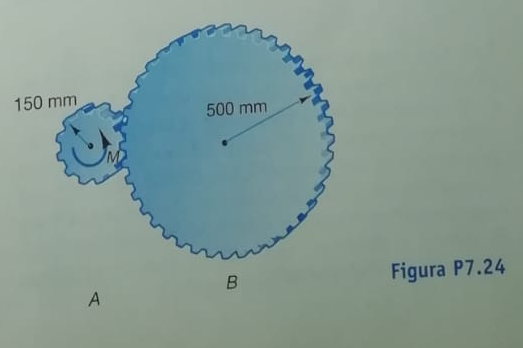
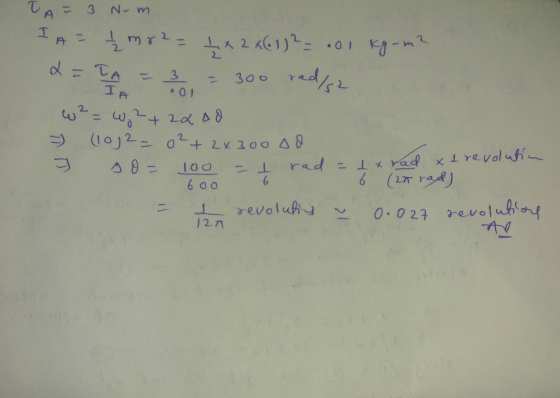
In Figure P7.24, gears A and B have masses of 2 kg and 5 kg and turning radii of 100 mm and 400 mm, respectively. If gear A is driven for a moment of 3 N * m, determine the number of revolutions A will rotate before it reaches an angular velocity of 10 rad / s.
Chapter: Power, Work, and Energy of Solid Momentum and Momentum.
Homework Answers
Question 2 (10 marks) Gears A and B have a mass of 4 kg and a...
 Question 2 (10 marks) Gears A and B have a mass of 4 kg and a radius of gyration (k) of 300 mm, and ae 2017-2018 m, and are which has a mass of 15 kg and a radius of gyration (k of 0.5 m. A motor is attache both meshea switched on while the system is initially at rest and provides a constant moment oed so gear c a) Determine the # of revolutions of gear C before it...
Each of the gears A and B has a mass of 1.6 kg and a radius...
 Each of the gears A and B has a mass of 1.6 kg and a radius of gyration of 60 mm, while gear C has a mass of 12 kg and a radius of gyration of 150 mm. A couple M of constant magnitude 10 N·m is applied to gear C. Determine the number of revolutions of gear C required for its angular velocity to increase from 100 to 450 rpm and the corresponding tangential force acting on gear A....
Each of the gears A and B has a mass of 3.2 kg and a radius...
 Each of the gears A and B has a mass of 3.2 kg and a radius of gyration of 60 mm, while gear C has a mass of 12 kg and a radius of gyration of 150 mm. A couple M of constant magnitude 10 N*m is applied to gear B. Determine the number of revolutions of gear C required for its angular velocity to increase from 100 to 450 rpm and the corresponding tangential force acting on gear A....
Problem 16.8 1 of 8 Review Gears A. B. C. and D have radii of 15...
 Problem 16.8 1 of 8 Review Gears A. B. C. and D have radii of 15 mm, 50 mm, 25 mm, and 75 mm, respectively. (Figure 1) Part A If gear A rotates with an angular velocity of wA = (0A 1) rad/s, where 0A is the angular displacement of gear A, measured in radians, determine the angular acceleration of gear D when 0 5 rad, starting from rest Express your answer to three significant figures and include the appropriate...
3. The two gears A and B in the figure have radii R and 2R, and...
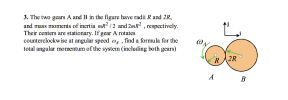 3. The two gears A and B in the figure have radii R and 2R, and mass moments of inertia mR2/2 and 2mR2 , respectively. Their centers are stationary. If gear A rotates counterclockwise at angular speed aA , find a formula for the total angular momentum of the system (including both gears) ω
Gear A starts from rest and accelerates uniformly with ??-0.8 [rad/s, in direction shown. Gears B...
 Gear A starts from rest and accelerates uniformly with ??-0.8 [rad/s, in direction shown. Gears B and C are fastened together and rotate together. Radii of gears are: r in],r 8 [in], rc 4 [in], and ro-6 [in]. After A has rotated through ?0A-3 [rev], determine: (a) the magnitude of angular velocity of gear D, oo [rad/s], (b) the magnitude of angular acceleration of gear D, an, [rad/s'], and (c) the magnitude of acceleration of point P on gear D,...
(6 Points) - Problem 5: Each of the gears A and B has a mass of...
 (6 Points) - Problem 5: Each of the gears A and B has a mass of 10 kg and a radius of gyration of 190 mm, while gear C has a mass of 2.5 kg and a radius of gyration of 80 mm. Assuming that the 6 N-m couple is applied to gear B. determine (a) the number of revolutions of gear C required for its angular velocity to increase from 450 rpm to 1800 rpm, (b) the corresponding tangential...
For a short time, gear A of the automobile starter (Figure 1) rotates with an angular...
 For a short time, gear A of the automobile starter (Figure 1) rotates with an angular acceleration of aA = (5001/2) rad/s?, where o is in rad/s. Determine the angular velocity of gear B after gear A has rotated 50 rev, starting from rest. The radii of gears A and B are 10 and 25 mm respectively. [4 marks) Figure 1 1 B
5. Three particles of masses 1.3 kg, 2.5 kg and 3.7 kg are located at the...
 5. Three particles of masses 1.3 kg, 2.5 kg and 3.7 kg are located at the points ( 3,4) m, ( 16,5)m, and (-1,2) m respectively. Calculate the rotational kinetic energy of this system of particles if they are revolving around the x-axis with an angular velocity of 3 rad/s. (1 point) A. 554.692 J B. 191.216 J C. 441.45 J D. 831.483 J E. 377.97 J 6. Three particles of masses 8.3 kg, 4.5 kg and 9.7 kg are...
Gear A and gear B have a radii of 400 mm and 450 mm respectively. The...
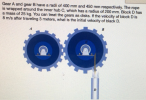 Gear A and gear B have a radii of 400 mm and 450 mm respectively. The rope is wrapped around the inner hub C, which has a radius of 200 mm. Block D has a mass of 25 kg. You can treat the gears as disks. If the velocity of block Dis 8 m/s after traveling 3 meters, what is the initial velocity of black D. 00 D
 Question 2 (10 marks) Gears A and B have a mass of 4 kg and a radius of gyration (k) of 300 mm, and ae 2017-2018 m, and are which has a mass of 15 kg and a radius of gyration (k of 0.5 m. A motor is attache both meshea switched on while the system is initially at rest and provides a constant moment oed so gear c a) Determine the # of revolutions of gear C before it...
 Each of the gears A and B has a mass of 1.6 kg and a radius of gyration of 60 mm, while gear C has a mass of 12 kg and a radius of gyration of 150 mm. A couple M of constant magnitude 10 N·m is applied to gear C. Determine the number of revolutions of gear C required for its angular velocity to increase from 100 to 450 rpm and the corresponding tangential force acting on gear A....
 Each of the gears A and B has a mass of 3.2 kg and a radius of gyration of 60 mm, while gear C has a mass of 12 kg and a radius of gyration of 150 mm. A couple M of constant magnitude 10 N*m is applied to gear B. Determine the number of revolutions of gear C required for its angular velocity to increase from 100 to 450 rpm and the corresponding tangential force acting on gear A....
 Problem 16.8 1 of 8 Review Gears A. B. C. and D have radii of 15 mm, 50 mm, 25 mm, and 75 mm, respectively. (Figure 1) Part A If gear A rotates with an angular velocity of wA = (0A 1) rad/s, where 0A is the angular displacement of gear A, measured in radians, determine the angular acceleration of gear D when 0 5 rad, starting from rest Express your answer to three significant figures and include the appropriate...
 3. The two gears A and B in the figure have radii R and 2R, and mass moments of inertia mR2/2 and 2mR2 , respectively. Their centers are stationary. If gear A rotates counterclockwise at angular speed aA , find a formula for the total angular momentum of the system (including both gears) ω
 Gear A starts from rest and accelerates uniformly with ??-0.8 [rad/s, in direction shown. Gears B and C are fastened together and rotate together. Radii of gears are: r in],r 8 [in], rc 4 [in], and ro-6 [in]. After A has rotated through ?0A-3 [rev], determine: (a) the magnitude of angular velocity of gear D, oo [rad/s], (b) the magnitude of angular acceleration of gear D, an, [rad/s'], and (c) the magnitude of acceleration of point P on gear D,...
 (6 Points) - Problem 5: Each of the gears A and B has a mass of 10 kg and a radius of gyration of 190 mm, while gear C has a mass of 2.5 kg and a radius of gyration of 80 mm. Assuming that the 6 N-m couple is applied to gear B. determine (a) the number of revolutions of gear C required for its angular velocity to increase from 450 rpm to 1800 rpm, (b) the corresponding tangential...
 For a short time, gear A of the automobile starter (Figure 1) rotates with an angular acceleration of aA = (5001/2) rad/s?, where o is in rad/s. Determine the angular velocity of gear B after gear A has rotated 50 rev, starting from rest. The radii of gears A and B are 10 and 25 mm respectively. [4 marks) Figure 1 1 B
 5. Three particles of masses 1.3 kg, 2.5 kg and 3.7 kg are located at the points ( 3,4) m, ( 16,5)m, and (-1,2) m respectively. Calculate the rotational kinetic energy of this system of particles if they are revolving around the x-axis with an angular velocity of 3 rad/s. (1 point) A. 554.692 J B. 191.216 J C. 441.45 J D. 831.483 J E. 377.97 J 6. Three particles of masses 8.3 kg, 4.5 kg and 9.7 kg are...
 Gear A and gear B have a radii of 400 mm and 450 mm respectively. The rope is wrapped around the inner hub C, which has a radius of 200 mm. Block D has a mass of 25 kg. You can treat the gears as disks. If the velocity of block Dis 8 m/s after traveling 3 meters, what is the initial velocity of black D. 00 D
Most questions answered within 3 hours.
-
Where is the error in this code sequence?
String s1 = "Hello";
String s2 = "ello";...
asked 11 months ago -
Financial data for Joel de Paris, Inc., for last year
follow:
Joel de Paris, Inc.
Balance...
asked 11 months ago -
Consider this reaction:
Al2(SO4)3 (aq)+ BaCl3
(aq) Al2Cl6 (aq)- +
3BaSO4(s) . What is the...
asked 11 months ago -
Suppose that Savneet is considering increasing her
recent random sample from 20 car rentals to 40...
asked 11 months ago -
Trucks arrive at an unloading terminal at an average rate of 120
per hour.
Trucks arrive...
asked 11 months ago -
Why are methanol and ethanol completely soluble in water while
octanol is not very little soluble....
asked 11 months ago -
A facilities manager at a university reads in a research report
that the mean amount of...
asked 11 months ago -
When the CuSO4 is rehydrated by adding water to the anhydrous
compound, is this an endothermic...
asked 11 months ago -
A ray of sunlight is passing from diamond into crown glass; the
angle of incidence is...
asked 11 months ago -
A block of mass 0.249 kg is placed on top of a light, vertical
spring of...
asked 11 months ago -
how do the kidneys compensate in the presences of acidosis
a) trigger hyperventilate
b) reserve acid...
asked 11 months ago -
Question 501 pts
The rental rate of capital to the firm increases. Which of the
following...
asked 11 months ago