
Homework Answers
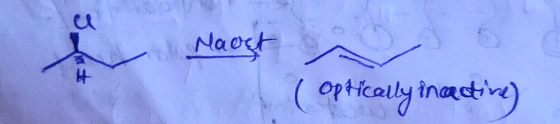
The correct answer is option (a). optically inactive and reaction undergo elimination reaction as strong base present. One example given below... If you are satisfied please give me rating..
Add Answer to:
SLO-2.3. The student used sodium ethoxide with an optically-active, secondary alkyl halide with a specific rotation,...
A student has isolated a chiral alkyl halide (shown below) with a specific rotation of [alpha] = +22.1 degrees. The stud...
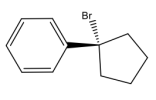 A student has isolated a chiral
alkyl halide (shown below) with a specific rotation of [alpha] =
+22.1 degrees. The student decided to store the compound in the
solvent MeOH overnight. However, reanalysis of the alkyl halide
showed a new chemical formula of C11H16O with a specific rotation
of [alpha] = 0 degrees. Suggest a mechanism to justify these
results.
A student has isolated a chiral
alkyl halide (shown below) with a specific rotation of [alpha] =
+22.1 degrees. The student decided to store the compound in the
solvent MeOH overnight. However, reanalysis of the alkyl halide
showed a new chemical formula of C11H16O with a specific rotation
of [alpha] = 0 degrees. Suggest a mechanism to justify these
results.
Consider the two reactions below for the optically active alkyl halide, (R)-2-chloropentane. The first reaction occurs...
 Consider the two reactions below for the optically active alkyl halide, (R)-2-chloropentane. The first reaction occurs rapidly at room temperature and gives an optically active product. The second reaction, starting with the same alkyl halide, occurs slowly at room temperature and gives a non-optically active product (racemic mixture). Draw a mechanism (include all H's and lone pairs) for cach reaction and explain how the mechanism leads to the observed results. Hics CHES- CH.OH CH,OH
Please help with pre-lab questions. Pre-Lab Questions: 1. A sample of 2-butanol has a specific rotation...
 Please help with pre-lab questions.
Pre-Lab Questions: 1. A sample of 2-butanol has a specific rotation of +3.25. Determine the optical purity (%ee) and percent composition of this sample (see Mohrig section 17.4). The specific rotation of pure (+)-2-butanol is +13.0°. 2. The equation for the formation of the diastereomeric salts is shown in the background information (performed in Part A of the procedure). Write this chemical equation in your notebook, then ALSO write a balanced equation for the formation...
Please help with pre-lab questions.
Pre-Lab Questions: 1. A sample of 2-butanol has a specific rotation of +3.25. Determine the optical purity (%ee) and percent composition of this sample (see Mohrig section 17.4). The specific rotation of pure (+)-2-butanol is +13.0°. 2. The equation for the formation of the diastereomeric salts is shown in the background information (performed in Part A of the procedure). Write this chemical equation in your notebook, then ALSO write a balanced equation for the formation...
 A student has isolated a chiral
alkyl halide (shown below) with a specific rotation of [alpha] =
+22.1 degrees. The student decided to store the compound in the
solvent MeOH overnight. However, reanalysis of the alkyl halide
showed a new chemical formula of C11H16O with a specific rotation
of [alpha] = 0 degrees. Suggest a mechanism to justify these
results.
A student has isolated a chiral
alkyl halide (shown below) with a specific rotation of [alpha] =
+22.1 degrees. The student decided to store the compound in the
solvent MeOH overnight. However, reanalysis of the alkyl halide
showed a new chemical formula of C11H16O with a specific rotation
of [alpha] = 0 degrees. Suggest a mechanism to justify these
results.
 Consider the two reactions below for the optically active alkyl halide, (R)-2-chloropentane. The first reaction occurs rapidly at room temperature and gives an optically active product. The second reaction, starting with the same alkyl halide, occurs slowly at room temperature and gives a non-optically active product (racemic mixture). Draw a mechanism (include all H's and lone pairs) for cach reaction and explain how the mechanism leads to the observed results. Hics CHES- CH.OH CH,OH
 Please help with pre-lab questions.
Pre-Lab Questions: 1. A sample of 2-butanol has a specific rotation of +3.25. Determine the optical purity (%ee) and percent composition of this sample (see Mohrig section 17.4). The specific rotation of pure (+)-2-butanol is +13.0°. 2. The equation for the formation of the diastereomeric salts is shown in the background information (performed in Part A of the procedure). Write this chemical equation in your notebook, then ALSO write a balanced equation for the formation...
Please help with pre-lab questions.
Pre-Lab Questions: 1. A sample of 2-butanol has a specific rotation of +3.25. Determine the optical purity (%ee) and percent composition of this sample (see Mohrig section 17.4). The specific rotation of pure (+)-2-butanol is +13.0°. 2. The equation for the formation of the diastereomeric salts is shown in the background information (performed in Part A of the procedure). Write this chemical equation in your notebook, then ALSO write a balanced equation for the formation...
Most questions answered within 3 hours.
-
Where is the error in this code sequence?
String s1 = "Hello";
String s2 = "ello";...
asked 10 months ago -
Financial data for Joel de Paris, Inc., for last year
follow:
Joel de Paris, Inc.
Balance...
asked 10 months ago -
Consider this reaction:
Al2(SO4)3 (aq)+ BaCl3
(aq) Al2Cl6 (aq)- +
3BaSO4(s) . What is the...
asked 10 months ago -
Suppose that Savneet is considering increasing her
recent random sample from 20 car rentals to 40...
asked 10 months ago -
Trucks arrive at an unloading terminal at an average rate of 120
per hour.
Trucks arrive...
asked 10 months ago -
Why are methanol and ethanol completely soluble in water while
octanol is not very little soluble....
asked 10 months ago -
A facilities manager at a university reads in a research report
that the mean amount of...
asked 10 months ago -
When the CuSO4 is rehydrated by adding water to the anhydrous
compound, is this an endothermic...
asked 10 months ago -
A ray of sunlight is passing from diamond into crown glass; the
angle of incidence is...
asked 10 months ago -
A block of mass 0.249 kg is placed on top of a light, vertical
spring of...
asked 10 months ago -
how do the kidneys compensate in the presences of acidosis
a) trigger hyperventilate
b) reserve acid...
asked 10 months ago -
Question 501 pts
The rental rate of capital to the firm increases. Which of the
following...
asked 10 months ago