The molality of lead nitrate in 0.726 M Pb(NO3)2 is: (The density of the solution is...
The molality of lead nitrate in 0.726 M Pb(NO3)2 is: (The density of the solution is 1.202 g/ml)
Homework Answers
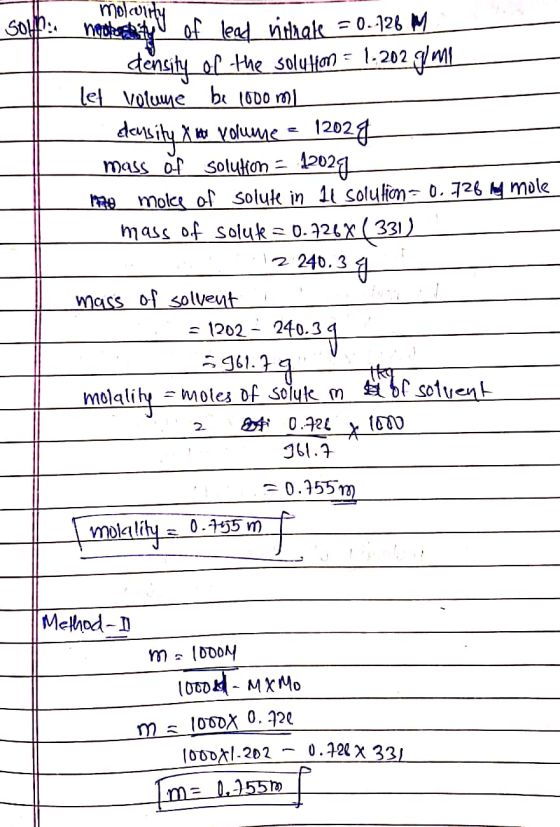
Please like this answer. THANK YOU
Please comment if YOU have any doubts about this answer.
All the best for your future.
Add Answer to:
The molality of lead nitrate in 0.726 M Pb(NO3)2 is: (The
density of the solution is...
an aqueous solution is .907M Pb(NO3)2. what is the molality of the lead(II) nitrate in this...
an aqueous solution is .907M Pb(NO3)2. what is the molality of the lead(II) nitrate in this solution? the density of the solution is 1.252g/ml
12. A solution of 0.00016 M lead (II) nitrate, or Pb(NO3)2, was poured into 450 mL...
 12. A solution of 0.00016 M lead (II) nitrate, or Pb(NO3)2, was poured into 450 mL of 0.00023 M sodium sulfate, Na2S04. Would a precipitate of lead(II)sulfate, PbSO4, be expected to form if 250 mL of the lead nitrate solution were added? Write the equilibrium equation of PbSO4 dissociation in water.
A solution of NaCl(aq) is added slowly to a solution of lead nitrate, Pb(NO3)2(aq) Pb ( NO 3 ) 2 ( aq ) , until no furth...
A solution of NaCl(aq) is added slowly to a solution of lead nitrate, Pb(NO3)2(aq) Pb ( NO 3 ) 2 ( aq ) , until no further precipitation occurs. The precipitate is collected by filtration, dried, and weighed. A total of 10.47 g PbCl2(s) 10.47 g PbCl 2 ( s ) is obtained from 200.0 mL 200.0 mL of the original solution. Calculate the molarity of the Pb(NO3)2(aq) Pb ( NO 3 ) 2 ( aq ) solution. concentration: M
8. A solution of NaCl(aq) is added slowly to a solution of lead nitrate, Pb(NO3)2(aq), until...
8. A solution of NaCl(aq) is added slowly to a solution of lead nitrate, Pb(NO3)2(aq), until no further precipitation occurs. The precipitate is collected by filtration, dried, and weighed. A total of 12.12 g PbCl2(s) is obtained from 200.0 mL of the original solution. Calculate the molarity of the Pb(NO3)2(aq) solution. concentration: M
A solution of NaCl(aq) is added slowly to a solution of lead nitrate, Pb(NO3)2(aq), until no further precipitation occur...
A solution of NaCl(aq) is added slowly to a solution of lead nitrate, Pb(NO3)2(aq), until no further precipitation occurs. The precipitate is collected by filtration, dried, and weighed. A total of 15.59 g PbCl2(s) is obtained from 200.0 mL of the original solution. Calculate the molarity of the Pb(NO3)2(aq) solution. concentration: M
When a solution of Lead Nitrate, Pb(NO3)2 , is mixed with a solution of sodium iodide,...
When a solution of Lead Nitrate, Pb(NO3)2 , is mixed with a solution of sodium iodide, NaI, a precipitate of lead iodide, PbI2 , is formed. a) Write the chemical equation for this reaction showing the state of all reactants and products. b) If 1 mol of Pb(NO3)2 reacts with 2 mols of NaI, what is the amount of PbI2 that will be formed? c) If 1 mol of Pb(NO3)2 reacts with 2 mols of NaI, which compound would be...
Suppose we have a solution of lead nitrate, Pb(NO3)2(aq). A solution of NaCl(aq) is added slowly...
 Suppose we have a solution of lead nitrate, Pb(NO3)2(aq). A solution of NaCl(aq) is added slowly until no further precipitation occurs. The precipitate is collected by filtration, dried, and weighed. A total of 15.93 g of PbCl2(s) is obtained from 200.0 mL of the original solution Calculate the molarity of the Pb(NO3)2(aq) solution. Number
A solution of 0.5 M lead(II) nitrate, Pb(NO3)2(aq) is added to an equal volume of 1.0...
A solution of 0.5 M lead(II) nitrate, Pb(NO3)2(aq) is added to an equal volume of 1.0 M sodium iodide, NaI(aq), and lead(II) iodide precipitates, PbI2(s). What is the molar concentration of lead ions, Pb2+(aq), that remains in solution? [FWPbI2 = 461.01 g/mol, Ksp = 1.4 x 10⁻⁸]? Assume 298 K.
Potassium iodide reacts with lead (ii) nitrate in the following precipitation reaction: 2KI (aq) + Pb(NO3)2...
Potassium iodide reacts with lead (ii) nitrate in the following precipitation reaction: 2KI (aq) + Pb(NO3)2 (aq)---> 2KNO3 (aq) + PbI2 (s) What minimum volume of 0.200 M potassium iodide solution is required to completely precipitate all the lead in 155.0 mL of a 0.122 M lead (ii) nitrate solution?
A26. What will be observed when 15.0 mL of 0.040 M lead(II) nitrate, Pb(NO3)2, is mixed...
A26. What will be observed when 15.0 mL of 0.040 M lead(II) nitrate, Pb(NO3)2, is mixed with 15.0 mL of 0.040 M sodium chloride? (lead chloride Ksp = 1.7 × 10⁻⁵). (A) A clear solution with no precipitate will result. (B) Solid PbCl2 will precipitate and excess Pb2+ ions will remain in solution. (C) Solid PbCl2 will precipitate and excess Cl– ions will remain in solution. (D) Solid PbCl2 will precipitate and there will be no excess ions in solution....
 12. A solution of 0.00016 M lead (II) nitrate, or Pb(NO3)2, was poured into 450 mL of 0.00023 M sodium sulfate, Na2S04. Would a precipitate of lead(II)sulfate, PbSO4, be expected to form if 250 mL of the lead nitrate solution were added? Write the equilibrium equation of PbSO4 dissociation in water.
 Suppose we have a solution of lead nitrate, Pb(NO3)2(aq). A solution of NaCl(aq) is added slowly until no further precipitation occurs. The precipitate is collected by filtration, dried, and weighed. A total of 15.93 g of PbCl2(s) is obtained from 200.0 mL of the original solution Calculate the molarity of the Pb(NO3)2(aq) solution. Number
Most questions answered within 3 hours.
-
Where is the error in this code sequence?
String s1 = "Hello";
String s2 = "ello";...
asked 11 months ago -
Financial data for Joel de Paris, Inc., for last year
follow:
Joel de Paris, Inc.
Balance...
asked 11 months ago -
Consider this reaction:
Al2(SO4)3 (aq)+ BaCl3
(aq) Al2Cl6 (aq)- +
3BaSO4(s) . What is the...
asked 11 months ago -
Suppose that Savneet is considering increasing her
recent random sample from 20 car rentals to 40...
asked 11 months ago -
Trucks arrive at an unloading terminal at an average rate of 120
per hour.
Trucks arrive...
asked 11 months ago -
Why are methanol and ethanol completely soluble in water while
octanol is not very little soluble....
asked 11 months ago -
A facilities manager at a university reads in a research report
that the mean amount of...
asked 11 months ago -
When the CuSO4 is rehydrated by adding water to the anhydrous
compound, is this an endothermic...
asked 11 months ago -
A ray of sunlight is passing from diamond into crown glass; the
angle of incidence is...
asked 11 months ago -
A block of mass 0.249 kg is placed on top of a light, vertical
spring of...
asked 11 months ago -
how do the kidneys compensate in the presences of acidosis
a) trigger hyperventilate
b) reserve acid...
asked 11 months ago -
Question 501 pts
The rental rate of capital to the firm increases. Which of the
following...
asked 11 months ago