
Homework Answers
Add Answer to:
#10
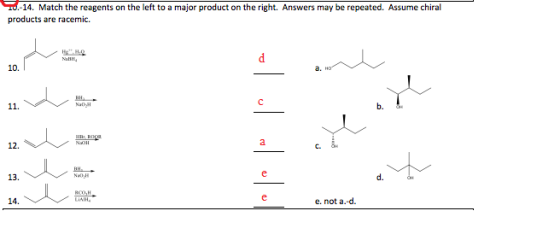
10.-14. Match the reagents on the left to a major product on the right. Answers...
1. match the reagents on the left to a major product on the right answers may...
 1. match the reagents on the left to a major product on the right
answers may be repeted assume chiral products are racemic
J.10. Match the reagents on the products are racemic. e left to a major product on the right. Answers may be repeated. Assume cra t 16 b. 18 d. 19. e. not a.-d 20, what is the major product of the following reaction? Assume chiral products are racemic e. not a.-d. a. d.
1. match the reagents on the left to a major product on the right
answers may be repeted assume chiral products are racemic
J.10. Match the reagents on the products are racemic. e left to a major product on the right. Answers may be repeated. Assume cra t 16 b. 18 d. 19. e. not a.-d 20, what is the major product of the following reaction? Assume chiral products are racemic e. not a.-d. a. d.
Match each reaction to its major product on the right. 1.-5. Match each reaction to its...
 Match each reaction to its major product on the right.
1.-5. Match each reaction to its major product on the right. Answers may be repeated. a slash. ^means both a wedge and room temperature 1. Nal in acetone 2. b. H catalysis heat NaOH heat 4. d. KOC(CH 5. e. not a.-d
Match each reaction to its major product on the right.
1.-5. Match each reaction to its major product on the right. Answers may be repeated. a slash. ^means both a wedge and room temperature 1. Nal in acetone 2. b. H catalysis heat NaOH heat 4. d. KOC(CH 5. e. not a.-d
6-10 6.-10. Match each reaction to its final major product on the right. Assume any necessary...
 6-10
6.-10. Match each reaction to its final major product on the right. Assume any necessary workup. Answers may be repeated. Li* 6. 2-methyl-N-(2-methylpropyl)propanamide + H H 7. 2-methylpropyl 2-methylpropanoate + 8. 2-methylpropanoic anhydride + H 9. 2-methylpropanoyl chloride + 10. 2-chloropropane + magnesium followed by 2-methylpropanenitrile e. not a.-d.
6-10
6.-10. Match each reaction to its final major product on the right. Assume any necessary workup. Answers may be repeated. Li* 6. 2-methyl-N-(2-methylpropyl)propanamide + H H 7. 2-methylpropyl 2-methylpropanoate + 8. 2-methylpropanoic anhydride + H 9. 2-methylpropanoyl chloride + 10. 2-chloropropane + magnesium followed by 2-methylpropanenitrile e. not a.-d.
Match each reaction on the left to a reaction classification on the right. Answers may be...
 Match each reaction on the left to a reaction classification on the right. Answers may be repeated. addition-elimination substitution, not a.-c.
15.-19. Starting with benzene, match each sequence of reagents (separated by commas) to a major product....
 15.-19. Starting with benzene, match each sequence of reagents (separated by commas) to a major product. Answers may be repeated. Assume any necessary workup. 15 AICI, Bro/FeBr Br 16. 6 /AlCI3, Zn/HC, HNO3/H2S04, H2/Pd, NaNO2/HCI/O C, CuBr b. /AlCl3, Br2/FeBr3, N2Ha/KOH/heat C. Br Br 18. /AlCl3, HS(CH2)2SH/H+, H2/Ni, H2S04, Br2/FeBr3, H2O/heat d. 19. /AICls, HNO:/H S04, H2/Pd, Bra/FeBr3, NaNO/HCI/o'C, H3PO2 e.not a.-d
5. What is the major product of the following reaction? Assume chiral products are racemic. ressurc...
 5. What is the major product of the following reaction? Assume
chiral products are racemic.
ressurc 5. What is the major product of the following reaction? Assume chiral products are racemic. OCH3 OCH3 a. b. H3 C. d. e. not a.-d.
5. What is the major product of the following reaction? Assume
chiral products are racemic.
ressurc 5. What is the major product of the following reaction? Assume chiral products are racemic. OCH3 OCH3 a. b. H3 C. d. e. not a.-d.
1. Match the disorder on the left with its pathogenic mechanism on the right. Answers may...
 1. Match the disorder on the left with its pathogenic mechanism on the right. Answers may be used more than once. Some disorders have two answers, and some disorders may have some uncertainty concerning their exact etiology - you may need to do some research to decide what the general consensus is on the cause(s). (6) - Rheumatoid arthritis Asthma Hemolytic disease of the newborn Contact dermatitis A. Type I hypersensitivity B. Type II hypersensitivity C. Type III hypersensitivity D....
Please help with 21-25 and explain the answers! 21.-25. Starting with benzene, match each reaction sequence...
 Please help with 21-25 and explain the answers!
21.-25. Starting with benzene, match each reaction sequence to a product on the right. Assume any necessary workup. Answers may be repeated. 21. Br/FeBr, a. b. C. , Br/FeBr, HS(CH),SH/HCI, H/Ni d. 25.Zn/HCI, HNO/H.SO, Br/FeBr, H/Pd, NaNO/HCl/cold, H,PO e. not a.-d.
Please help with 21-25 and explain the answers!
21.-25. Starting with benzene, match each reaction sequence to a product on the right. Assume any necessary workup. Answers may be repeated. 21. Br/FeBr, a. b. C. , Br/FeBr, HS(CH),SH/HCI, H/Ni d. 25.Zn/HCI, HNO/H.SO, Br/FeBr, H/Pd, NaNO/HCl/cold, H,PO e. not a.-d.
Matching Match the terms on the right with the appropriate description on the left: 1) Another...
 Matching Match the terms on the right with the appropriate description on the left: 1) Another term for spontaneous generation ) A) Bioremediation B) Abiogenesis 2) A term that literally means "against putrefaction" C) Pathogen D) Prokaryote 3) Refers to an infection acquired in a health care setting E) Nosocomial E F) Antisepsis 4) A term that literally means "produces disease" Match the terms on the right with the appropriate definition on the left: A) Molecular biology 5) The study...
Question MATCH THE ORTHOGRAPHIC NEWS ON THE LEFT WITH THE CORRECT ISOMETRIC VIEW ON THE RIGHT,...
 Question MATCH THE ORTHOGRAPHIC NEWS ON THE LEFT WITH THE CORRECT ISOMETRIC VIEW ON THE RIGHT, (1) B D (2) (3) MO (4) 5) ID 4C oooo Question 2 MATCH THE ORTHOGRAPHIC VIEWS ON THE LEFT WITH THE CORRECT ISOMETRIC VIEW ON THE RIGHT. (1) А B E (2) A (3) B m (4) B m 15) OA OB Od OE Question Completion MATCH THE ORTHOGRAPHIC WEWS ON THE LEFT WITH THE CORRECT ISOMETRIC VIEW ON THE RIGHT (1) А...
 1. match the reagents on the left to a major product on the right
answers may be repeted assume chiral products are racemic
J.10. Match the reagents on the products are racemic. e left to a major product on the right. Answers may be repeated. Assume cra t 16 b. 18 d. 19. e. not a.-d 20, what is the major product of the following reaction? Assume chiral products are racemic e. not a.-d. a. d.
1. match the reagents on the left to a major product on the right
answers may be repeted assume chiral products are racemic
J.10. Match the reagents on the products are racemic. e left to a major product on the right. Answers may be repeated. Assume cra t 16 b. 18 d. 19. e. not a.-d 20, what is the major product of the following reaction? Assume chiral products are racemic e. not a.-d. a. d.
 Match each reaction to its major product on the right.
1.-5. Match each reaction to its major product on the right. Answers may be repeated. a slash. ^means both a wedge and room temperature 1. Nal in acetone 2. b. H catalysis heat NaOH heat 4. d. KOC(CH 5. e. not a.-d
Match each reaction to its major product on the right.
1.-5. Match each reaction to its major product on the right. Answers may be repeated. a slash. ^means both a wedge and room temperature 1. Nal in acetone 2. b. H catalysis heat NaOH heat 4. d. KOC(CH 5. e. not a.-d
 6-10
6.-10. Match each reaction to its final major product on the right. Assume any necessary workup. Answers may be repeated. Li* 6. 2-methyl-N-(2-methylpropyl)propanamide + H H 7. 2-methylpropyl 2-methylpropanoate + 8. 2-methylpropanoic anhydride + H 9. 2-methylpropanoyl chloride + 10. 2-chloropropane + magnesium followed by 2-methylpropanenitrile e. not a.-d.
6-10
6.-10. Match each reaction to its final major product on the right. Assume any necessary workup. Answers may be repeated. Li* 6. 2-methyl-N-(2-methylpropyl)propanamide + H H 7. 2-methylpropyl 2-methylpropanoate + 8. 2-methylpropanoic anhydride + H 9. 2-methylpropanoyl chloride + 10. 2-chloropropane + magnesium followed by 2-methylpropanenitrile e. not a.-d.
 Match each reaction on the left to a reaction classification on the right. Answers may be repeated. addition-elimination substitution, not a.-c.
 15.-19. Starting with benzene, match each sequence of reagents (separated by commas) to a major product. Answers may be repeated. Assume any necessary workup. 15 AICI, Bro/FeBr Br 16. 6 /AlCI3, Zn/HC, HNO3/H2S04, H2/Pd, NaNO2/HCI/O C, CuBr b. /AlCl3, Br2/FeBr3, N2Ha/KOH/heat C. Br Br 18. /AlCl3, HS(CH2)2SH/H+, H2/Ni, H2S04, Br2/FeBr3, H2O/heat d. 19. /AICls, HNO:/H S04, H2/Pd, Bra/FeBr3, NaNO/HCI/o'C, H3PO2 e.not a.-d
 5. What is the major product of the following reaction? Assume
chiral products are racemic.
ressurc 5. What is the major product of the following reaction? Assume chiral products are racemic. OCH3 OCH3 a. b. H3 C. d. e. not a.-d.
5. What is the major product of the following reaction? Assume
chiral products are racemic.
ressurc 5. What is the major product of the following reaction? Assume chiral products are racemic. OCH3 OCH3 a. b. H3 C. d. e. not a.-d.
 1. Match the disorder on the left with its pathogenic mechanism on the right. Answers may be used more than once. Some disorders have two answers, and some disorders may have some uncertainty concerning their exact etiology - you may need to do some research to decide what the general consensus is on the cause(s). (6) - Rheumatoid arthritis Asthma Hemolytic disease of the newborn Contact dermatitis A. Type I hypersensitivity B. Type II hypersensitivity C. Type III hypersensitivity D....
 Please help with 21-25 and explain the answers!
21.-25. Starting with benzene, match each reaction sequence to a product on the right. Assume any necessary workup. Answers may be repeated. 21. Br/FeBr, a. b. C. , Br/FeBr, HS(CH),SH/HCI, H/Ni d. 25.Zn/HCI, HNO/H.SO, Br/FeBr, H/Pd, NaNO/HCl/cold, H,PO e. not a.-d.
Please help with 21-25 and explain the answers!
21.-25. Starting with benzene, match each reaction sequence to a product on the right. Assume any necessary workup. Answers may be repeated. 21. Br/FeBr, a. b. C. , Br/FeBr, HS(CH),SH/HCI, H/Ni d. 25.Zn/HCI, HNO/H.SO, Br/FeBr, H/Pd, NaNO/HCl/cold, H,PO e. not a.-d.
 Matching Match the terms on the right with the appropriate description on the left: 1) Another term for spontaneous generation ) A) Bioremediation B) Abiogenesis 2) A term that literally means "against putrefaction" C) Pathogen D) Prokaryote 3) Refers to an infection acquired in a health care setting E) Nosocomial E F) Antisepsis 4) A term that literally means "produces disease" Match the terms on the right with the appropriate definition on the left: A) Molecular biology 5) The study...
 Question MATCH THE ORTHOGRAPHIC NEWS ON THE LEFT WITH THE CORRECT ISOMETRIC VIEW ON THE RIGHT, (1) B D (2) (3) MO (4) 5) ID 4C oooo Question 2 MATCH THE ORTHOGRAPHIC VIEWS ON THE LEFT WITH THE CORRECT ISOMETRIC VIEW ON THE RIGHT. (1) А B E (2) A (3) B m (4) B m 15) OA OB Od OE Question Completion MATCH THE ORTHOGRAPHIC WEWS ON THE LEFT WITH THE CORRECT ISOMETRIC VIEW ON THE RIGHT (1) А...
Most questions answered within 3 hours.
-
Where is the error in this code sequence?
String s1 = "Hello";
String s2 = "ello";...
asked 11 months ago -
Financial data for Joel de Paris, Inc., for last year
follow:
Joel de Paris, Inc.
Balance...
asked 11 months ago -
Consider this reaction:
Al2(SO4)3 (aq)+ BaCl3
(aq) Al2Cl6 (aq)- +
3BaSO4(s) . What is the...
asked 11 months ago -
Suppose that Savneet is considering increasing her
recent random sample from 20 car rentals to 40...
asked 11 months ago -
Trucks arrive at an unloading terminal at an average rate of 120
per hour.
Trucks arrive...
asked 11 months ago -
Why are methanol and ethanol completely soluble in water while
octanol is not very little soluble....
asked 11 months ago -
A facilities manager at a university reads in a research report
that the mean amount of...
asked 11 months ago -
When the CuSO4 is rehydrated by adding water to the anhydrous
compound, is this an endothermic...
asked 11 months ago -
A ray of sunlight is passing from diamond into crown glass; the
angle of incidence is...
asked 11 months ago -
A block of mass 0.249 kg is placed on top of a light, vertical
spring of...
asked 11 months ago -
how do the kidneys compensate in the presences of acidosis
a) trigger hyperventilate
b) reserve acid...
asked 11 months ago -
Question 501 pts
The rental rate of capital to the firm increases. Which of the
following...
asked 11 months ago