
Homework Answers
Sice optimal table is
| Z | x1 | x2 | x3 | x4 | rhs | |
| 1 | 2 | 1 | 0 | 0 | 10 | |
| 0 | 3 | 2 | 1 | 0 | 3 | |
| 0 | 4 | 3 | 0 | 1 | 5 |
Optimal solution is z=10 for x1=x2=0, x3=3,x4=5
To find the second best basic feasible solution i.e.bfs
One pivot away from the optimal solution we choose x2 as the entering variable bcoz it gives the smallest decrease in objective value z and corresponding leaving variable is x3 according to the ratio test
After two iteration new table is determined by applying


| z | x1 | x2 | x3 | x4 | rhs | |
| 1 | 1/2 | 0 | -1/2 | 0 | 17/2 | |
| 0 | 3/2 | 1 | 1/2 | 0 | 3/2 | |
| 0 | -1/2 | 0 | -3/2 | 1 | 1/2 |
So second best bfs is x2=3/2 ; x4=1/2 ;z=17/2
Add Answer to:
please Solve This!!
Consider a maximization problem with the optimal tableau in Table 73. The optimal...
Q4. (Sensitivity Analysis: Adding a new constraint) (3 marks) Consider the following LP max z= 6x1+x2 s.t.xi + x2 S5 2x1 + x2 s6 with the following final optimal Simplex tableau basis x1 r2 S2 rhs 0...
 Q4. (Sensitivity Analysis: Adding a new constraint) (3 marks) Consider the following LP max z= 6x1+x2 s.t.xi + x2 S5 2x1 + x2 s6 with the following final optimal Simplex tableau basis x1 r2 S2 rhs 0 0 18 0.5 0.5 0.5 0.5 x1 where sı and s2 are the slack variables in the first and second constraints, respectively (a) Please find the optimal solution if we add the new constraint 3x1 + x2 S 10 into the LP (b)...
original right-hand Table Q2 shows the final optimal maximization simplex tableau. The sides were 100 and...
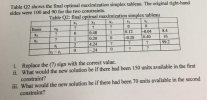 original right-hand Table Q2 shows the final optimal maximization simplex tableau. The sides were 100 and 90 for the two constraints. Table Q2: final optimal maximization simplex tableau 0 0.12 8.4 16 ? 99.2 04 0.48 0.20 4.24 -.24 X3 -0.20 0.40 X1 G-2 i. ii. Replace the (?) sign with the correct value. What would the new solution be if there had been 150 units available in the first constraint? ii. What would the new solution be if there...
The following tableau represents a specific simplex iteration for a maximization problem. &...
The following tableau represents a specific simplex iteration for a maximization problem. Z x1 x2 x3 s1 s2 s3 RHS 1 0 a 0 3 5 0 15 0 0 0 1 1 0 b 3 0 1 d 0 1 2 0 5 0 0 -3 0 -2 6 1 c For each part 1)-3) specify any numerical value for each of a, b, c, and d that would: 1) allow x2 to enter the basis to improve the...
Consider the following optimal tableau of a maximization problem where the constraints are of the s...
 Consider the following optimal tableau of a maximization problem where the constraints are of the s type. (Initial basis consisted of the columns corresponding to the slack variables in order shown) SLACK 0 2 0-2-1/10 2 0 1 01/21/5-1 0 1/2 0 0 0 0 1 1 25-3/10 2 a. Find the optimal objective function value, as well as the value of 0. b. Would the solution be altered if a new activity x, with coefficients (2,0,3) in the constraints,...
b. Given the following tableau find an alternative basic feasible optimal solution. (10 pts) 2 X,...
 b. Given the following tableau find an alternative basic feasible optimal solution. (10 pts) 2 X, X2 X3 X4 X5 X6 RHS 2 1 0 0 0 0 2 3 4 X 0 1 0 2 -1 -1 1 2 X, 0 0 -2 2 3 2
Consider the simplex tableau for a maximization problem shown. Provide a particular solution for the given...
 Consider the simplex tableau for a maximization problem shown. Provide a particular solution for the given tableau. 1 0 -6 1 -2 0 2 2 1 5 0 0 0 1 4 8 32 5 0 18 1 Maximum z= at the point when Xi = X2 = , and X3 =
Problem #7: Consider the linear program st. max z = 5x, + 3x2 + xz x...
 Problem #7: Consider the linear program st. max z = 5x, + 3x2 + xz x + x2 + x3 56 5x2 + 3x2 +6x3 =15 X1, X2, xz 20 and an associated tableau N X1 X2 X3 S1 S2 RHS 1 0 0 5 0 1 15 0 0 0.4 -0.2 1 -0.2 3 0 1 0.6 1.2 0 0.2 3 (a) What basic solution does this tableau represent? Is this solution optimal? Why or why not? (b) Does...
(1 point) Consider the following maximization problem. Maximize P = 9x1 + 7x2 + x3 subject...
 (1 point) Consider the following maximization problem. Maximize P = 9x1 + 7x2 + x3 subject to the constraints 13x1 x1 - x2 + 6x2 + - 10x3 12x3 = = 20 56 xi 20 x2 > 0 X3 > 0 Introduce slack variables and set up the initial tableau below. Keep the constraints in the same order as above, and do not rescale them. P X X2 X3 S1 RHS
1) Consider the simplex tableau obtained after a few iterations: RHS Basic 1 1/4 5/8 57/4 57/4 0 ...
 1) Consider the simplex tableau obtained after a few iterations: RHS Basic 1 1/4 5/8 57/4 57/4 0 01/4 1 1/8 /2 14 3/2 1/4 1/8 5/8 0 a) (10pts) We do not know the original problem, but is given that x and xs are the slack variables for the first and second constraints respectively. The initial basis was constructed as хв=fu xs] and after several simplex tableau iter tions the optimal basis is determined as x [x, x]. From...
QUESTION 3 Duality Theory : Consider the following LP problem: Maximize Z = 2x1 + x2...
QUESTION 3 Duality Theory : Consider the following LP problem: Maximize Z = 2x1 + x2 - x3 subject to 2x1 + x2+ x3 ≤ 8 4x1 +x2 - x3 ≤ 10 and x1 ≥ 0, x2 ≥ 0, x3 ≥ 0. (a) Find the dual for this LP (b) Graphically solve the dual of this LP. And interpret the economic meaning of the optimal solution of the dual. (c) Use complementary slackness property to solve the max problem (the...
 Q4. (Sensitivity Analysis: Adding a new constraint) (3 marks) Consider the following LP max z= 6x1+x2 s.t.xi + x2 S5 2x1 + x2 s6 with the following final optimal Simplex tableau basis x1 r2 S2 rhs 0 0 18 0.5 0.5 0.5 0.5 x1 where sı and s2 are the slack variables in the first and second constraints, respectively (a) Please find the optimal solution if we add the new constraint 3x1 + x2 S 10 into the LP (b)...
 original right-hand Table Q2 shows the final optimal maximization simplex tableau. The sides were 100 and 90 for the two constraints. Table Q2: final optimal maximization simplex tableau 0 0.12 8.4 16 ? 99.2 04 0.48 0.20 4.24 -.24 X3 -0.20 0.40 X1 G-2 i. ii. Replace the (?) sign with the correct value. What would the new solution be if there had been 150 units available in the first constraint? ii. What would the new solution be if there...
 Consider the following optimal tableau of a maximization problem where the constraints are of the s type. (Initial basis consisted of the columns corresponding to the slack variables in order shown) SLACK 0 2 0-2-1/10 2 0 1 01/21/5-1 0 1/2 0 0 0 0 1 1 25-3/10 2 a. Find the optimal objective function value, as well as the value of 0. b. Would the solution be altered if a new activity x, with coefficients (2,0,3) in the constraints,...
 b. Given the following tableau find an alternative basic feasible optimal solution. (10 pts) 2 X, X2 X3 X4 X5 X6 RHS 2 1 0 0 0 0 2 3 4 X 0 1 0 2 -1 -1 1 2 X, 0 0 -2 2 3 2
 Consider the simplex tableau for a maximization problem shown. Provide a particular solution for the given tableau. 1 0 -6 1 -2 0 2 2 1 5 0 0 0 1 4 8 32 5 0 18 1 Maximum z= at the point when Xi = X2 = , and X3 =
 Problem #7: Consider the linear program st. max z = 5x, + 3x2 + xz x + x2 + x3 56 5x2 + 3x2 +6x3 =15 X1, X2, xz 20 and an associated tableau N X1 X2 X3 S1 S2 RHS 1 0 0 5 0 1 15 0 0 0.4 -0.2 1 -0.2 3 0 1 0.6 1.2 0 0.2 3 (a) What basic solution does this tableau represent? Is this solution optimal? Why or why not? (b) Does...
 (1 point) Consider the following maximization problem. Maximize P = 9x1 + 7x2 + x3 subject to the constraints 13x1 x1 - x2 + 6x2 + - 10x3 12x3 = = 20 56 xi 20 x2 > 0 X3 > 0 Introduce slack variables and set up the initial tableau below. Keep the constraints in the same order as above, and do not rescale them. P X X2 X3 S1 RHS
 1) Consider the simplex tableau obtained after a few iterations: RHS Basic 1 1/4 5/8 57/4 57/4 0 01/4 1 1/8 /2 14 3/2 1/4 1/8 5/8 0 a) (10pts) We do not know the original problem, but is given that x and xs are the slack variables for the first and second constraints respectively. The initial basis was constructed as хв=fu xs] and after several simplex tableau iter tions the optimal basis is determined as x [x, x]. From...
Most questions answered within 3 hours.
-
Where is the error in this code sequence?
String s1 = "Hello";
String s2 = "ello";...
asked 11 months ago -
Financial data for Joel de Paris, Inc., for last year
follow:
Joel de Paris, Inc.
Balance...
asked 11 months ago -
Consider this reaction:
Al2(SO4)3 (aq)+ BaCl3
(aq) Al2Cl6 (aq)- +
3BaSO4(s) . What is the...
asked 11 months ago -
Suppose that Savneet is considering increasing her
recent random sample from 20 car rentals to 40...
asked 11 months ago -
Trucks arrive at an unloading terminal at an average rate of 120
per hour.
Trucks arrive...
asked 11 months ago -
Why are methanol and ethanol completely soluble in water while
octanol is not very little soluble....
asked 11 months ago -
A facilities manager at a university reads in a research report
that the mean amount of...
asked 11 months ago -
When the CuSO4 is rehydrated by adding water to the anhydrous
compound, is this an endothermic...
asked 11 months ago -
A ray of sunlight is passing from diamond into crown glass; the
angle of incidence is...
asked 11 months ago -
A block of mass 0.249 kg is placed on top of a light, vertical
spring of...
asked 11 months ago -
how do the kidneys compensate in the presences of acidosis
a) trigger hyperventilate
b) reserve acid...
asked 11 months ago -
Question 501 pts
The rental rate of capital to the firm increases. Which of the
following...
asked 11 months ago