
Homework Answers
![HC4 H4 °. = 16 –: pH = -log Cht) СНf) = Cetiaking antilog) jo - pH را) [HE] in К Pбч 0 - – Ч. 2. = 6. Зіх.- 5 (9) in [HE] о:](http://img.homeworklib.com/questions/229baa90-3517-11ec-bd38-654429a21230.png?x-oss-process=image/resize,w_560)
Add Answer to:
please briefly explain please :)
Question 11 (1 point) Use the table below to answer the...
10. Some of the acids listed in Question 7 have different masses, but the same K....
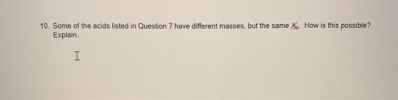 10. Some of the acids listed in Question 7 have different masses, but the same K. How is this possible? Explain. Concepts 7. Use the following table of potential acids to determine your unknown acid, Circle the acid you believe you were given. acid formula molar mass (g/mol) KPK sodium dihydrogen phosphate NaHePO4 119.98 1.02 x 10$ 7.200 sodium dihydrogen phosphate NaH POHO 137.99 1.02 x 100 7.200 monohydrate sodium hydrogen sulfate NaHSO4 120.06 1.02 x 10² 1.991 sodium hydrogen...
Please explain the correct answer. Thank you! Incorrect Question 2 0/1 pts What change will be...
 Please explain the correct
answer. Thank you!
Incorrect Question 2 0/1 pts What change will be caused by addition of a small amount of HCl to a solution containing fluoride ions and hydrogen fluoride? (Cl is chlorine, not carbon and iodine) The concentration of hydrogen fluoride will decrease and the concentration of fluoride ions will increase. The fluoride ions will precipitate out of solution as its acid salt. The concentration of hydronium ions will increase significantly. The concentration of fluoride...
Please explain the correct
answer. Thank you!
Incorrect Question 2 0/1 pts What change will be caused by addition of a small amount of HCl to a solution containing fluoride ions and hydrogen fluoride? (Cl is chlorine, not carbon and iodine) The concentration of hydrogen fluoride will decrease and the concentration of fluoride ions will increase. The fluoride ions will precipitate out of solution as its acid salt. The concentration of hydronium ions will increase significantly. The concentration of fluoride...
Please explain the correct answer to all three questions. Thank you! Incorrect Question 11 0/1 pts...
 Please explain the correct
answer to all three questions. Thank you!
Incorrect Question 11 0/1 pts A 25.0 mL sample of a solution of a monoprotic acid is titrated with a 0.115 M NaOH solution. The titration curve below was obtained. Which of the following indicators would be best for this titration? 12.01 10.0 8.0 pH of solution in flask 6.01 Equivalence Point Indicator methyl orange methyl red bromocresol purple bromthymol blue thymol blue phenolpthalein pka 3.46 5.00 6.12 7.10...
Please explain the correct
answer to all three questions. Thank you!
Incorrect Question 11 0/1 pts A 25.0 mL sample of a solution of a monoprotic acid is titrated with a 0.115 M NaOH solution. The titration curve below was obtained. Which of the following indicators would be best for this titration? 12.01 10.0 8.0 pH of solution in flask 6.01 Equivalence Point Indicator methyl orange methyl red bromocresol purple bromthymol blue thymol blue phenolpthalein pka 3.46 5.00 6.12 7.10...
The above is just one question. please answer the following according to the above. 1. Assign...
 The above is just one question. please answer the following
according to the above.
1. Assign signals of 13C and 1H spectra as well as find the
structural unit and functional group.
2. Give the structure
sample answer - as follows
1H NMR: p-substituted Ar at 7.27-7.97 ppm, benzylic CH3 group at
2.42 ppm, COOH proton at 12.9 ppm
13C NMR: carbonyl C at 167.8 ppm (ester or acid), benzylic CH3
at 21.40 ppm, 4 remaining signals are Ar carbons,...
The above is just one question. please answer the following
according to the above.
1. Assign signals of 13C and 1H spectra as well as find the
structural unit and functional group.
2. Give the structure
sample answer - as follows
1H NMR: p-substituted Ar at 7.27-7.97 ppm, benzylic CH3 group at
2.42 ppm, COOH proton at 12.9 ppm
13C NMR: carbonyl C at 167.8 ppm (ester or acid), benzylic CH3
at 21.40 ppm, 4 remaining signals are Ar carbons,...
Both the above is for one question. please answer the following according to the above. 1....
 Both the above is for one question. please answer the following
according to the above.
1. Assign signals of 13C and 1H spectra as well as find the
structural unit and functional group.
2. Give the structure
sample answer - as follows
1H NMR: p-substituted Ar at 7.27-7.97 ppm, benzylic CH3 group at
2.42 ppm, COOH proton at 12.9 ppm
13C NMR: carbonyl C at 167.8 ppm (ester or acid), benzylic CH3
at 21.40 ppm, 4 remaining signals are Ar...
Both the above is for one question. please answer the following
according to the above.
1. Assign signals of 13C and 1H spectra as well as find the
structural unit and functional group.
2. Give the structure
sample answer - as follows
1H NMR: p-substituted Ar at 7.27-7.97 ppm, benzylic CH3 group at
2.42 ppm, COOH proton at 12.9 ppm
13C NMR: carbonyl C at 167.8 ppm (ester or acid), benzylic CH3
at 21.40 ppm, 4 remaining signals are Ar...
Need 9-11 answered PLEASE ANSWER ALL QUESTION 9 1 points Save Answer Aluminum metal shavings (10.0...
 Need 9-11 answered
PLEASE ANSWER ALL
QUESTION 9 1 points Save Answer Aluminum metal shavings (10.0 g) are placed in 100 mL of 6.00 M hydrochloric acid. At STP, what is the maximum volume of hydrogen which can be produced ? 2 Al (5) + 6 HCl(aq) → 2 AlCl3 (aq) + 3 H2(g) O a. 2.241 6.6.72L O C. 1.34 L O d. 4.48 L QUESTION 10 1 points Save Answer For a set amount of gas at constant...
Need 9-11 answered
PLEASE ANSWER ALL
QUESTION 9 1 points Save Answer Aluminum metal shavings (10.0 g) are placed in 100 mL of 6.00 M hydrochloric acid. At STP, what is the maximum volume of hydrogen which can be produced ? 2 Al (5) + 6 HCl(aq) → 2 AlCl3 (aq) + 3 H2(g) O a. 2.241 6.6.72L O C. 1.34 L O d. 4.48 L QUESTION 10 1 points Save Answer For a set amount of gas at constant...
Please help with solving Question 1 (A-C) Thank you! Unless otherwise specified in the problem, you...
 Please help with solving Question 1 (A-C) Thank you!
Unless otherwise specified in the problem, you may assume that all solutions are at 25°C. 1. 50.0 mL of a pH 6.00 carbonic acid buffer is titrated with 0.2857 M NaOH, requiring 17.47 mL to reach the second equivalence point. a. Calculate the molarity of carbonic acid and bicarbonate in the original buffer. Carbonic acid: Bicarbonate: b. Calculate the pH of the solution after a total of 100.0 mL of 0.2857...
Please help with solving Question 1 (A-C) Thank you!
Unless otherwise specified in the problem, you may assume that all solutions are at 25°C. 1. 50.0 mL of a pH 6.00 carbonic acid buffer is titrated with 0.2857 M NaOH, requiring 17.47 mL to reach the second equivalence point. a. Calculate the molarity of carbonic acid and bicarbonate in the original buffer. Carbonic acid: Bicarbonate: b. Calculate the pH of the solution after a total of 100.0 mL of 0.2857...
 10. Some of the acids listed in Question 7 have different masses, but the same K. How is this possible? Explain. Concepts 7. Use the following table of potential acids to determine your unknown acid, Circle the acid you believe you were given. acid formula molar mass (g/mol) KPK sodium dihydrogen phosphate NaHePO4 119.98 1.02 x 10$ 7.200 sodium dihydrogen phosphate NaH POHO 137.99 1.02 x 100 7.200 monohydrate sodium hydrogen sulfate NaHSO4 120.06 1.02 x 10² 1.991 sodium hydrogen...
 Please explain the correct
answer. Thank you!
Incorrect Question 2 0/1 pts What change will be caused by addition of a small amount of HCl to a solution containing fluoride ions and hydrogen fluoride? (Cl is chlorine, not carbon and iodine) The concentration of hydrogen fluoride will decrease and the concentration of fluoride ions will increase. The fluoride ions will precipitate out of solution as its acid salt. The concentration of hydronium ions will increase significantly. The concentration of fluoride...
Please explain the correct
answer. Thank you!
Incorrect Question 2 0/1 pts What change will be caused by addition of a small amount of HCl to a solution containing fluoride ions and hydrogen fluoride? (Cl is chlorine, not carbon and iodine) The concentration of hydrogen fluoride will decrease and the concentration of fluoride ions will increase. The fluoride ions will precipitate out of solution as its acid salt. The concentration of hydronium ions will increase significantly. The concentration of fluoride...
 Please explain the correct
answer to all three questions. Thank you!
Incorrect Question 11 0/1 pts A 25.0 mL sample of a solution of a monoprotic acid is titrated with a 0.115 M NaOH solution. The titration curve below was obtained. Which of the following indicators would be best for this titration? 12.01 10.0 8.0 pH of solution in flask 6.01 Equivalence Point Indicator methyl orange methyl red bromocresol purple bromthymol blue thymol blue phenolpthalein pka 3.46 5.00 6.12 7.10...
Please explain the correct
answer to all three questions. Thank you!
Incorrect Question 11 0/1 pts A 25.0 mL sample of a solution of a monoprotic acid is titrated with a 0.115 M NaOH solution. The titration curve below was obtained. Which of the following indicators would be best for this titration? 12.01 10.0 8.0 pH of solution in flask 6.01 Equivalence Point Indicator methyl orange methyl red bromocresol purple bromthymol blue thymol blue phenolpthalein pka 3.46 5.00 6.12 7.10...
 The above is just one question. please answer the following
according to the above.
1. Assign signals of 13C and 1H spectra as well as find the
structural unit and functional group.
2. Give the structure
sample answer - as follows
1H NMR: p-substituted Ar at 7.27-7.97 ppm, benzylic CH3 group at
2.42 ppm, COOH proton at 12.9 ppm
13C NMR: carbonyl C at 167.8 ppm (ester or acid), benzylic CH3
at 21.40 ppm, 4 remaining signals are Ar carbons,...
The above is just one question. please answer the following
according to the above.
1. Assign signals of 13C and 1H spectra as well as find the
structural unit and functional group.
2. Give the structure
sample answer - as follows
1H NMR: p-substituted Ar at 7.27-7.97 ppm, benzylic CH3 group at
2.42 ppm, COOH proton at 12.9 ppm
13C NMR: carbonyl C at 167.8 ppm (ester or acid), benzylic CH3
at 21.40 ppm, 4 remaining signals are Ar carbons,...
 Both the above is for one question. please answer the following
according to the above.
1. Assign signals of 13C and 1H spectra as well as find the
structural unit and functional group.
2. Give the structure
sample answer - as follows
1H NMR: p-substituted Ar at 7.27-7.97 ppm, benzylic CH3 group at
2.42 ppm, COOH proton at 12.9 ppm
13C NMR: carbonyl C at 167.8 ppm (ester or acid), benzylic CH3
at 21.40 ppm, 4 remaining signals are Ar...
Both the above is for one question. please answer the following
according to the above.
1. Assign signals of 13C and 1H spectra as well as find the
structural unit and functional group.
2. Give the structure
sample answer - as follows
1H NMR: p-substituted Ar at 7.27-7.97 ppm, benzylic CH3 group at
2.42 ppm, COOH proton at 12.9 ppm
13C NMR: carbonyl C at 167.8 ppm (ester or acid), benzylic CH3
at 21.40 ppm, 4 remaining signals are Ar...
 Need 9-11 answered
PLEASE ANSWER ALL
QUESTION 9 1 points Save Answer Aluminum metal shavings (10.0 g) are placed in 100 mL of 6.00 M hydrochloric acid. At STP, what is the maximum volume of hydrogen which can be produced ? 2 Al (5) + 6 HCl(aq) → 2 AlCl3 (aq) + 3 H2(g) O a. 2.241 6.6.72L O C. 1.34 L O d. 4.48 L QUESTION 10 1 points Save Answer For a set amount of gas at constant...
Need 9-11 answered
PLEASE ANSWER ALL
QUESTION 9 1 points Save Answer Aluminum metal shavings (10.0 g) are placed in 100 mL of 6.00 M hydrochloric acid. At STP, what is the maximum volume of hydrogen which can be produced ? 2 Al (5) + 6 HCl(aq) → 2 AlCl3 (aq) + 3 H2(g) O a. 2.241 6.6.72L O C. 1.34 L O d. 4.48 L QUESTION 10 1 points Save Answer For a set amount of gas at constant...
 Please help with solving Question 1 (A-C) Thank you!
Unless otherwise specified in the problem, you may assume that all solutions are at 25°C. 1. 50.0 mL of a pH 6.00 carbonic acid buffer is titrated with 0.2857 M NaOH, requiring 17.47 mL to reach the second equivalence point. a. Calculate the molarity of carbonic acid and bicarbonate in the original buffer. Carbonic acid: Bicarbonate: b. Calculate the pH of the solution after a total of 100.0 mL of 0.2857...
Please help with solving Question 1 (A-C) Thank you!
Unless otherwise specified in the problem, you may assume that all solutions are at 25°C. 1. 50.0 mL of a pH 6.00 carbonic acid buffer is titrated with 0.2857 M NaOH, requiring 17.47 mL to reach the second equivalence point. a. Calculate the molarity of carbonic acid and bicarbonate in the original buffer. Carbonic acid: Bicarbonate: b. Calculate the pH of the solution after a total of 100.0 mL of 0.2857...
Most questions answered within 3 hours.
-
Where is the error in this code sequence?
String s1 = "Hello";
String s2 = "ello";...
asked 10 months ago -
Financial data for Joel de Paris, Inc., for last year
follow:
Joel de Paris, Inc.
Balance...
asked 10 months ago -
Consider this reaction:
Al2(SO4)3 (aq)+ BaCl3
(aq) Al2Cl6 (aq)- +
3BaSO4(s) . What is the...
asked 10 months ago -
Suppose that Savneet is considering increasing her
recent random sample from 20 car rentals to 40...
asked 10 months ago -
Trucks arrive at an unloading terminal at an average rate of 120
per hour.
Trucks arrive...
asked 10 months ago -
Why are methanol and ethanol completely soluble in water while
octanol is not very little soluble....
asked 10 months ago -
A facilities manager at a university reads in a research report
that the mean amount of...
asked 10 months ago -
When the CuSO4 is rehydrated by adding water to the anhydrous
compound, is this an endothermic...
asked 10 months ago -
A ray of sunlight is passing from diamond into crown glass; the
angle of incidence is...
asked 10 months ago -
A block of mass 0.249 kg is placed on top of a light, vertical
spring of...
asked 10 months ago -
how do the kidneys compensate in the presences of acidosis
a) trigger hyperventilate
b) reserve acid...
asked 10 months ago -
Question 501 pts
The rental rate of capital to the firm increases. Which of the
following...
asked 10 months ago