Probabilities - There are 4 marbles in a bag to choose from Blue, Red, Green, and...
Probabilities
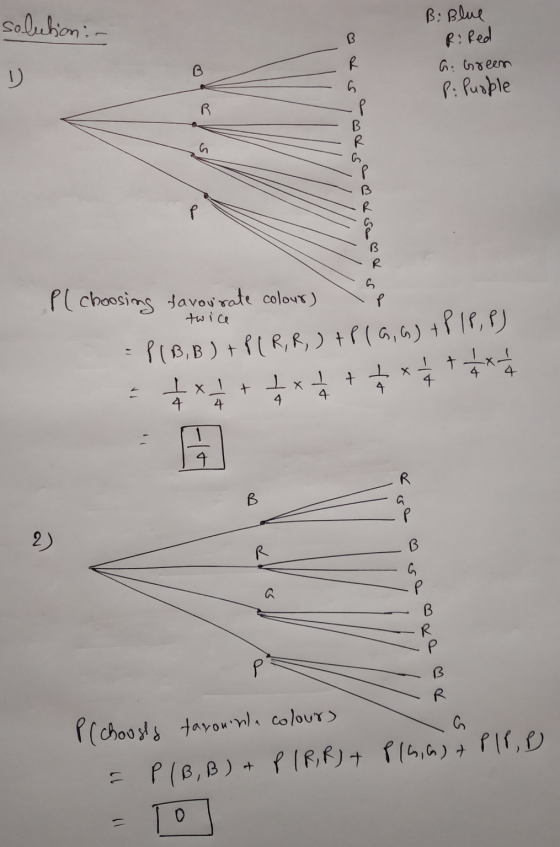
- There are 4 marbles in a bag to choose from Blue, Red, Green, and Purple.
You are to select 1 marble, put it back in the bag, and then select the second marble.
Draw a tree diagram for this situation.
What is the probability of choosing your favorite color two times in the row?
- There are 4 marbles in a bag to choose from:
Blue, Red, Green, and Purple.
You are to select 1 marble, keep it, and then select the second marble.
Draw a tree diagram for this situation.
What is the probability of choosing your favorite color two times in the row?
Homework Answers
Add Answer to:
Probabilities
- There are 4 marbles in a bag to choose from Blue, Red, Green,
and...
We have two bags containing marbles: • Bag A contains 4 blue, and 3 green marbles...
 We have two bags containing marbles: • Bag A contains 4 blue, and 3 green marbles • Bag B contains 2 blue, 5 green, and 3 yellow marbles We perform this two step procedure. First, draw a marble from bag A uniformly at random. Then put this marble into bag B. Second, draw a marble from bag B uniformly at random. We keep this marble. What is the probability that the marble we keep is green?
First bag contains 7 blue marbles , 6 green marbles and another bag contains 2 blue...
First bag contains 7 blue marbles , 6 green marbles and another bag contains 2 blue marbles, 4 green marbles and 3 yellow marbles. We draw a random marble from first bag and and place it to the other bag. Then We draw a marble from the second bag randomly and keep this one. Calculate the probability that the marble we pick is green.
A bag contains 2 red marbles, 3 blue marbles, and 7b green marbles. One marble is...
A bag contains 2 red marbles, 3 blue marbles, and 7b green marbles. One marble is randomly selected from the bag.Find the following probabilities: a) It was not a blue marble b)It was red or blue marble
There are 3 green marbles and 5 blue marbles in a bag and 4 red marbles....
There are 3 green marbles and 5 blue marbles in a bag and 4 red marbles. Two marbles are drawn from the bag at random without replacement. Find the probability that both marbles are blue. Find the probability that the first is blue and the second green.
Use a probability tree to answer the following. A jar contains 7 red marbles, 7 green...
Use a probability tree to answer the following. A jar contains 7 red marbles, 7 green marbles, and 7 blue marbles. What is the probability that you draw a red marble? = What is the probability that you choose exactly one of each color, if you pick 3 from the jar? = What is the probability that you draw 4 green marbles in a row if you do not replace the marbles after each draw? =
7A bag contains 6 red marbles, 3 blue marbles, and 4 green marbles. If five marbles...
 7A bag contains 6 red marbles, 3 blue marbles, and 4 green marbles. If five marbles are randomly selected from the bag, what is the probability that (a) exactly three are red marbles. (b) there is no red marble. (Hint: use combinations)
A box with 3 green marbles, 4 white marbles, 2 blue marbles, and 1 red marble...
A box with 3 green marbles, 4 white marbles, 2 blue marbles, and 1 red marble is sitting on the counter. If you are blind-folded and select two marbles without replacement, what is the probability you will get: a) two blue marbles ________ b) a white marble and then a green one _________ c) a green marble and then a blue one _______ d) two red marbles __________ e) no blue marble ________ f) at least one blue marble _________
a. A bag contains 3 black marbles, 6 blue marbles, and 4 green marbles. If a...
a. A bag contains 3 black marbles, 6 blue marbles, and 4 green marbles. If a marble is drawn from the bag, replaced, and another marble is drawn, what is the probability of drawing first a black marble and then a green marble? Round to 4 decimal places b. A bag contains 6 yellow marbles, 4 green marbles, and 3 blue marbles. If two different marbles are drawn from the bag , what is the probability of drawing first...
There are 5 red marbles, 7 green marbless, 4 black marbles, and 8 blue marbles in...
There are 5 red marbles, 7 green marbless, 4 black marbles, and 8 blue marbles in a bag. Suppose you select one marble at random. Find each probability. a. P(red) b. P(orange) c.P(blue) d. P(not green) d. P(green or black) eP(not yellow)
(Adapted from Tolga Tasdizen): We have a bag with 5 red marbles and 9 blue marbles....
 (Adapted from Tolga Tasdizen): We have a bag with 5 red marbles
and 9 blue marbles. You draw three marbles out of the bag without
replacement.
(a) What is the probability that you got a red, blue, and red
marble in that order? Hint: use the multiplication rule to get the
size of the sample space (and size of the event set) as if the
marbles were distinguishable.
(b) What is the probability of not getting any blue marbles?
(c)...
(Adapted from Tolga Tasdizen): We have a bag with 5 red marbles
and 9 blue marbles. You draw three marbles out of the bag without
replacement.
(a) What is the probability that you got a red, blue, and red
marble in that order? Hint: use the multiplication rule to get the
size of the sample space (and size of the event set) as if the
marbles were distinguishable.
(b) What is the probability of not getting any blue marbles?
(c)...
 We have two bags containing marbles: • Bag A contains 4 blue, and 3 green marbles • Bag B contains 2 blue, 5 green, and 3 yellow marbles We perform this two step procedure. First, draw a marble from bag A uniformly at random. Then put this marble into bag B. Second, draw a marble from bag B uniformly at random. We keep this marble. What is the probability that the marble we keep is green?
 7A bag contains 6 red marbles, 3 blue marbles, and 4 green marbles. If five marbles are randomly selected from the bag, what is the probability that (a) exactly three are red marbles. (b) there is no red marble. (Hint: use combinations)
 (Adapted from Tolga Tasdizen): We have a bag with 5 red marbles
and 9 blue marbles. You draw three marbles out of the bag without
replacement.
(a) What is the probability that you got a red, blue, and red
marble in that order? Hint: use the multiplication rule to get the
size of the sample space (and size of the event set) as if the
marbles were distinguishable.
(b) What is the probability of not getting any blue marbles?
(c)...
(Adapted from Tolga Tasdizen): We have a bag with 5 red marbles
and 9 blue marbles. You draw three marbles out of the bag without
replacement.
(a) What is the probability that you got a red, blue, and red
marble in that order? Hint: use the multiplication rule to get the
size of the sample space (and size of the event set) as if the
marbles were distinguishable.
(b) What is the probability of not getting any blue marbles?
(c)...
Most questions answered within 3 hours.
-
Where is the error in this code sequence?
String s1 = "Hello";
String s2 = "ello";...
asked 10 months ago -
Financial data for Joel de Paris, Inc., for last year
follow:
Joel de Paris, Inc.
Balance...
asked 10 months ago -
Consider this reaction:
Al2(SO4)3 (aq)+ BaCl3
(aq) Al2Cl6 (aq)- +
3BaSO4(s) . What is the...
asked 10 months ago -
Suppose that Savneet is considering increasing her
recent random sample from 20 car rentals to 40...
asked 10 months ago -
Trucks arrive at an unloading terminal at an average rate of 120
per hour.
Trucks arrive...
asked 10 months ago -
Why are methanol and ethanol completely soluble in water while
octanol is not very little soluble....
asked 10 months ago -
A facilities manager at a university reads in a research report
that the mean amount of...
asked 10 months ago -
When the CuSO4 is rehydrated by adding water to the anhydrous
compound, is this an endothermic...
asked 10 months ago -
A ray of sunlight is passing from diamond into crown glass; the
angle of incidence is...
asked 10 months ago -
A block of mass 0.249 kg is placed on top of a light, vertical
spring of...
asked 10 months ago -
how do the kidneys compensate in the presences of acidosis
a) trigger hyperventilate
b) reserve acid...
asked 10 months ago -
Question 501 pts
The rental rate of capital to the firm increases. Which of the
following...
asked 10 months ago