
Homework Answers
Add Answer to:
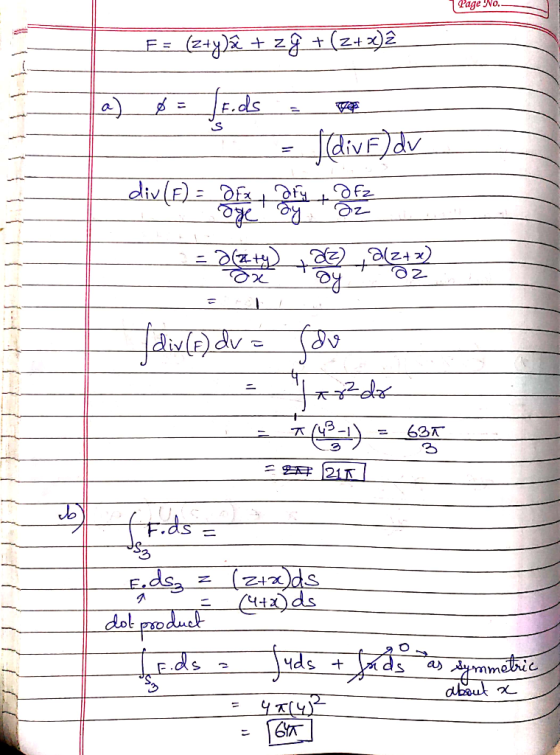
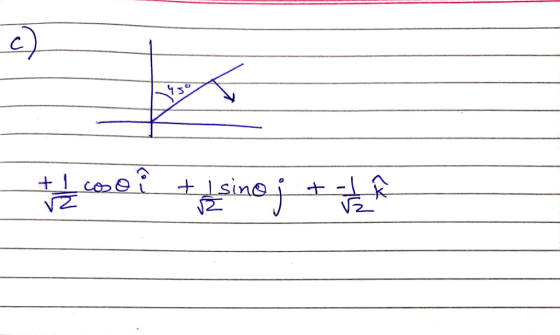
2. Consider the vector field F = (z v)a I zy (z + a)2. Consider also...
Consider the vector field F(x, y, z) -(z,2x, 3y) and the surface z- /9 - x2 -y2 (an upper hemisph...
 Consider the vector field F(x, y, z) -(z,2x, 3y) and the surface z- /9 - x2 -y2 (an upper hemisphere of radius 3). (a) Compute the flux of the curl of F across the surface (with upward pointing unit normal vector N). That is, compute actually do the surface integral here. V x F dS. Note: I want you to b) Use Stokes' theorem to compute the integral from part (a) as a circulation integral (c) Use Green's theorem (ie...
Help would be greatly appreciated!! 1. Let S be the surface in R3 parametrized by the vector function ru, v)(,-v, v+ 2u) with domain D-{(u, u) : 0 u 1,0 u 2). This surface is a plane segment shaped...
 Help would be greatly appreciated!!
1. Let S be the surface in R3 parametrized by the vector function ru, v)(,-v, v+ 2u) with domain D-{(u, u) : 0 u 1,0 u 2). This surface is a plane segment shaped like a parallelogram, and its boundary aS (with positive orientation) is made up of four line segments. Compute the line integral fos F -dr where F(z, y, z) = 〈エ2018 + y, 2r, r2-Ins). Hint: use Stokes' theorem to transform this...
Help would be greatly appreciated!!
1. Let S be the surface in R3 parametrized by the vector function ru, v)(,-v, v+ 2u) with domain D-{(u, u) : 0 u 1,0 u 2). This surface is a plane segment shaped like a parallelogram, and its boundary aS (with positive orientation) is made up of four line segments. Compute the line integral fos F -dr where F(z, y, z) = 〈エ2018 + y, 2r, r2-Ins). Hint: use Stokes' theorem to transform this...
Help Entering Answers (1 point) Verify that Stokes' Theorem is true for the vector field F -yi+ z...
 Verify that Stokes' Theorem is true for the vector field
Help Entering Answers (1 point) Verify that Stokes' Theorem is true for the vector field F -yi+ zj + xkand the surface S the hemisphere x2 + y2 + z2-25, y > 0oriented in the direction of the positive y- axis To verify Stokes' Theorem we will compute the expression on each side. First compute curl F dS curl F The surface S can be parametrized by S(s, t) -...
Verify that Stokes' Theorem is true for the vector field
Help Entering Answers (1 point) Verify that Stokes' Theorem is true for the vector field F -yi+ zj + xkand the surface S the hemisphere x2 + y2 + z2-25, y > 0oriented in the direction of the positive y- axis To verify Stokes' Theorem we will compute the expression on each side. First compute curl F dS curl F The surface S can be parametrized by S(s, t) -...
(c) Let F be the vector field on R given by F(x, y, z) = (2x...
 (c) Let F be the vector field on R given by F(x, y, z) = (2x +3y, z, 3y + z). (i) Calculate the divergence of F and the curl of F (ii) Let V be the region in IR enclosed by the plane I +2y +z S denote the closed surface that is the boundary of this region V. Sketch a picture of V and S. Then, using the Divergence Theorem, or otherwise, calculate 3 and the XY, YZ...
3. Consider the vector field A = (x – z)i + (x3 + yz)j – 3xyềk....
 3. Consider the vector field A = (x – z)i + (x3 + yz)j – 3xyềk. Use Stokes' theorem to calculate S/CD x A) . nds where S is the surface of the cone z = 2 - V x2 + y2 above the zy plane. You may use the formula n cos" u du = – cos”- u sin u + 2 -1 [ cos”-2 u du.
1. Consider the vector field z, y, z) = 〈re,zz,H) and the surface s in the figure below oriented...
 1. Consider the vector field z, y, z) = 〈re,zz,H) and the surface s in the figure below oriented outward. Unit circle Use Stokes' Theorem in two different ways to find/curl F dS, by: (a) [7 pts.] evaluating ф F-dr where C in the positively oriented unit circle in the figure (which is the boundary of S), (b) [7 pts.] evaluating curl F dS, where Si is the upward oriented unit disc bounded by C
1. Consider the vector field...
1. Consider the vector field z, y, z) = 〈re,zz,H) and the surface s in the figure below oriented outward. Unit circle Use Stokes' Theorem in two different ways to find/curl F dS, by: (a) [7 pts.] evaluating ф F-dr where C in the positively oriented unit circle in the figure (which is the boundary of S), (b) [7 pts.] evaluating curl F dS, where Si is the upward oriented unit disc bounded by C
1. Consider the vector field...
Help Entering Answers (1 point) Verify that Stokes' Theorem is true for the vector field F = 3yd-...
 Help Entering Answers (1 point) Verify that Stokes' Theorem is true for the vector field F = 3yd-2ǐ + 2xk and the surface S the part of the paraboloid z = 20-x2-y2 that lies above the plane z = 4, oriented upwards. To verify Stokes' Theorem we will compute the expression on each side. First computel curl F dS curl F- curl F. dS- EEdy di where curl F dS- Now compute F dr The boundary curve C of the...
(1) Let F denote the inverse square vector field (axr, y, z) F= (Note that ||F...
 (1) Let F denote the inverse square vector field (axr, y, z) F= (Note that ||F 1/r2.) The domain of F is R3\{(0, 0, 0)} where r = the chain rule (a) Verify that Hint: first show that then use (b) Show that div(F 0. (c) Suppose that S is a closed surface in R3 that does not enclose the origin. Show that the flux of F through S is zero. Hint: since the interior of S does not contain...
Help Entering Answers (1 point) Verify that Stokes' Theorem is true for the vector field F = 2yzi...
 Help Entering Answers (1 point) Verify that Stokes' Theorem is true for the vector field F = 2yzi + 3yj + xk and the surface S the part of the paraboloid Z-5-x2-y2 that lies above the plane z 1, oriented upwards. / curl F diS To verify Stokes' Theorem we will compute the expression on each side. First compute curl F <0.3+2%-22> curl F - ds - where y1 curl F ds- Now compute /F dr The boundary curve C...
10. Stokes' Theorem and Surface Integrals of Vector Fields a. Stokes' Theorem: F dr- b. Let S be the surface of the paraboloid z 4-x2-y2 and C is the trace of S in the xy-plane. Draw a sk...
 10. Stokes' Theorem and Surface Integrals of Vector Fields a. Stokes' Theorem: F dr- b. Let S be the surface of the paraboloid z 4-x2-y2 and C is the trace of S in the xy-plane. Draw a sketch of curve C in the xy-plane. Let F(x,y,z) = <2z, x, y?». Compute the curl (F) c. d. Find a parametrization of the surface S: G(u,v)- Compute N(u,v) e. Use Stokes' Theorem to computec F dr
10. Stokes' Theorem and Surface Integrals...
10. Stokes' Theorem and Surface Integrals of Vector Fields a. Stokes' Theorem: F dr- b. Let S be the surface of the paraboloid z 4-x2-y2 and C is the trace of S in the xy-plane. Draw a sketch of curve C in the xy-plane. Let F(x,y,z) = <2z, x, y?». Compute the curl (F) c. d. Find a parametrization of the surface S: G(u,v)- Compute N(u,v) e. Use Stokes' Theorem to computec F dr
10. Stokes' Theorem and Surface Integrals...
 Consider the vector field F(x, y, z) -(z,2x, 3y) and the surface z- /9 - x2 -y2 (an upper hemisphere of radius 3). (a) Compute the flux of the curl of F across the surface (with upward pointing unit normal vector N). That is, compute actually do the surface integral here. V x F dS. Note: I want you to b) Use Stokes' theorem to compute the integral from part (a) as a circulation integral (c) Use Green's theorem (ie...
 Help would be greatly appreciated!!
1. Let S be the surface in R3 parametrized by the vector function ru, v)(,-v, v+ 2u) with domain D-{(u, u) : 0 u 1,0 u 2). This surface is a plane segment shaped like a parallelogram, and its boundary aS (with positive orientation) is made up of four line segments. Compute the line integral fos F -dr where F(z, y, z) = 〈エ2018 + y, 2r, r2-Ins). Hint: use Stokes' theorem to transform this...
Help would be greatly appreciated!!
1. Let S be the surface in R3 parametrized by the vector function ru, v)(,-v, v+ 2u) with domain D-{(u, u) : 0 u 1,0 u 2). This surface is a plane segment shaped like a parallelogram, and its boundary aS (with positive orientation) is made up of four line segments. Compute the line integral fos F -dr where F(z, y, z) = 〈エ2018 + y, 2r, r2-Ins). Hint: use Stokes' theorem to transform this...
 Verify that Stokes' Theorem is true for the vector field
Help Entering Answers (1 point) Verify that Stokes' Theorem is true for the vector field F -yi+ zj + xkand the surface S the hemisphere x2 + y2 + z2-25, y > 0oriented in the direction of the positive y- axis To verify Stokes' Theorem we will compute the expression on each side. First compute curl F dS curl F The surface S can be parametrized by S(s, t) -...
Verify that Stokes' Theorem is true for the vector field
Help Entering Answers (1 point) Verify that Stokes' Theorem is true for the vector field F -yi+ zj + xkand the surface S the hemisphere x2 + y2 + z2-25, y > 0oriented in the direction of the positive y- axis To verify Stokes' Theorem we will compute the expression on each side. First compute curl F dS curl F The surface S can be parametrized by S(s, t) -...
 (c) Let F be the vector field on R given by F(x, y, z) = (2x +3y, z, 3y + z). (i) Calculate the divergence of F and the curl of F (ii) Let V be the region in IR enclosed by the plane I +2y +z S denote the closed surface that is the boundary of this region V. Sketch a picture of V and S. Then, using the Divergence Theorem, or otherwise, calculate 3 and the XY, YZ...
 3. Consider the vector field A = (x – z)i + (x3 + yz)j – 3xyềk. Use Stokes' theorem to calculate S/CD x A) . nds where S is the surface of the cone z = 2 - V x2 + y2 above the zy plane. You may use the formula n cos" u du = – cos”- u sin u + 2 -1 [ cos”-2 u du.
 1. Consider the vector field z, y, z) = 〈re,zz,H) and the surface s in the figure below oriented outward. Unit circle Use Stokes' Theorem in two different ways to find/curl F dS, by: (a) [7 pts.] evaluating ф F-dr where C in the positively oriented unit circle in the figure (which is the boundary of S), (b) [7 pts.] evaluating curl F dS, where Si is the upward oriented unit disc bounded by C
1. Consider the vector field...
1. Consider the vector field z, y, z) = 〈re,zz,H) and the surface s in the figure below oriented outward. Unit circle Use Stokes' Theorem in two different ways to find/curl F dS, by: (a) [7 pts.] evaluating ф F-dr where C in the positively oriented unit circle in the figure (which is the boundary of S), (b) [7 pts.] evaluating curl F dS, where Si is the upward oriented unit disc bounded by C
1. Consider the vector field...
 Help Entering Answers (1 point) Verify that Stokes' Theorem is true for the vector field F = 3yd-2ǐ + 2xk and the surface S the part of the paraboloid z = 20-x2-y2 that lies above the plane z = 4, oriented upwards. To verify Stokes' Theorem we will compute the expression on each side. First computel curl F dS curl F- curl F. dS- EEdy di where curl F dS- Now compute F dr The boundary curve C of the...
 (1) Let F denote the inverse square vector field (axr, y, z) F= (Note that ||F 1/r2.) The domain of F is R3\{(0, 0, 0)} where r = the chain rule (a) Verify that Hint: first show that then use (b) Show that div(F 0. (c) Suppose that S is a closed surface in R3 that does not enclose the origin. Show that the flux of F through S is zero. Hint: since the interior of S does not contain...
 Help Entering Answers (1 point) Verify that Stokes' Theorem is true for the vector field F = 2yzi + 3yj + xk and the surface S the part of the paraboloid Z-5-x2-y2 that lies above the plane z 1, oriented upwards. / curl F diS To verify Stokes' Theorem we will compute the expression on each side. First compute curl F <0.3+2%-22> curl F - ds - where y1 curl F ds- Now compute /F dr The boundary curve C...
 10. Stokes' Theorem and Surface Integrals of Vector Fields a. Stokes' Theorem: F dr- b. Let S be the surface of the paraboloid z 4-x2-y2 and C is the trace of S in the xy-plane. Draw a sketch of curve C in the xy-plane. Let F(x,y,z) = <2z, x, y?». Compute the curl (F) c. d. Find a parametrization of the surface S: G(u,v)- Compute N(u,v) e. Use Stokes' Theorem to computec F dr
10. Stokes' Theorem and Surface Integrals...
10. Stokes' Theorem and Surface Integrals of Vector Fields a. Stokes' Theorem: F dr- b. Let S be the surface of the paraboloid z 4-x2-y2 and C is the trace of S in the xy-plane. Draw a sketch of curve C in the xy-plane. Let F(x,y,z) = <2z, x, y?». Compute the curl (F) c. d. Find a parametrization of the surface S: G(u,v)- Compute N(u,v) e. Use Stokes' Theorem to computec F dr
10. Stokes' Theorem and Surface Integrals...
Most questions answered within 3 hours.
-
Where is the error in this code sequence?
String s1 = "Hello";
String s2 = "ello";...
asked 11 months ago -
Financial data for Joel de Paris, Inc., for last year
follow:
Joel de Paris, Inc.
Balance...
asked 11 months ago -
Consider this reaction:
Al2(SO4)3 (aq)+ BaCl3
(aq) Al2Cl6 (aq)- +
3BaSO4(s) . What is the...
asked 11 months ago -
Suppose that Savneet is considering increasing her
recent random sample from 20 car rentals to 40...
asked 11 months ago -
Trucks arrive at an unloading terminal at an average rate of 120
per hour.
Trucks arrive...
asked 11 months ago -
Why are methanol and ethanol completely soluble in water while
octanol is not very little soluble....
asked 11 months ago -
A facilities manager at a university reads in a research report
that the mean amount of...
asked 11 months ago -
When the CuSO4 is rehydrated by adding water to the anhydrous
compound, is this an endothermic...
asked 11 months ago -
A ray of sunlight is passing from diamond into crown glass; the
angle of incidence is...
asked 11 months ago -
A block of mass 0.249 kg is placed on top of a light, vertical
spring of...
asked 11 months ago -
how do the kidneys compensate in the presences of acidosis
a) trigger hyperventilate
b) reserve acid...
asked 11 months ago -
Question 501 pts
The rental rate of capital to the firm increases. Which of the
following...
asked 11 months ago