show all work only answer if you feel confident. thanks

Homework Answers
Add Answer to:
show all work only answer if you feel confident. thanks
Problem 8.021 Tutorial S1 Water is...
Problem 8.021 SI Water is the working fluid in a Rankine cycle with reheat. Superheated vapor...
Problem 8.021 SI Water is the working fluid in a Rankine cycle with reheat. Superheated vapor enters the turbine at 10 MPa, 520°C, and the condenser pressure is 6 kPa. Steam expands through the first-stage turbine to 0.7 MPa and then is reheated to 520°C. The pump and each turbine stage have an isentropic efficiency of 80%. Determine for the cycle: (a) the heat addition, in kJ per kg of steam entering the first-stage turbine. (b) the percent thermal efficiency....
Tutorial Questions 1 1. Water is the working fluid in an ideal Rankine cycle. The condenser...
Tutorial Questions 1.1. Water is the working fluid in an ideal Rankine cycle. The condenser pressure is kPa, and saturated vapor enters the turbine at 10 MPa. Determine the heat transfer rates, in kJ per kg of steam flowing, for the working fluid passing through the boiler and condenser and calculate the thermal efficiency.2. Water is the working fluid in an ideal Rankine cycle. Saturated vapor enters the turbine at 16 MPa, and the condenser pressure is 8 kPa ....
Water is the working fluid in an ideal Rankine cycle with reheat. Superheated vapor enters...
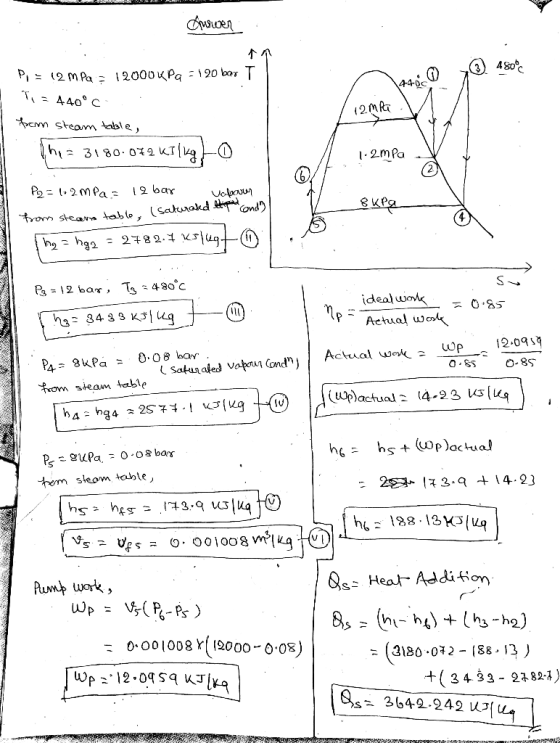
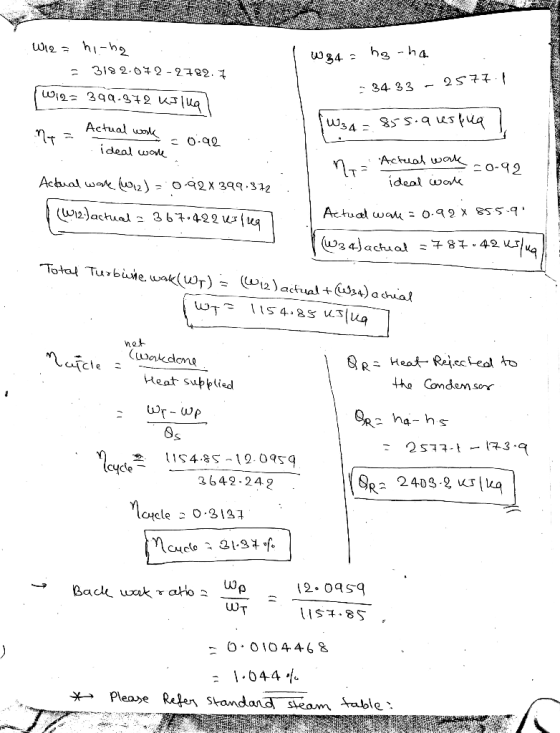
 Water is the working fluid in an ideal Rankine cycle with reheat. Superheated vapor enters the turbine at 8 MPa, 480℃, and the condenser pressure is 8 kPa. Steam expands through the first stage turbine to 700 kPa and then is reheated to 480℃. Assumptions: see problem 1 . Determine for the cycle(a) the rate of heat addition, in kJ per kg to the working fluid in the steam generator.(b) the thermal efficiency.(c) the rate of heat transfer from the...
Water is the working fluid in an ideal regenerative Rankine cycle with one closed feedwater heater....
Water is the working fluid in an ideal regenerative Rankine cycle with one closed feedwater heater. Superheated vapor enters the turbine at 12 MPa, 480°C, and the condenser pressure is 6 kPa. Steam expands through the first-stage turbine where some is extracted and diverted to a closed feedwater heater at 0.7 MPa. Condensate drains from the feedwater heater as saturated liquid at 0.7 MPa and is trapped into the condenser. The feedwater leaves the heater at 10 MPa and a...
Consider a regenerative vapor power cycle with two feedwater heaters, a closed one and an open...
 Consider a regenerative vapor power cycle with two feedwater heaters, a closed one and an open one, and reheat. Steam enters the first turbine stage at 12 MPa, 480°C, and expands to 2 MPa. Some steam is extracted at 2 MPa and fed to the closed feedwater heater. The remainder is reheated at 2 MPa to 440°C and then expands through the second-stage turbine to 0.3 MPa, where an additional amount is extracted and fed into the open feedwater heater...
Consider a regenerative vapor power cycle with two feedwater heaters, a closed one and an open...
Consider a regenerative vapor power cycle with two feedwater heaters, a closed one and an open one, and reheat. Steam enters the first turbine stage at 12 MPa, 480°C, and expands to 2 MPa. Some steam is extracted at 2 MPa and fed to the closed feedwater heater. The remainder is reheated at 2 MPa to 440°C and then expands through the second-stage turbine to 0.3 MPa, where an additional amount is extracted and fed into the open feedwater heater...
Problem 1. (40) Water is the working fluid in an ideal Rankine cycle with reheat. Superheated...
 Problem 1. (40) Water is the working fluid in an ideal Rankine cycle with reheat. Superheated vapor enters the turbine at 12 MPa, 480 °C and the pressure at the exit of the second stage turbine is 8 kPa. Steam expands through the first stage turbine to 1 MPa and then is reheated to 440 °C. Saturated liquid water leaves the condenser. After the pump, pressure goes back to 12 MPa. Find: (1) Sketch the process on a T-s diagram...
QUESTION 5 (PO2, CO3, C6) Clara is a power plant engineer and she is performing a...
 QUESTION 5 (PO2, CO3, C6) Clara is a power plant engineer and she is performing a study on Ideal Reheat Rankine Cycle using Steam as the working fluid. The steam enters the first stage turbine at 480°C and expands from 8.0 MPa and to 0.8 MPa. It is then reheated to 440°C before entering the second-stage turbine, where it expands to the condenser pressure of 0.010 MPa. If the first stage turbine has an isentropic efficiency, 1 = 85% and...
the question(5.) the answer please in meters. SI units. the Taeal gas model Tol alr aiia Hegligible potential energy effects. a. Determine the temperature of the air at the exit of the diffuser, i...
 the question(5.) the answer please in meters. SI
units.
the Taeal gas model Tol alr aiia Hegligible potential energy effects. a. Determine the temperature of the air at the exit of the diffuser, in K b. Ifthe air would undergo an isentropic process as It fows through the diffuser, determine the pressure of the air at the diffuser exit. in kPa. c. Ie friction were present would the pressure of the air at the diffuser exit be greater than. less...
the question(5.) the answer please in meters. SI
units.
the Taeal gas model Tol alr aiia Hegligible potential energy effects. a. Determine the temperature of the air at the exit of the diffuser, in K b. Ifthe air would undergo an isentropic process as It fows through the diffuser, determine the pressure of the air at the diffuser exit. in kPa. c. Ie friction were present would the pressure of the air at the diffuser exit be greater than. less...
Include given, find, EFD, assumptions, basic equations and solution Water is the working fluid in a...
 Include given, find, EFD, assumptions, basic equations and solution Water is the working fluid in a Rankine cycle. Superheated vapor enters the turbine at 10 MPa, 480 °C, and the condenser pressure is 6 kPa. Water exits the condenser as a saturated liquid. The turbine and pump have isentropic efficiencies of 80 and 70%, respectively. Determine for the cycle a) work developed by the turbine, in kJ per kg of steam flowing (b) work consumed by the pump, in k.J...
 Consider a regenerative vapor power cycle with two feedwater heaters, a closed one and an open one, and reheat. Steam enters the first turbine stage at 12 MPa, 480°C, and expands to 2 MPa. Some steam is extracted at 2 MPa and fed to the closed feedwater heater. The remainder is reheated at 2 MPa to 440°C and then expands through the second-stage turbine to 0.3 MPa, where an additional amount is extracted and fed into the open feedwater heater...
 Problem 1. (40) Water is the working fluid in an ideal Rankine cycle with reheat. Superheated vapor enters the turbine at 12 MPa, 480 °C and the pressure at the exit of the second stage turbine is 8 kPa. Steam expands through the first stage turbine to 1 MPa and then is reheated to 440 °C. Saturated liquid water leaves the condenser. After the pump, pressure goes back to 12 MPa. Find: (1) Sketch the process on a T-s diagram...
 QUESTION 5 (PO2, CO3, C6) Clara is a power plant engineer and she is performing a study on Ideal Reheat Rankine Cycle using Steam as the working fluid. The steam enters the first stage turbine at 480°C and expands from 8.0 MPa and to 0.8 MPa. It is then reheated to 440°C before entering the second-stage turbine, where it expands to the condenser pressure of 0.010 MPa. If the first stage turbine has an isentropic efficiency, 1 = 85% and...
 the question(5.) the answer please in meters. SI
units.
the Taeal gas model Tol alr aiia Hegligible potential energy effects. a. Determine the temperature of the air at the exit of the diffuser, in K b. Ifthe air would undergo an isentropic process as It fows through the diffuser, determine the pressure of the air at the diffuser exit. in kPa. c. Ie friction were present would the pressure of the air at the diffuser exit be greater than. less...
the question(5.) the answer please in meters. SI
units.
the Taeal gas model Tol alr aiia Hegligible potential energy effects. a. Determine the temperature of the air at the exit of the diffuser, in K b. Ifthe air would undergo an isentropic process as It fows through the diffuser, determine the pressure of the air at the diffuser exit. in kPa. c. Ie friction were present would the pressure of the air at the diffuser exit be greater than. less...
 Include given, find, EFD, assumptions, basic equations and solution Water is the working fluid in a Rankine cycle. Superheated vapor enters the turbine at 10 MPa, 480 °C, and the condenser pressure is 6 kPa. Water exits the condenser as a saturated liquid. The turbine and pump have isentropic efficiencies of 80 and 70%, respectively. Determine for the cycle a) work developed by the turbine, in kJ per kg of steam flowing (b) work consumed by the pump, in k.J...
Most questions answered within 3 hours.
-
Where is the error in this code sequence?
String s1 = "Hello";
String s2 = "ello";...
asked 10 months ago -
Financial data for Joel de Paris, Inc., for last year
follow:
Joel de Paris, Inc.
Balance...
asked 10 months ago -
Consider this reaction:
Al2(SO4)3 (aq)+ BaCl3
(aq) Al2Cl6 (aq)- +
3BaSO4(s) . What is the...
asked 10 months ago -
Suppose that Savneet is considering increasing her
recent random sample from 20 car rentals to 40...
asked 10 months ago -
Trucks arrive at an unloading terminal at an average rate of 120
per hour.
Trucks arrive...
asked 10 months ago -
Why are methanol and ethanol completely soluble in water while
octanol is not very little soluble....
asked 10 months ago -
A facilities manager at a university reads in a research report
that the mean amount of...
asked 10 months ago -
When the CuSO4 is rehydrated by adding water to the anhydrous
compound, is this an endothermic...
asked 10 months ago -
A ray of sunlight is passing from diamond into crown glass; the
angle of incidence is...
asked 10 months ago -
A block of mass 0.249 kg is placed on top of a light, vertical
spring of...
asked 10 months ago -
how do the kidneys compensate in the presences of acidosis
a) trigger hyperventilate
b) reserve acid...
asked 10 months ago -
Question 501 pts
The rental rate of capital to the firm increases. Which of the
following...
asked 10 months ago