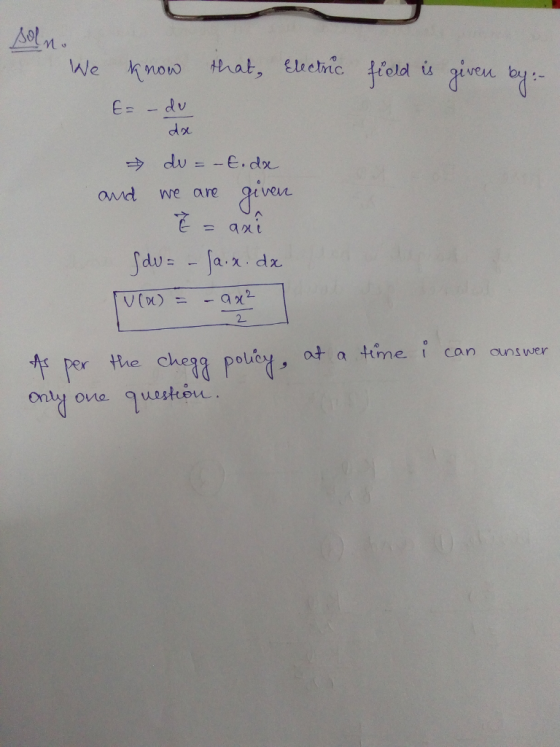
4. Find the potential as a function of position in an electric field given by E...
4. Find the potential as a function of position in an electric field given by E = a x i, where a is a constant and where V = 0 at x = 0.
5. A charge +Q lies at the origin, and a charge –3Q at x = a. Find two points on the x – axis where V = 0.
Homework Answers
Add Answer to:
4. Find the potential as a function of position in an electric
field given by E...
Find the potential as a function of position in an electric field given by E(x) =...
Find the potential as a function of position in an electric field given by E(x) = (a*x-12) i V/m, where x is in meters and a is a constant. Assume V = 0 at x = 0 and enter your answer as a formula like 3*x^2+7:
The potential as a function of position in a certain region is given by V(x) 3x-2x2x',...
 The potential as a function of position in a certain region is given by V(x) 3x-2x2x', X-2X-X, with x expression for the electric field, and (c) all points on the x-axis where E-0 in meters and V in volts. Find (a) all points on the x-axis where V0, (b) an
1. Find the electric field (in vacuum) as a function of position z along the axis...
 1. Find the electric field (in vacuum) as a function of position z along the axis of a uniformly charged disk of outer radius R with a hole of radius R in its centre. The charge per unit area on the disk is σ. 2, A straight rod, with uniform charge λ per unit length, lies along the z axis from z=11 to z=12-(Thus, the length of the rod is l2-11.) Find the x and y components of the electric...
1. The potential at the surface of a 15 cm radius sphere is 5.5 kV. Assuming...
1. The potential at the surface of a 15 cm radius sphere is 5.5 kV. Assuming the charge is distributed uniformly, what is the sphere’s total charge? 2. Two points, 20 cm apart, lie in an electric field where a line joining the points would be parallel to the field. If the potential difference between those point sin 960 V, what is the field strength? 3. A charge Q is placed at the origin. Point A is on the x-axis...
We know that the electric field E due to a charge q at the origin is...
 We know that the electric field E due to a charge q at the origin is given by Tr Tr where →= xi + y R3 (a) Determine if E is conservative. [Make sure you check the domain! (b) If it is conservative, find a potential function for it J + zk is the position vector of a point (x,y, 2) E
Variable Potential Part A The potential as a function of position in a region is V(x)...
 Variable Potential Part A The potential as a function of position in a region is V(x) = 5x-7x2-x3, with x in meters and V in volts. Find all points on the x-axis (in m) where V-0. Enter your answers below separated by a comma. (You do not need to enter any units.) Submit Answer Incorrect. Tries 2/6 Previous Tries Part B Find an expression for the electric field. Your expression should be in terms of the given variable. D E(x)...
2. An electric field is oriented in the positive x direction and has a magnitude E-2x....
 2. An electric field is oriented in the positive x direction and has a magnitude E-2x. Find the potential at x = 10m if V = 24V at x = 3m. -14x -1Ho 3. Given two point charges located on the x axis, separated by a distance of 4m. The rightmost charge, located at x-2m, has a positive charge, q-8 and the leftmost charge, located at x-2m, has a negative charge,-q location(s) on the x axis where the electric potential...
The electric field on the x axis due to a point charge fixed at the origin...
 The electric field on the x axis due to a point charge fixed at the origin is given by E = (b/x2)I, where b = 6.00 kv. m and x > 0. (a) Find the magnitude and sign of the point charge. 0.066 x nC positive (b) Find the potential difference between the points on the x axis at x V=-4 1.00 m and x 2.10 m. Which of these points is at the higher potential? 74%. O 1.00 m...
1. Find the electric field (in vacuum) as a function of position z along the axis...
 1. Find the electric field (in vacuum) as a function of position z along the axis of a uniformly charged disk of outer radius R with a hole of radius Ri in its centre. The charge per unit area on the disk is σ. 2. A straight rod, with uniform charge λ per unit length, lies along the z axis from z=11 to z=12. (Thus, the length of the rod is 12-11.) Find the x and y components of the...
Help please 4.34 Given the electric field 12 E = (V/m) find the electric potential of...
 Help please
4.34 Given the electric field 12 E = (V/m) find the electric potential of point A with respect to point B where A is at +2 m and B at-4 m, both on the z-axis.
Help please
4.34 Given the electric field 12 E = (V/m) find the electric potential of point A with respect to point B where A is at +2 m and B at-4 m, both on the z-axis.
 The potential as a function of position in a certain region is given by V(x) 3x-2x2x', X-2X-X, with x expression for the electric field, and (c) all points on the x-axis where E-0 in meters and V in volts. Find (a) all points on the x-axis where V0, (b) an
 1. Find the electric field (in vacuum) as a function of position z along the axis of a uniformly charged disk of outer radius R with a hole of radius R in its centre. The charge per unit area on the disk is σ. 2, A straight rod, with uniform charge λ per unit length, lies along the z axis from z=11 to z=12-(Thus, the length of the rod is l2-11.) Find the x and y components of the electric...
 We know that the electric field E due to a charge q at the origin is given by Tr Tr where →= xi + y R3 (a) Determine if E is conservative. [Make sure you check the domain! (b) If it is conservative, find a potential function for it J + zk is the position vector of a point (x,y, 2) E
 Variable Potential Part A The potential as a function of position in a region is V(x) = 5x-7x2-x3, with x in meters and V in volts. Find all points on the x-axis (in m) where V-0. Enter your answers below separated by a comma. (You do not need to enter any units.) Submit Answer Incorrect. Tries 2/6 Previous Tries Part B Find an expression for the electric field. Your expression should be in terms of the given variable. D E(x)...
 2. An electric field is oriented in the positive x direction and has a magnitude E-2x. Find the potential at x = 10m if V = 24V at x = 3m. -14x -1Ho 3. Given two point charges located on the x axis, separated by a distance of 4m. The rightmost charge, located at x-2m, has a positive charge, q-8 and the leftmost charge, located at x-2m, has a negative charge,-q location(s) on the x axis where the electric potential...
 The electric field on the x axis due to a point charge fixed at the origin is given by E = (b/x2)I, where b = 6.00 kv. m and x > 0. (a) Find the magnitude and sign of the point charge. 0.066 x nC positive (b) Find the potential difference between the points on the x axis at x V=-4 1.00 m and x 2.10 m. Which of these points is at the higher potential? 74%. O 1.00 m...
 1. Find the electric field (in vacuum) as a function of position z along the axis of a uniformly charged disk of outer radius R with a hole of radius Ri in its centre. The charge per unit area on the disk is σ. 2. A straight rod, with uniform charge λ per unit length, lies along the z axis from z=11 to z=12. (Thus, the length of the rod is 12-11.) Find the x and y components of the...
 Help please
4.34 Given the electric field 12 E = (V/m) find the electric potential of point A with respect to point B where A is at +2 m and B at-4 m, both on the z-axis.
Help please
4.34 Given the electric field 12 E = (V/m) find the electric potential of point A with respect to point B where A is at +2 m and B at-4 m, both on the z-axis.
Most questions answered within 3 hours.
-
Where is the error in this code sequence?
String s1 = "Hello";
String s2 = "ello";...
asked 10 months ago -
Financial data for Joel de Paris, Inc., for last year
follow:
Joel de Paris, Inc.
Balance...
asked 10 months ago -
Consider this reaction:
Al2(SO4)3 (aq)+ BaCl3
(aq) Al2Cl6 (aq)- +
3BaSO4(s) . What is the...
asked 10 months ago -
Suppose that Savneet is considering increasing her
recent random sample from 20 car rentals to 40...
asked 10 months ago -
Trucks arrive at an unloading terminal at an average rate of 120
per hour.
Trucks arrive...
asked 10 months ago -
Why are methanol and ethanol completely soluble in water while
octanol is not very little soluble....
asked 10 months ago -
A facilities manager at a university reads in a research report
that the mean amount of...
asked 10 months ago -
When the CuSO4 is rehydrated by adding water to the anhydrous
compound, is this an endothermic...
asked 10 months ago -
A ray of sunlight is passing from diamond into crown glass; the
angle of incidence is...
asked 10 months ago -
A block of mass 0.249 kg is placed on top of a light, vertical
spring of...
asked 10 months ago -
how do the kidneys compensate in the presences of acidosis
a) trigger hyperventilate
b) reserve acid...
asked 10 months ago -
Question 501 pts
The rental rate of capital to the firm increases. Which of the
following...
asked 10 months ago